PC reports and market data
Documents
Exploring E-Sports: A Case Study of Gameplay in Counter-Strike
Counter-Strike, examined as a competitive e-sport, is the subject of this study, which argues that gameplay should be understood as a situated, distributed social and cultural practice rather than analyzed solely through formal game design.
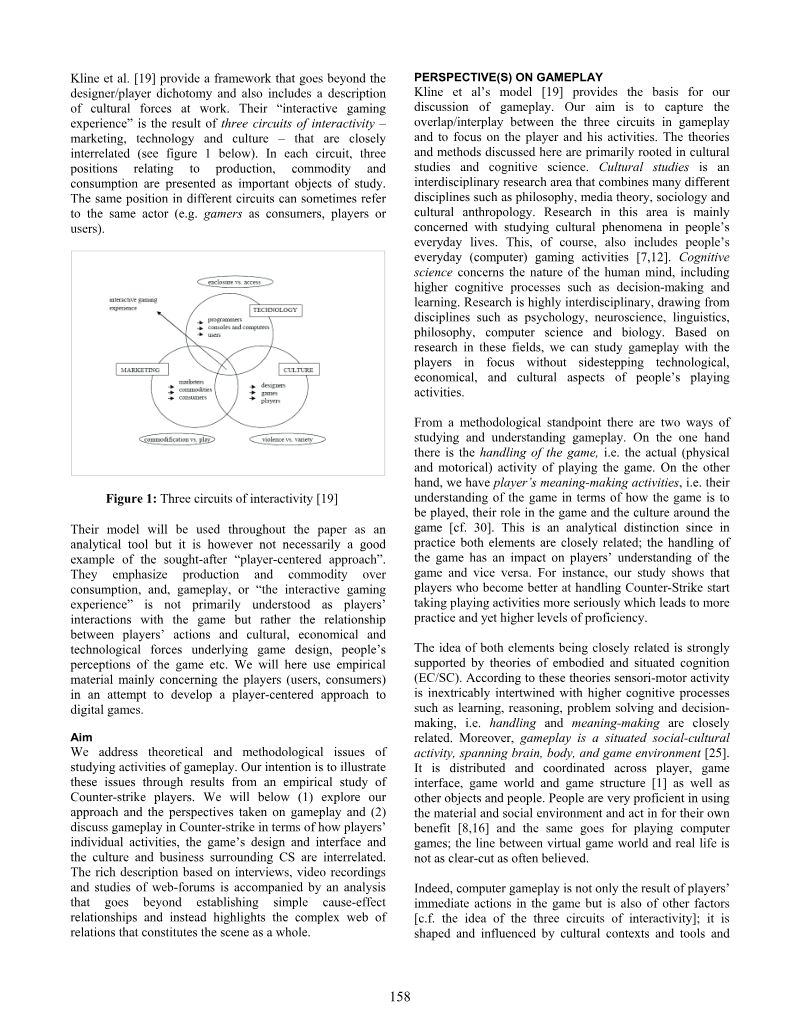
- Counter-Strike competitive play is framed as a situated, distributed social and cultural practice, not just a product of formal game design, drawing on Kline et al.'s three circuits of interactivity model and embodied and situated cognition theory.
- The study's findings rest on 34 interviews with clan members at the 2007 World Cyber Games finals, supplemented by video recordings and forum analysis.
- Strong teams depend on a combination of individual proficiency and collective coordination, while equipment proves less decisive than commonly assumed.

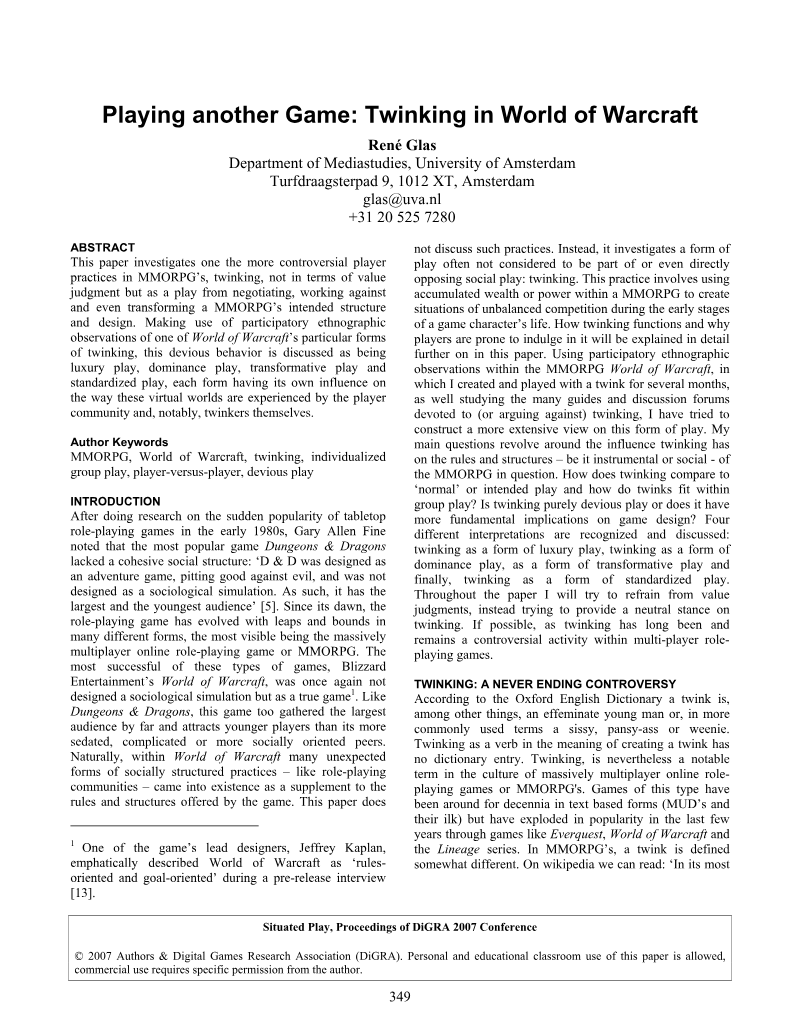
Playing Another Game: Twinking in World of Warcraft
René Glas's study examines "twinking" in World of Warcraft, the practice of giving a character unearned advantages through borrowed gear, money, or assistance from high-level players, which produces unbalanced competition in the early stages of the game.
- Twinking is treated not as cheating to be judged but as a form of play, analyzed through four lenses: luxury, dominance, transformative, and standardized play.
- The study relies on participatory ethnography, in which the author created and played a twink for several months, combined with analysis of guides and forums.
- Twinking contributes to hyperinflation of in-game currency, a phenomenon intertwined with real-money trading and goldfarming.
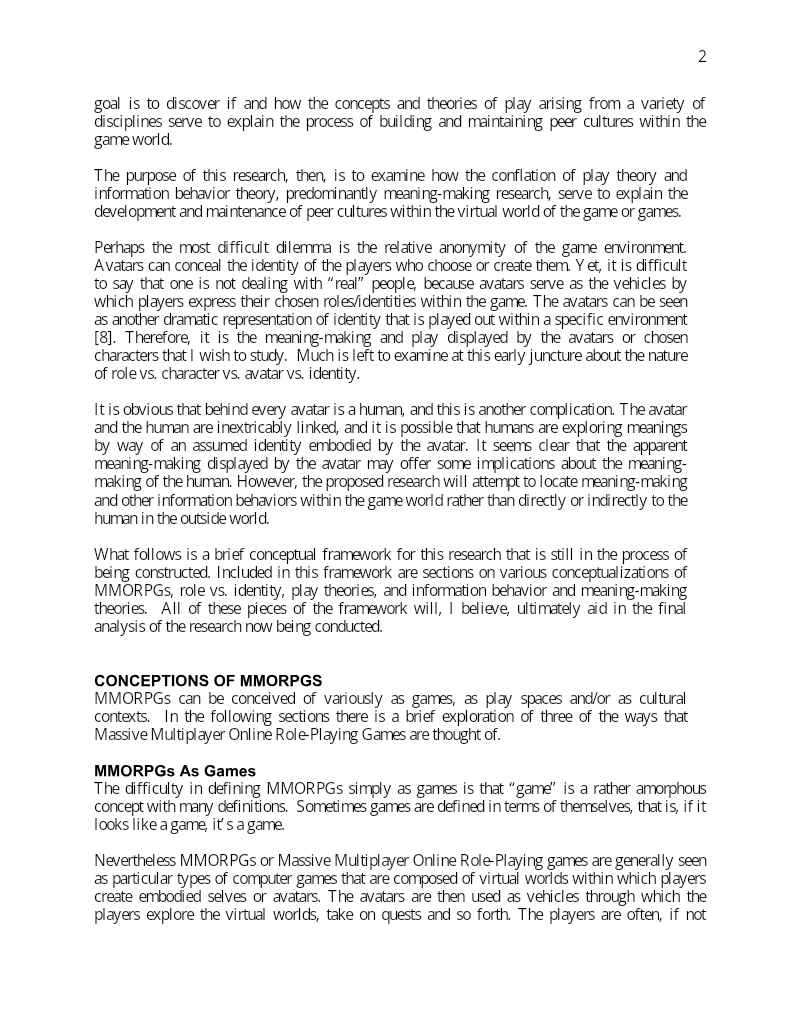
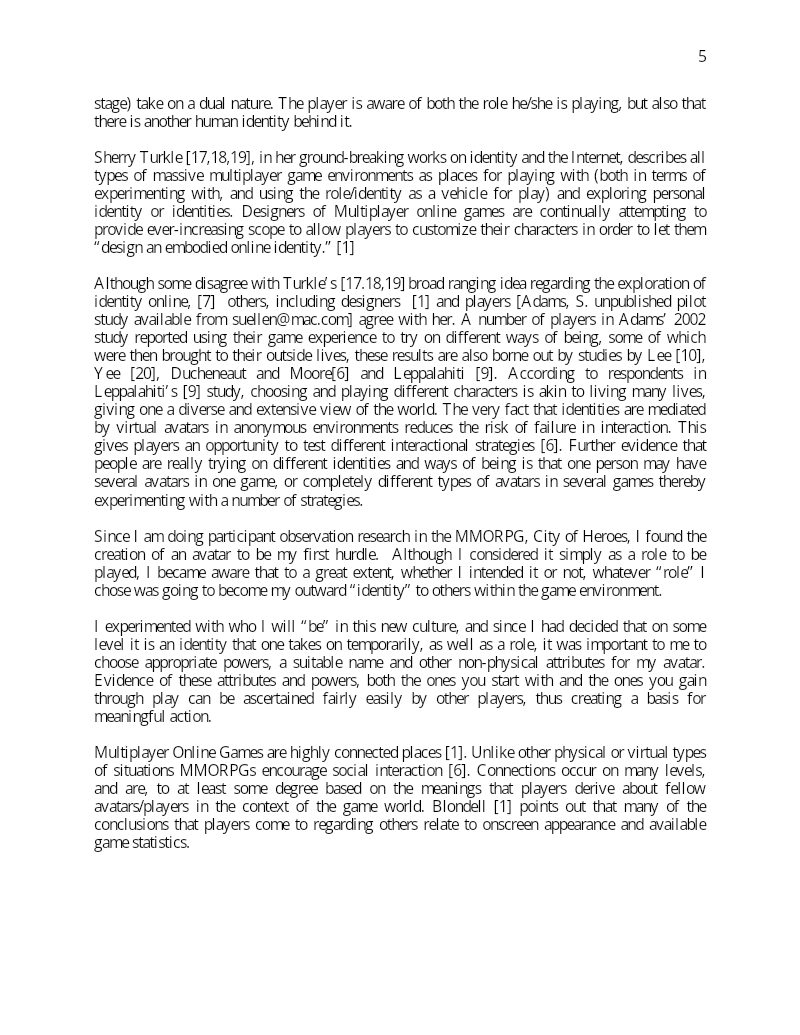
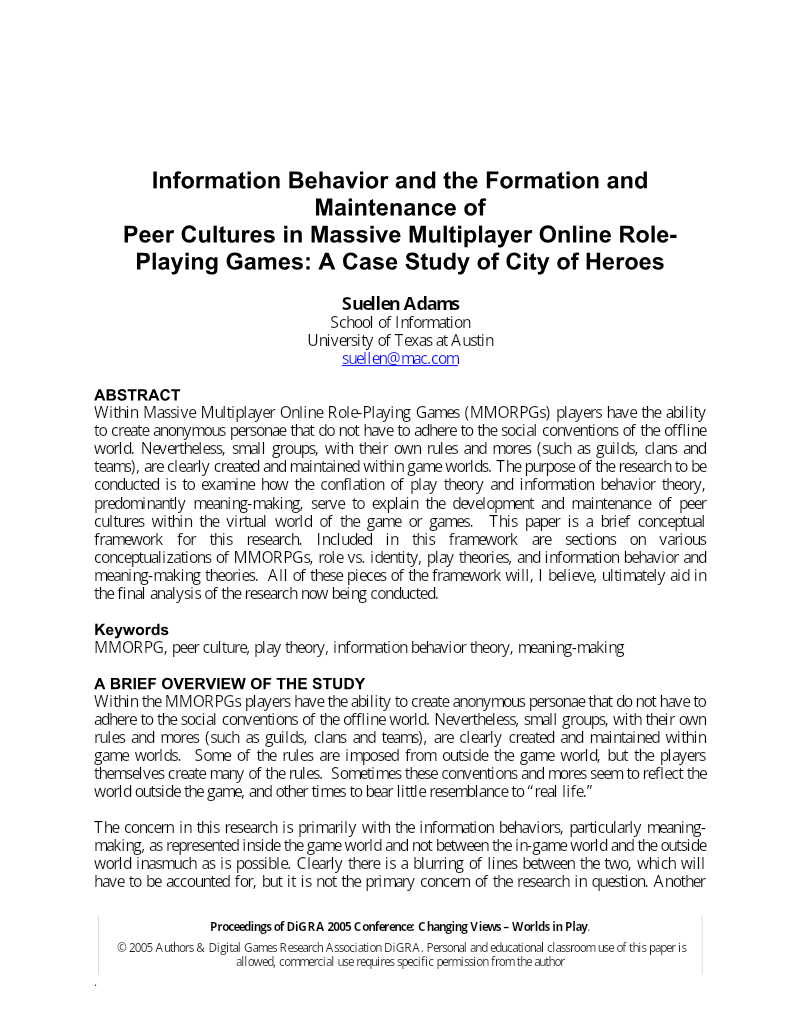
Information Behavior and the Formation and Maintenance of Peer Cultures in Massive Multiplayer Online Role-Playing Games: A Case Study of City of Heroes
This paper offers a conceptual framework for a planned study of how players in Massive Multiplayer Online Role-Playing Games (MMORPGs) form and sustain small peer groups such as guilds, clans, and teams, using the massively multiplayer game City of Heroes as its case.
- The paper is an early-stage conceptual framework for a planned study, not a report of empirical results; its claims rest mainly on existing literature rather than new data.
- It proposes that play theory and information behavior theory (especially meaning-making) together can explain how MMORPG players form and sustain guilds, clans, and teams with their own rules and mores despite anonymity and missing offline social cues.
- The framework treats MMORPGs three ways: as games, as 'virtual sandbox' play spaces, and as cultures where knowledge, behavior, and artifacts are learned and negotiated.
Presence Experience in Mobile Gaming
A controlled experiment compared presence experienced while playing a rally game on a large PC screen versus a small PDA screen, asking whether mobile gaming is as immersive as PC gaming.
- Players experienced significantly higher presence on a large PC screen than on a small PDA screen, with spatial situation model scores of 3.31 versus 2.73 and self-location scores of 3.40 versus 2.10.
- Attentional engagement did not differ by device (4.23 on the PDA versus 4.20 on the PC), indicating that attention is necessary but not sufficient for presence: small-screen players can be highly engaged without feeling spatially immersed.
- Suspension of disbelief showed no significant device effect, and involvement approached but did not reach significance.
Consumer Driven Computer Game Design
This study, presented at the DiGRA 2005 conference, proposes a methodology for consumer-driven computer game design that uses the Critical Incident Technique (CIT) to ground game development in player experiences rather than designers' assumptions.
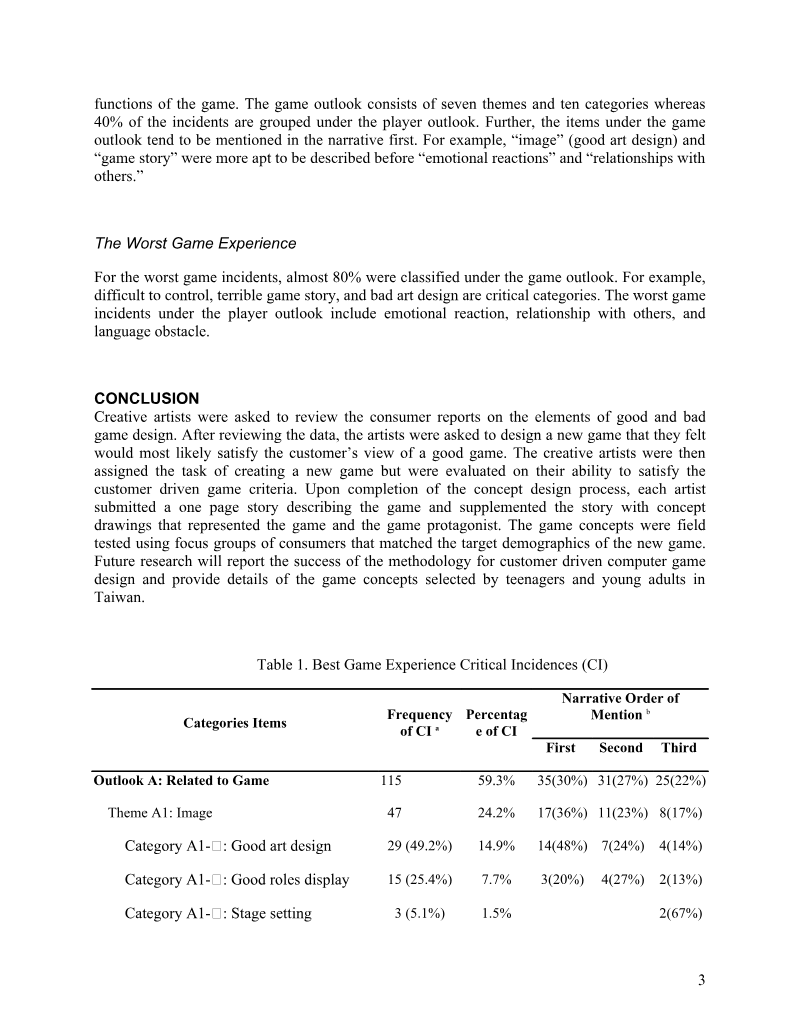
- The paper proposes consumer-driven game design using the Critical Incident Technique, grounding development in players' reported satisfying and dissatisfying experiences rather than designers' assumptions, with player narratives handed to creative designers as a reference for new games.
- The study drew on 61 active players (about 70% male, 30% female, roughly 70% students, ages 13 to 29, average 22), each writing one best and one worst game experience account.
- Two trained analysts coded the incidents with a third checking reliability, reaching 88% inter-judge agreement for positive incidents and 86% for negative ones.
Cognitive Callisthenics: Do FPS Computer Games Enhance the Player's Cognitive Abilities?
This study, a 2005 DiGRA conference paper by Paul Kearney of Unitec New Zealand, investigates whether playing the first-person shooter Counter-Strike can enhance cognitive abilities, particularly multitasking.
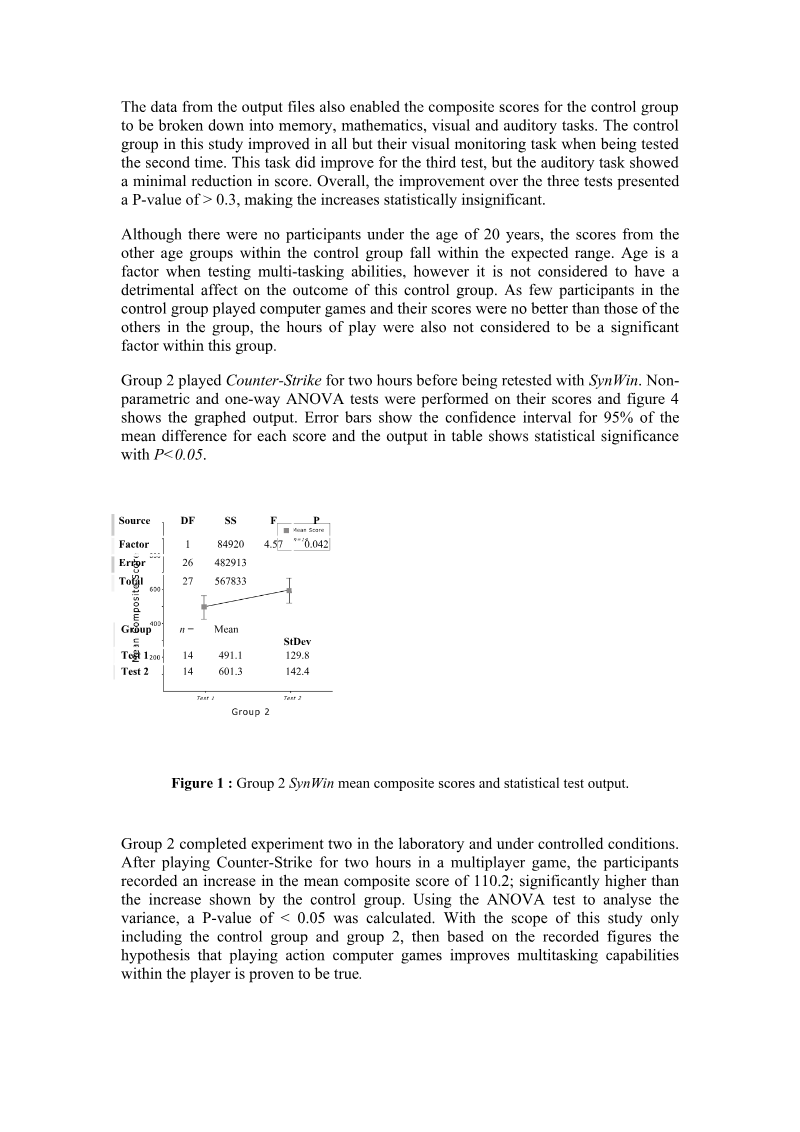
- A 2005 DiGRA study by Paul Kearney (Unitec New Zealand) found that two hours of multiplayer Counter-Strike play raised the mean composite multitasking score of 14 participants by 110.2 points, a statistically significant gain (P < 0.05) measured with the SynWin synthetic work-environment software.
- The control group of eight largely non-gaming participants, tested three times without any intervention, showed only modest gains that were not statistically significant (P > 0.3), consistent with ordinary practice effects.
- The author attributes the gains to immersion, collaborative play, and realism, but the study had no control condition in which participants played a non-game activity, so the game itself cannot be isolated as the cause.
Game Fiction: Playing the Interface in Prince of Persia: The Sands of Time and Asheron's Call
This paper argues that videogame play involves negotiating several simultaneous points of view, including cameras, avatars, interfaces, and cut-scenes, and that mastering these perspectives is central to completing a game's goals.
- Videogame play requires negotiating several simultaneous points of view (cameras, avatars, interfaces, and cut-scenes), and mastering these perspectives is central to completing a game's goals.
- The paper proposes "game fiction" as the imaginative devices games use as native rule elements, a framing that sidesteps the ludology-narratology debate and lets non-narrative games like Tetris or chess be analyzed for their fictional construction.
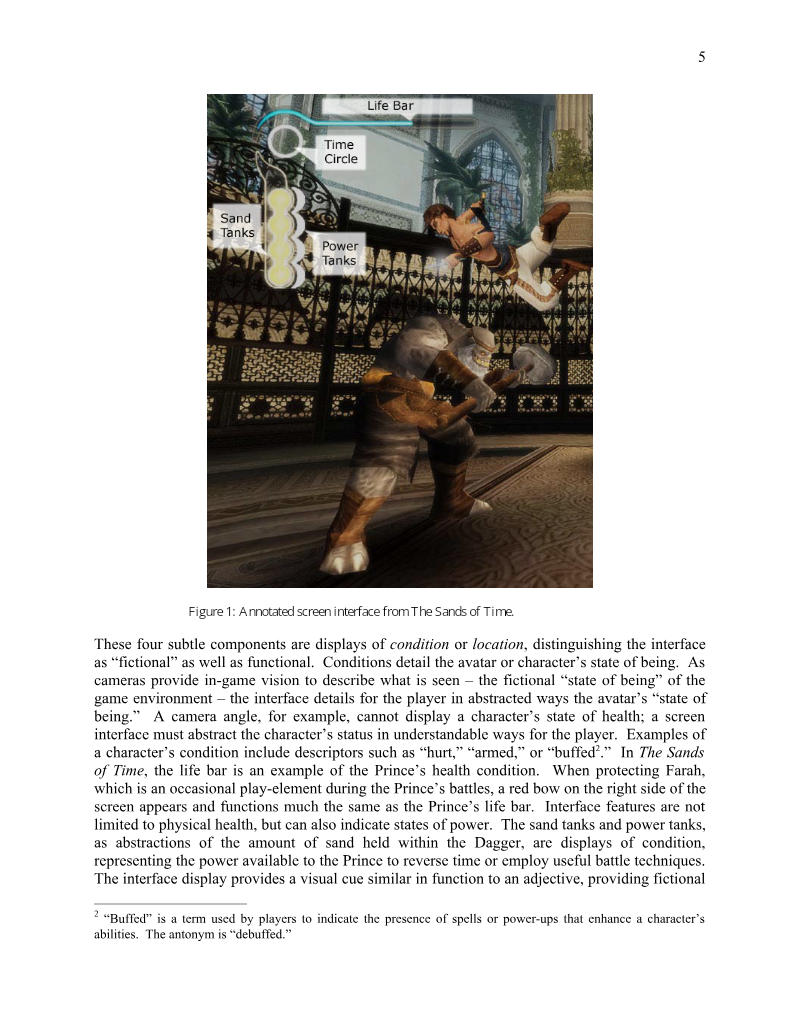
- In Prince of Persia: The Sands of Time, the minimal on-screen interface (life bar, time circle, sand tanks, power tanks) functions like adjectives describing the Prince's state and location, with the time circle marking chronological position in the reversed-time narrative.
Feel It, Don't Think: The Significance of Affect in the Study of Digital Games
Eugénie Shinkle's paper argues that game studies methodologies focused on visual, narrative, and semiotic content overlook the embodied, physiological dimensions that give digital games their meaning.
- Shinkle argues that game studies focused on visual, narrative, and semiotic content overlook the embodied, physiological 'feel' of gameplay, which she calls affect: a multisensory, temporally delocalized experience that operates partly outside linear time and conscious choice.
- The paper distinguishes affect from emotion and presents itself as a preliminary theoretical examination rather than an empirical study, drawing on Massumi, Grodal, Aarseth, and Poole.
- Sega's rave-inspired Rez is cited as an example whose appeal lies in a trance-like synchronicity between player and environment rather than in level completion.

Together We Brand: America's Army
The document examines America's Army: Operations (AA:O), a free online military first-person shooter developed by the US Army's MOVES Institute, and argues that the game functions simultaneously as an advergame, a recruiting tool, an educational training simulation, and a branding vehicle.
- America's Army: Operations functioned simultaneously as an advergame, recruiting tool, training simulation, and branding vehicle, with the authors calling this blend "advertainment" and arguing the Army deliberately fused commercial, entertainment, and participatory online objectives into one brand experience.
- Rather than collecting explicit personal data, the game built the Army's identity through aesthetic and sensory immersion, positioning it as a central expression of the Army brand during its "Together We Stand" rebranding campaign.
- By November 2002 the free game had attracted over one million registered accounts and 32 million completed missions, and Army recruiting website traffic reportedly rose 28 percent after launch.
Towards Communicative, Collaborative and Constructive Multi-Player Games
Tony Manninen's work argues that multiplayer games are often mechanically shallow and that academic theory and industry practice remain poorly connected.
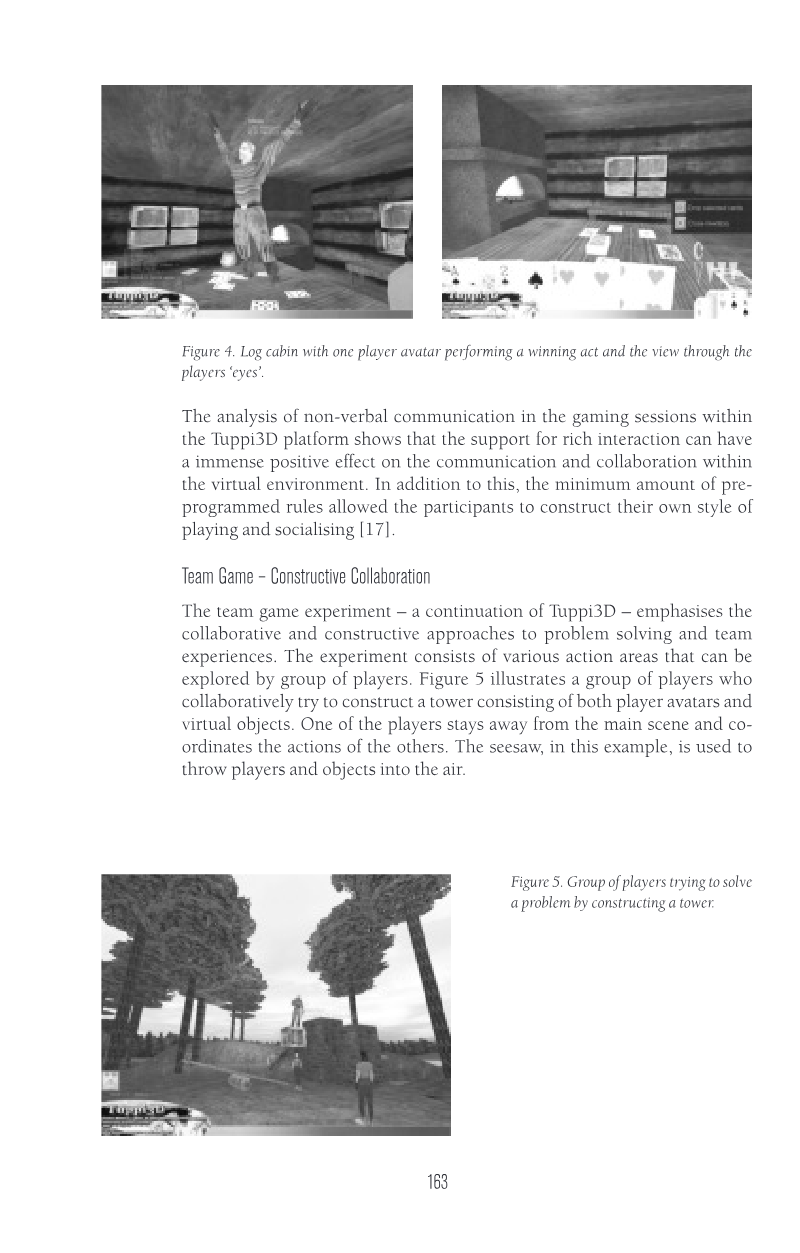
- The central finding is that participants communicate effectively in virtual environments when systems offer multiple communication channels in a "memorable, yet invisible" manner, with non-verbal communication identified as a key design priority.
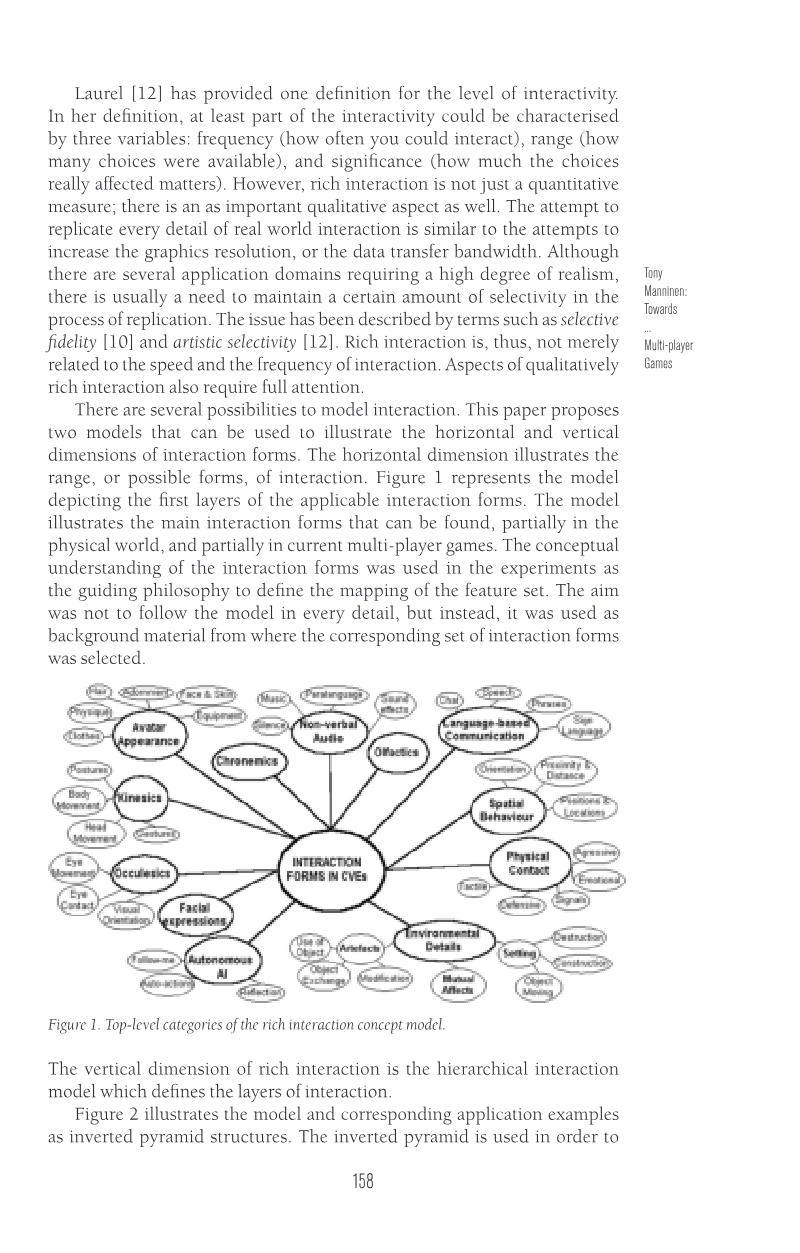
- The author proposes two models of "rich interaction": a horizontal concept model describing forms of interaction and a vertical hierarchical model structuring them, aimed at making multiplayer games more communicative, collaborative and constructive.
- The work argues that multiplayer games are often mechanically shallow and that academic theory and industry practice remain poorly connected, partly because commercial secrecy limits researchers' access to industry data.
3Dxp: DirectSound 3.0 Extension API
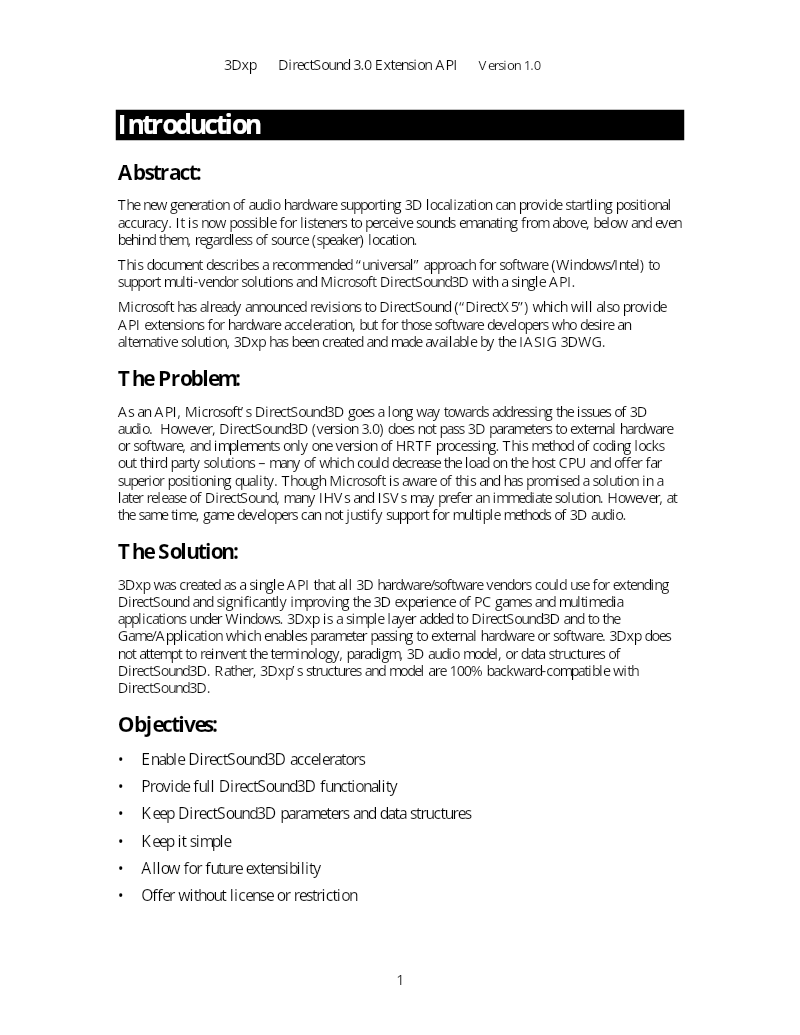
The 3Dxp API, developed by the Interactive Audio Special Interest Group’s 3D Working Group in 1997, serves as a standardized extension to Microsoft’s DirectSound 3.0.
- The 3Dxp API was introduced in 1997 as a standardized extension to Microsoft’s DirectSound 3.0 to enable hardware-accelerated 3D audio positioning on Windows PCs.
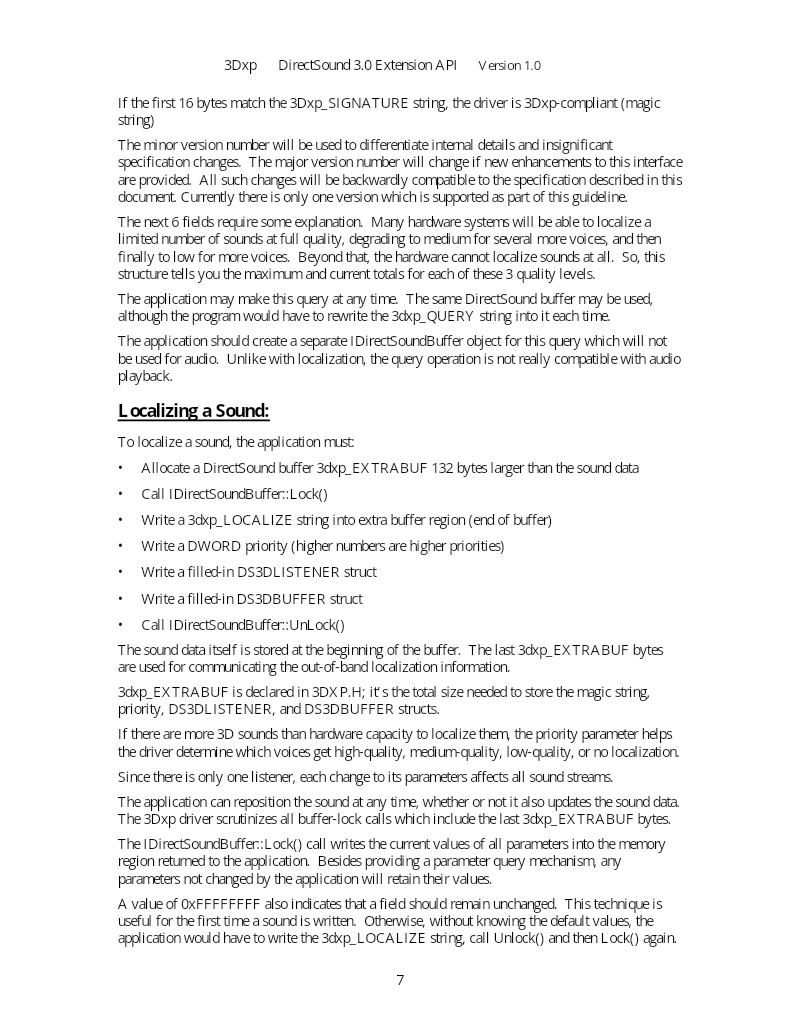
- The API functions by appending a 132-byte data structure to standard DirectSound buffers, allowing developers to pass 3D parameters like position, velocity, and cone orientation to external renderers.
- A reference wrapper enables automatic detection of 3Dxp-compliant drivers, proprietary solutions such as Aureal’s A3D, or a fallback to standard DirectSound3D.



2019 Year in Review: Digital Games and Interactive Media
This report, published by SuperData (a Nielsen company) as a 2019 year-in-review, surveys the global digital games and interactive media market, covering mobile, PC, console, gaming video content (GVC), and extended reality (XR) segments.
- Digital games revenue reached $109.4 billion in 2019, up 3% year over year, while the broader interactive media sector grew about 4%.
- Free-to-play titles drove growth, accounting for roughly 80% of digital games revenue, with mobile contributing $64.4 billion, about three-fifths of total spending.
- Premium game revenue fell 5% to $18.9 billion, reflecting a year with fewer blockbuster releases than 2018.