Monetization reports and market data
Documents

Web Shops: From 10% to 50% Revenue – The Playbook Top Games Don't Want You to Know
Mobile game developers are increasingly adopting direct-to-consumer web shops to circumvent the 30% platform fees imposed by Apple and Google, which often consume over 40% of gross revenue.
- Transitioning to direct-to-consumer web shops allows developers to reduce transaction costs from the standard 30% platform fee to between 5% and 10%, increasing net margins by 25% or more.
- Top-performing studios are leveraging reclaimed revenue to increase player lifetime value and outbid competitors in user acquisition auctions, aiming to capture 40% to 50% of total revenue through web channels.
- Successful web shops function as community hubs rather than simple payment portals, integrating loyalty programs, progression incentives, and social tools to drive repeat traffic and higher average order values.

Don't be big to start, start to get big - Tony Markov from FastSpring
The gaming industry is increasingly prioritizing direct-to-consumer (D2C) monetization strategies as regulatory shifts, such as recent Apple rulings, allow developers to bypass traditional app store payment ecosystems.
- Developers are increasingly adopting direct-to-consumer (D2C) monetization via web shops and third-party infrastructure to bypass traditional app store ecosystems and gain greater control over user experience.
- Despite a 7% decline in global mobile game installs, per-user spending has increased by 11%, signaling a shift toward higher monetization efficiency.
- Emerging markets in Latin America, the Asia-Pacific region, and the Middle East and Africa are driving revenue growth, necessitating the integration of localized payment methods beyond traditional credit cards.

Uma Musume Pretty Derby: All YOU need to Know! Full Breakdown
Uma Musume Pretty Derby stands as a premier example of a high-revenue mobile RPG that blends roguelite mechanics with idol-building and sports simulation.
- Uma Musume Pretty Derby has generated over $2 billion in lifetime revenue from approximately 16 million downloads, maintaining consistent monthly earnings of $10 to $30 million in the Japanese market.
- The game’s core monetization is driven by a sophisticated support card system, which players use to optimize character builds for competitive PvP and event-based challenges.
- The gameplay features a complex, multi-layered training loop that integrates roguelite mechanics, idol-building, and stats management based on real-world Japanese horse racing history.

Mobile Gaming by Genre: Hypercasual
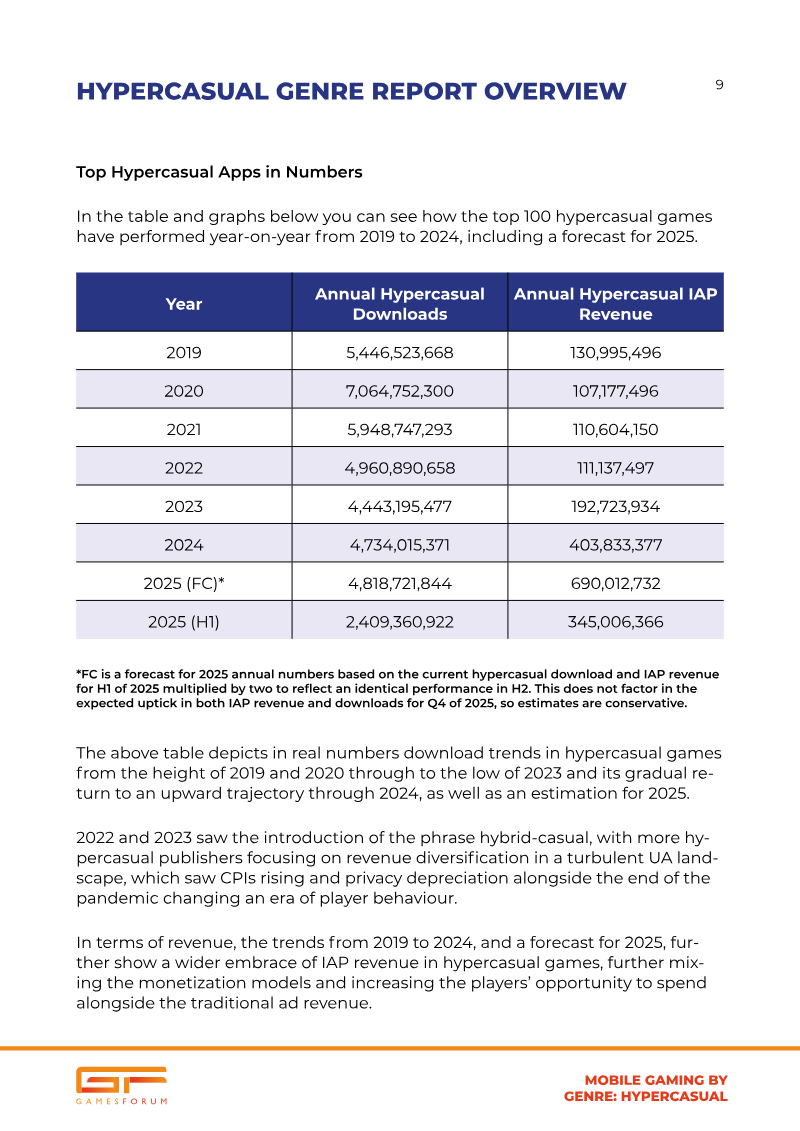
The hypercasual segment continues to dominate mobile gaming revenue, with the top 100 titles achieving 5.48 billion downloads and $345 million in in-app purchase (IAP) revenue during the first half of 2025—double the figures from 2024 and the highest ever recorded for this genre.
- Hypercasual revenue for the top 100 titles is projected to reach $690 million in 2025, a significant increase from $403 million in 2024.
- H1 2025 performance for the top 100 hypercasual titles hit record highs of 5.48 billion downloads and $345 million in IAP revenue, doubling the figures from the same period in 2024.
- Leading publishers like AZUR GAMES, Supersonic Studios, and Voodoo are shifting toward hybrid-casual models that blend traditional advertising with deeper IAP monetization to extend player engagement.

US consumers are planning to cut back on buying video games
Economic instability in the United States, characterized by rising costs for essential goods such as food, utilities, and insurance, has significantly dampened consumer sentiment to levels not seen since mid-2022.
- The US video game market growth forecast has been revised from a projected 4.3% increase to a 4.7% decline due to economic instability and rising costs for essential goods.
- Approximately 30% of US consumers intend to reduce their spending on entertainment and gaming as financial pressure reaches levels not seen since mid-2022.
- Consumer engagement is shifting toward high-value, low-friction platforms like Fortnite and subscription services, which allow users to maximize utility while minimizing discretionary spending.

FPS Strike Ops: Modern Arena gameplay breakdown - PvP Offline Shooter FTW!
FPS Strike Ops: Modern Arena functions as a high-volume mobile shooter that captures a massive audience by prioritizing accessibility and performance on low-end hardware.
- FPS Strike generates $30,000 to $50,000 daily with over 4 million DAU, primarily through video and interstitial ads, despite having almost zero IAP revenue.
- The game’s ad stack is significantly under-optimized, missing key networks like AppLovin, Mintegral, Imobi, and Yandex, which could increase revenue by 30% to 100%.
- Growth is driven almost entirely by organic reach—including millions of TikTok and YouTube videos—rather than paid user acquisition or formal creative testing.

Tariffs and Affordability: The US Consumer In Limbo
The United States consumer market is currently defined by significant economic strain, characterized by a shift in discretionary spending away from general merchandise—including video games and apparel—toward essential categories like food and beverage.
- The U.S. video game industry growth forecast has been downgraded from an initial 4.3% projection to a 4.7% decline.
- Retail spending growth of 4.6% in Q1 2024 is driven by inflation-adjusted pricing rather than an increase in unit volume.
- Approximately 40% of consumers plan to reduce overall spending if tariffs increase retail prices, with nearly one-third of that group specifically targeting video games and entertainment subscriptions for cuts.

Google Ads for Mobile Apps: Choosing the Best Optimization Event
Optimizing mobile app campaigns requires a strategic shift from prioritizing low-cost installs toward focusing on high-value, predictive in-app events.
- Prioritize optimization for high-value, predictive in-app events rather than low-cost installs to align campaign performance with long-term metrics like lifetime value and monthly active user growth.
- Select optimization events that occur at a minimum frequency of 30 times per day to provide sufficient data for machine learning algorithms.
- Target events that manifest within a short 24- to 72-hour window post-install to ensure the feedback loop is tight enough for effective campaign optimization.



Games Industry Region Report China
The China Region Report provides a comprehensive analysis of the Chinese games market as of July 2025, positioning it as the most lucrative and influential territory in the global industry.
- The Chinese games market generated $48.7 billion in 2024, accounting for approximately 30% of total global industry revenue.
- Chinese entities now dominate the global landscape, owning or developing 14 of the top 30 highest-grossing games worldwide as of early 2025.
- The market supports a massive player base of over 701 million, with a significant shift occurring as domestic firms expand from mobile dominance into premium triple-A PC and console development.

Raid Rush Review: If you miss Battle.net tower defense, Raid Rush is your new addiction.
Raid Rush occupies a distinct position within the mobile tower defense genre by successfully blending traditional strategic mechanics with modern roguelike deck-building elements.
- Raid Rush generates approximately $24,000 to $28,000 in daily revenue, with ad-based monetization accounting for roughly 30% of total earnings.
- The game differentiates itself from standard roguelike tower defense titles by allowing players to build their own road paths, adding significant strategic depth that mitigates the staleness common in the genre.
- The US market accounts for 50% of the game's total revenue, with a notable secondary performance in Korea, proving that hardcore tower defense remains a viable niche for stable, loyal player bases.

Inside In-App Ads: Past, Present, and What’s Next?
Mobile advertising has undergone a profound transformation, evolving from rudimentary banner placements and incentivized installs into a sophisticated, machine-learning-driven ecosystem.
- The global mobile advertising market is projected to reach an annual spend of $1 trillion by 2030.
- Publishers can achieve revenue uplifts of 8% to 20% by implementing specialized solutions to streamline the bidding process.
- Intermediary costs and platform fees can consume up to 30% of a publisher's total revenue, necessitating a shift toward direct SDK integrations and data ownership.

How to launch a Mobile App Startup with No Investment
Launching a mobile app startup without external capital requires a strategic shift from pursuing speculative, high-growth trends toward solving specific, painful problems.
- Prioritize solving specific, painful problems over pursuing speculative high-growth trends to ensure long-term sustainability without external capital.
- Utilize a lean, bootstrapped model to maintain total autonomy and equity, focusing on profitability at a small scale rather than rapid, resource-heavy scaling.
- Integrate artificial intelligence tools to replace early-stage hires, effectively bridging skill gaps and reducing overhead costs for small teams.