Monetization reports and market data
Documents

Pokemon GO Raises the Price Cap, Console Kill Switches & C.S. Mott Makes Children's Lives Better!
The integration of gaming technology into pediatric healthcare serves as a transformative tool for patient recovery, as evidenced by the Michigan Game Day Experience at C.S. Mott Children’s Hospital.
- Gaming technology is being integrated into pediatric healthcare, exemplified by the Michigan Game Day Experience at C.S. Mott Children’s Hospital, to improve patient recovery through physical mobilization and social interaction.
- Nintendo is enforcing stricter digital rights management by implementing remote hardware bans against users of unauthorized flash cartridges to protect its ecosystem.
- The gaming industry is experiencing a shift toward inclusivity, with platforms like Steam and hardware such as the Xbox Adaptive Controller setting new standards for players with diverse physical and cognitive needs.

Carnival Tycoon’s Playbook: From Idle to Social Casino?
Carnival Tycoon functions as a strategic hybrid, utilizing an idle game aesthetic as a Trojan horse to deliver the high-frequency monetization mechanics characteristic of the social casino genre.
- Carnival Tycoon generates approximately $5 million in monthly revenue, positioning it as the fifth-largest social casino game despite marketing itself as an idle game.
- The game functions as a 'Trojan Horse' by using idle-game mechanics and approachable onboarding to mask a core loop that is fundamentally a social casino slot machine.
- Approximately 70% of the game's net revenue is derived from iOS, suggesting that rewarded ad placements are likely restricted to high-end Android devices or specific user segments.

Panel: D2C for Mobile – THE Do’s and Don’ts and Everything in Between.
Direct-to-consumer strategies have emerged as a vital evolution for mobile publishers seeking to improve profit margins and gain granular control over user data.
- Direct-to-consumer (D2C) web shops allow mobile publishers to bypass standard platform commission structures, improving profit margins while gaining granular control over user data.
- Top-performing D2C implementations that integrate loyalty programs and live operations can achieve conversion rates as high as 80 percent.
- The industry is shifting toward a hybrid model where web-based commerce complements app stores, which remain essential for mass-market discovery.
Panel: Fact vs Fiction – Mobile Games
The mobile gaming industry is undergoing a fundamental shift toward direct-to-consumer monetization through the implementation of web shops.
- Over 60 percent of top-grossing mobile titles have implemented web shops to bypass traditional app store transaction fees and improve profit margins.
- Web shops enable publishers to collect critical first-party data, which is essential for informing long-term product development and player retention strategies.
- Transitioning players to web-based environments requires offering exclusive incentives such as loyalty programs, community rewards, and flexible pricing structures to overcome the perceived security of platform-native payment systems.
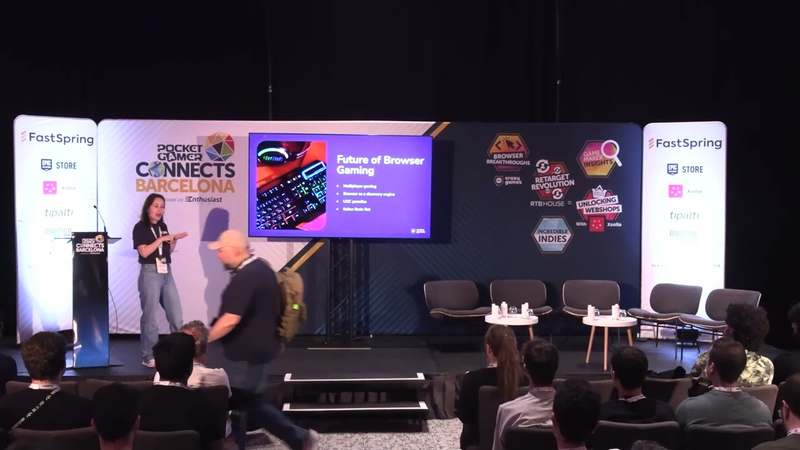
Session: Beyond the App Store: Why Top Studios Are Embracing The Browser Again - Rabia Dincer.
The browser gaming market is experiencing a significant resurgence as a primary distribution channel for game studios, driven largely by the escalating costs of user acquisition and restrictive gatekeeping within mobile app stores.
- Web gaming serves as a zero-UA-cost discovery channel where developers can build user bases, test game concepts, and generate revenue without the gatekeeping and review delays associated with mobile app stores.
- Crazy Games hosts 40 million monthly active users, with a significant portion originating from the US and other Tier 1 countries, providing a high-quality audience for both ad-supported and in-app purchase monetization models.
- WebGPU technology is enabling high-quality, graphically intensive games to load in approximately 10 seconds, allowing for complex titles that were previously considered unsuitable for browser environments.
Session: From Spawn to Scale – Navigating Funding Rounds In The Gaming Industry - Rick Verma.
This presentation outlines the operational and financial requirements for gaming companies as they navigate various funding stages, from seed rounds through series D. The core thesis emphasizes that as gaming startups scale, they must proactively build robust, automated financial infrastructure to meet escalating investor…
- Gaming industry funding experienced a sharp contraction, falling from approximately $11 billion in 2022 to under $3 billion in 2023.
- Investors have shifted their focus away from pure content plays toward scalable platform technologies and infrastructure, though early-stage seed funding remains resilient.
- Founders must transition from manual spreadsheet-based processes to automated financial infrastructure to avoid payment failures, compliance risks, and administrative bottlenecks as they scale.
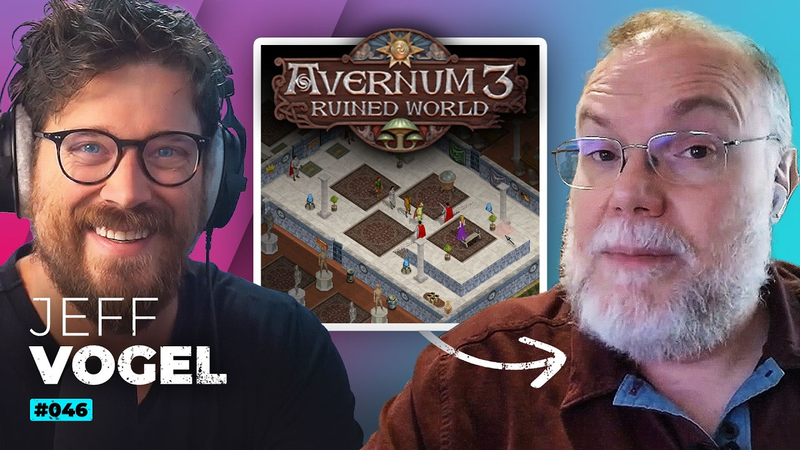
Jeff Vogel: Making Games Alone For 30 Years, Unity vs Custom Engine, Indie Survival | Ep. #046
Long-term survival in the independent game industry is best achieved by prioritizing sustainable business practices and niche creative focus over the pursuit of fleeting commercial trends.
- Survival as a solo indie developer for over 30 years is best achieved by cultivating a loyal, niche audience rather than chasing commercial hits.
- A sustainable indie business model relies on a large back catalog of titles and direct fan support through platforms like Kickstarter, which provides financial stability during industry downturns.
- Jeff Vogel’s studio, Spiderweb Software, has released 25 retro RPGs since 1994 by prioritizing consistent, manageable production over high-polish, high-risk projects.
Session: Web Stores Are So 2023: The Next Generation Of DTC Is Already Here - Broader, Richer.......
The mobile gaming industry is undergoing a seismic shift in direct-to-consumer (DTC) monetization, moving beyond basic web stores toward a more fragmented and sophisticated ecosystem.
- Developers are shifting from basic web stores to integrating payment links directly into native apps, allowing them to bypass standard 30% platform commissions.
- The monetization landscape is evolving toward a hybrid model where developers segment players to apply different transactional methods based on individual loyalty and spending behavior.
- New regulatory environments in the US and EU now permit developers to redirect transactions to cost-effective payment vendors, moving beyond the initial web-store-only strategy.
Session: Webshops: You Don't Need To Be Big To Start, But You Need To Start To Get Big.
The emergence of web shops in the gaming industry represents a fundamental shift in how developers manage revenue and player relationships, moving away from the traditional 30% commission model imposed by major app store monopolies.
- Web shops are now a necessary component of a sustainable business strategy, serving as a critical alternative to the 30% commission model imposed by major app store monopolies.
- The primary long-term value of a web shop is not just cost savings, but the acquisition of direct data ownership and the ability to build personalized relationships with players.
- Developers should launch with a simple Minimum Viable Product (MVP) to test the market, focusing on learning from early transactions and identifying high-value segments rather than immediate high-volume sales.

Session: The State of Gaming 2025: Mobile Trends, Transmedia Impact & Global Shifts by Josh Skinner
The state of the global gaming industry in early 2025 reflects a period of stabilization and strategic evolution, characterized by a shift in revenue models and the increasing importance of cross-platform engagement.
- Strategy games have overtaken RPGs in quarterly consumer spend for the first time, while action games saw a 53% year-over-year growth in Q1 2025.
- Global mobile gaming revenue growth is currently driven exclusively by iOS, as Android gaming revenue experienced a decline in Q1 2025.
- While total worldwide mobile game downloads are down year-over-year, in-app purchase revenue has seen slight growth, indicating a shift toward higher monetization per user.

Puzzle & Dragons: Five Billion $$$ Made, Zero Influence in the West
Puzzle & Dragons stands as a monumental achievement in mobile gaming history, having generated over $5 billion in lifetime revenue through its pioneering integration of elemental dungeon progression and gacha mechanics.
- Puzzle & Dragons has generated over $5 billion in lifetime revenue, establishing it as a foundational mobile RPG that pioneered the integration of elemental dungeon progression and gacha mechanics.
- Despite its massive financial success, the game remains a localized phenomenon in Japan, failing to achieve significant commercial or cultural traction in Western markets.
- The title currently generates approximately $13 million in monthly revenue, demonstrating the viability of prioritizing a deeply engaged, hardcore domestic audience over broad global expansion.

One bad integration, $20,000 gone in minutes. Fraud is real! Rewarded UA is not dying, it’s evolving
Rewarded user acquisition remains a vital growth strategy, provided advertisers transition from vulnerable client-side tracking to secure server-to-server (S2S) event reporting.
- Insecure rewarded UA integrations can lead to $20,000 in losses within minutes due to fraud from faked events, cheat engines, and emulator hackers.
- To prevent attribution fraud, advertisers must implement server-to-server (S2S) tracking, secure MMP integrations, and use protocols like Adjust’s Signature V5.
- Rewarded UA strategy must be tailored to game genre: playtime offers are effective for casual titles, while multi-reward structures are essential for strategy games that can support high-value bids.