Monetization reports and market data
Documents

Hyper-casual in China: Games, players and lessons learned
The hyper-casual gaming market in China represents a significant, albeit distinct, opportunity for international developers.
- China represents a massive market opportunity with 242 million iOS devices, a figure comparable to the entire U.S. smartphone market across both iOS and Android platforms.
- While Day 1 retention should serve as a baseline metric of at least 40% to validate core gameplay, increasing Day 7 retention by just 1% yields 10 times the impact on long-term lifetime value.
- The Chinese hyper-casual market is distinct from the West, as it evolved from a core-gaming-first culture; consequently, games require more than simple mechanics to succeed and must incorporate socially-minded, competitive, or culturally relatable elements.
Tips on making your hyper-casual game a success in China
The hyper-casual gaming market in China represents a significant growth opportunity for international developers, driven by a massive mobile user base and evolving consumer habits.
- China is the world's largest mobile game market, with projections estimating 120 billion downloads and $62.4 billion in consumer spending by 2022.
- The Chinese market is shifting from hardcore games to hyper-casual titles, driven by users with fragmented leisure time and a growing female gaming demographic.
- Publishing on Android in China is highly complex and generally discouraged for foreign developers due to licensing requirements (ISBN) and a lengthy approval process that can take one to two years.
How to Sell Your Game on Steam!
Publishing a game on Steam has become significantly more accessible through the Steam Direct program, which allows developers to distribute titles by creating a Steam account, paying a $100 fee, and completing the necessary legal and administrative documentation via the Steamworks portal.
- Developers can access the Steam marketplace by paying a $100 fee and completing legal documentation through the Steam Direct program.
- Steam waives its revenue share on retail keys generated by developers for sale on third-party platforms or personal websites.
- Technical integration of Steam features like achievements and leaderboards is typically handled via the Steamworks API, often using wrappers such as Steamworks.NET for Unity.
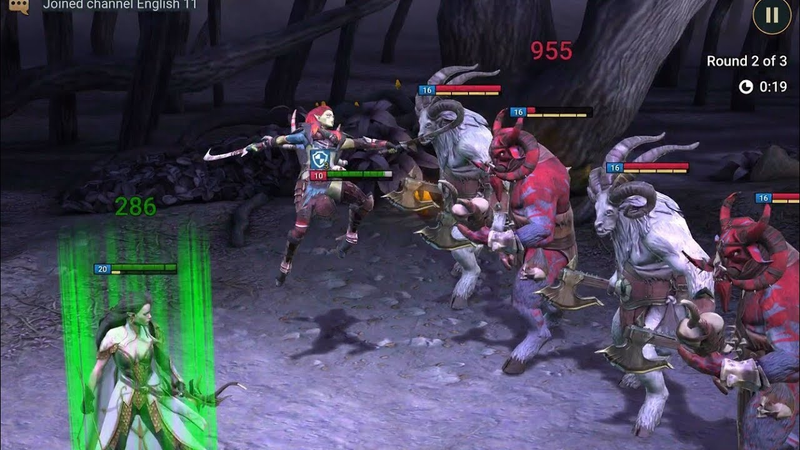
RAID: SHADOW LEGENDS | Gameplay
Raid: Shadow Legends is a squad-based mobile RPG developed by Plarium, a studio historically recognized for its expertise in 4X strategy titles.
- Plarium, a studio historically focused on 4X strategy, entered the character-collection RPG market with Raid: Shadow Legends to compete with established titles like Star Wars: Galaxy of Heroes and Marvel Strike Force.
- The core gameplay loop centers on managing a squad of four champions through turn-based combat, utilizing an energy-based system to progress through campaign missions, dungeons, and PvP arena modes.
- The game prioritizes meta-game progression over twitch-based reflexes, offering auto-battle modes with speed multipliers to facilitate the systematic grinding required for character optimization.

RAID: SHADOW LEGENDS | Metagame
Raid: Shadow Legends, developed by Plarium, represents a strategic shift for the studio from its traditional 4X strategy roots toward a squad-based, turn-based RPG.
- Plarium shifted its development focus from 4X strategy games to squad-based, turn-based RPGs with Raid: Shadow Legends to prioritize high-fidelity character design and complex progression loops.
- The game’s economy is built on a four-currency system—energy, silver, gems, and shards—that integrates directly into every player action to drive monetization.
- Monetization is driven by a tiered rarity system and a summoning mechanic, where players purchase shards to unlock higher-tier champions required for advanced campaign, dungeon, and arena progression.
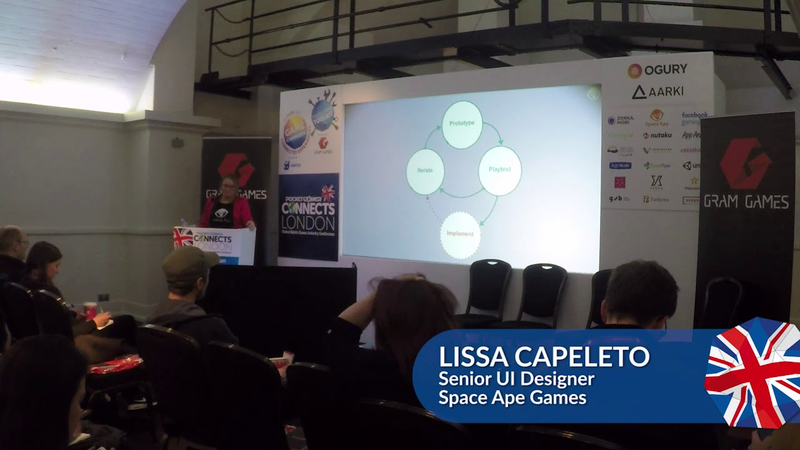
The pain and pleasure of free-to-play game UI design
Designing user interfaces for free-to-play mobile games presents a unique set of professional challenges characterized by constant iteration and the necessity of balancing player experience with business metrics.
- Free-to-play UI design requires balancing player experience with business metrics, necessitating a skill set that spans visual aesthetics, data analysis, and product economics.
- Designers must act as ethical advocates to prevent the use of dark patterns, prioritizing long-term player trust over short-term statistical gains.
- Usability issues should be treated as design failures rather than player incompetence, requiring designers to iterate based on objective playtesting feedback.
Where Do Your Fortnite Dollars Really Go? - The Origin Story of Tim Sweeney - Extra Credits
Tim Sweeney, the founder of Epic Games, has utilized his significant wealth generated from the success of titles like Fortnite to become one of the largest private landowners in North Carolina.
- Epic Games founder Tim Sweeney has utilized wealth from titles like Fortnite to acquire nearly 40,000 acres of land in North Carolina for conservation purposes.
- Sweeney’s land holdings exceed the total geographic size of the country of Liechtenstein.
- In 2016, Sweeney donated $15 million to reroute power lines away from the ecologically sensitive Box Creek Wilderness.

Wappier on using dynamic pricing in mobile games to increase retention
The mobile gaming industry is undergoing a significant shift toward automated revenue optimization, moving away from manual LiveOps management toward machine learning-driven personalization.
- Automated machine learning-driven personalization can increase mobile game revenue by 30% to 50% without requiring expanded analyst teams.
- Dynamic pricing and automated loyalty programs shift the industry focus from heavy user acquisition spending toward the monetization and retention of existing players.
- Machine learning models calculate individual price elasticity and churn propensity to determine the 'next best action' for each player in real-time.
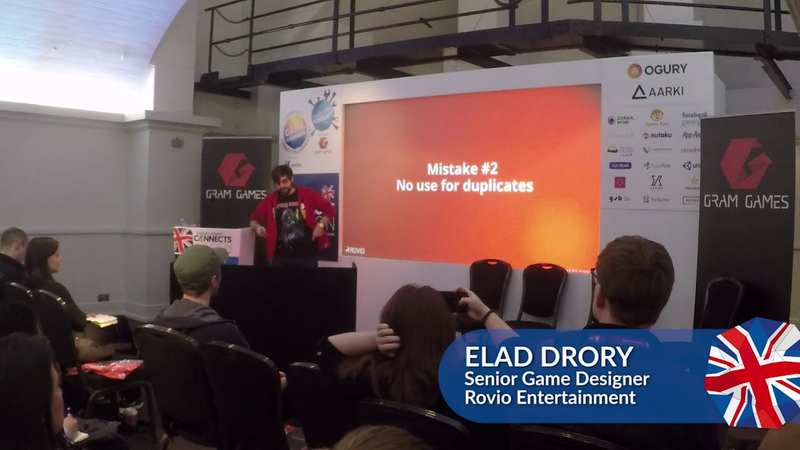
Top 5 mistakes designing free-to-play collectibles
This analysis outlines five critical design mistakes in free-to-play (F2P) collectible games, drawing on industry experience from titles like Angry Birds Evolution, Clash Royale, and Star Wars: Galaxy of Heroes.
- Prioritize long-term retention by making characters easy to acquire while gating their full potential behind significant time and resource-heavy upgrade paths.
- Prevent stagnant meta-games by enforcing collection diversity through attribute-based content gates, performance-based event boosts, and unit-specific counters.
- Mitigate player frustration in random drop systems by implementing 'safety nets' such as pity counters and currency-based exchange paths to anchor the value of digital goods.
In-game advertising Sucks. We are fixing that – A chat on dynamic in-game advertising
The current landscape of in-game advertising is characterized by intrusive formats that often degrade the user experience and fail to provide effective brand awareness for advertisers.
- Dynamic in-game advertising achieves brand recall rates of 80% to 85%, significantly outperforming the 17% to 18% recall typically seen with standard video ads.
- Traditional ad formats like rewarded videos and interstitials cause over 70% of gamers to actively avoid them, often leading to player churn and the cannibalization of in-app purchase revenue.
- Dynamic advertising replaces intrusive pop-ups with non-disruptive, cinematic-style product placements on in-game assets, such as billboards, that maintain the game's aesthetic integrity.
Interactive livestreaming and the future of esports
Interactive livestreaming represents a fundamental shift in the gaming industry, moving beyond traditional esports to create a new category of spectator-driven experiences.
- Game developers are shifting from viewing streaming as a marketing cost to treating it as a primary revenue-generating opportunity through interactive broadcast rights and monetization.
- Interactive streaming tools, such as those provided by Genvid Technologies, allow viewers to influence gameplay in real-time, effectively blurring the line between passive spectators and active participants.
- Current esports spectator modes are often underdeveloped because they are designed from a player-centric perspective rather than a viewer-centric one, failing to provide the third-person data and UI needed for a high-quality broadcast experience.

Gaming Spotlight 2018 Review
The 2018 Gaming Spotlight Review analyzes the global gaming landscape, focusing on the shifting dynamics between mobile, PC, and console platforms.
- Mobile gaming solidified its market dominance in 2018, with consumer spending exceeding the combined totals of PC, home consoles, and handheld consoles by nearly 20%.
- Mobile games accounted for 75% of total consumer spend on the iOS App Store and Google Play, despite representing only 35% of total app downloads.
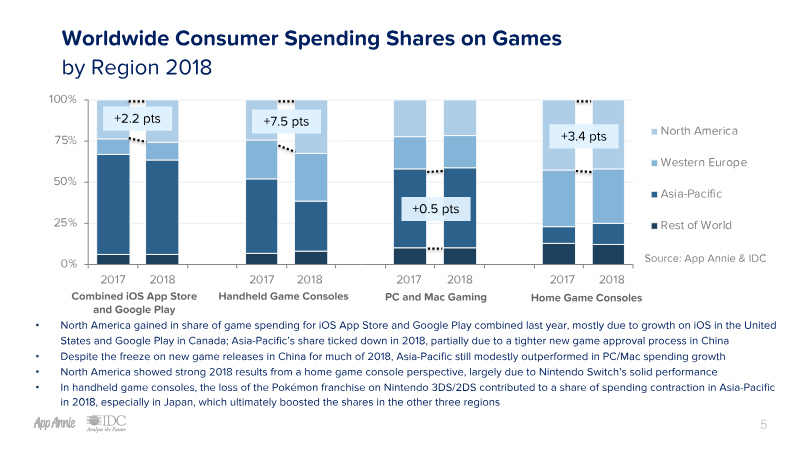
- The Asia-Pacific region accounted for over 55% of global mobile game spending in 2018, maintaining its lead despite a nine-month freeze on new game approvals in China.