Mobile reports and market data
Documents

Winning the Game: Leveraging Contextual Bandits for Creative Optimization - Joseph Iris, Persona.ly.
Contextual bandits represent a sophisticated evolution in machine learning for creative optimization within the mobile gaming industry.
- Contextual bandits, a subset of reinforcement learning, outperform traditional A/B testing by dynamically allocating traffic to creative variations to minimize exploration costs while maximizing performance goals.
- Contextual bandit algorithms improve upon standard Thompson sampling by incorporating additional data layers—such as user behavior, app context, and creative metadata—to tailor ad delivery to specific audience segments.
- Machine learning models can automatically identify creative preferences for different user cohorts, as demonstrated by an Alien Invasion campaign where idle and RPG players were served distinct, game-relevant creative mechanics without manual intervention.

Kicking off 2024 for iOS Device IDs, Privacy Manifests & SKAN - David Philippson, Dataseat.
The evolution of iOS advertising is defined by a consistent, long-term shift toward user privacy and the systematic elimination of device-level tracking.
- Apple is mandating privacy manifests and 'required reasons' APIs by spring 2024, which explicitly prohibit fingerprinting regardless of user consent status.
- App developers are now legally and operationally responsible for auditing all third-party SDKs to ensure compliance with Apple's data collection and tracking disclosure requirements.
- Common app functionalities, such as checking disk space for updates, now trigger mandatory privacy manifest disclosures regarding data collection and tracking domains.

Introducing Kwalee's New Publishing Platform - Muhammad Waqas Khan, Kwalee.
Kwalee is launching a new publishing platform designed to serve as an intuitive, data-driven ecosystem for mobile game developers.
- Kwalee has launched a centralized, zero-cost publishing platform designed to provide independent mobile developers with data-driven insights and professional resources.
- The platform features a three-step submission process and a lightweight, automated SDK that provides developers with real-time dashboard analytics and KPI tracking.
- Developers gain direct access to Kwalee’s internal engineering, QA, and creative teams, alongside a centralized file management system and the Kwalee Academy educational hub.

Leveraging Data Analytics for Game Advertising & Marketing - Summer Liu, SocialPeta.
This analysis of global game advertising trends throughout 2023 highlights a significant increase in user acquisition activity, characterized by a 49% year-over-year growth in active advertisers.
- Active game advertisers grew by 49% year-over-year in 2023, with publishers producing an average of over 150 creatives per advertiser annually.
- The demand for constant content freshness is high, as new ad creatives accounted for more than 80% of total output in the second half of 2023.
- Video remains the dominant advertising format at 70% of all creatives, with the majority of these assets lasting 30 seconds or less.

Why you should diversify your demand | Eado Hofstetter from Digital Turbine
The mobile gaming industry faces significant economic headwinds characterized by reduced venture capital investment and a decline in consumer in-app purchases.
- Developers must diversify revenue beyond performance-based ad rotations by integrating external capital from brand advertisers, such as consumer goods companies and fintech firms.
- To build economic resilience, publishers should adopt a multi-channel strategy incorporating offer walls, device preloads, and brand-performance hybrid ad formats.
- The industry is shifting from traditional waterfall monetization to in-app bidding, a transition that is essential for maintaining competitive performance throughout 2024.

How to create authenticity in video advertising | Itai Raveh from Uplifted
The modern digital advertising landscape is undergoing a significant shift away from high-production, cinematic commercials toward authentic, user-generated content (UGC).
- Advertisers are shifting from high-production cinematic commercials to authentic, user-generated content (UGC) to combat consumer 'ad blindness' and skip rates.
- Following iOS 14 privacy restrictions that limited behavioral data, creative assets have become the primary mechanism for targeting specific demographics.
- Brands can effectively target audiences by producing a high volume of diverse creatives featuring varied topics, ages, and backgrounds, allowing the content itself to act as the targeting filter.

Panel: Mobile Gaming Revolution: Tackling UA Challenges & Pioneering Future Opportunities.
The mobile gaming industry is currently navigating a critical transition as traditional reliance on device identifiers and probabilistic matching becomes increasingly untenable.
- The mobile gaming industry is shifting away from device identifiers and probabilistic matching toward a privacy-first architecture to comply with mandates like the Digital Markets Act.
- Adopting Consent Management Platforms can increase eCPMs by 10% to 120% by enabling access to premium brand-advertiser budgets.
- Publishers must integrate technical solutions such as Google Consent Mode and Apple’s SKAdNetwork to mitigate policy-driven disruptions and maintain measurement capabilities.

Levelling up in the new era: Unlocking Success Amidst Evolving Marketing & Privacy Regulation.
The mobile gaming industry is currently navigating a transformative period defined by stringent privacy regulations and shifting market policies.
- The Digital Markets Act (DMA) is expected to be the most significant industry disruptor over the next 18 months, potentially enabling third-party app stores and alternative payment systems that bypass traditional platform fees.
- Privacy-centric frameworks like Apple’s App Tracking Transparency (ATT) and Google’s Consent Management Platform (CMP) have restricted traditional performance marketing, contributing to a measurable decline in consumer spending since 2021.
- Developers should mitigate reliance on platform-gated advertising by diversifying user acquisition through influencer partnerships, out-of-home advertising, and community-building platforms such as Discord and Reddit.
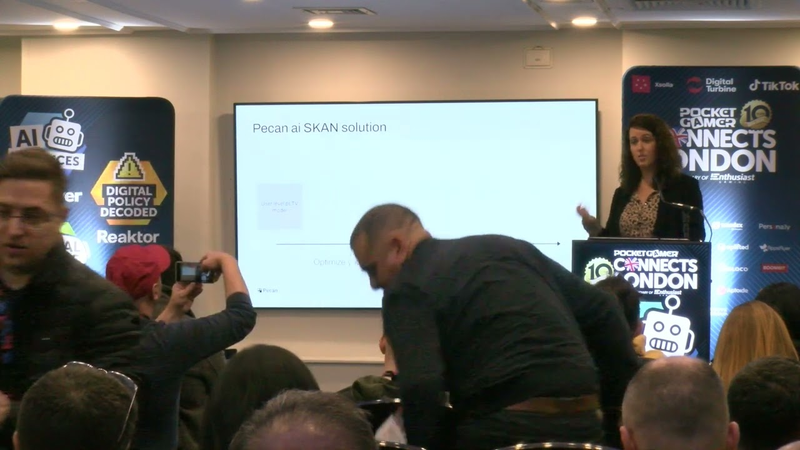
How to Leverage Predictive Analytics to Enhance iOS Marketing Performance - Keren Gritzman, Pecan.ai
Predictive analytics serves as a critical tool for mobile game developers seeking to regain marketing visibility and optimize user acquisition in the post-Apple App Tracking Transparency (ATT) landscape.
- Apple’s SKAdNetwork (SKAN) limits attribution to aggregated, delayed data within the first 24 hours, forcing marketers to rely on incomplete short-term metrics like Day 1 or Day 7 ROAS.
- Machine learning models can analyze early engagement and revenue patterns to forecast long-term metrics such as Day 30, 90, or 180 Lifetime Value (LTV).
- Integrating predictive signals into a customized SKAN conversion schema allows marketers to distribute predicted revenue across campaigns, enabling budget decisions based on long-term value rather than immediate snapshots.

Evolution of Mobile UA: AI Lessons From Gamelight - Valentina Bailly & Julia Scurtul.
The evolution of mobile user acquisition (UA) is increasingly defined by the integration of sophisticated artificial intelligence, which shifts the industry away from manual, demographic-based targeting toward automated, data-driven personalization.
- AI-driven targeting significantly outperforms manual methods by identifying non-obvious audience segments, resulting in performance gains such as a 400% increase in day-seven ARPU for top-grossing RPG titles.
- Gamelight optimizes user acquisition by analyzing real-time behavioral data and limiting recommendations to four games per user, which maximizes ROAS and ARPU by focusing on high-intent, loyal players.
- Unlike traditional demographic-based targeting, AI models continuously self-optimize using historical and real-time data, which minimizes the campaign learning phase and allows for immediate performance adjustments.

Fireside Chat: Supercharge Your Game art Production - Volkan Gurel, & Andriy Matviychuk.
This discussion explores the integration of generative AI into professional game art pipelines, focusing on a partnership between Layer AI and Tripledot Studios.
- Tripledot Studios reduced the production time for specific game assets from two weeks to a matter of minutes by integrating Layer AI into their pipeline.
- By training custom AI models on proprietary assets, Tripledot Studios was able to eliminate most of its external outsourcing while maintaining a 60-person internal art team.
- Fine-tuning private, model-agnostic workspaces requires only 20 to 25 assets per model to ensure output remains stylistically consistent with a studio's existing brand identity.

AI Driven Game Monetization in a Post ATT World - Don Reilley, Scuti
The gaming industry faces significant challenges in the post-ATT (App Tracking Transparency) and IDFA (Identifier for Advertisers) landscape, characterized by rising user acquisition costs, declining lifetime values, and player frustration with intrusive advertising.
- The gaming industry is pivoting to 'g-commerce' to offset rising user acquisition costs and declining lifetime values caused by post-ATT and IDFA privacy restrictions.
- The g-commerce model integrates an e-commerce marketplace into game lobbies, providing developers with three revenue streams: retail sales commissions, ad revenue, and in-game currency conversion fees.
- Data indicates that 91% of players are willing to purchase physical goods if they are rewarded for doing so, and 30% of daily active users currently convert these rewards into in-game currency.
Writers
Games and companies
Games