Global reports and market data
Documents
The Sponsored Avatar: Examining the Present Reality and Future Possibilities of Advertising in Digital Games
This paper examines advertising within digital games, both current practice and future possibilities, including full sponsorship, product placement, brand integration, and cross-promotion with other entertainment media.
- Advertising spending is shifting away from traditional television commercials toward placements in entertainment, with one cited beverage company redirecting more than $300 million in annual spending.
- Game-based advertising remained a small share of revenue relative to film and television, with projections of roughly $260 million by 2008, though agencies increasingly seek game placements and some have created dedicated game advertising divisions.
- Players generally accept in-game advertising, mostly because it enhances realism, but they worry that placements may feel incongruous and detract from the experience.
How Serious Are Serious Games?: Some Lessons From Infra-games
This paper examines whether serious games, particularly computer-based simulation games, can support advanced professional learning and decision-making in complex infrastructure domains such as utilities, ports, and wind farms.
- Serious simulation games are argued to help managers, policymakers, and young professionals grasp complex infrastructure systems (utilities, ports, wind farms) by letting them experiment with decisions and observe consequences over time in a safe setting.
- The authors contend that simulation games are only effective when combined with realism and engagement and embedded in broader research, debriefing, and follow-up processes, not used as standalone tools.
- Infrastructure planning is framed as a 'wicked' problem, marked by weak consensus on values and facts, pluricentric decision-making, and strategic stakeholder behaviour, which games can help participants experience and manage.
Affective Videogames and Modes of Affective Gaming: Assist Me, Challenge Me, Emote Me
This paper, presented at the DiGRA 2005 conference, examines affective videogames, which use players' physiological signals to modify gameplay in real time.
- Affective games differ from biofeedback games: in biofeedback the player consciously controls physiological responses to influence play, while affective games sense uncontrolled emotional reactions and feed them back into gameplay, forming an affective feedback loop.
- The authors' case study used an early prototype built with their Intelligent Gaming System toolkit, a Missile Command-style target-acquisition game that adjusted threat number and damage based on the player's heartbeat relative to a resting baseline to keep engagement in an optimal range.
- The evaluation involved only eight participants aged 21 to 38, so the findings are preliminary; players reported enjoyment, but experienced gamers responded less physiologically than novices, which the authors link to habituation and individual differences that must be compensated for.

Dialog as a Game
Peter Border's paper, presented at the 2005 DiGRA conference, proposes treating in-game conversation as a rule-governed game in which speakers make moves by transitioning between short dialog "chunks" rather than traversing ever-larger decision trees.
- Border proposes treating in-game dialog as a rule-governed game in which speakers move between short dialog "chunks" rather than traversing ever-larger decision trees, with the central claim that this yields more socially and emotionally coherent NPCs.
- The framework models characters with simplified emotional states (e.g., happy/sad, afraid/confident) and relationship variables (closeness, face, liking or irritation, trust), with the conversational "ball" passing between speakers as face is gained or lost.
- Relationship and emotional values decay toward zero over time unless refreshed, and each character uses a payoff function to decide whether a chunk is offered based on whether its requirements are met.
Lesser-Known Worlds: Bridging the Telematic Flows with Located Human Experience Through Game Design
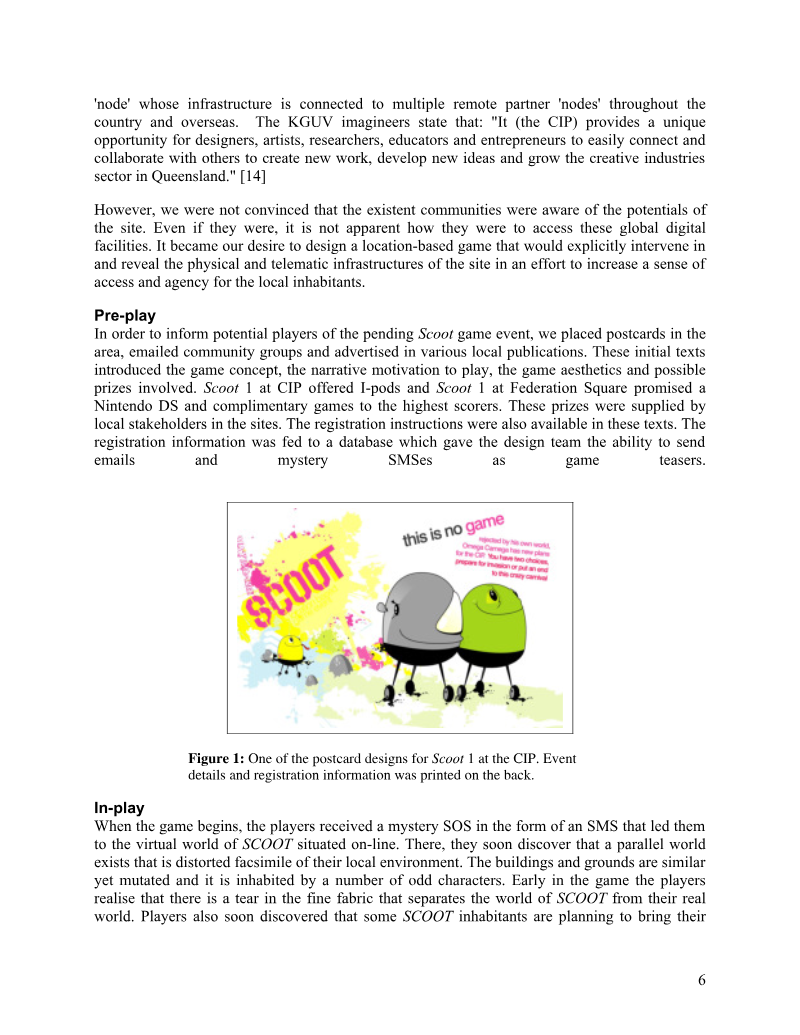
This paper, presented at the DiGRA 2005 conference, argues that location-based games (LBGs), which use mobile technologies to structure play in real-world environments, should be understood not merely as commercial novelties but as potential contributors to cultural production and to people's engagement with urban space.
- The paper argues location-based games (LBGs) using mobile technology should be seen as contributors to cultural production and urban engagement, not merely commercial novelties, positioning city sites as active participants in play.
- Most existing LBGs and alternate reality games treat environments as backdrops for treasure hunts or combat, while a smaller set, such as GeoQuest in Marseille and Close Encounters in Los Angeles, engage more deeply with local history and communities.
- User research with roughly eighty first-year university students found a strong preference for playing with others in the same physical location, and games generated social and creative artifacts such as fan fiction, strategy guides, and modifications.
Early Games Production in New Zealand
Melanie Swalwell's paper examines the early digital games industry in New Zealand during the late 1970s and 1980s, a period that is largely absent from mainstream accounts of games history, which tend to focus on the United States, United Kingdom, and Japan.
- Early digital games reached New Zealand in the late 1970s and 1980s despite geographic isolation and restrictive import policies, yet this history is largely absent from mainstream games histories focused on the US, UK, and Japan.
- Major systems including Atari, Sinclair, Commodore, Sega, and Nintendo products did reach New Zealand, typically one to two years after their overseas release, with distribution uneven across platforms.
- Local manufacturers produced at least four early consoles, most prominently the Sportronic, a Pong-style clone, and around eleven companies were involved in arcade cabinet manufacture at some point.
Girls Creating Games: Challenging Existing Assumptions about Game Content
This paper examines the content of 45 games designed and programmed by middle school girls in California, aiming to deepen understanding of what girls find appealing in games and to inform the debate over whether games should be gender-specific or gender-neutral.
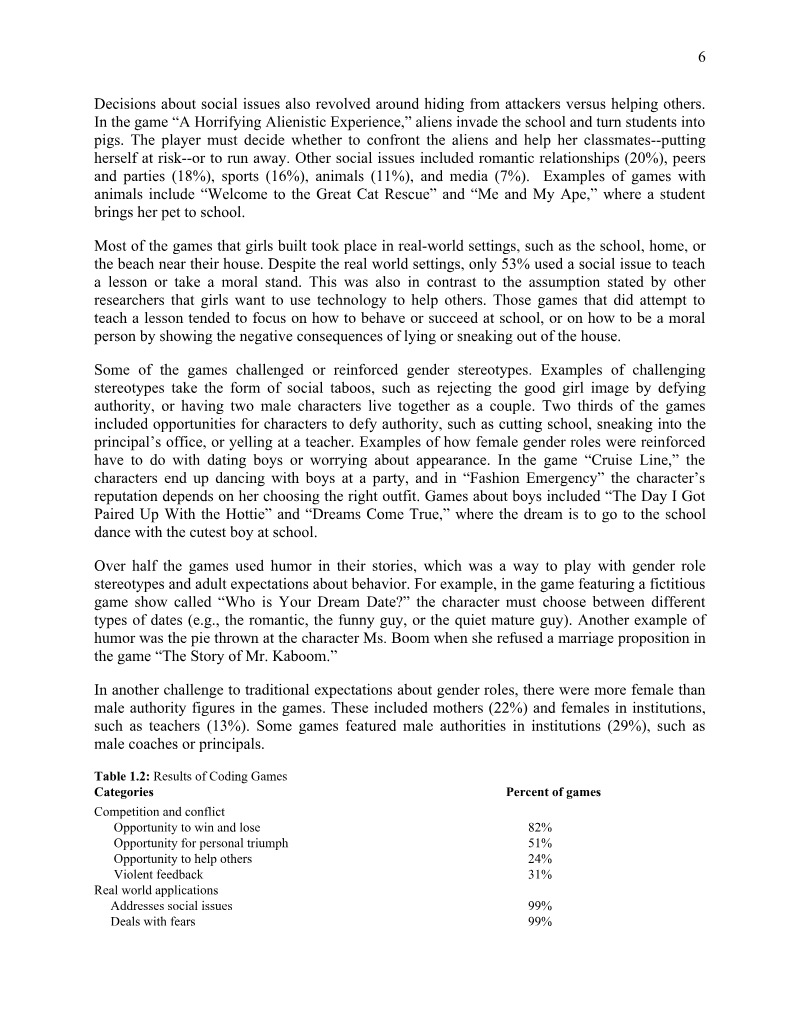
- Girls who were given the chance to design games produced content that departs from the commercial industry's dominant themes of competition, violence, and male-oriented fantasy, challenging assumptions about what girls want from games.
- Nearly all of the 45 games analyzed (99%) addressed social issues and fears, most often concerns about getting into trouble, the threat of violence, and relationship consequences.
- Real-world settings appeared in 71% of games and 53% used a prosocial lesson, while only 31% included violent feedback.
Fictive Affinities in Final Fantasy XI: Complicit and Critical Play in Fantastic Nations
This paper is a critical analysis of Final Fantasy XI, a persistent-world massively multiplayer online role-playing game produced by Square-Enix in 2002, arguing that the game's fantasy setting engineers the player's complicity in the racial and national ideologies it depicts.
- The paper argues that Final Fantasy XI (Square-Enix, 2002) engineers player complicity in the racial and national ideologies it depicts, treating the game as a text and a site of playable procedure rather than received narration.
- The game's three playable nations, San D'Oria, Bastok, and Windurst, and the opposing Beastmen races are modeled on real-world histories of nationalism, colonialism, and ethnogenesis, including European Reconquista imagery, American industrial race relations, and Japanese debates over Yamatai and pan-Asianism.
- Mechanisms of complicity include initial conflict with Beastmen, the economic practice of 'farming' them, and the territorial Conquest system, which position players as participants in ongoing hostilities.
Narrative Structure in Trans-Reality Role-Playing Games: Integrating Story Construction from Live Action, Table Top and Computer-Based Role-Playing Games
This paper proposes a framework for Trans-Reality Role-Playing Games (TRRPGs), a form of role-playing that integrates the established modalities of table-top RPGs (TTRPGs), live-action RPGs (LARPs), and computer-based massively multiplayer online RPGs (MMORPGs) within a single, coherent, persistent game world.
- Trans-Reality Role-Playing Games (TRRPGs) propose integrating table-top, live-action, and computer-based MMORPG role-playing into one coherent, persistent game world so players across staging contexts experience a shared world.
- The authors argue each form offers distinct storytelling strengths: table-top RPGs rely on collaborative verbal improvisation, MMORPGs on fixed audiovisual performance primitives, and LARPs on embodied face-to-face performance that produces a multitext where each player holds a different story perspective.
- Achieving a shared experience requires a unified and persistent game space, consistent characters, objects, NPCs and mobs across all players, and shared rules and mechanics.
Her Own Boss: Gender and the Pursuit of Incompetent Play
This paper, presented at the DiGRA 2005 conference, examines how gender shapes girls' and women's relationships to computer and video games, with particular attention to identity, access, and playful engagement.
- The paper argues that computer game-based learning initiatives risk deepening girls' existing disadvantage in computing, since educational game design is often treated as technologically neutral and rarely incorporates girls' perspectives.
- Aggregate statistics showing women playing as much as men are misleading, partly because classification shifts that count women who play card or board games as "gamers" fold gender into homogeneous player data.
- When broken down by genre and time spent, men play action and role-playing games for roughly twice as long as women, indicating video game playing remains predominantly male territory.

Gendered Gaming Experience in Social Space: From Home to Internet Café
This study, presented at the DiGRA 2005 conference, examines how the social relations embedded in different gaming spaces shape online gamers' experiences, with particular attention to how gender structures those experiences.
- Online gaming is primarily a social activity, so access to both virtual and physical gaming spaces strongly shapes players' enjoyment.
- Girls face stricter regulation than boys at home and are discouraged from visiting Internet cafés, especially with friends, which widens gender disparities in public gaming.
- Internet cafés in Taipei are a stigmatized public space dominated by male customers, and this social stigma limits girls' access to them.
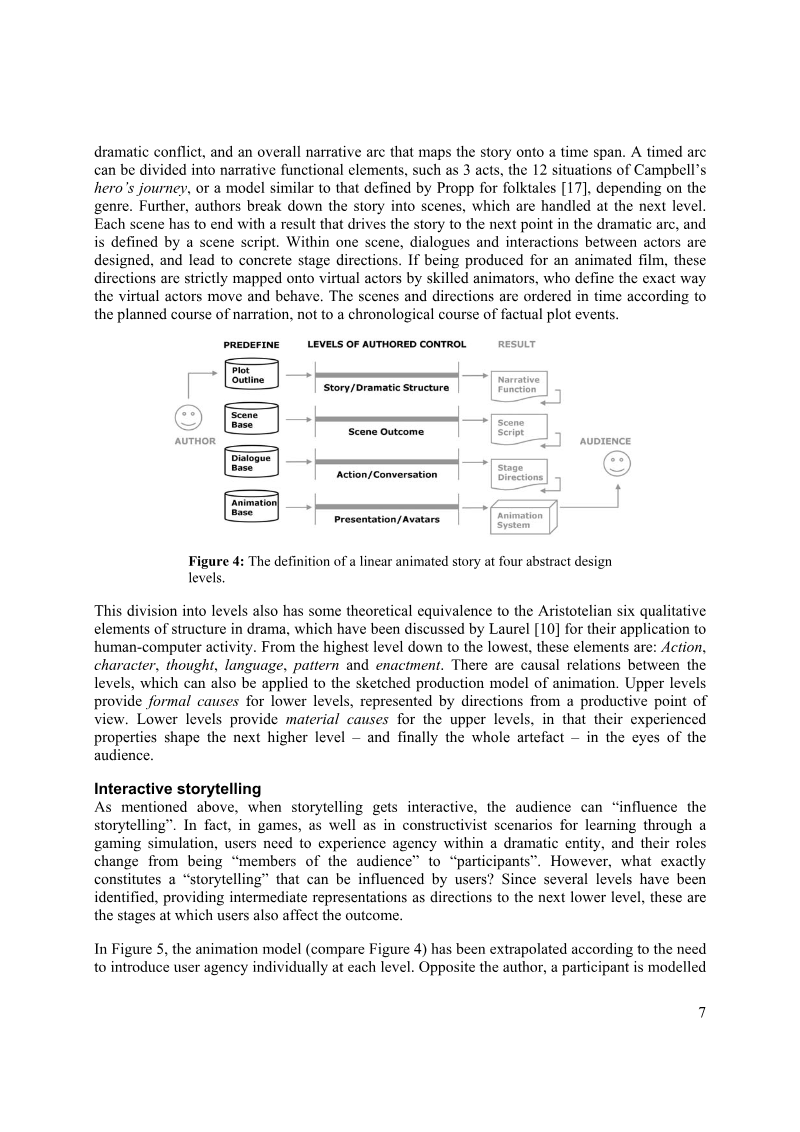
Interactive Digital Storytelling: Towards a Hybrid Conceptual Approach
Interactive Digital Storytelling: Towards a Hybrid Conceptual Approach argues that interactive storytelling is best understood not as a single concept but as a hybrid of game design and cinematic narrative, shaped by influences from computer animation, human-computer interaction, game design, and artificial intelligence.
- Interactive storytelling is framed as a hybrid of game design and cinematic narrative, shaped by computer animation, human-computer interaction, game design, and artificial intelligence, rather than as a single concept.
- The central tension is between predefined story structure and user agency, and the quality of interactive storytelling depends on how, where, and to what degree user input shapes the narrative.
- The author argues this balance can only be refined through play-testing, not resolved in theory alone.