1 free read left. Create a free account for unlimited reading + AI research.
Create free accountWhitepaper DiGRA
1 free read left. Create a free account for unlimited reading + AI research.
Create free accountWhitepaperDiGRA
The study examined 45 games designed and programmed by middle school girls in California. The girls worked in pairs to build interactive choose-your-own-adventure games.
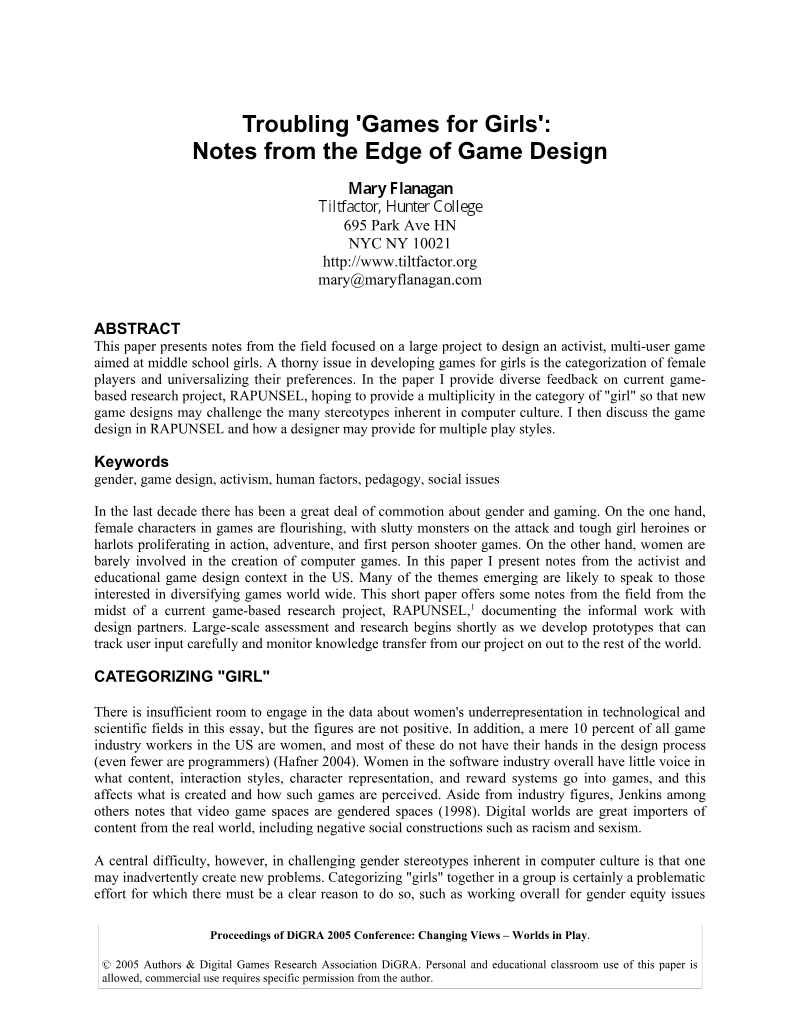
This paper examines the content of 45 games designed and programmed by middle school girls in California, aiming to deepen understanding of what girls find appealing in games and to inform the debate over whether games should be gender-specific or gender-neutral. Its central claim is that when given the opportunity to create games, girls produce content that departs from the dominant thematic trends of the commercial gaming industry, which tends to emphasize competition, violence, and male-oriented fantasy settings. The study frames its work within a constructionist approach, asking girls to build games rather than simply report their preferences.
The coded results reveal several patterns. Nearly all games (99%) addressed social issues and fears, most commonly concerns about getting into trouble, the threat of violence, and relationship consequences. Real-world settings appeared in 71% of games, and 53% used a prosocial lesson. Only 31% included violent feedback, and games frequently used humor (35%) and defiance of authority (64%) to play with gender roles, with female authority figures appearing in 33%. Winning and losing options were common (82%), but winning typically involved meaningful personal achievement rather than defeating others. Character gender was often left to the player, with 42% allowing gender selection and 13% using gender-neutral or unclear characters.
The study draws on a sample of 126 girls, predominantly sixth through eighth graders, from an after-school and summer program in which girls worked in pairs to build interactive, choose-your-own-adventure games in Macromedia Flash. Coding was conducted by two researchers using twelve subcategories grouped under three themes. The authors acknowledge limitations, including the pairing structure, the constraints of the story-path format, the inability to ask directly what games girls would prefer, and content restrictions imposed by the school setting, and they conclude that girls' creations offer a model for gender-inclusive game design.



DiGRA · 2018

DiGRA · 2018



DiGRA · 2018



DiGRA · 2018

DiGRA · 2018

DiGRA · 2018



DiGRA · 2018



DiGRA · 2018



DiGRA · 2018



DiGRA · 2018

DiGRA · 2018



DiGRA · 2018