1 free read left. Create a free account for unlimited reading + AI research.
Create free accountWhitepaper DiGRA
1 free read left. Create a free account for unlimited reading + AI research.
Create free accountWhitepaperDiGRA
The analysis reads the game as a text and as a site of playable procedure rather than received narration. Its central claim is that the game engineers player complicity in the ideologies it depicts.
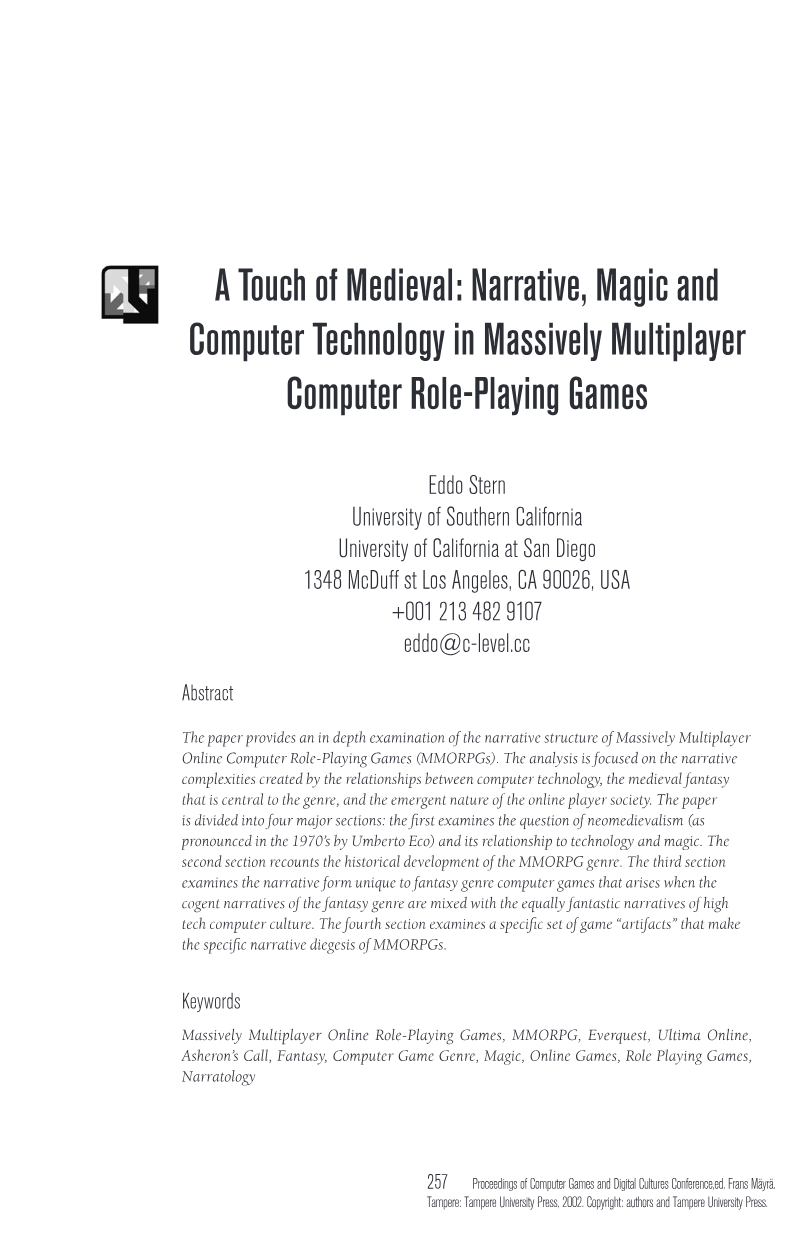
This paper is a critical analysis of Final Fantasy XI, a persistent-world massively multiplayer online role-playing game produced by Square-Enix in 2002, arguing that the game's fantasy setting engineers the player's complicity in the racial and national ideologies it depicts. Drawing on theories of fantasy as a mimetic episteme, the analysis treats the game as a text and as a site of playable procedure rather than received narration. Its central thesis is that the game's three playable nations, San D'Oria, Bastok, and Windurst, along with the monstrous Beastmen races opposing them, are visually and structurally modeled on real-world histories of nationalism, colonialism, and ethnogenesis, including European Reconquista imagery, American industrial race relations, and Japanese debates over Yamatai and pan-Asianism.
The argument identifies several mechanisms of complicity. Initial conflict with Beastmen races, the economic practice of "farming" them, and the territorial Conquest system all position players as participants in ongoing hostilities, while the social structure of group play creates obligations that override fictional choice. Mission and quest structures reveal a contested historical record, suggesting that the Beastmen were not solely responsible for conflict, yet they offer the player little meaningful historical agency. The paper also examines the game's "epistemes of time," showing how oral history, missions, and quests build an alternate historical narrative with differing temporal scales.
The analysis is grounded in close textual reading of the game's cinematics, characterizations, architecture, and mechanics, supplemented by a personal interview with the game's US producer and reference to player forums. It draws on a broad literature spanning genre theory, fantasy scholarship, Japanese cultural history, and anthropology, and it offers its method explicitly as an exercise in critical close-play for the study of hybrid game genres.
Each row is a game or company this document names, each column a document, oldest first. A mark means that document names it. Select a row to see those documents.
DiGRA · 2018
DiGRA · 2018
DiGRA · 2018
DiGRA · 2018
DiGRA · 2018
DiGRA · 2018
DiGRA · 2018
DiGRA · 2018
DiGRA · 2018
DiGRA · 2018
DiGRA · 2018
DiGRA · 2018
DiGRA · 2002