Global reports and market data
Documents
A World to Build: World-building and Capitalism in Games
The document analyzes the relationship between world-building in video games and capitalist social relations, arguing that world-building functions as a mechanism for developing and prolonging intellectual property for media monopolies.
- The paper argues that videogame world-building is a form of political-economic production under capitalism, with game worlds functioning as fixed capital, comparable to land, that media companies use to develop and extend intellectual property.
- Through analysis of Fallout 4 and Disco Elysium, the author positions the player's relationship to game worlds as closer to a rentier than a consumer, treating these worlds as stores of value that can be repeatedly returned to and licensed as brands.
- The central aesthetic claim is that capitalist logic produces persistent, always-on game worlds marked by stasis, since altering them would waste the value embedded in them.



Slow Gaming: Applying Slow Movement to Post-anthropocentric Play
This paper introduces "slow gaming," an approach to play that draws on the broader slow movement, which champions mindful, sustainable alternatives to fast, consumption-driven life.
- Slow gaming applies the broader slow movement's ethos of mindful, sustainable pacing to play, resisting the speed, efficiency, and constant progression expected of contemporary media.
- The paper's central analysis compares Journey (2012) and Stray (2022) as two games depicting post-human worlds, using them to test how slow play operates in practice.
- Journey is presented as an example of coherent coziness, where visual harmony, fluid movement, and minimal conflict sustain a near-meditative atmosphere.
Three Rights to Play: Liberalist, Fascist, and Compositionist
This theoretical paper explores the concept of a "right to play" by contrasting three ideological approaches: liberalist, fascistic, and compositionist.
- The paper argues that three competing frameworks define 'play' as a political and moral category: liberalist (a right to compete in a supposedly fair market order), fascistic (play as transgressive self-assertion and unaccountable power), and compositionist (play as cooperative, creative capacity that continually recomposes social worlds).
- The liberalist view, exemplified by the promotional discourse of Toronto-based non-profit Right to Play (roughly 25 years of play-based learning in developing regions, underserved communities, and conflict zones), is linked to John Rawls's procedural 'justice as fairness,' which the paper claims has been repurposed to justify neoliberal policy aimed at leveling the playing field for markets.
- The paper contends that the widespread experience of unfairness produced by the liberalist competitive order creates openings that fascistic actors exploit by blaming migrants, minorities, and elites.



Changing the Game Forever: MapleStory's Big Bang as a Climate Change Event
This paper reads the 2010 Big Bang update to MapleStory as a climate change event, arguing that the game's player-inhabited world rehearses how the climate crisis is experienced by its inhabitants.
- The paper reads MapleStory's 2010 Big Bang update as a climate change event, arguing the game's player-inhabited world rehearses how the climate crisis is experienced, with its history split into pre- and post-Big Bang sensibilities mirroring the spatiotemporal rupture of the Anthropocene.
- The Big Bang overhaul introduced faster traversal, a reduced experience-point requirement for leveling, and a new narrative centered on the revival of the Black Mage, shifting players' perception of the game from slower and communal to individualized, fast-paced, and power-centered.
- Pay-to-win mechanics and aggressive cosmetic marketing are associated with the post-update shift and have fueled documented player resistance, though the update did not introduce them directly.
Analysing Historical Distortion in Large Language Model Roleplay
The document analyzes historical distortion in Large Language Model (LLM) roleplay, specifically examining how LLMs curate and represent collective memory in a historical game scenario.
- Historical accuracy is a serious weakness across all tested LLMs in the roleplay setting: of 37 extracted proper names, only 8 of the 24 fully named historical figures could plausibly have been in Vienna in July 1936, and several named individuals had no verifiable historical basis.
- Model choice significantly affected narrative tone: sentiment analysis (VADER, ANOVA p<0.001) found GPT-4o and GPT-4o-mini produced slightly positive average scores, while the other models trended negative.
- Models differed in how much fabricated history they introduced, with Llama3.1 introducing the most proper names per session on average and GPT-4o the fewest.

Death-Themed Games and Playing the "Good Death"
This research examines how "death-themed games" – those designed to encourage reflection on death, dying, and grief – intersect with the concept of a "good death."
- Heather Maycock's paper examines death-themed video games, which encourage players to reflect on death, dying, and grief rather than treating death only as punishment or a mechanical feedback loop.
- The paper argues that death-themed games, though often presented as humane and empathetic, can encode particular cultural values, particularly the dominant twenty-first-century Anglosphere model of the "good death" originating in palliative care.
- That dominant model emphasises individualism and the dying person's control over timing, place, symptoms, and activities.



No Room in the Infinite for the Masculine and Queer: How Do Dress-Up Pleasures in Infinity Nikki Collide with Player Desire and Queer/Masculine Fashion?
This analysis investigates the aesthetic limitations of dress-up options in the Chinese gacha game Infinity Nikki, focusing on the underrepresentation of masculine and queer fashion styles despite the game's emphasis on "infinite" variety.
- The paper's central finding is that Infinity Nikki's fashion pleasures are aesthetically limited, skewing overwhelmingly toward cute, comfort-focused, and ballgown-style feminine outfits, while masculine and queer styles are largely absent.
- The authors describe the absence of butch, tomboy, androgynous, ouji, drag king, Takarazuka, and British pantomime styles as a "misappearance" of masculine and queer expression, with the developer providing little explicit support for them.
- Players improvise masculine and boyish looks with available tools and read queer themes into the narrative, but the game itself offers limited structural support for these identities.
How Streaming Facilitates Affective Transformation: A Case Study of Horror Game Spectatorship
This document investigates how game streaming facilitates an affective transformation, specifically from horror to humor, using the horror game Little Nightmares as a case study.
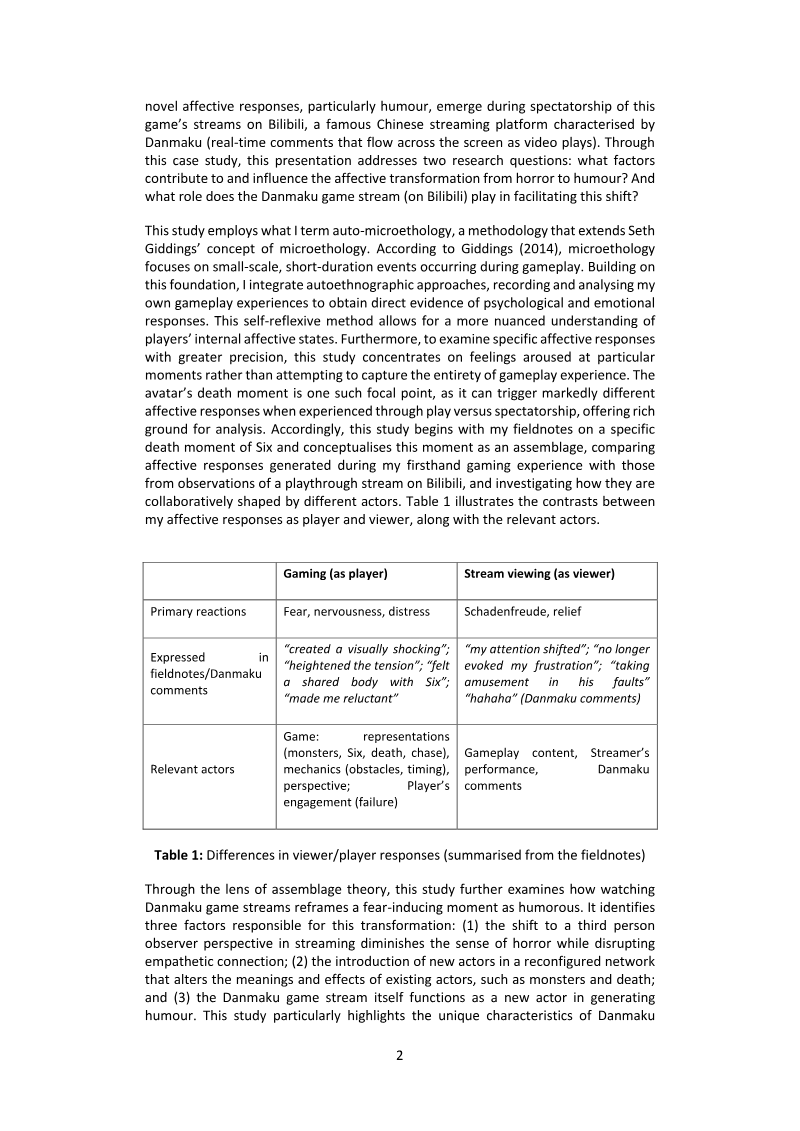
- Stream spectatorship of horror games can convert fear into humour: on Bilibili, watching Little Nightmares shifts viewers from the visceral, empathetic horror felt by players toward amusement and schadenfreude.
- The paper's concept of empathetic horror arises from a player's bond with a front-facing, side-scrolling avatar, and that bond is disrupted when viewers adopt a third-person observer stance.
- Three factors drive the affective transformation: the shift from embodied to observer perspective, the introduction of new actors that change the meaning of monsters and death, and the Danmaku comment stream acting as an active participant in producing humour.



From Restoration to Extinction: Intersectional Pleasures in Ecological Game Reception
The study investigates how players interpret ecological messages in eco-games, challenging the assumption that affective engagement reliably translates into ecological awareness.
- Emotional intensity does not reliably produce ecological consciousness: the study challenges the assumption that games are effective vehicles for environmental messaging, finding a structural ceiling on consciousness-raising.
- Terra Nil and Endling elicit sharply divergent affect, with Terra Nil producing mainly joy and calm (described as meditative) and Endling producing sadness and love, including players reporting crying and maternal feelings toward its fox protagonist.
- Despite these contrasting emotional profiles, ecology-focused orientation converges at roughly 13 percent for both games, showing that differing feelings do not translate into different levels of ecological awareness.

The Classical Roman Reception in Genshin Impact: Within the Region of the Sea of Bygone Eras
The document analyzes the classical Roman reception within the "Sea of Bygone Eras" region in the East Asian game Genshin Impact.
- The paper is an academic study of how classical Roman culture is reimagined in Genshin Impact (2020, developed by the Chinese studio HoYoVerse), focusing on the Sea of Bygone Eras region of the fantasy world Teyvat.
- The authors argue that East Asian video games have been largely overlooked in scholarship on classical reception, which has concentrated on Western titles, and position Genshin Impact as a distinctive case that bridges research on Chinese cultural influence and classical reception in digital media.
- Two principal characters, Boethius and Cassiodor, derive their names and roles from the historical late antique Roman figures Boethius and Cassiodorus, active in the fifth and sixth centuries amid the decline of the Western Roman Empire.
From Policy to Paradox: Diversity Washing, Policy Failures, and the Limits of Authentic Intersectional Pleasure in the European Video Game Industry
This extended abstract from the Horizon Europe GAMEHEARTS project critically examines the systemic failure of inclusiveness within the European Video Game Industry Ecosystem (EVGIE).
- The paper argues that weak institutional frameworks and formalised organisational mechanisms encourage superficial compliance with inclusivity goals, a practice it terms "Diversity Washing", with inclusivity often imposed to satisfy financing and reporting requirements rather than arising from grassroots creativity.
- The study's evidence base combines a systematic review of 61 academic publications, analysis of 55 industry reports and 18 statistical reports, and nine comparative case studies of games incorporating European cultural heritage.
- A 2024 quantitative survey of 1,270 European video game developers, supplemented by 27 in-depth interviews, three national and one international design thinking marathons (72 participants), and focus groups with eight practitioners from Austria, Ireland, Sweden, and Poland, forms the empirical core of the research.

Designing Hybrid Agency: AI-Mech Collaboration in Contemporary Mecha Games
The research explores how contemporary mecha games construct AI-mech units as sites of hybrid agency, where initiative, responsibility, and risk are distributed between human and non-human actors through game rules, automation thresholds, and representational cues.
- The paper reframes AI-controlled mechs in games as co-acting subjects ('hybrid agency') whose decisions directly shape what the player can do, rather than as enemy routines, scripted companions, or background coordination systems.
- Its analysis rests on three titles spanning genres: Titanfall 2 (first-person shooter), Daemon X Machina (third-person mech action), and BattleTech (turn-based tactics), each built on a human pilot collaborating with a semi-autonomous war machine.
- Initiative shifts between pilot and machine through mech takeovers, automated follow-up actions, and quieter reallocations via turn order and accuracy thresholds, often without the player noticing the transfer.