1 free read left. Create a free account for unlimited reading + AI research.
Create free accountWhitepaper DiGRA
1 free read left. Create a free account for unlimited reading + AI research.
Create free accountWhitepaperDiGRA
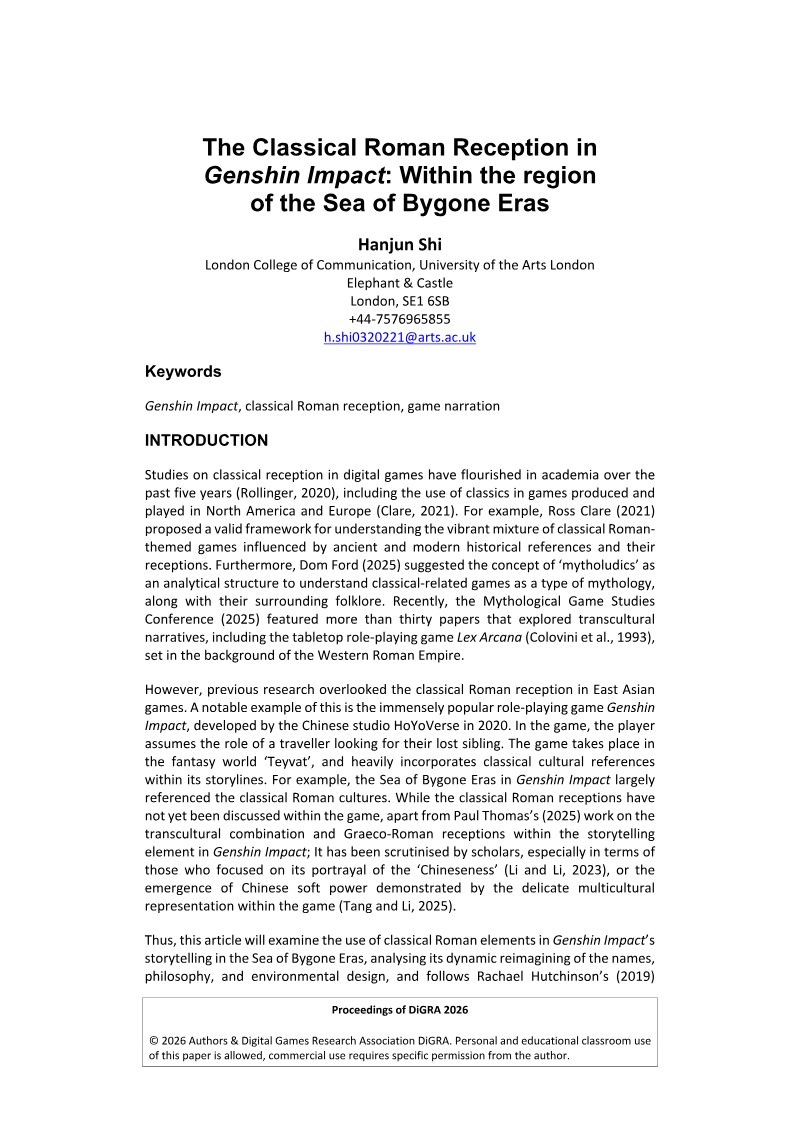
The paper is an academic study of how classical Roman culture is reimagined in Genshin Impact, focusing on the Sea of Bygone Eras region of Teyvat.
This paper examines how classical Roman culture is reimagined in Genshin Impact, the 2020 role-playing game developed by the Chinese studio HoYoVerse, with a particular focus on the Sea of Bygone Eras region of the fantasy world Teyvat. The authors argue that while Western classical reception in games has received substantial scholarly attention, East Asian titles have been largely overlooked, and that Genshin Impact offers a distinctive case. The paper positions itself as a contribution that bridges existing research on the game's Chinese cultural influence with the broader study of classical reception in digital media.
The analysis proceeds through a textual and visual reading of the game's dynamic reworking of names, philosophy, and environmental design, drawing on an established analytical framework for Japanese-influenced game culture. As a central example, the paper points to two principal characters, Boethius and Cassiodor, whose names and roles derive from the historical Roman figures Boethius and Cassiodorus, both active in late antique Rome during the fifth and sixth centuries amid the decline of the Western Roman Empire and the uneasy collaboration between Roman elites and Gothic military aristocrats.
The paper further argues that the game's treatment of classical material is shaped by the multicultural traditions of Japanese role-playing games, which gained wide popularity in mainland China from the 1990s onward. Drawing on earlier scholarship on Japanese cultural industries, the authors contrast the "culturally odourless" global strategy and the self-Orientalist parody associated with Japanese games against what they characterise as a more proactive multicultural approach in Genshin Impact. This approach, the paper suggests, is supported by official Chinese cultural policy and reflects the emergence of Chinese soft power through the game's multicultural representation.
Each row is a game or company this document names, each column a document, oldest first. A mark means that document names it. Select a row to see those documents.

DiGRA · 2026

DiGRA · 2026



DiGRA · 2026



DiGRA · 2026



DiGRA · 2026



DiGRA · 2026



DiGRA · 2026



DiGRA · 2026

DiGRA · 2026



DiGRA · 2026



DiGRA · 2026

DiGRA · 2026
DiGRA · 2026