Global reports and market data
Documents



Shan-shui Game: Worldbuilding for a Pluriverse Through Relational Game Assets
The document proposes a re-evaluation of "shan-shui games" by centering them within Chinese Daoist philosophy and the tradition of shan-shui-hua (mountain-water painting), moving beyond predominantly Western theoretical frameworks in game studies.
- The paper argues that shan-shui games should be analyzed and created through Chinese and Daoist frameworks, such as Alenda Chang's Mountain-Water game concept and Yuk Hui's cosmotechnics, rather than primarily through Western theory like cybernetics and anthropocentric game analysis.
- Shan-shui is framed as a worlding process that generates multiple temporalities grounded in non-Western imaginaries, using a comparative, non-binary approach.
- Drawing on the Song-Yuan period (960-1368), the paper notes that shan-shui painting was understood as a cosmic body unified in rhythm with the human body, not as a mere scenic backdrop.
Community Resilience and Nostalgia: The Case of the Metal Slug Saga
This study examines the Metal Slug video game series (1996-present) to understand its enduring cultural significance and the resilience of its gaming communities, particularly through the lens of nostalgia.
- Metal Slug's longevity is attributed to a strong visual and sonic identity, accessible gameplay, and a cross-media presence that let it outlast most arcade titles of its era.
- The authors frame nostalgia as an active cultural force: players reactivate past gaming experiences by combining original hardware with emulation, streaming, and online sharing.
- The franchise was launched by Nazca Corporation and later developed by SNK, and the paper treats its broad distribution as evidence of mass-phenomenon status.
The Relationship Between Signs and Context: Semiotic Meaning-Making in Digital Games
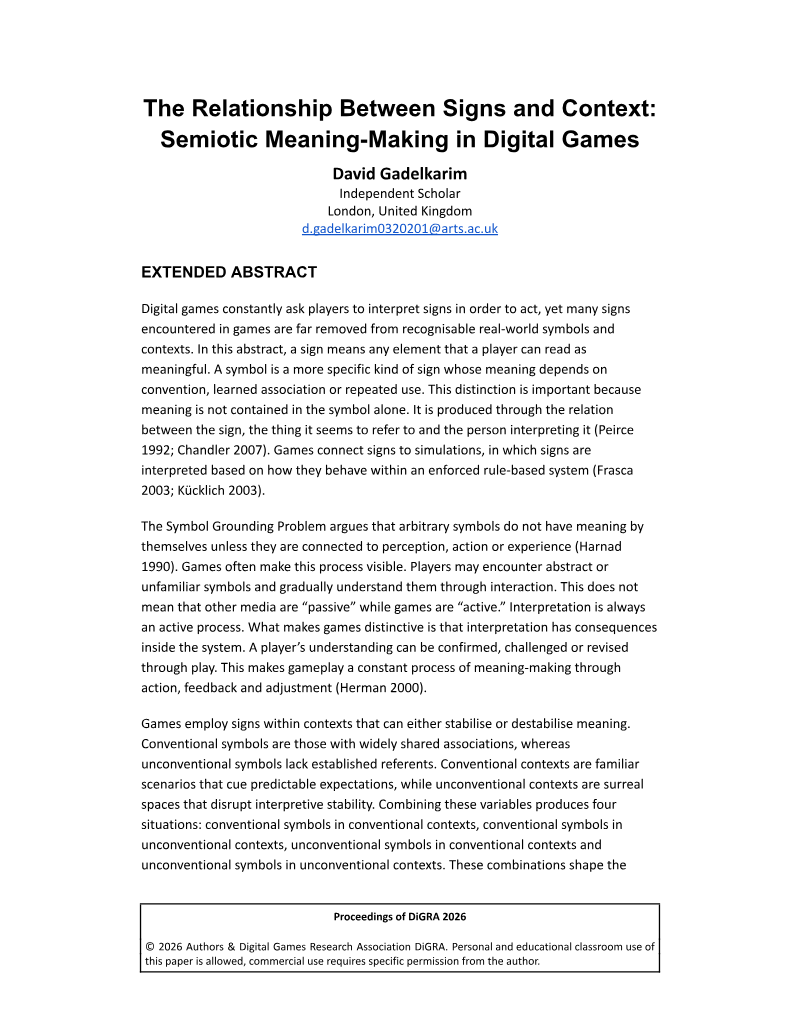
This paper examines how players interpret signs in digital games, arguing that meaning arises from the relationship between a sign, the thing it seems to refer to, and the player's interpretive activity rather than from the symbol alone.
- Meaning in digital games arises from the relationship between a sign, what it seems to refer to, and the player's interpretive activity, not from the symbol alone.
- The paper proposes a two-variable model crossing symbol familiarity (conventional or unconventional) with context familiarity (conventional or unconventional), yielding four distinct interpretive situations.
- Conventional symbols in conventional contexts give immediately legible meaning because denotation and genre convention align, while conventional symbols in surreal contexts shift attention toward connotation, atmosphere, and reflection.
How to Play Academia: Conceptual and Methodological Observations
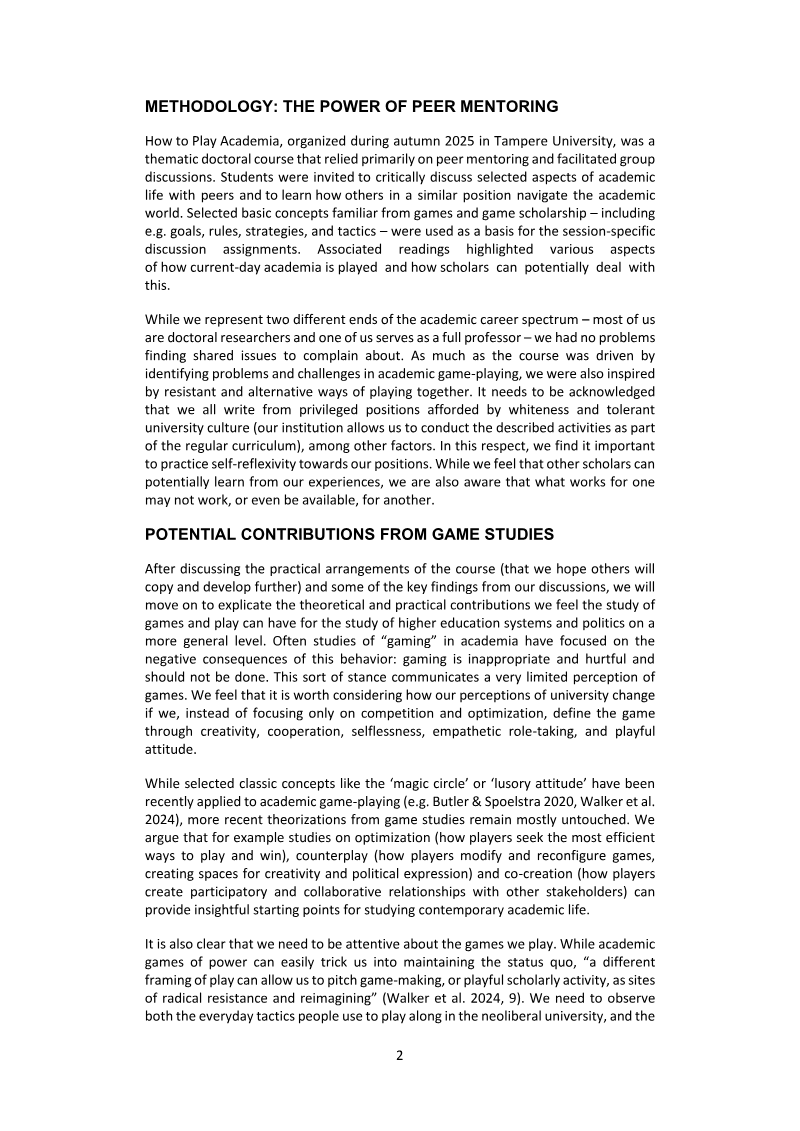
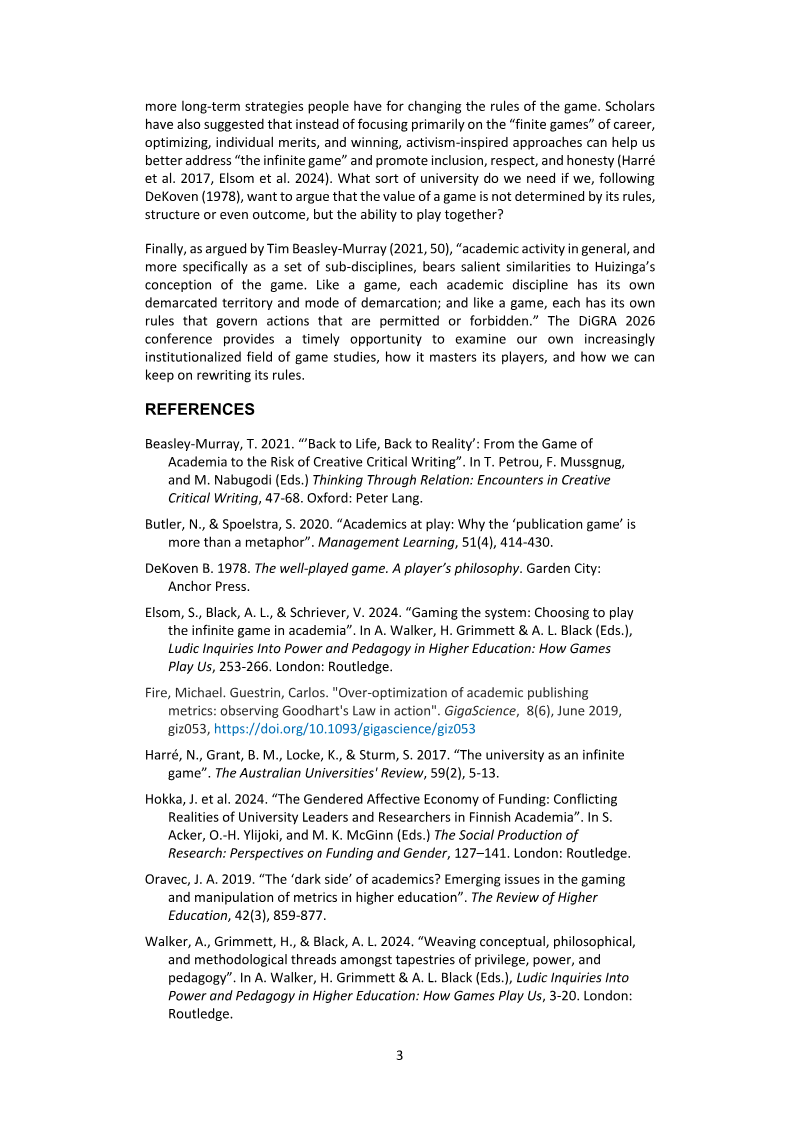
This paper, "How to Play Academia," argues that game studies scholars should contribute more actively to debates about the gamelike dimensions of contemporary higher education, which are often framed in terms of a "publication game," funding applications as rule-bound play, and the gaming of performance metrics that illustrates…
- The paper argues that game studies should engage more actively with the gamelike dimensions of higher education, such as the publication game, funding applications as rule-bound play, and the gaming of performance metrics illustrating Goodhart's law.
- The authors contend that existing scholarship on academic gaming focuses narrowly on negative consequences and propose an activism-oriented approach examining the goals, rules, strategies, and tactics of academic life.
- The central thesis is that game concepts such as optimization, counterplay, co-creation, the magic circle, and lusory attitude offer richer analytical resources than the dominant resource-management view of academic careers.
Instrumental Pleasures: Game Informer and the Masculinist Review Discourse of Fantasy Game Magic
This analysis examines how the American mass-market magazine Game Informer discursively framed the enjoyment of magic systems in fantasy games between 1991 and 2011.
- The paper analyzes reviews in Game Informer, an American mass-market game magazine, from 1991 to 2011 to examine how fantasy game magic systems were praised and framed.
- Reviewers repeatedly valued magic systems for five themes: destruction, spectacle, choice, creativity, and mastery, which the author interprets through Taylor's concept of instrumental play (efficiency, goal orientation, system understanding).
- The author argues that the magazine's repeated valorization of instrumental engagement amounted to a gendered script of enjoyment, since instrumental rationality has historically been coded as masculine.
Pleasure in Play: Hyperscanning Shared Card Game Experience
This interdisciplinary project investigates how game mechanics influence players' emotional, social, and neural responses, combining artistic game design, cognitive neuroscience, and empirical aesthetics.
- A DiGRA 2026 study used 32-channel EEG hyperscanning on 66 participants playing a custom three-player trick-taking card game (501) over two roughly 20-minute rounds to link inter-brain synchrony to game events, player roles, and subjective experience.
- Players' mood and emotional arousal increased significantly after play, but broader prosocial and social-closeness measures showed no overall change.
- Frontal, central, and lateral electrodes showed significant neural differences across player roles, and consistent event-related potentials appeared for game actions.
The Evolution of Emotion Work in The Sims 1-4
The document analyzes the evolution of emotion work in The Sims series, specifically focusing on how The Sims 4, the latest installment, reinforces patriarchal feminization of emotion work and happiness scripts.
- The paper argues that The Sims 4 (2014) increasingly requires complex emotional management from players, and that this design reinstates a patriarchal feminization of emotion work.
- The central claim is that the game's moodlet system, which assigns positive and negative emotional effects to social interactions, objects, and life events, materializes Sara Ahmed's concept of "happiness scripts" and encodes specific ideological expectations about happiness.
- The author contends that the game quantifies and makes emotional labor visible via moodlets and a satisfaction-point reward structure, contrasting this with patriarchal systems that typically render women's emotional labor invisible.
Collective Memory Lapse: LLMs Omissions in Roleplay
This study investigates how Large Language Models (LLMs) represent historical events, particularly focusing on their potential to distort collective memory in role-playing game settings.
- The authors ran an experimental, non-immersive text-based time-travel game about the 1945 Rechnitz massacre of Hungarian Jews, plus an earlier prototype on the 1936 murder of philosopher Moritz Schlick, with models instructed to stick strictly to historical facts and to offer four numbered choices after each scene.
- The study combined a three-month public installation in Vienna in 2025, player interviews and debriefings, and a quantitative analysis of 115 LLM-generated role-play texts using semantic similarity and sentiment analysis.
- Text analysis found significant differences in how individual models (European, Chinese, and US-American) presented the same historical content, and players were grouped into three distinct user types.
Queer Resistance Through Sexual Role-play: Arousal and Community
The document explores BDSM live-action role-play (larp) within a long-standing Nordic and European leather dyke+ community as a site of shared pleasure, communal care, and queer resistance.
- The paper analyzes one BDSM role-play event (larp) within a long-standing leather dyke+ community in the Nordics and Europe, using seven scene-focused small-group interviews, participatory observation, and design document analysis.
- The authors argue that pleasure is structurally embedded in erotic larp design: sensory registers such as touch, taste, sound, and smell become part of the game system, shaping individual arousal and a communal erotic atmosphere.
- Participants described arousal as emerging from the interplay of fiction, bodily sensation, and community culture, moving between self and character rather than attaching to a fixed identity.
Powered by GameSpy: Theorizing and Analyzing the GameSpy Network as Platform Infrastructure
The document analyzes GameSpy as a foundational "platform infrastructure" in the late 1990s and early 2000s, integral to the popularization of online gaming and the mainstreaming of games.
- GameSpy combined a network of enthusiast gaming news sites with online play services that publishers embedded in their titles, with hundreds of games advertising they were "powered by GameSpy" before the company's 2014 shutdown.
- The authors treat GameSpy's closure as a "dead platform" whose afterlives reveal the precarity and constraints of present-day digital media, arguing its history offers insight into the contemporary Internet despite its relative obscurity.
- The study's method applies Tamara Kneese's screenshot approach to archival captures of the GameSpy Network via the Wayback Machine, examining anniversary retrospectives, company overviews, content guidelines, and the sites themselves.
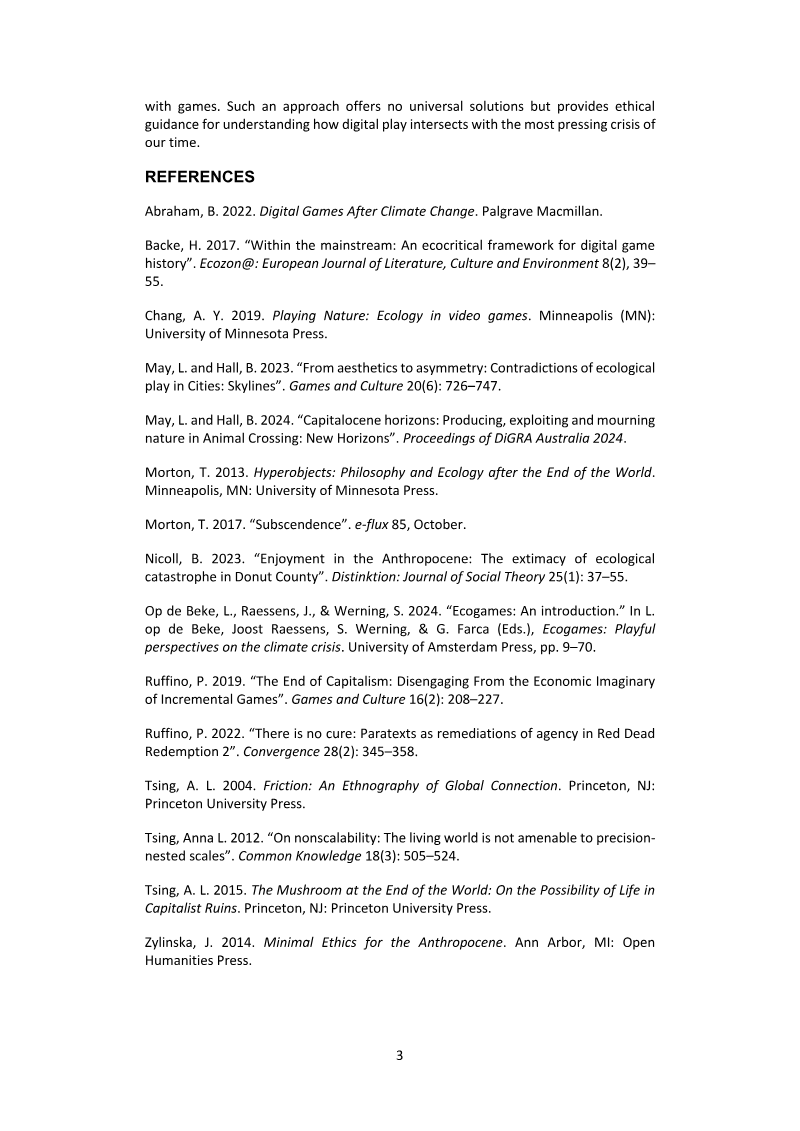
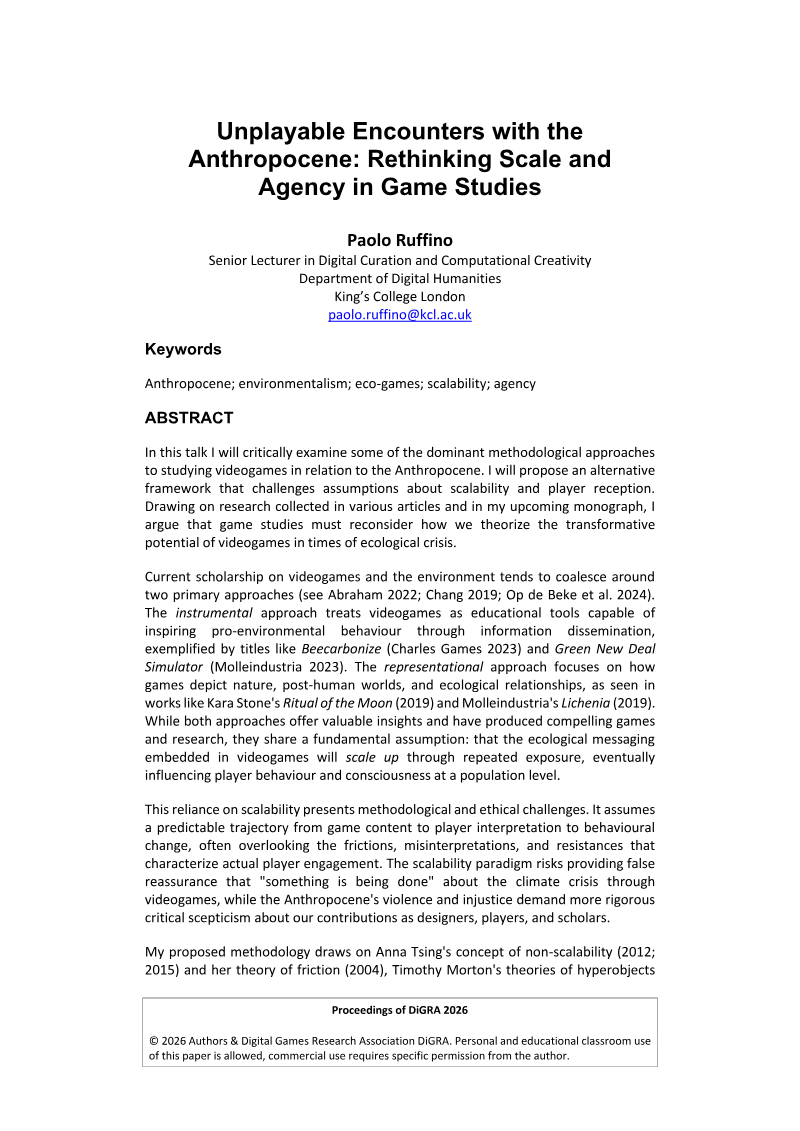
Unplayable Encounters with the Anthropocene: Rethinking Scale and Agency in Game Studies
Paolo Ruffino's paper critically examines the dominant approaches to studying videogames in relation to the Anthropocene and proposes an alternative framework centred on non-scalability.
- Ruffino argues that the dominant approaches to games and the Anthropocene, the instrumental (games as tools for pro-environmental behaviour) and the representational (games depicting nature), share an unexamined assumption that ecological messages scale up through repeated exposure to shift player behaviour at population level.
- The paper contends this scalability paradigm offers false reassurance that the climate crisis is being addressed through games, when it may not be.
- Drawing on Anna Tsing's non-scalability and friction, Timothy Morton's hyperobjects and subscendence, and Joanna Zylinska's minimal ethics of the Anthropocene, the author proposes studying meaningful game engagement as situated, contradictory encounters that resist aggregation into unified political messages.
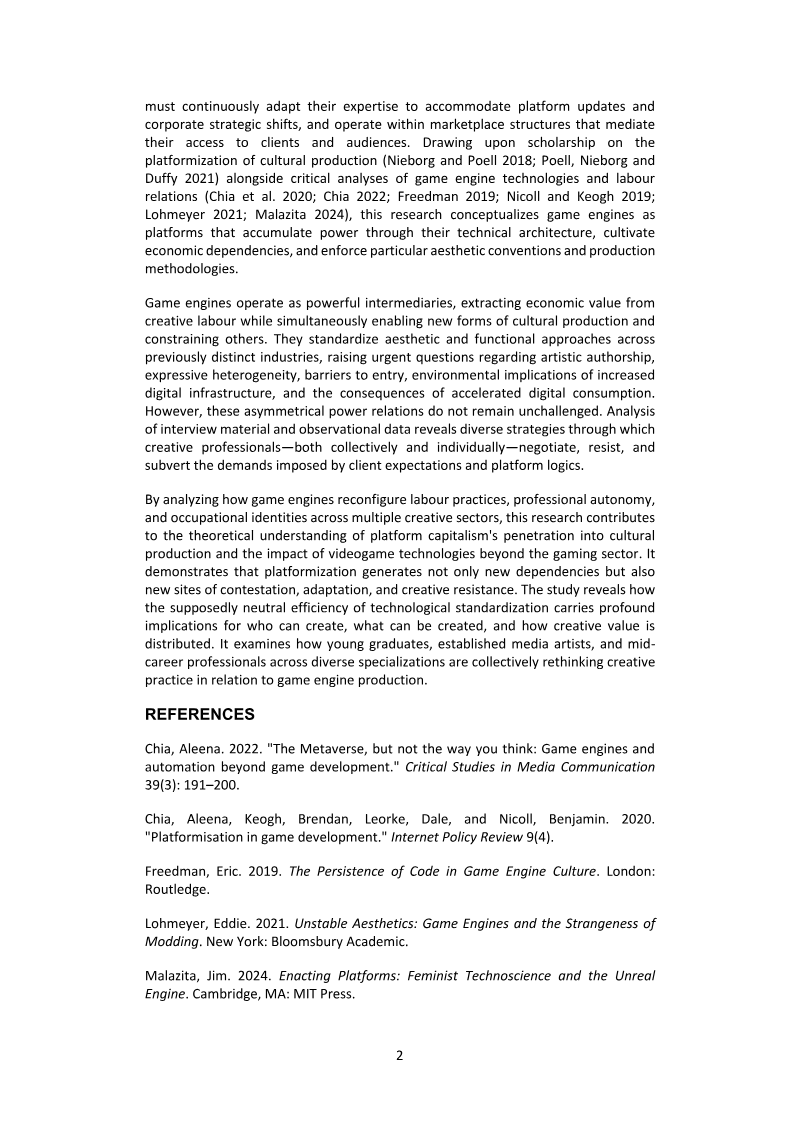

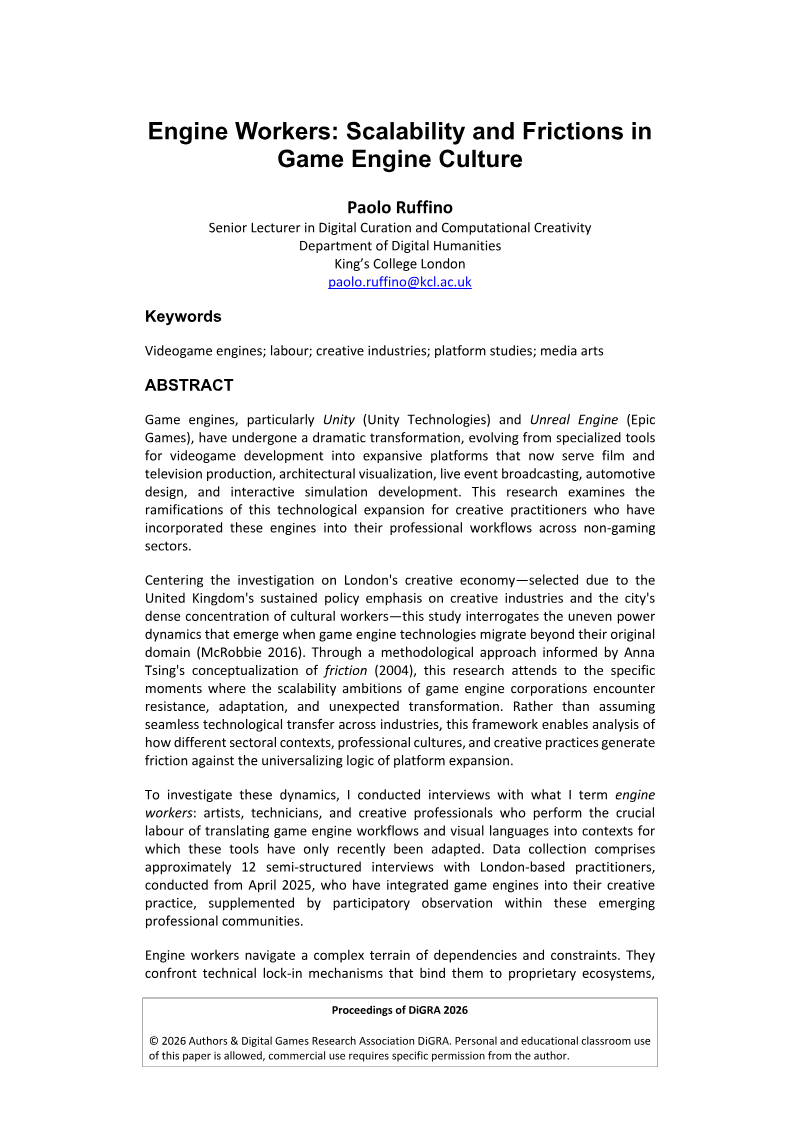
Engine Workers: Scalability and Frictions in Game Engine Culture
This paper examines how game engines such as Unity and Unreal Engine, originally built for videogame development, have expanded into film and television production, architectural visualization, live broadcasting, automotive design, and interactive simulation.
- Game engines such as Unity and Unreal Engine, originally built for videogame development, have migrated into film and television, architectural visualization, live broadcasting, automotive design, and interactive simulation, but this migration generates friction rather than seamless technology transfer.
- The paper's central argument is that platformization meets the professional cultures of non-gaming sectors, producing new dependencies alongside new forms of contestation and adaptation.
- Practitioners described as "engine workers" face technical lock-in to proprietary ecosystems, continual adaptation to platform updates and corporate strategic shifts, and marketplace structures that mediate their access to clients and audiences.