1 free read left. Create a free account for unlimited reading + AI research.
Create free accountWhitepaperTampere University
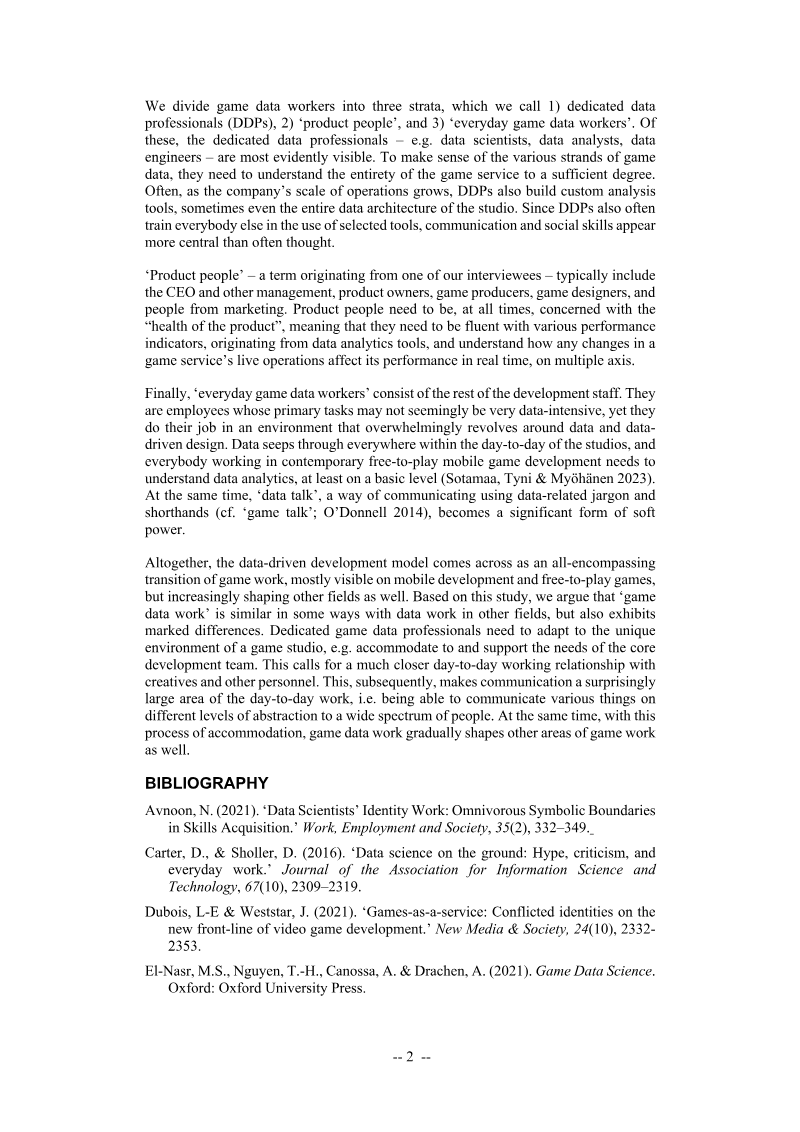
The authors argue that scholars in game studies should contribute more actively to debates about academic life. They point to the publication game, rule-bound funding applications and the gaming of performance metrics.
This paper, "How to Play Academia," argues that game studies scholars should contribute more actively to debates about the gamelike dimensions of contemporary higher education, which are often framed in terms of a "publication game," funding applications as rule-bound play, and the gaming of performance metrics that illustrates Goodhart's law. The authors contend that prevailing scholarly treatments of academic gaming focus narrowly on its negative consequences, and they propose a more activism-oriented approach that examines the goals, rules, strategies, and tactics of academic life. Their central thesis is that concepts from game studies, such as optimization, counterplay, co-creation, the magic circle, and lusory attitude, can offer richer analytical resources than the resource-management view of academic careers that dominates current discussion.
The methodological basis is a thematic doctoral course, How to Play Academia, run at Tampere University in autumn 2025. The course relied on peer mentoring and facilitated group discussion, using basic game concepts as the framework for session-specific assignments. The participating group spanned doctoral researchers and a full professor, and the authors explicitly acknowledge that their privileged positions, shaped by whiteness and an institutionally tolerant university culture, limit how far their experiences generalize. The paper is therefore a conceptual and reflective contribution rather than an empirical study, with no survey sample or quantitative data presented.
Drawing on finite and infinite game distinctions and DeKoven's notion that a game's value lies in the ability to play together, the authors argue that academic life can be reframed around creativity, cooperation, selflessness, and empathetic role-taking rather than competition alone. They also distinguish everyday tactics that sustain participation in a neoliberal university from longer-term strategies for changing its rules. The paper closes by suggesting that the DiGRA 2026 conference offers an occasion to examine game studies itself as an increasingly institutionalized field and to consider how its own rules might be rewritten.
International Journal of Role-Playing · 2026



























Comments