Game Studies reports and market data
Documents
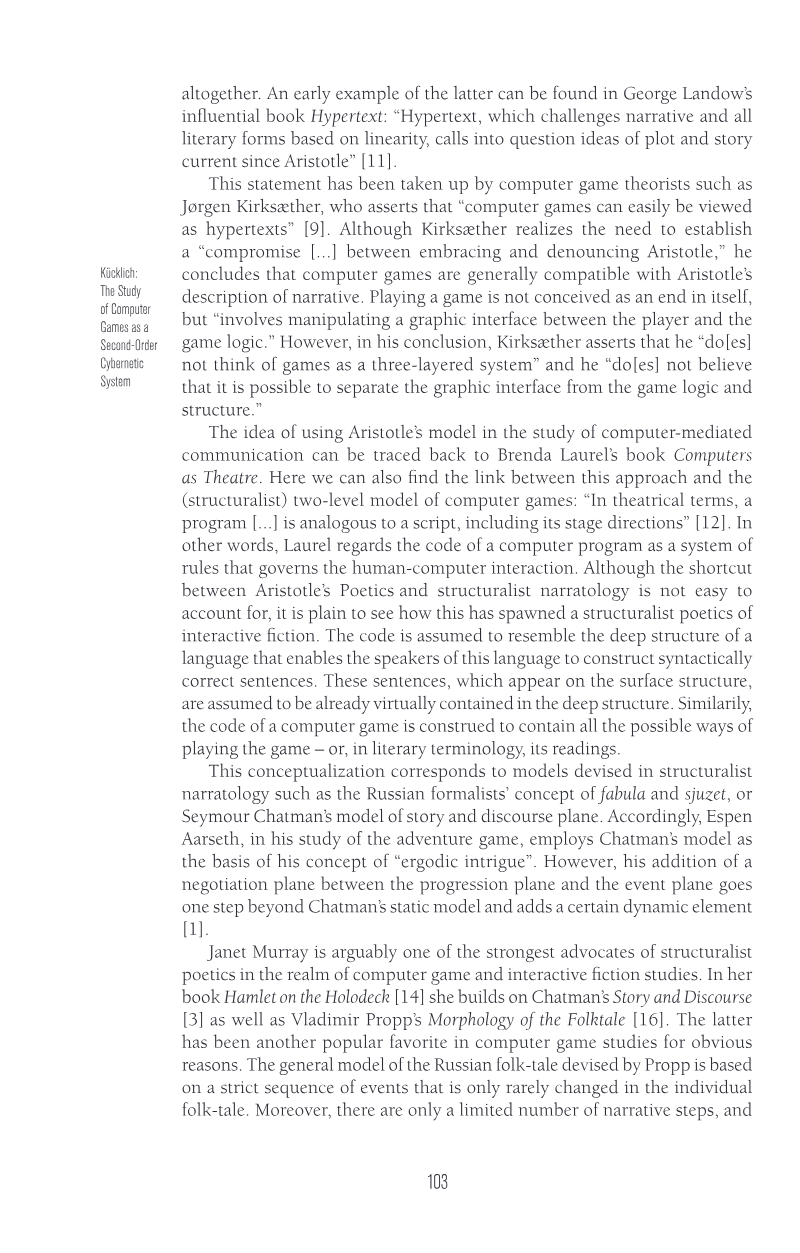
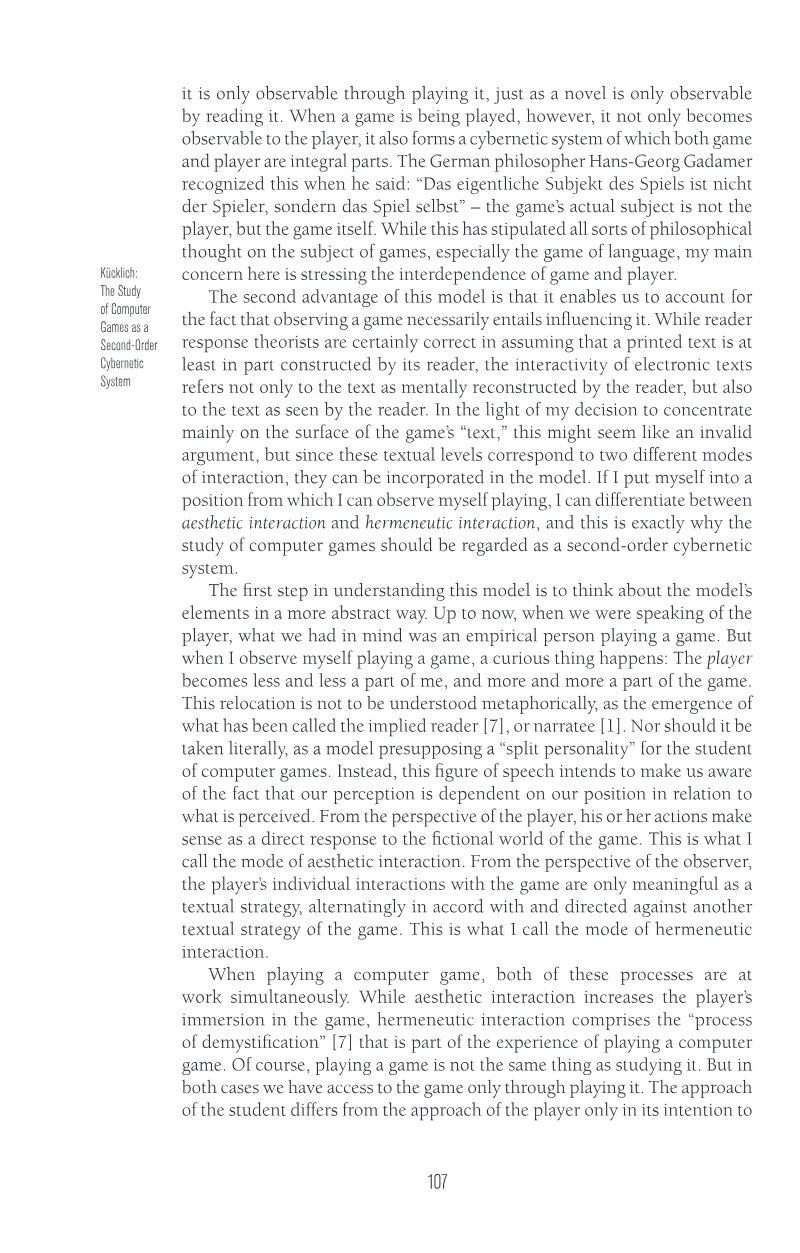
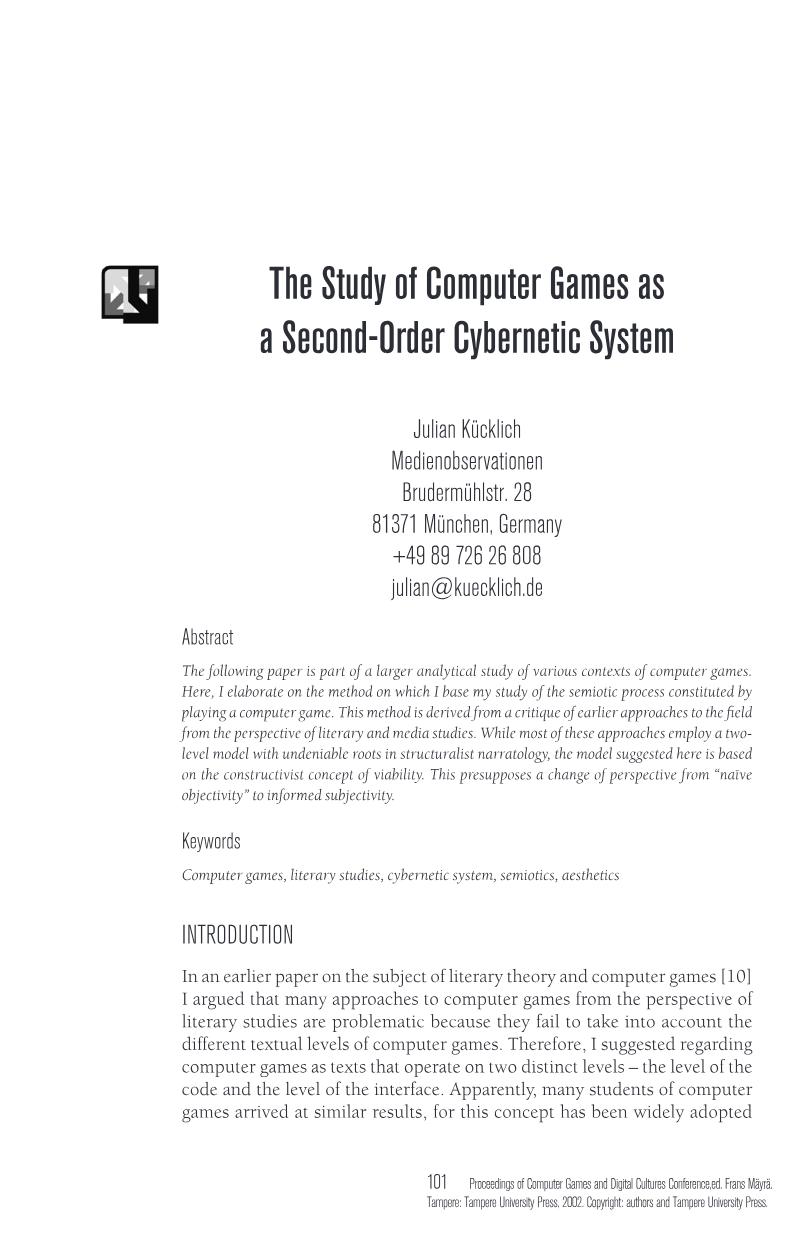
The Study of Computer Games as a Second-Order Cybernetic System
Kücklich's paper argues that the dominant literary and narratological approaches to computer games rest on a problematic two-level model of code and interface, inherited from Aristotelian and structuralist traditions.
- The paper argues that narratology should not be the governing discipline for game studies; games should instead be situated within ludic, representational, and media traditions.
- It proposes a constructivist, second-order cybernetic framework in which game and player form an interdependent whole, shifting focus from the underlying code to the player's experience of play.
- Interactivity and narrativity are treated as synergetic effects of semiosis rather than fixed properties of the software.
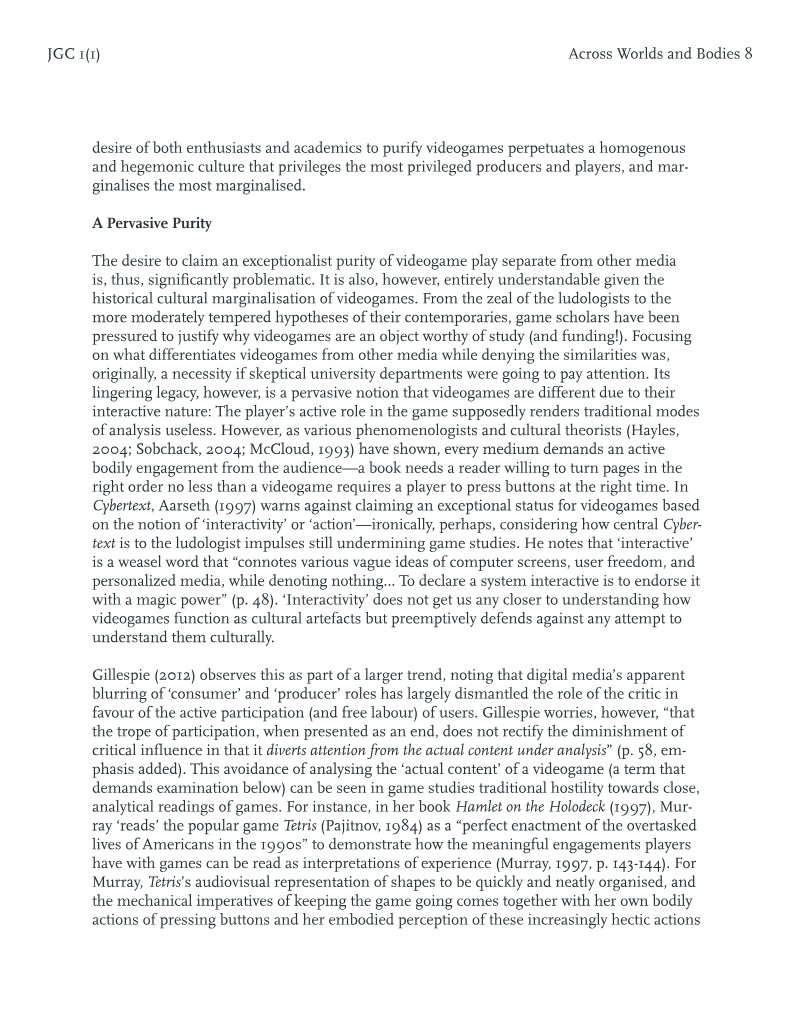
Across Worlds and Bodies: Criticism in the Age of Video Games
Academic game studies currently suffers from a restrictive purity complex that prioritizes formal, rule-based systems at the expense of the medium’s inherent complexity.
- Academic game studies should transition from rigid formalist analysis of rule-based systems to a phenomenological approach that views games as complex, hybrid assemblages.
- Traditional formalist criticism often relies on exclusionary, masculinist ideologies by attempting to isolate game mechanics from audiovisual representation.
- Video games should be analyzed as ergodic, cybernetic circuits where the player, hardware, and virtual content function as a single, inseparable entity.
Visualizing Game Studies: Materiality and Sociality from Chessboard to Circuit Board
This analysis examines the disciplinary genealogy of game studies, arguing that the field has historically struggled with an insular, fragmented identity.
- Game studies must shift its focus from analyzing games as representational texts to examining them as procedural instruments that actively shape social dynamics.
- The evolution of games from physical artifacts like chess to digital, code-based systems has transitioned their role from reflecting social dynamics to governing human behavior.
- Gamification has integrated game logic into public infrastructure, such as transit systems and traffic law enforcement, making game rules function as enforceable law.
Do You Feel Like a Hero Yet?: Externalized Morality in Video Games
Traditional video game morality systems frequently fail to facilitate genuine ethical reflection, instead reducing complex dilemmas to binary, utilitarian mechanics that prioritize ludic progression over meaningful choice.
- Traditional binary morality systems in games fail to foster ethical reflection by reducing complex dilemmas to utilitarian mechanics optimized for reward rather than genuine choice.
- Games that remove karma-based feedback loops, such as 'Papers, Please' and 'Spec Ops: The Line,' force players to confront the consequences of their actions without the comfort of programmed justifications.
- True moral weight in interactive media is achieved by stripping away the illusion of agency and implicating the player directly in the narrative outcomes of their decisions.
Red Dead Masculinity: Constructing a Conceptual Framework for Analyzing Video Game Narratives
Video game narratives function as powerful ideological conduits that shape player identity and social performance.
- Video games function as ideological conduits that shape player identity by facilitating the transfer of virtual worldviews into the player’s physical reality.
- The Western genre, specifically exemplified by Red Dead Redemption, utilizes gameplay rhythm and avatar identification to reinforce specific social performances.
- Red Dead Redemption constructs a 'revisionist' masculine ideal that frames government, technology, and corporate interests as inherently corrupt.
Imperialism in the Worlds and Mechanics of First-Person Shooters
First-person shooters function as significant cultural vectors for imperialist ideologies, systematically reinforcing Western geopolitical agendas through the mechanics of territorial conquest and the pacification of foreign environments.
- First-person shooters function as cultural vectors that reinforce imperialist ideologies by framing non-Western landscapes as hostile environments requiring Western intervention.
- The genre’s core gameplay loops rely on territorial conquest and the pacification of foreign spaces, which procedurally normalizes colonial expansion.
- FPS titles frequently utilize white savior narratives where players master indigenous tools and environments to impose order, sanitizing the real-world consequences of military violence.
Ludic Spolia in Sid Meier's Civilization: Beyond Earth
Ludic spolia serves as a critical framework for understanding the development and reception of Sid Meier’s Civilization: Beyond Earth.
- Sid Meier’s Civilization: Beyond Earth utilizes 'ludic spolia' by repurposing the engine, mechanics, and assets of Civilization V to create a modern architectural palimpsest.
- The transition from Civilization’s traditional linear technology trees to the non-linear technology webs in Beyond Earth represents a deliberate ideological shift away from deterministic progress models.
- By evolving the original series' barbarian and ideology systems into alien and affinity frameworks, the game challenges inherent Enlightenment-era biases and colonialist narratives.
Swipe Left to Detain: A Procedural Comparison Between Tinder and Papers, Please
Tinder and the border-control simulation Papers, Please function as persuasive machines that utilize identical procedural mechanics to shape user behavior and reinforce specific ideologies.
- Tinder and the game Papers, Please utilize identical procedural mechanics, such as lateral swiping and binary decision-making, to reduce complex human interactions into quantifiable, rule-based tasks.
- The design of modern dating applications mirrors the structures of oppressive bureaucracies by treating potential romantic partners as disposable, data-driven assets.
- High-speed, gamified decision-making in digital interfaces functions as a procedural rhetoric that obscures the moral consequences of social interactions.
Labour and Love: Play-Centrism and Procedurality in Spiritfarer
The tension between procedurality, which posits that meaning is embedded within a game’s formal rules, and play-centrism, which emphasizes the subjective role of the player, serves as a critical framework for understanding modern game design.
- Effective game design balances procedural rules, which provide necessary constraints, with play-centrism, which allows players to derive personal, emergent meaning from those structures.
- Procedurality and play-centrism should be treated as a symbiotic framework rather than contradictory forces, mirroring the human reconciliation of labor demands with selfhood.
- Spiritfarer demonstrates that repetitive, task-oriented labor can be reframed as acts of care when the game’s procedural framework is designed to facilitate emotional reflection.


The Kid in the Fridge: Sacrificial Children and Vengeful Masculinity in Contemporary Videogames
The sacrificial child trope in contemporary gaming serves as a critical narrative mechanism designed to justify hypermasculine, militarized violence.
- The 'sacrificial child' trope functions as a narrative device to justify hypermasculine, militarized violence by framing lethal actions as righteous, protective paternalism.
- Games like Assassin’s Creed: Odyssey and Origins utilize scripted child deaths to strip players of agency, redirecting resulting frustration into sanctioned, aggressive combat.
- By positioning vulnerable children as symbols of innocence that must be avenged, these narratives eliminate moral ambiguity and validate retaliatory, patriarchal power structures.
Theorizing Whiteness as a Proceduralized Ideology in Videogames
Proceduralized whiteness functions as a foundational ideology within video games, manifesting not merely through visual representation but through the core rules, mechanics, and goal structures that govern play.
- Game design often embeds Eurocentric and settler-colonial ideologies into core mechanics, normalizing extractive and expansionist behaviors as the default logic of play.
- Proceduralized whiteness functions as an invisible, foundational ideology in digital spaces by reinforcing dominant social norms through repetitive, automatic gameplay systems.
- Western role-playing games and 4X strategy titles, such as Civilization, Mass Effect, and The Oregon Trail, frequently equate progress with territorial conquest and resource accumulation.

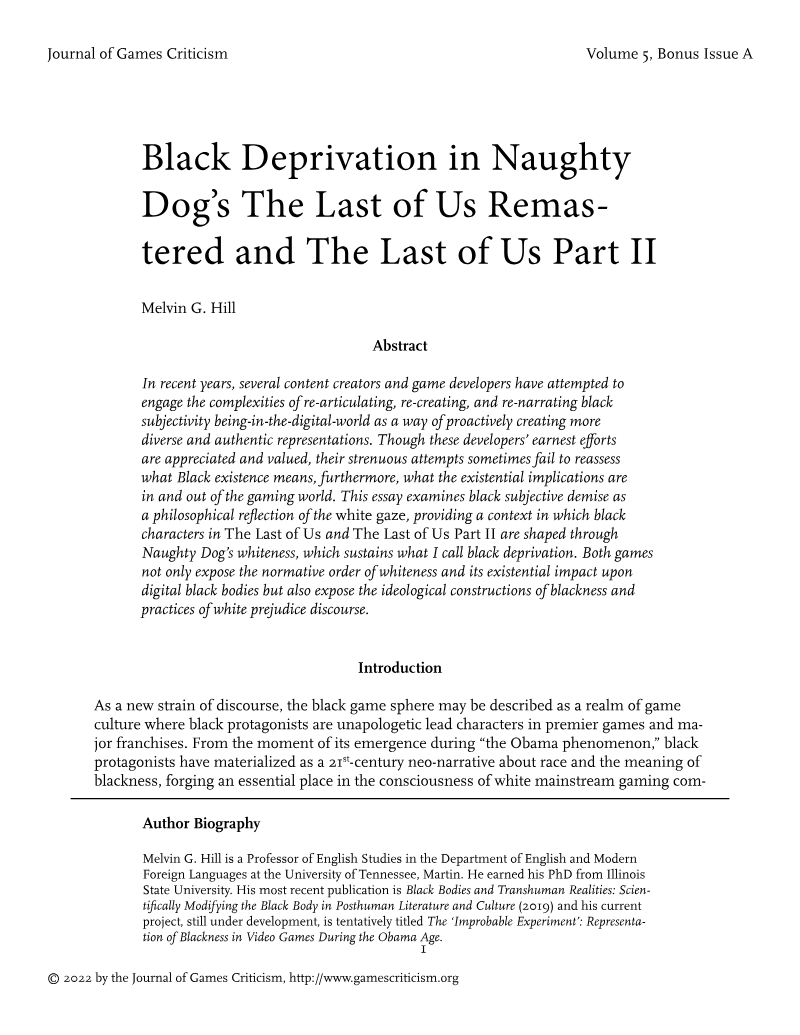
Black Deprivation in Naughty Dog's The Last of Us Remastered and The Last of Us Part II
Naughty Dog’s The Last of Us series functions through a framework of black deprivation, a narrative strategy that systematically relegates Black characters to disposable roles to ensure the existential longevity and emotional development of white protagonists.
- Naughty Dog’s The Last of Us series utilizes a narrative framework of 'black deprivation,' where Black characters are systematically relegated to disposable roles to facilitate the emotional development and survival of white protagonists.
- Characters such as Henry, Sam, Marlene, Nora, and Isaac are denied meaningful agency or long-term narrative arcs, functioning primarily as spectacles of death within the games' post-apocalyptic settings.
- The franchise’s reliance on tropes of nihilism and expendability for Black characters reinforces a racialized hierarchy that centers the white experience at the expense of autonomous Black representation.