Game Studies reports and market data
Documents
The Expert, The Novice, and The Skeptic: Game Literacy and Pedagogical Practice
This qualitative case study examines how teachers' video game literacy shapes their pedagogical use of The Walking Dead in an ethics course at a Norwegian high school.
- Operational literacy, the ability to play and interpret a game's mechanics and structure, strongly shaped how teachers navigated gameplay and identified its moral dilemmas in a Norwegian high school ethics course using The Walking Dead.
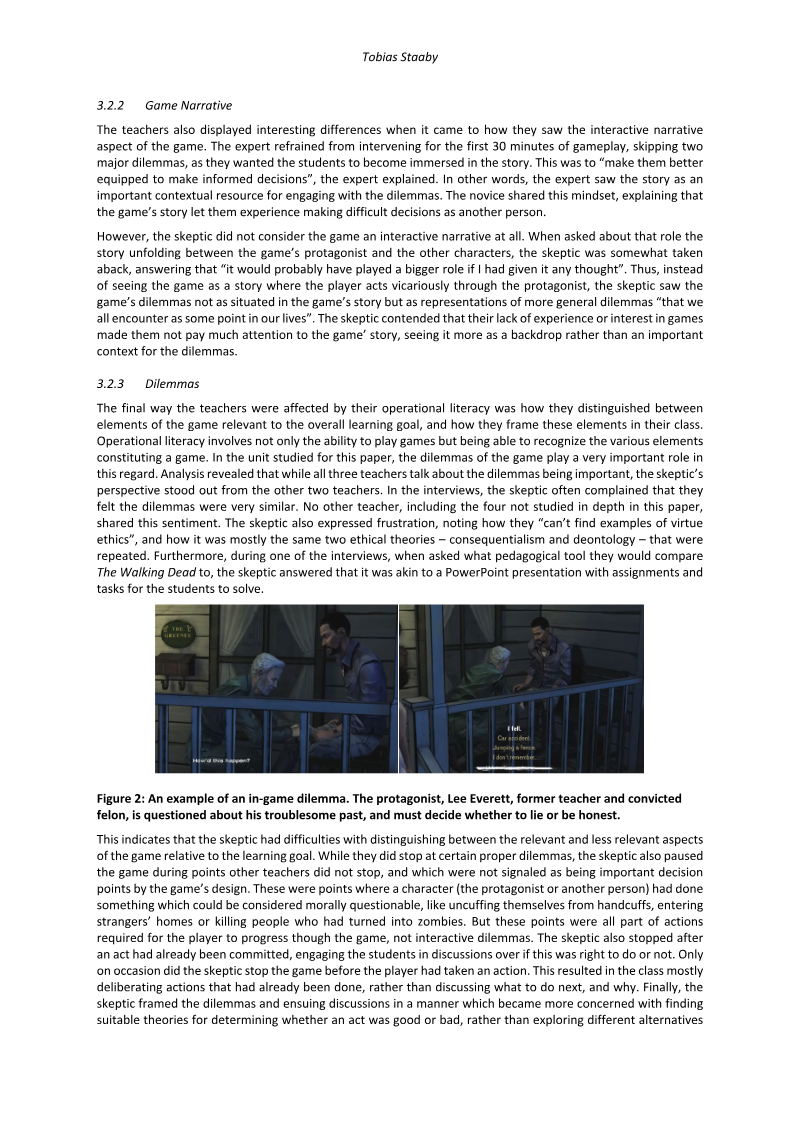
- The teacher with low operational literacy (the skeptic) treated the narrative as mere backdrop and struggled to separate pedagogically relevant decision points from routine, incidental actions.
- The skeptic tended to pause only after actions had already occurred and framed discussions around identifying ethical theories rather than exploring alternative choices.

The Genesis of Wuxia Gaming: Adaptation, Nationalism, Rebellion, and the Emergence of Early Gaming Communities in the Sinosphere
This study traces the origins of Wuxia video games in the Sinosphere, spanning mainland China, Hong Kong, and Taiwan, during the late 1980s and 1990s.
- Wuxia gaming in the Sinosphere is traced to Taiwan in 1986 and developed through the late 1980s and 1990s across mainland China, Hong Kong, and Taiwan, shaped heavily by Hong Kong Wuxia literature and martial arts cinema.
- Chinese-speaking developers chose the Wuxia genre deliberately, using localization and nationalism to differentiate their products from global competitors that entered the market earlier.
- The genre's cultural resonance came from the popularity of Wuxia novels and their film adaptations, and its themes of heroic ascension and scholarly ideals matched an early gaming community often viewed as elite and geek-centric.
Toward a History of Emulation: Five Eras for Videogame Emulators
This paper proposes a periodization of videogame emulator history, extending Sam Pettus's 2000 account to the present.
- The paper argues that scholarship on emulators has focused overwhelmingly on legality and preservation while neglecting their cultural influence and historiography, and proposes a five-era periodization extending Sam Pettus's 2000 account to the present.
- The five eras are the Dawn of Emulation (1964–1988), Golden Age (1989–1998), Silver Age (1999–2008), Bronze Age (2008–2024), and Modern Age (2024–present), each anchored to a pivotal event such as the 1964 IBM System/360 or the Nintendo vs. Yuzu case.
- Emulator development shifted from commercial hardware and bridge cards in the Dawn era, to a proliferation of short-lived hobbyist projects in the Golden Age, to an underground focus on refining existing emulators after legal takedowns in the Silver Age.

Immersion Attribution and Design Suggestions for Script Murder: A Game Studies Perspective
This paper examines the immersion of script murder (剧本杀), a Chinese tabletop role-playing and deduction game that became popular from around 2016, through the lens of game studies.
- Immersion in script murder (剧本杀) is driven by players' sense of agency, control, and connection, and players' avatar identification is multiple and fluid, shifting among real self, ideal self, virtual avatar, and hybrid avatar.
- The study used a grounded theory approach, coding semi-structured interviews with script murder players alongside analyses of specific game scripts and their interactive and audiovisual design; the sample size is not specified in the excerpt.
- Factors that foster immersion include guidance, props, music, room layout, performance, well-crafted icebreaker sessions, evidence-gathering formats, and short scenes.
The Promise of Love: Love Is All Around and Vulnerable Masculinity in China
This paper examines Love Is All Around, a 2023 Chinese dating-simulation game by Intiny that remediates the conventions of bishōjo games by replacing anime-style graphics with live-action first-person video and drawing on micro-dramas and YY fiction.
- Love Is All Around (2023), a Chinese dating-simulation game by Intiny, adapts bishōjo game conventions by replacing anime graphics with live-action first-person video and drawing on micro-dramas and YY fiction.
- The paper argues the game's appeal extends beyond bishōjo and otaku fandom, offering young Chinese male players a mediated space to process precarious employment, intimate frustration, and gendered anxiety.
- The author's central concept, the "promise of love," describes how the game eases a sense of vulnerable masculinity shaped by competitive achievement culture and post-feminist social conditions, since players can readily win affection within its fantasy structure.
Game Studies Scrimmage
The document is a panel proposal submitted to DiGRA, the Digital Games Research Association, for an experimental session titled "Game Studies Scrimmage."
- The document is a DiGRA panel proposal for an experimental session called "Game Studies Scrimmage," in which scholars play an unfamiliar game and give ten-minute analytical talks, aiming to test analytical agility and foster collaborative enjoyment.
- A randomly selected game would be chosen two to three weeks before the annual meeting in Guadalajara and must be completable within about 24 hours.
- A Discord server would be opened so researchers worldwide can participate, stream, and comment on the session.
Radical Digital Fishing: From Minigames to Bad Environmentalism
This paper examines digital fishing in video games through a posthumanist and ecocritical lens, arguing that fishing mechanics can expose and complicate the binaries that separate human society from the natural world.
- The paper argues that fishing mechanics in AAA games such as Red Dead Redemption 2 serve as a reflective counterpoint to neoliberal game temporalities, but tend to reproduce an idealized, escapist vision of nature that mirrors real-world angling attitudes.
- Drawing on social science research by Adrian Franklin and Jacob Bull, the paper characterizes angling as ambivalent: it can reinforce the modernist separation of humans and nature while also foregrounding embodiment and the materiality of water and flow.
- The paper proposes "radical digital fishing" as a category, reading Ridiculous Fishing through absurdist humor and irony and Dredge through a grotesque conflation of human subjectivity with the nonhuman waterscape, drawing on Jeff VanderMeer's concept of the new weird.
Big Brother Meets Joystick: Ethical Perspectives on Surveillance Imagery in Digital Games
This paper examines how surveillance is depicted in digital games and evaluates those depictions from an ethical and epistemological standpoint.
- Games shape players' imaginaries of surveillance, and their depictions, both visual and mechanical, can either normalize questionable monitoring practices or make distributed surveillance visible and open to critical reflection.
- The authors propose a two-dimensional framework for analyzing surveillance in games: visual aesthetics (e.g., eye-in-the-sky cameras, scan lines and glitches, blue/green overlays and binary code) and ludic, rule-based embedding.
- Many games, including some ostensibly critical of surveillance, reward players for hacking cameras or data mining in consequence-free minigames, which can create a false sense of empowerment.
Gaming the Future: How Games Help Us Play What's to Come
This paper argues that science fiction videogames can serve as critical tools for examining technology's social and ethical implications, rather than merely providing aesthetic backdrops.
- The paper argues science fiction videogames can serve as critical tools for examining technology's social and ethical implications, not merely as aesthetic backdrops, drawing on Cameron Kunzelman's concept of "mechanics of speculation."
- Speculative play works best when player action is necessary and outcomes remain uncertain, turning games into virtual playgrounds where players imagine alternative futures and confront the consequences of technological change.
- The study contrasts escapist SF titles such as the Mass Effect series, Starfield, and Titanfall, which treat advanced technology as set dressing, with newer games that foreground contested technologies like artificial intelligence, biotechnology, and brain-computer interfaces.
Cursed: A Ludic Genealogy of the Myth of El Dorado
This paper offers a critical genealogy of the El Dorado myth as it has been remediated across board and video games, drawing on Foucault's approach to history as a series of interpretations shaped by power.
- The paper applies Foucault's view of history as power-shaped interpretation, using interaction criticism to trace how the El Dorado legend was reshaped by Spanish and Indigenous storytellers and later by contemporary tomb-raiding games.
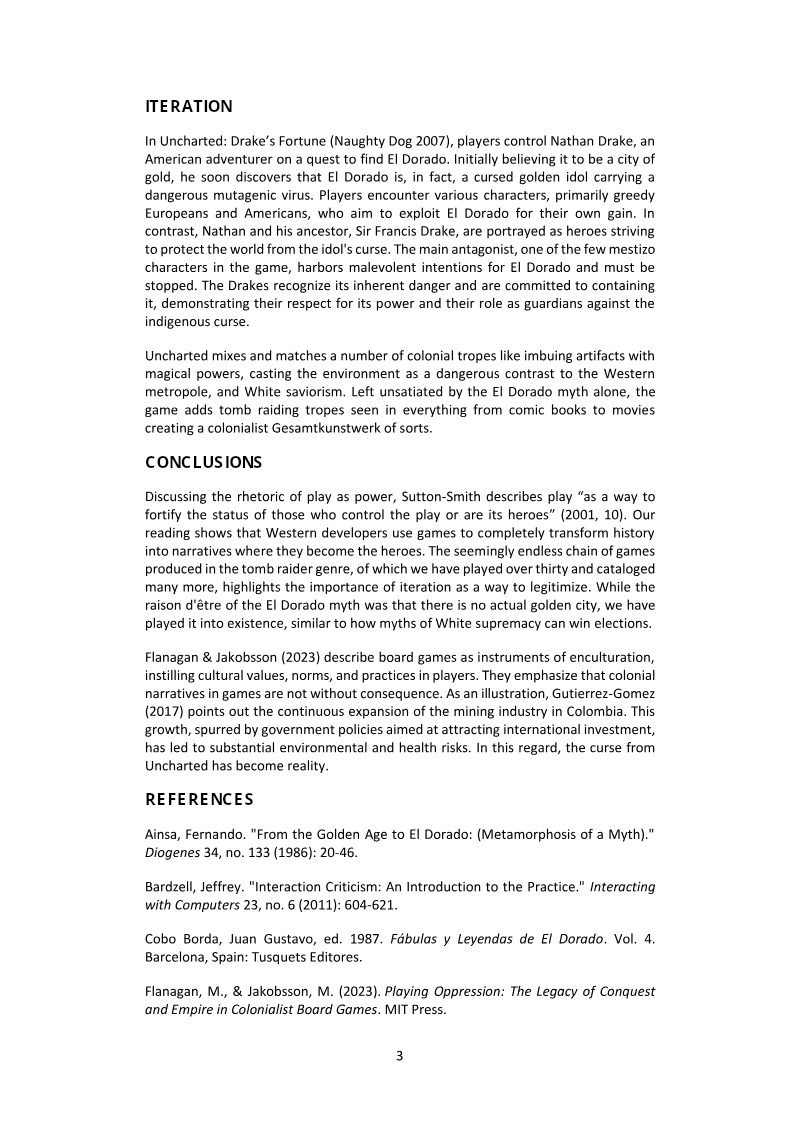
- Close readings of The Quest for El Dorado and Uncharted: Drake's Fortune argue that games carry forward colonial assumptions, presenting El Dorado as a winnable city of gold and framing Western actors as heroes despite appearing to be neutral entertainment.
- The board game is criticized for casting predominantly White expert characters and for treating Colombia's sovereignty as irrelevant to the expedition's claim on the riches.
1-Bit Skin: Materializing Abjection in World of Horror (2023)
This extended abstract, presented at DiGRA 2024, proposes an interdisciplinary study of how the videogame World of Horror (Ysbyrd Games, released October 2023) materializes abjection, drawing on Julia Kristeva's theory from Powers of Horror (1980).
- The paper is a DiGRA 2024 proposal-stage abstract analysing World of Horror (Ysbyrd Games, released October 2023) through Julia Kristeva's theory of abjection from Powers of Horror (1980).
- Its central argument is that videogames, unlike film or text, let players interact with grotesque imagery rather than merely react to it, and that this interactivity reshapes the experience of the abject.
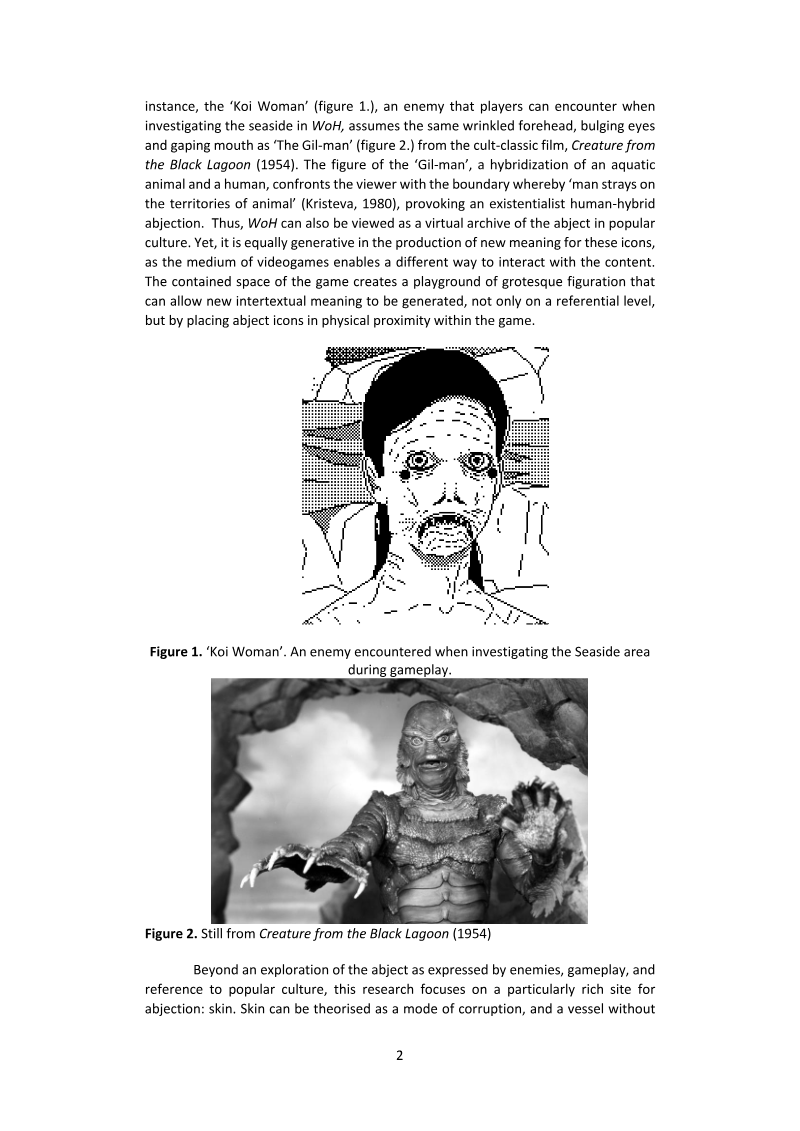
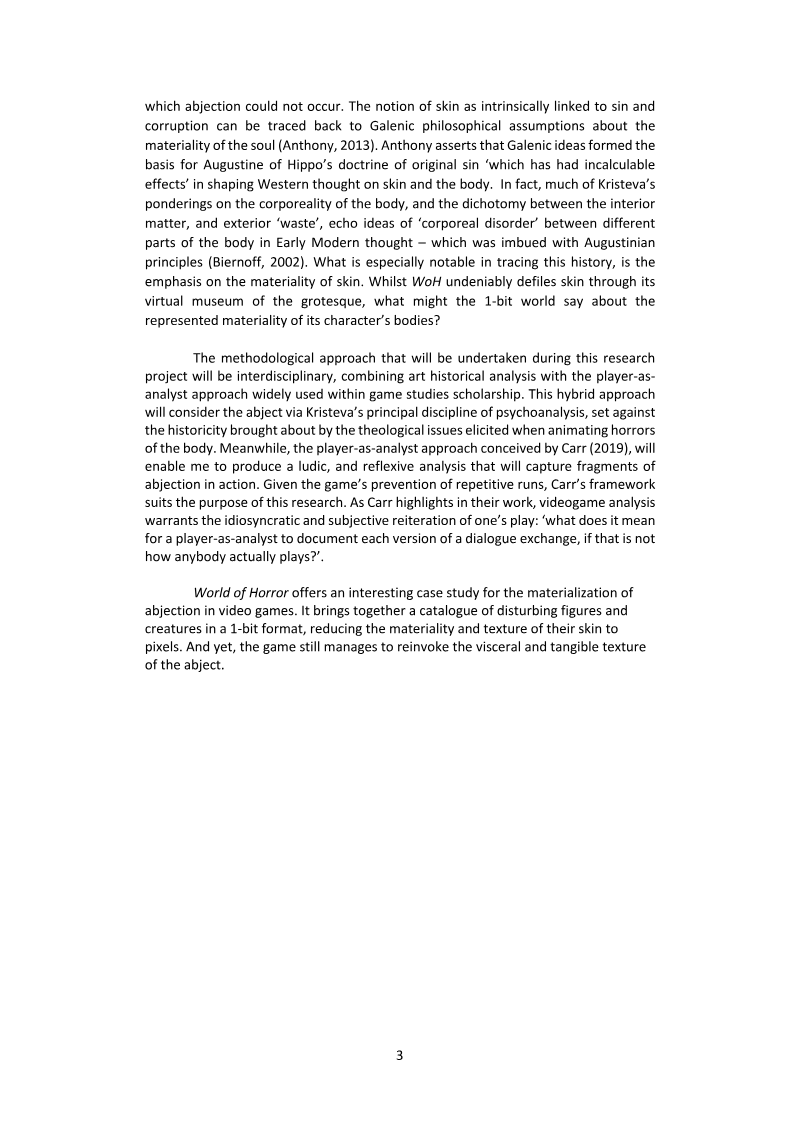
- The author treats the game as a virtual archive of cosmic and body-horror references, including Junji Ito, H.P. Lovecraft, and the 1954 film Creature from the Black Lagoon, where these icons gain new meaning through proximity.
Order in Chaos: Toward a Theory of Videoludic Noise
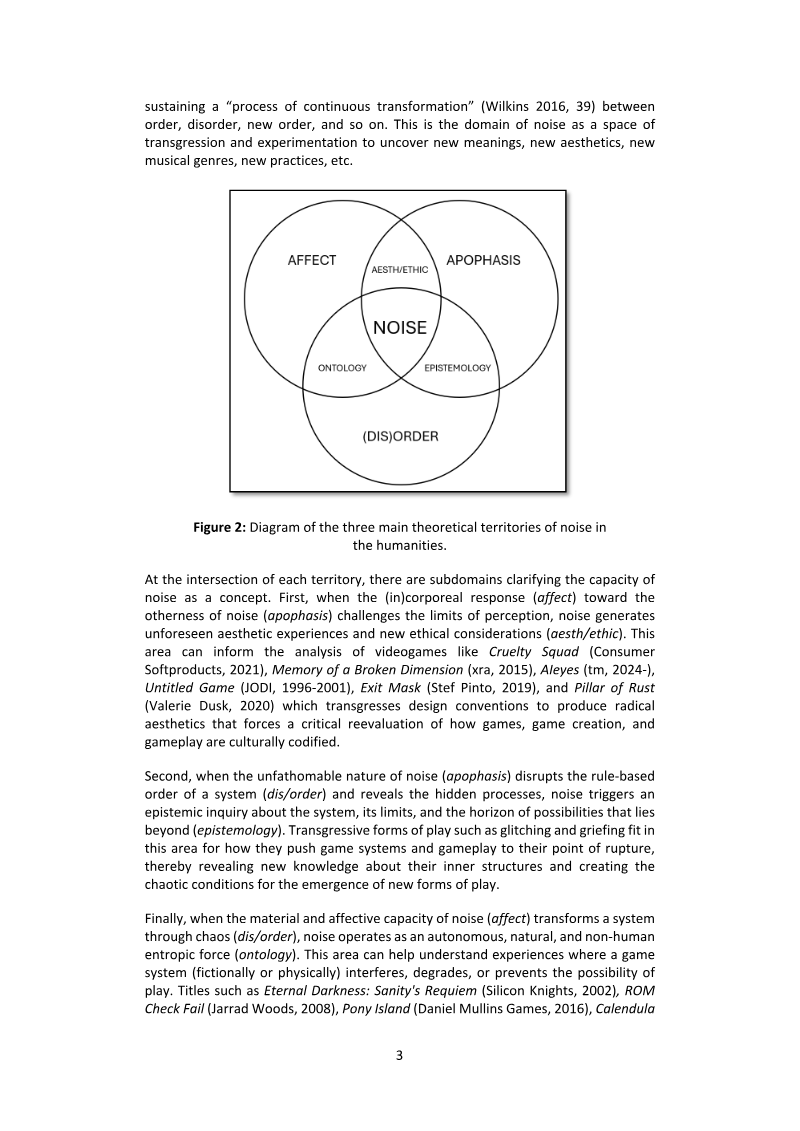
This paper proposes a theoretical framework for understanding "noise" within video game studies, arguing that the field has only begun to engage with a concept that has long been central to information theory and the humanities.
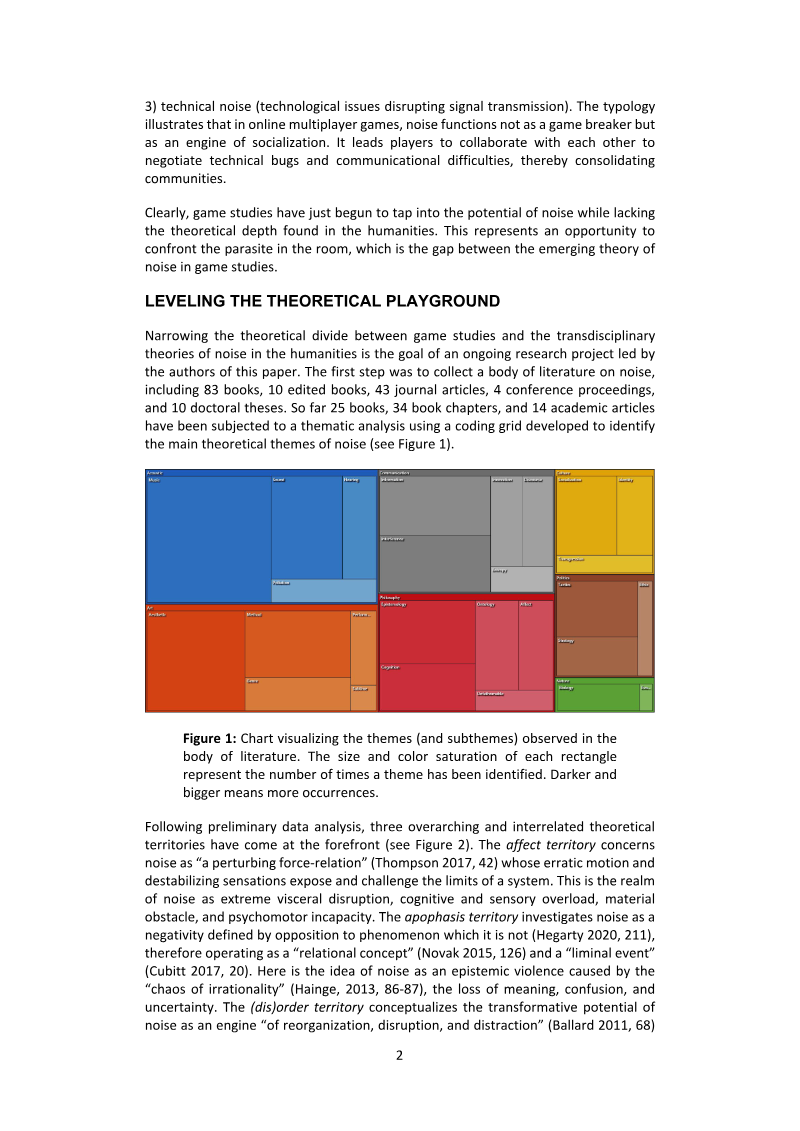
- The paper argues that 'noise' in video games should be treated as a productive analytical category that can generate new knowledge about games, play, and game culture, rather than merely as a technical error or game-breaking nuisance.
- The authors aim to bridge emerging game-studies discussions of noise, such as Salen and Zimmerman's treatment of chaos within rule systems and Consalvo's typology of cultural, semantic, and technical noise in online multiplayer spaces, with more developed transdisciplinary theories from media, sound, film, and philosophical scholarship.
- The research is based on a corpus of 83 books, 10 edited volumes, 43 journal articles, 4 conference proceedings, and 10 doctoral theses, of which 25 books, 34 book chapters, and 14 academic articles were thematically coded.