Game Development reports and market data
Documents


Mobile Audio Technology: Report and Recommendations
The mobile audio industry faces significant operational challenges due to extreme market fragmentation, characterized by the existence of over 50 file formats and 400 distinct device implementations.
- The mobile audio industry is hindered by extreme fragmentation, involving over 50 file formats and 400 distinct device implementations that inflate development and quality assurance costs.
- To achieve cross-platform interoperability, the industry must transition to non-proprietary standards, specifically adopting SP-MIDI, General MIDI, and the XMF format.
- Standardizing APIs such as JSR-234 and OpenSL ES is essential to provide developers with consistent access to advanced features like Digital Signal Processing and 3D audio.
Visiting the Floating World: Tracing a Cultural History of Games Through Japan and America
Mia Consalvo's paper proposes a framework for understanding the relationships among Japanese and American games, visual styles, and cultural influence, drawing on a broader cultural history of Japan and America and critically examining the application of Orientalism to digital games.
- Consalvo argues Japanese cultural influence on the West has a longer history than recent media scholarship acknowledges, and that digital games' transnational flows and Japanese corporate power cannot be understood through simple East-West binaries.
- The paper draws parallels between art history and games, showing how Japanese art, porcelain, and fans became popular in Europe and America through mass production, dealer and collector influence, World Fairs such as the 1876 Centennial Exposition, and borrowing by Western painters like the Impressionists and John La Farge.
- Nintendo's cautious localization strategy after the 1983 crash is presented as having shaped what Western audiences came to see as acceptable games.

Real-Time Sweetspot: The Multiple Meanings of Game Company Playtests
This paper examines how game companies use playtesting, focusing on a single "Sweetspot" balancing test conducted in March 2006 for a real-time strategy game at a medium-sized Swedish studio, part of an international entertainment conglomerate.
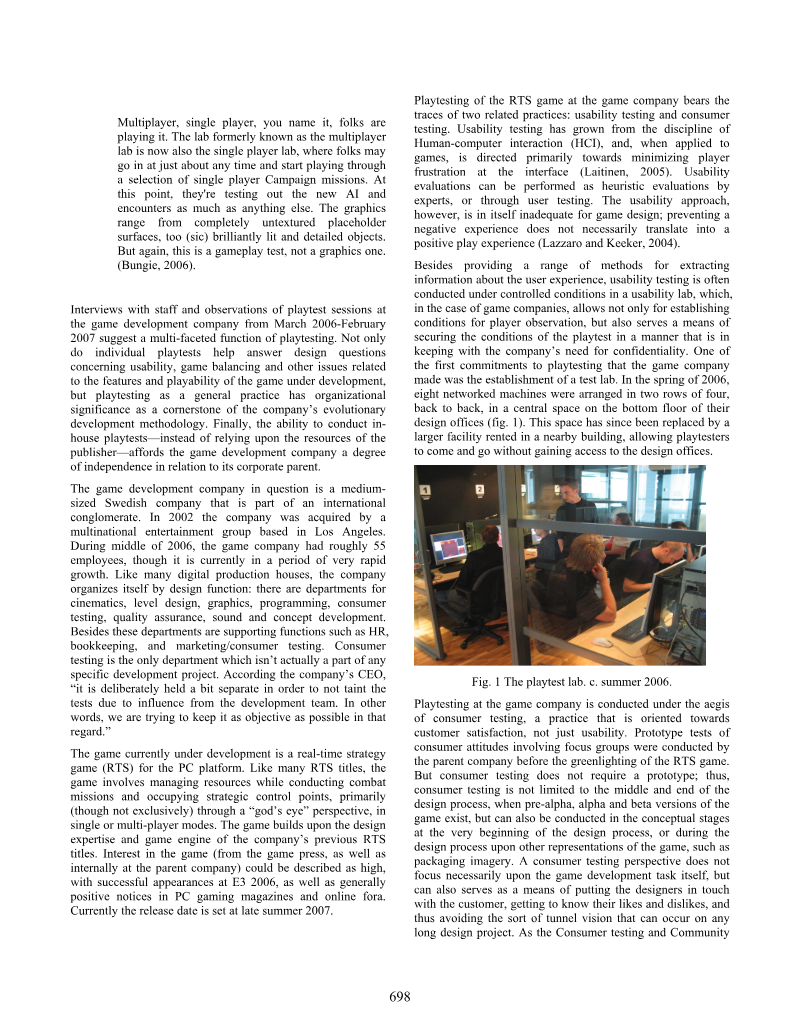
- The paper examines a single 'Sweetspot' balancing playtest conducted in March 2006 for a real-time strategy game at a medium-sized Swedish studio owned by an international entertainment conglomerate, based on interviews and observations from March 2006 to February 2007.
- Playtesting serves more than design iteration: inside the company it creates clarity in an evolutionary, biweekly build-based process, and outside it communicates project status to the publisher and parent company.
- In the Sweetspot test, eight playtesters rated four builds varying unit hit points and reinforcement tempo, and the lead designer implemented changes overnight, with the next build confirming the balancing decision.
Virtual Worlds and Fraud: Approaching Cybersecurity in Massively Multiplayer Online Games
Virtual Worlds and Fraud examines the emerging security threat posed by fraud in massively multiplayer online games (MMOGs).
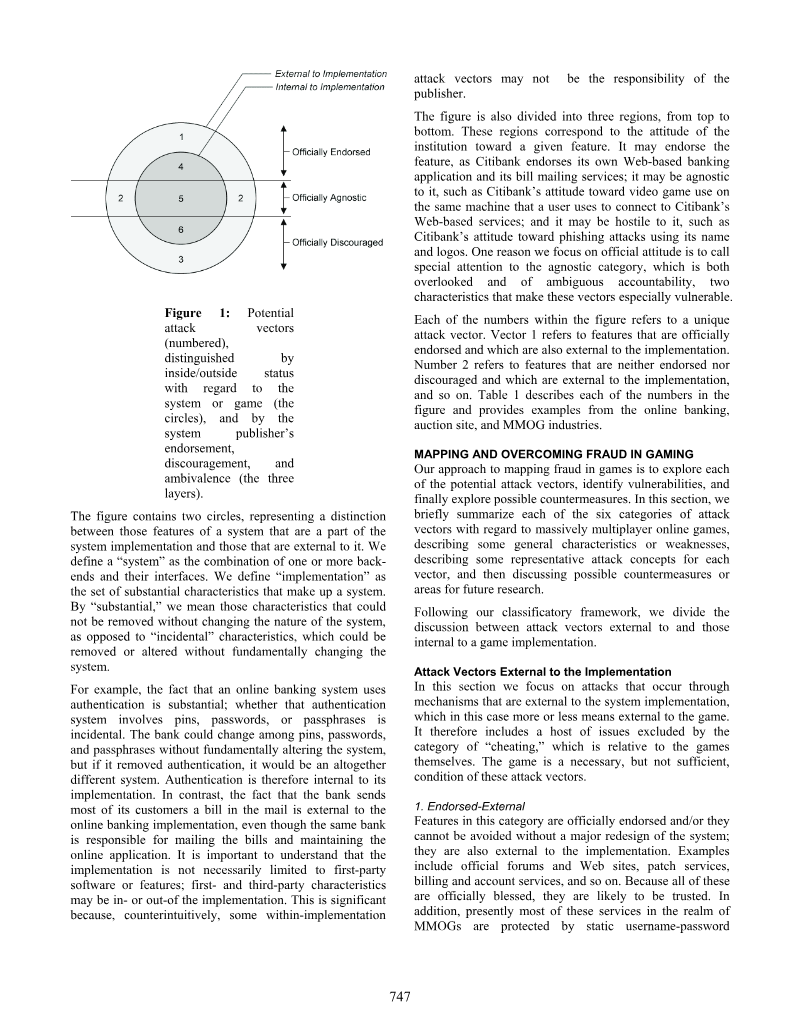
- Fraud in massively multiplayer online games is emerging as a security threat because the monetization of virtual possessions and growing product placement are pulling conventional online fraud (phishing, click-fraud, impression fraud) into game environments.
- Game scripts and modifications can serve as vehicles for malware and spam, making game content itself a potential attack channel.
- The authors argue that MMOGs are a distinct security domain, since their rule complexity and social features set them apart from earlier cheating research, which focused narrowly on cheating (taxonomies, bot detection, lag exploitation, player ranking).
The State of the Art: Western Modes of Videogame Production
Western videogame production has long been defined by a close entanglement between the making and the playing of games, and this study argues that the boundary between producer and consumer has grown increasingly porous over the industry's history.
- The study traces the producer-consumer boundary in Western videogame production from Atari's founding in 1972 through the UK home-computer boom of the early 1980s, arguing that the line between making and playing games has grown increasingly porous.
- Atari's loosely managed, Fordist-influenced production gave way to home consoles that moved play into private space, while Spectrum-era bedroom coding and cassette copying fostered a more integrated relationship between creators and players.
- Interviews with eleven industry professionals conducted in 2006 indicate that development is increasingly governed by market research, licensing arrangements, and consumer demand rather than purely creative or technical possibility, with long working hours and globally distributed teams common.
Because Players Pay: The Business Model Influence on MMOG Design
This paper examines how business models shape the design of Massively Multiplayer Online Games (MMOGs), arguing that the economic structure of a game directly or indirectly constrains its design choices.
- In MMOGs, the business model is not a secondary concern because large upfront investment and continuous operating costs (server infrastructure, game masters, community support) make economic structure a fundamental design constraint.
- Financial risk pushes MMOG producers toward cloning proven successful titles, which limits innovation in the genre.
- Subscription-based MMOGs such as World of Warcraft and Star Wars Galaxies typically charge US$10 to US$15 per month, and their revenue depends on sustained player engagement, giving players considerable leverage over producers.

The Quest in a Generated World
This paper presents a method for generating quests within procedurally generated three-dimensional game worlds, arguing that procedural content creation alone lacks the context necessary to make game spaces meaningful.
- Procedural world generation requires quest structures—defined by setting, space, challenge, and goal—to provide meaningful context and player direction.
- The Charbitat prototype, built on the Unreal Tournament 2004 engine, utilizes a graph-based analysis to integrate key-and-lock puzzles into infinite, procedurally generated 3D environments.
- World generation relies on an incremental construction method that scores candidate tile configurations using approximately twelve distinct design evaluators.
Recognizing New Literacies: Teachers and Students Negotiating the Creation of Video Games in School
This paper reports initial findings from the first year of a three-year ethnographic study examining how video game creation functions as a learning and literacy practice in secondary school classrooms.
- Video game creation is framed as a sophisticated learning and literacy practice that schools should recognize as valuable rather than dismiss as distraction, drawing on new literacies theory that treats digital and multimodal texts as part of literacy.
- The study is an exploratory, first-year qualitative ethnography at one large high school in Western Canada, with two technology teachers using Kid's Programming Language (Grades 11-12) and Game Maker (Grades 9-10), so its findings are not generalizable.
- Data came from several weeks of classroom observation, interviews with nine students and two teachers, and stimulated-recall sessions in which students explained their reasoning while watching recordings of their own work, analyzed in NVivo.
Please Biofeed the Zombies: Enhancing the Gameplay and Display of a Horror Game Using Biofeedback
This paper, presented at a 2007 DiGRA conference, explores whether low-cost biometric sensing can personalize the emotional experience of a video game without altering its core design.
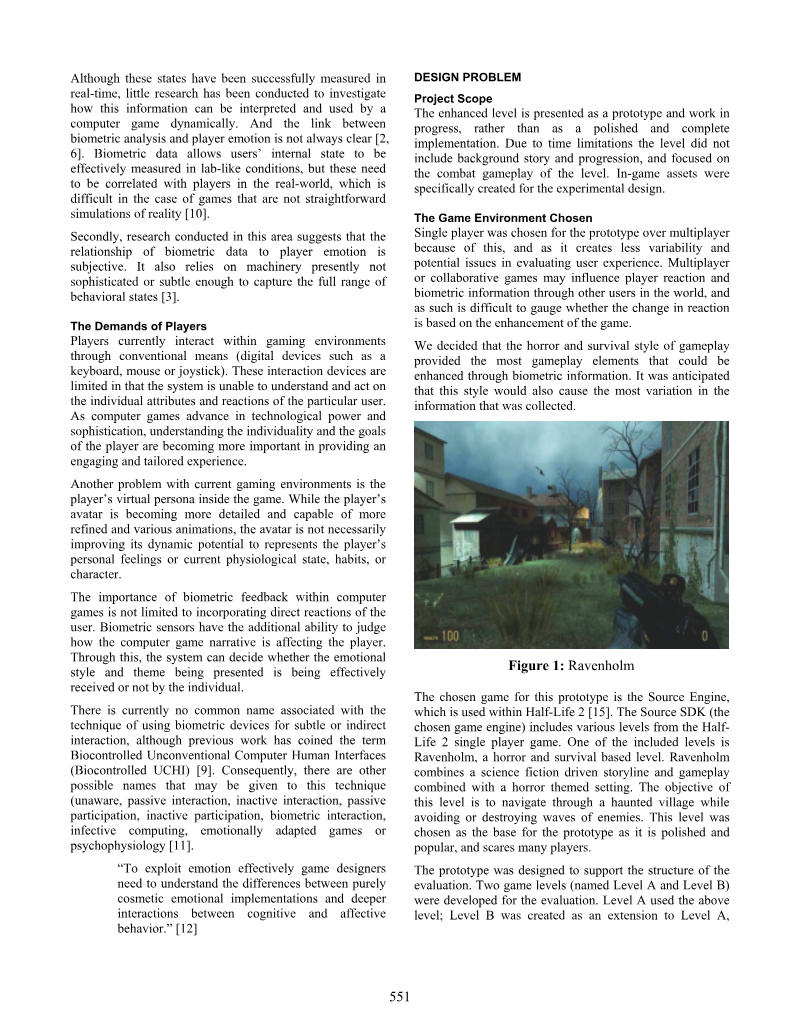
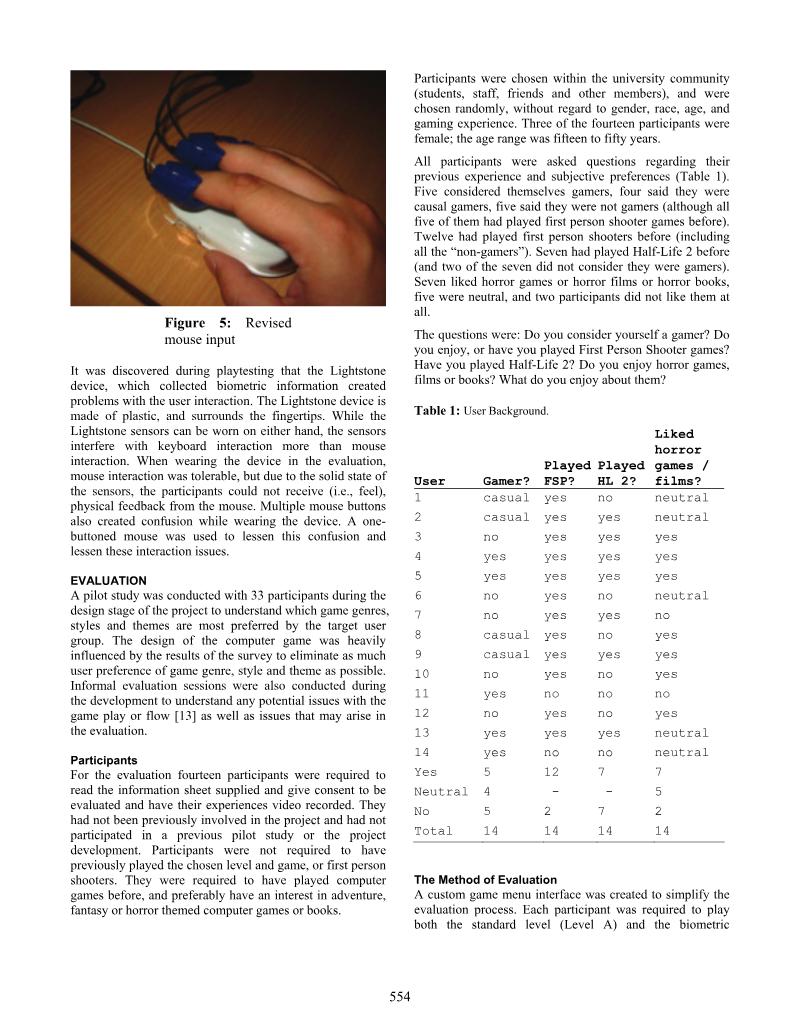
- The authors adapted the sub-$200 Wild Divine Lightstone, which measures heart rate variability and galvanic skin response, to dynamically scale horror elements (shaders, screen shake, enemy spawning, movement speed, weapon damage) in the Ravenholm zombie level of Half-Life 2 via the Source engine, using multipliers relative to each player's calibration baseline smoothed over two-second intervals.
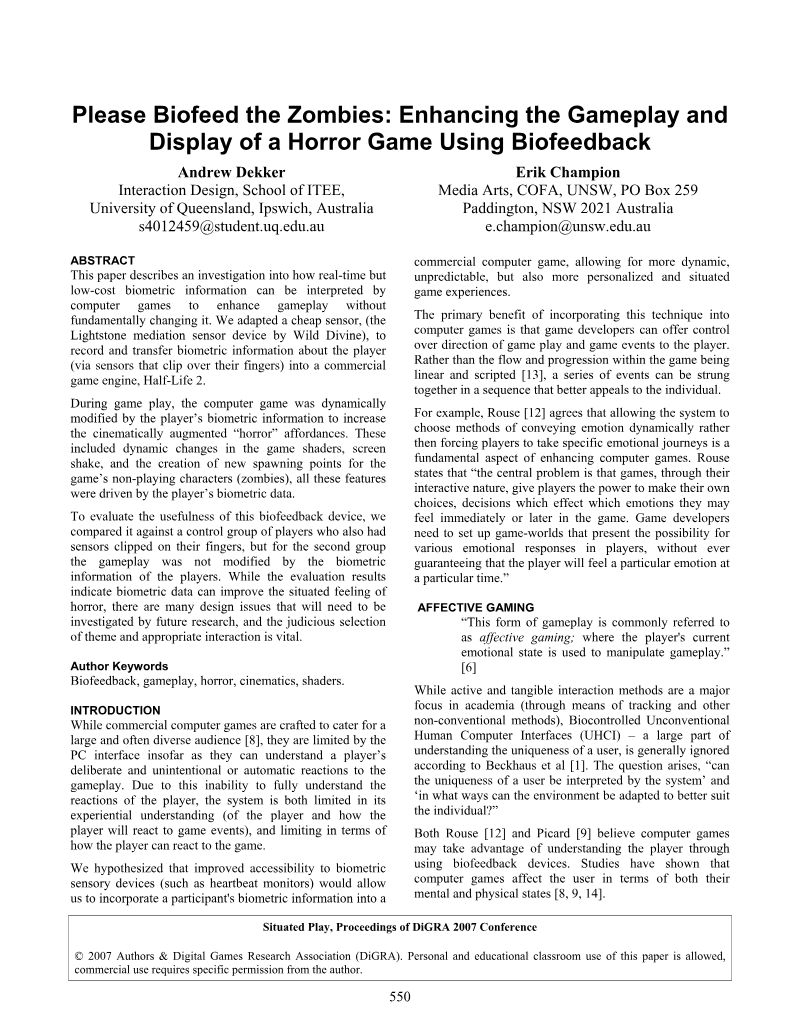
- In a 14-participant user study (mostly university-recruited, only three women), 9 of 14 players preferred the biometrically enhanced version of the zombie level, and 11 believed biometric information could make games more engaging.
- Engagement benefits depended heavily on prior enjoyment of horror games: the authors conclude biometric enhancement can deepen engagement for genre-receptive players while potentially diminishing it for others.
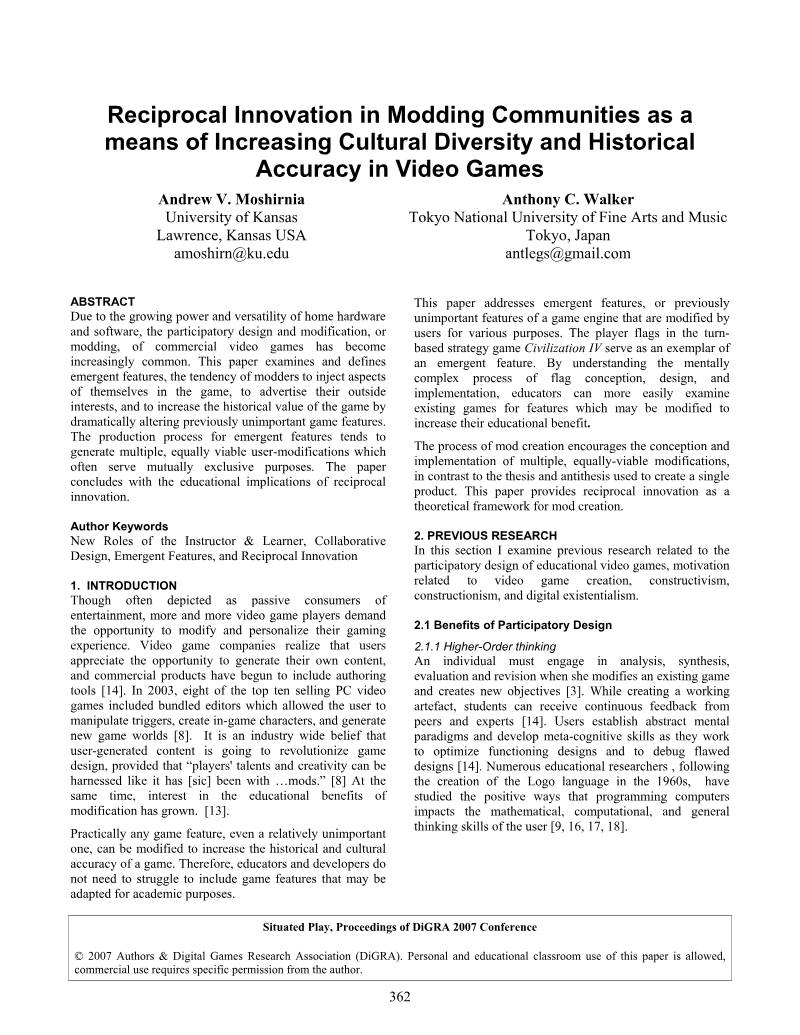
Reciprocal Innovation in Modding Communities as a Means of Increasing Cultural Diversity and Historical Accuracy in Video Games
This paper proposes "reciprocal innovation" as a theoretical framework for understanding how modding communities generate educational and cultural value from commercial video games.
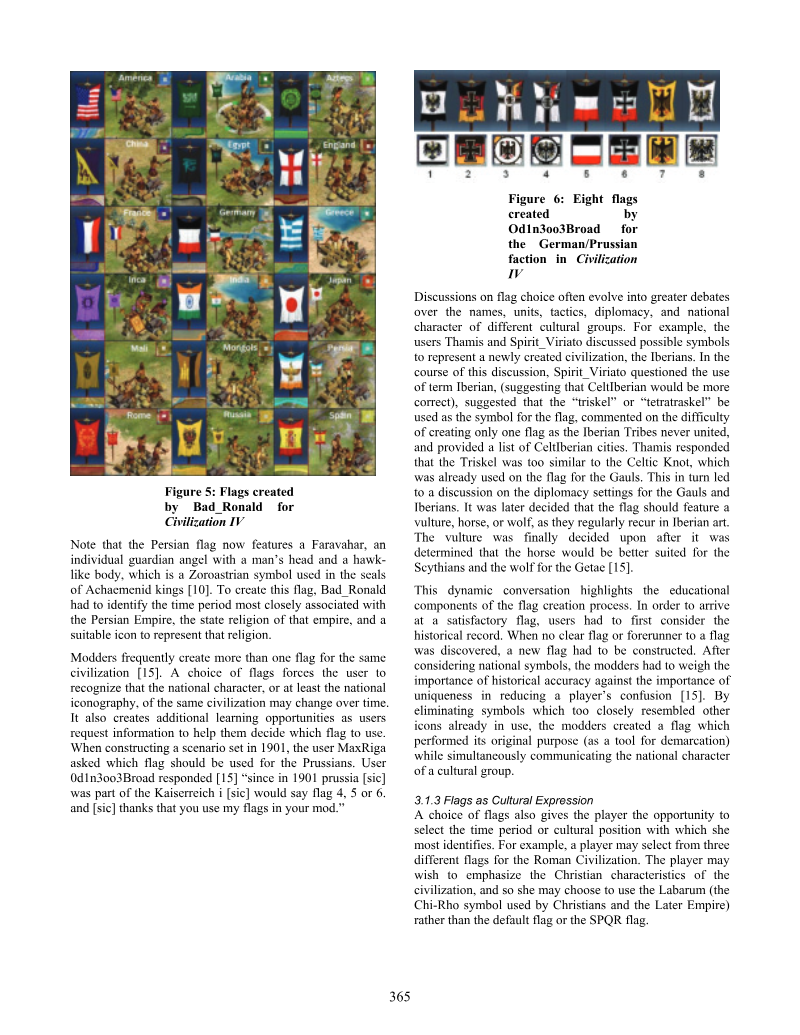
- Modders often repurpose seemingly minor 'emergent features' of a game engine, such as player-generated flags in Civilization IV, into vehicles for historical accuracy, cultural expression, and self-representation.
- The authors propose 'reciprocal innovation' as a framework in which one modification branches into multiple, sometimes contradictory uses determined by individual modders rather than a fixed hierarchy.
- Flag-redesign examples for the Persian, Roman, Chinese, American, and Iberian civilizations required modders to research imperial colors, religious iconography, and national symbols, illustrating how modding drives historical research.

Survey of the Adjourned Sale Rate of the Japanese Home Video Game Industry
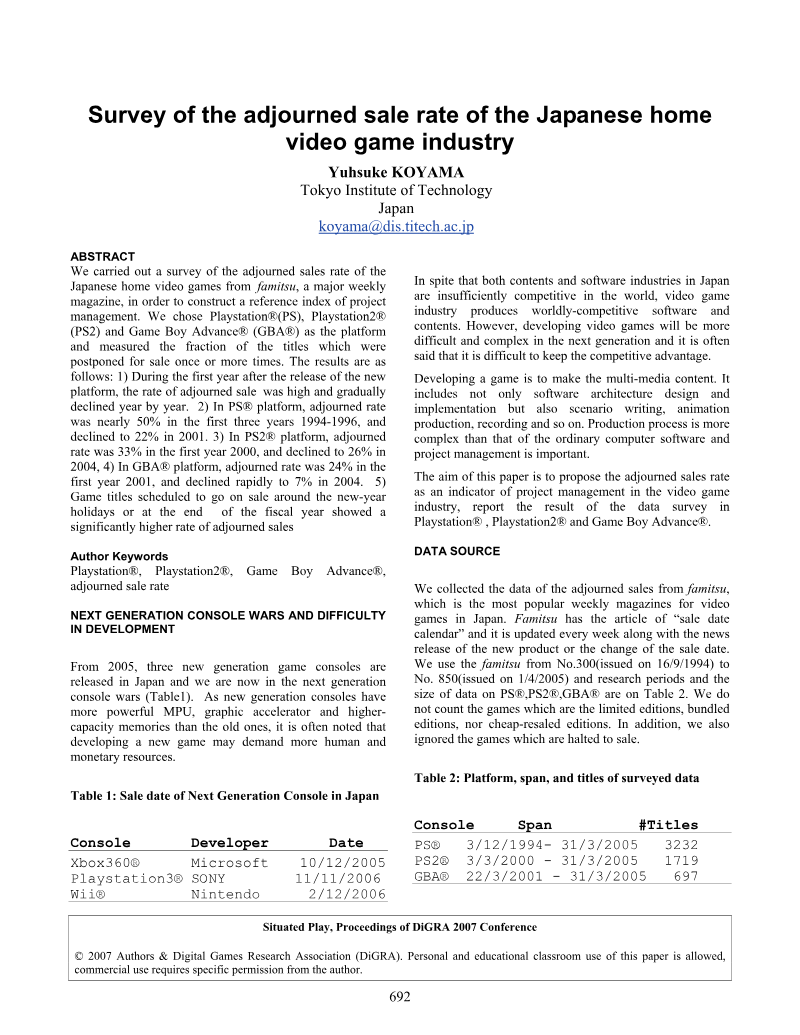
This study by Yuhsuke Koyama of the Tokyo Institute of Technology examines the adjourned sale rate of Japanese home video games, defined as the share of titles whose release was postponed at least once, with the aim of establishing it as an indicator of project management in the industry.
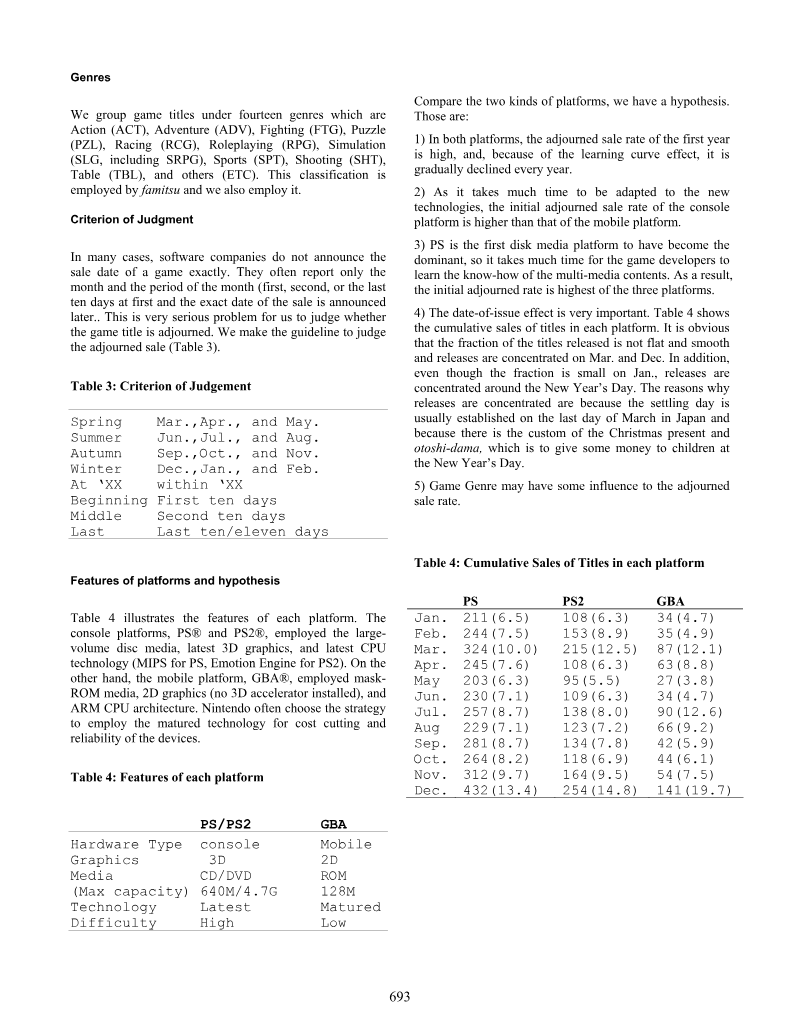
- Adjournment rates (titles whose release was postponed at least once) were highest in each platform's first year and declined steadily afterward, consistent with a learning-curve effect in project management.
- Sony's PlayStation started near 50% adjournment in its early years and fell to about 22% by 2001, while PlayStation 2 began at roughly 33% in 2000 and reached 26% by 2004.
- Nintendo's Game Boy Advance started at about 24% in 2001 and dropped sharply to around 7% by 2004, the steepest decline among the three platforms studied.
The Spontaneous Playfulness of Creativity: Lessons from Interactive Theatre for Digital Games
This paper argues that the practices and theories of improvisational and activist theatre can enrich digital game design by introducing spontaneous, playful creativity into how developers conceive characters, relationships, social issues, and gameplay.
- The paper argues that improvisational and activist theatre methods can introduce spontaneous, playful creativity into digital game design, shifting developers away from a sole focus on technical topics like facial rendering and AI agents.
- It proposes adapting Uta Hagen's character analysis questions and Stanislavski-inspired "inside out" development to build digital characters from the inside rather than from surface traits.
- It applies Chris Crawford's arithmetic formulation of relationship motivation, along with Keith Johnstone's status-tower and "Lists" exercises, to construct relationship dynamics and generate first-instinct game ideas.