1 free read left. Create a free account for unlimited reading + AI research.
Create free accountWhitepaper DiGRA
1 free read left. Create a free account for unlimited reading + AI research.
Create free accountWhitepaperDiGRA
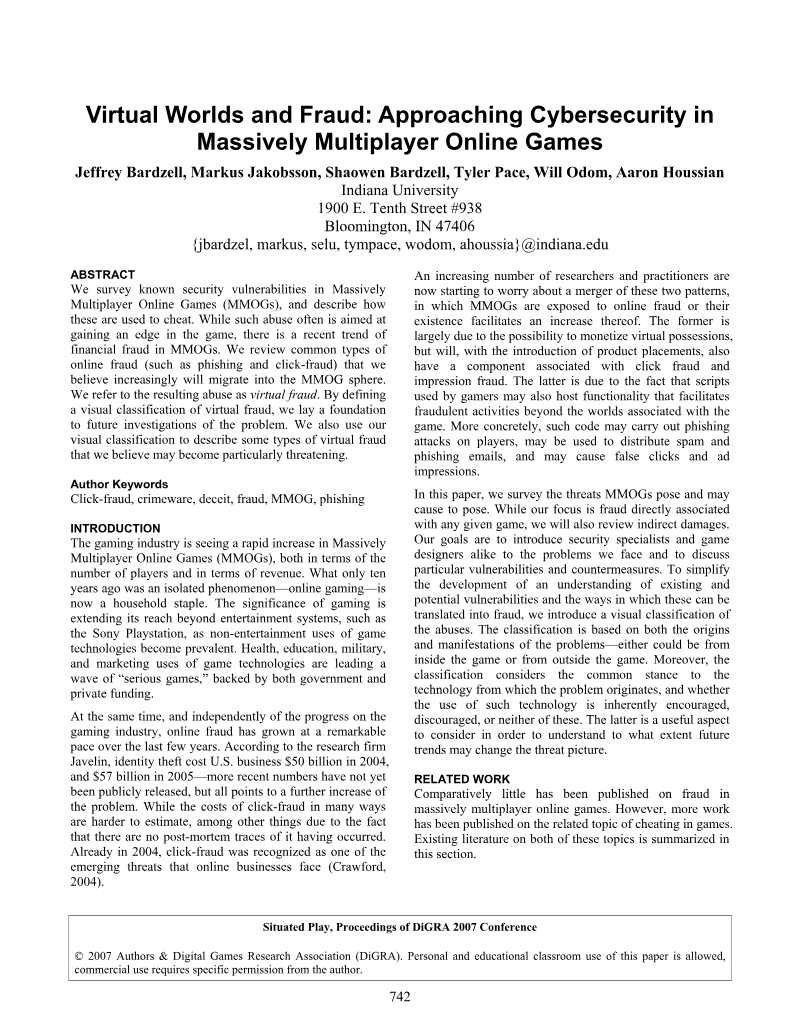
The paper argues that monetized virtual possessions and growing product placement are drawing phishing, click-fraud, and impression fraud into game environments.
Virtual Worlds and Fraud examines the emerging security threat posed by fraud in massively multiplayer online games (MMOGs). Its central argument is that the monetization of virtual possessions and the growing presence of product placement are drawing conventional online fraud, including phishing, click-fraud, and impression fraud, into game environments. The authors point out that game scripts and modifications can serve as vehicles for malware and spam, and they cite identity theft losses in the United States of $50 billion in 2004 and $57 billion in 2005 to underscore the scale of the broader problem. Prior research on cheating in games, including cheating taxonomies, bot detection, lag exploitation, and player ranking systems, is reviewed as a foundation, but the authors contend that the rule complexity and social features of MMOGs make them a distinct security domain warranting dedicated analysis.
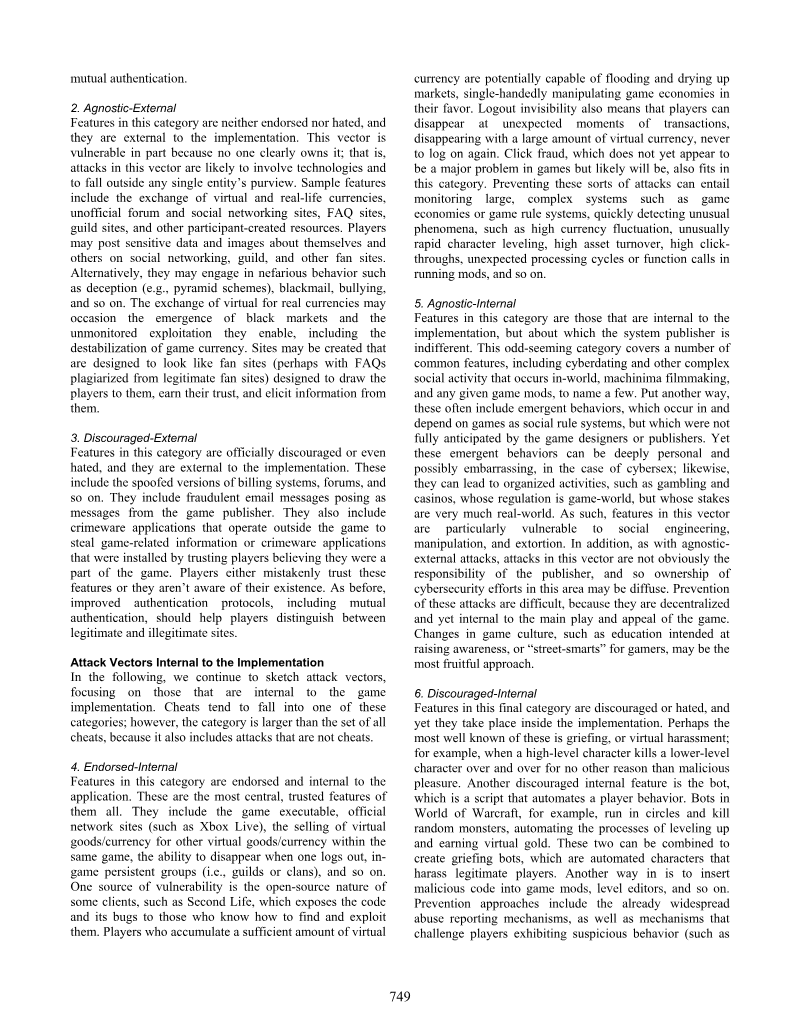
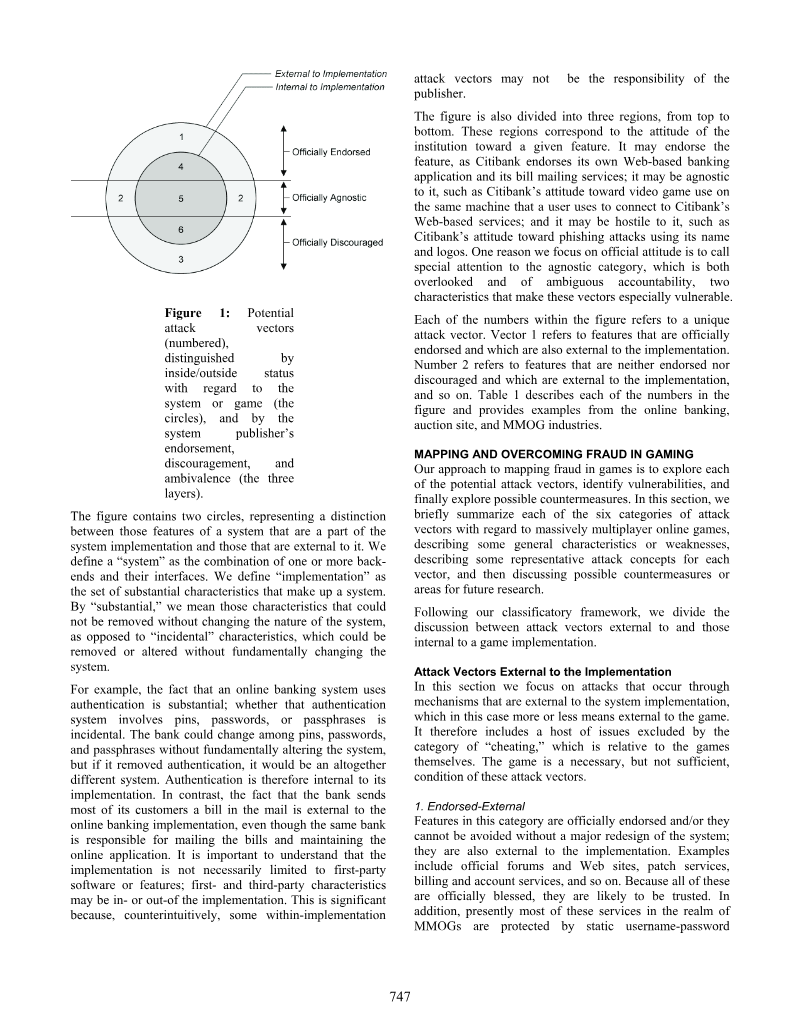
The paper's analytical contribution rests on a two-axis classification framework for MMOG attack vectors. The first axis distinguishes features internal to the game implementation from those external to it, while the second considers whether the publisher endorses or discourages a given feature. The resulting categories range from agnostic-external threats, such as fake fan sites and black markets that convert virtual currency into real money, to discouraged-internal threats, such as griefing and automated bots. The authors give particular emphasis to "officially agnostic" features that fall outside clear publisher responsibility, arguing that these are both especially vulnerable and comparatively understudied.
The authors conclude that current cybersecurity research, which has concentrated narrowly on cheating, lacks a conceptual vocabulary adequate to the phenomenon of virtual fraud. They recommend a set of mitigation strategies, including stronger authentication, monitoring of game economies for anomalies such as rapid currency fluctuations, and player education. The work positions virtual fraud as an area requiring coordinated attention from publishers, researchers, and players alike.



DiGRA · 2018

DiGRA · 2018



DiGRA · 2018



DiGRA · 2018

DiGRA · 2018

DiGRA · 2018



DiGRA · 2018



DiGRA · 2018



DiGRA · 2018



DiGRA · 2018

DiGRA · 2018



DiGRA · 2018