VideoDeconstructor of Fun
$500M in 2 Years: What Grand Games Knows About Scaling That Others Don't
8 Jun 202659 min video
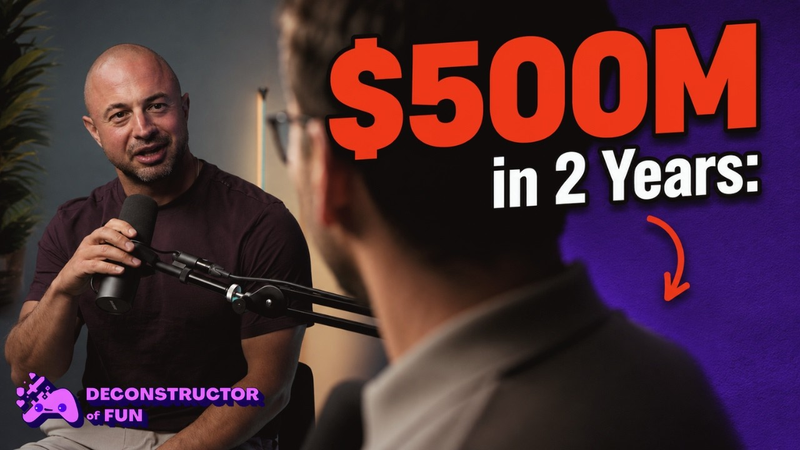
I think usually we treat pain and suffering as something bad. We don't see the outcome or the person we become at the end of the day. So, obstacle is the way. Yeah, unfortunately it is.
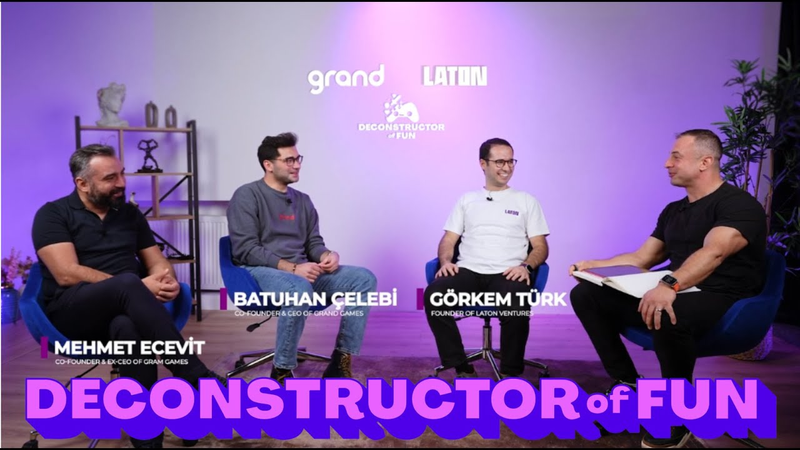
Batu Han, Grand Games founded in 2024. It's 2026 now. You've raised all together $103 million. Your company is on a $500 million annual run rate and last year alone you've increased your revenues fivefold. Now, these are not numbers that are typical in the gaming industry today. So, this podcast is to figure out how did you do that? So, welcome back.
Thanks so much. Thanks so much. It's been a pleasure to make this podcast with you last year and I'm really curious to what we have next.
Okay. Well, we have a lot of things to cover. Typically we don't do this, but I want to start right from the beginning when you started Grand Games. Like walk
me back there. What did you have before the pitch deck?
I think before the pitch deck the thing that I had was some pain and frustration regarding the the culture within the Turkish mobile gaming ecosystem and also the product differentiation because everybody wanted to do a match three game 2.5 years ago. All of them wanted to have some part of that success and I thought we were leaving a lot of good things on the table while focusing only on match three and these two things were the frustrations that I had. So, frustration towards the culture and also the strategy.
And talking about your investors, so I want to first kind of like talk about the investor before we drop in and really talk about how you make games because you just raised $70 million. Series A was a year ago and that's when you you were the fastest company that raised Series A at $30 million, right?
I think in that round size, yes.
And now Series B came in at $70 million just a year later. So, I'm curious to understand what were the investors buying at Series A and what are they buying at series B?
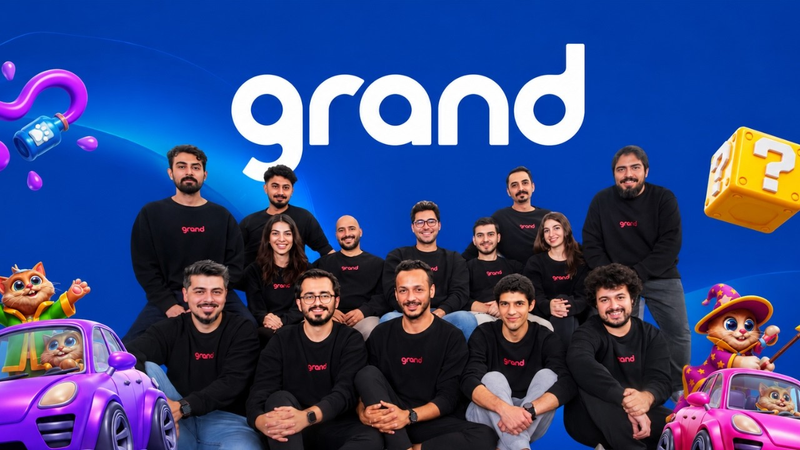
I think what they saw at series A was a half-made culture, a half-made strategy, and a really crowded office. Like 20 people uh trying to work it out in like a 70 m² area working on top of each other. But they saw the passion, they saw the ambition, and that's what they want to back in the first place. At series B we were much more like a defined company compared to like a year ago because our culture is now evolved into what it is today. Our strategy is much more solid compared to what it was because back then we only had Magic Sword. Right now we have three successful titles, one killed title, two in soft launch. And they have seen the path with us as well. So they have seen our growth in in a year. They have seen how we evolved, how we responded to different situations. I think one of them bought the promise, one of them bought the real thing.
And are the investors on series B the same as they were on series A?
Yes.
Oh, no new friends?
No new friends for us.
All right. I like that.
Um
[clears throat]
what I want to know is so you're reaching unicorn status, almost there, in just two and a half years. Walk me through a normal I don't know I don't I don't know if you have normal but walk me through a Tuesday in Batu Khan Celebi's life.
Yeah, yeah. I don't
be Thursday, too, but not Friday or Monday.
So I don't think there is a normal day to begin with but I understand. So you want me to walk you back to the Tuesday or Thursdays of any word so I think what I try to do is I start with the really high level of like what do I want to do today which is like how percentage of me acting and how percentage of me is like reacting to the things that is happening. So I think I found peace in like 20% of acting and 80% reacting to the stuff that is happening. And for me what this means is I can do three hours of interviews. I can do 3 hours of product. I can do 3 hours of level design and I can focus on marketing side as well. And any given Tuesday is like for me
selecting what is needed and also leaving some room to react to to the things that is happening. So that I could that I can be the support.
How structured are your days? Like you talk about 3-hour blocks. How many 3-hour blocks do you do a day?
I try to do three so that I have some room to spare for support as well.
Do you block them off in your calendar? Like when I come to work, I'm going to spend 3 hours on focusing on level design, then I'm out and going to have an hour break of of something random, then 3 hours on hopefully not investor updates, but something more important.
[laughter]
That's a good question. So it might be personal, but if I don't block my days in terms of calendars, I find myself 100% reacting to the stuff that is happening. Maybe in some days it is necessary, but most of the time I I don't feel fulfilled and I don't feel the company is driving to where it goes to be. So I try to block them and I'm not sure if you have seen our office, but our office provides a lot of room to get rid of decision anxiety, context adjustments
because it has a basketball court, it has a uh let's say pickleball court as well. And it has a lot of room for distraction in terms of if your goal is entertainment, I think you'll you'll be entertained there.
Yeah? Yeah. Why? Why why did you put these these aspects?
It's unorthodox and it's not common, but when you're doing something creative, I think you need some time to let the gas off a bit and understand what is going on and I think if you are doing a lot of context switches, you need something that is completely out of out of your day to make it happen. It can be a power nap, it can be a playing basketball, it can be completely different, yeah.
Yeah, yeah, I well, I I need I need the photos of that. Um and and you have Okay, so I I actually wanted to talk about We talked about capital. I want to talk about the people because in order to make a great company or any company, you need two things. You need capital and you need people. Can you kind of walk me through what type of people do you hire and not the titles, but but like what do you search in in in the type of people that
join Grand Games?
So, apart from the resume that we look in, apart from the experience and also the ambition, I think the the biggest thing that separates us is is the passion for mobile games, because Grand is founded to create new games in a really really good cultured environment. So, if you want to make new games, if you want to be successful, if you want to achieve something while making new games, I think this is the perfect place for you. And we are really doing a great job in understanding if a person is really acting or if it's really a passion for them. So, we are playing games like at least 1 or 2 hours within our our days for every role almost. And in order to survive that, you have to like what you are doing. And these are the things that we are looking for when making any new hire in any role that is open.
What's the signal that somebody is passionate and what's the signal that somebody is playing games?
We have a lot of questions. I can just give you one example. If you had
unlimited amount of money, what would you do?
Oof. If I had unlimited amount of money, what what would I do?
How would a day of Mishka look like?
It probably wouldn't do be much different than it is right now. I'd probably do more of podcasting, talking to people like yourself. Uh and and probably do less of of all kind of admin work and that kind of stuff. So, I really enjoy this part and this wouldn't change if if I had unlimited money.
That's an amazing answer, by the way. So, uh this is a passion for you. It's obvious. If if your answer would be like, I'll do completely something apart from this, like completely different, I want to sell cars, this is not a passion for you. It's like a job to you. So, that is the thing that we are looking for in like the difference between how they live now and how would they live in in their normal life if they had unlimited amount of money.
Interesting. And then, how do you test that somebody really likes the type of games that you are making? Because oftentimes when I was hiring people, you
always have people who love games who apply here to a company, mostly. But, then people like different types of games. And they're like, I love games. Do you mean League of Legends or you mean, you know, Block Blast? What are we talking about? Because you can love both or you can hate the other one and love the other one.
Yeah. The most common answer is FIFA, unfortunately, in Turkey as well. Yeah. I like games. I What do you play? It's FIFA. It's nothing else.
EA FC, but I understand.
[laughter]
I think the the good thing is like you I like games other than puzzles as well. But, I'm really enjoying when I'm playing puzzles. So, it has to be like what what we produce it has to make sense in order to make that passion a part of our job. So, if you like FIFA, but then you don't like playing any puzzle games, it still might not be the best place for you to work for.
Got it. So, you have to like the type of a games, casual puzzle games, that you're making. Do you have to like the business of casual puzzle Turkish games, hybrid casual?
I'm not so sure. Depending on the role,
I think that can change. But, you have to like what you're producing in order to feel the fulfillment. So, you don't have to like the business as a whole, but you have to like the end product.
Last time you were on the podcast, I played 6 months of Magic Sword afterwards. It wasn't nice. I was like, what am I doing? Way after the podcast, I was still magic sorting. And I was So, yeah. Your games are incredibly addictive and it would be kind of like I'm just giving that as an example of even if your favorite game is EA FC, if you play Magic Sword and you don't feel playing it that again, there's something wrong with you. Uh let's hope so.
[laughter]
That's that's the case. The The one thing that in the interviews that I read where which you did, you talked about real ownership of over product and outcome. What does that actually mean at Grand Games?
Let's assume you're a product owner at Grand Games, right? You come, you have a team to lead like mostly 10 people most of the time. And most of the backlog, of course, we
agreed upon and we we agree on planning as well. But the rest is up to you. It can It can go to a really good point. It can go to really bad point. We'll be there with you regardless of the outcome. We celebrate the effort. We celebrate the passion. We We don't celebrate the results. Results celebrates itself, so But for you, the whole day would be like what do I need to do to achieve all these goals? So, you are making every every day decisions by yourself. So, we don't intervene in any art process. We don't intervene in any development process. It is up to you and the team to deliver what you promised. And as a result, you get full ownership of the success and also full ownership of accountability when failure happens, so.
What are the parameters? Cuz you're talking about uh roughly 10 people, that's a studio. So, you have 75 people, that's about like five studios that you have currently, correct? How do you set those Is it a budget? Is it a timeline?
Is like in what constraints am I having this ownership?
After like 10, closer to 20, we felt that it it becomes more people management rather than product management. Let's say we produce some feature in Magic Sort. That is probably take like a month for us. Duplicating that feature to any other product takes 3 days for us. Because we we structure the code accordingly to that. We can use it many times in many games as well, so speed is not the issue with you. Having the sense of ownership and fulfillment after like 20 to 30 people is really low. When you take a vacation, we are probably not going to feel anything. We are not going to miss you if if if that's the case. With 10 people, you you feel the sense of achievement. You feel the sense of okay. If the product is there, it is because of me. And also, of course, we do this as a team, but you you sense that you are really great pie.
So, you're building these squads, but but like what are the parameter? How do you know that they're moving forward?
That that squad is functioning as it is. I understand the the element of being in a squad of 10 that everybody knows everybody by name and they're very close. And yes, there's probably very little admin with just 10 people. You don't need a complicated Jira system to analyze everything. But how like let's say I'm making a puzzle game at Grand Games and I have my team of 10. How much time do I have to ship? Like how do you how do you measure if I'm successful or not apart from when I reach the numbers?
I think understanding how many wrong paths you take is a good KPI for us. So, what did you try before launching the game? How is the gameplay polished? So, our mostly focuses on gameplay when we are launching the MVP version. So, how is that looking like? How does the team feel about the thing that they shipped rather than the rather than the end product? So, I think these are the things that we look for in terms of defining success because at the end of the day, when the MVP is launched, I think you need a lot of things, which
is like is the team motivated towards what they have built? Is the MVP really good in terms of gameplay and also level design and also overall polish of the game. Do you sense hope moving towards or fear? Since we are really low in terms of head count, I think understanding how someone feels is a bit easier for us. And also, we do the we do the meetings before starting the game and after we have launched the MVP. So, I think we got a sense of how everybody is feeling about the product that they have shipped and we try to make sure that everybody is also happy with what they ship, but it it it makes sense business-wise as well.
So, you talk to them or anonymously?
I don't think surveys is like a great way to handle this.
It depends. I understand you're very approachable, but as this company grows and it'll be like 500 people and Batu Khan just casually comes in for a conversation. I think people will perceive you as much bigger than you perceive yourself.
You're right. You're right.
And they will tell you whatever you want to hear.
Probably you're right, yeah. When that time comes, I think surveys would be the better one, yeah.
Yeah, maybe or somebody else.
By the way, we do we do surveys in twice a year, but it's not about the game, it's about the overall performance of the company.
Who have you parted ways with? What Not Not like naming people, uh but what type of a people did not stay at Grand?
I think it all ties to who we hire, right? Our criteria's are passion, ambition, and work rate, right? And we align on those when we hire you. Sometimes thing people change. Sometimes they lie in in terms of the interview. Sometimes they are they thought they are going to get something different from us and there is like a misconception of what they get, so it happens. I don't think anyone is to blame for that. But turns out that you cannot teach passion. You cannot teach ambition. And if you're optimizing towards your ambition and benefit rather than the team's,
I think these are red flags that we try to intervene and guide towards a more successful path for us and for them as well.
If they don't show the passion after joining the company and if they're optimizing for their individual success versus the company success.
versus the team success.
team success. Got it. Okay, so basically creating conflicts inside of the inside of the small company.
Unless you've been living under a rock, you know this is Web Store Rumspringa. 70% of top apps are using a Web Store and the best ones, they're doing it with AppCharge. Do you want a $20,000 in-app purchase? Yeah, AppCharge does that. How about using web-based Apple Pay checkout? Yeah, AppCharge does that. Do you want to pretend that subscriptions are still a viable monetization strategy for games? Yeah, AppCharge even lets you do that. Look, these guys are backed by Supercell, Moon Active and Playtika. They get what high average revenue per paying customer means and they're already doing over half a billion
dollars in transactions a year. So, are you going to be the first to do a $20,000 IAP? Don't accept the microtransactions, embrace macrotransactions. Learn more at appcharge.com.
Guessing where your users come from? That's so 2010. AppsFlyer is like having a cheat code for mobile marketing. Pinpoint attribution, real-time insights and analytics that actually make sense. Stop flying blind and start flying smart. AppsFlyer, because your data is your best co-op partner.
Uh let's talk about how new game ideas get greenlit. Where do new ideas come from? Who gets to decide that we're doing this new game? Because again, you're in hybrid casual genre that is dependent on innovation and every hybrid casual game is kind of like new. Like it's a little bit new because if you do something that is already done, it doesn't really market too well. It's going to be like a me too game.
I think in the older days, it it was more originated from the founder team.
Currently, it is much more unanimous. A lot of good product people has joined our company since our foundation and they all of course have their riff in terms of what needs to be done. And when there is a need to start a new product, we make a list of potential possible games, let's say, or genres that we want to enter, or something completely new that is like out of the box. And we start to form some hypotheses around it. And if there is no differentiation in terms of art, level design, or product in general, we don't even start because it doesn't make sense for us to just directly copy or make any any let's say existing game, if that's the scenario. Then we discuss these hypotheses among ourselves, among the team. And after the let's say back and forth discussions, hopefully we reach a unanimous decision and it a team that is really excited towards building it. When that is the case, we start it. If not, we don't.
For example, Magic Sword was on at foundation, Car Match was on Match 3. We didn't start a new game for like a year or so because we we didn't feel like the idea was a fit. We didn't found the team that could execute the ideas, etc. Then we stopped and we started building upon Magic Sword and Car Match.
And who's we? Like Like how does it work in a practice? Cuz like you almost describe to me a scenario where everybody gets into a boardroom, discusses things, you know, in a polite way, finds anonymous decision. It sounds like EU and then
[laughter]
executes on it after a year. But like I'm sure it's a little bit different in in practice. Like Like is it you? Is it Do you play basketball or do you Do you just like talk about certain games that you've been playing as like how can we do this game better? Like Like what's the What's the honest truth and and not the other the boardroom version?
Yeah, yeah. The good thing is when you hire passionate people and you have playing games as a culture, these ideas just flow naturally to you.
So, when you're playing basketball like you said, when you're on your break, you you're drinking a coffee and you're playing a game and you're discussing it with the person next to you and these ideas I think the generation is much more natural compared to what it was two two years ago. In terms of the making the final decision, of course, as founders, we are trying to minimize the, let's say, risk-reward balance as well. So, if a studio comes up with a, let's say, Clash Royale idea, that is probably going to take like at least a year to ship and at least a year to optimize, we try to prevent that because it doesn't make sense for us currently. And if the idea is that can be done in two to three months, is a really is a real hypothesis that we believe in, we try to back the studio as much as possible.
What signals do you look at in that studio that they can actually execute on the idea?
I think the planning and also thinking about the hypothesis is the KPI that I go for. If the planning and the road map
looks like a bit messy, I don't think it makes sense to go with that. But if the planning is purely towards like, how can I test this hypothesis as fast as possible, that is a ready ready studio to make a really new hit game.
Do they have to have a specific background before for you believe that they can do it or just a very believable plan?
I think these two come hand in hand. If you don't have the product background, I think it's a bit harder for you to come up with a plan. But yeah, if the question is, do you account for anybody's ideas? Yes. But of course, we try to filter it out and understand what is the best fit for us.
Talking about like innovating inside the constraints, the way I see hybrid casual games is you have to have a very addictive loop. Again, Magic Sword, great example of that. You have to have a meta or meta progression layer added to that for to reach that day 30, day 60, day 90, and so forth. Uh you have to have very high
level of marketability. And then you have to have um dual monetization strategies so to both make the your ad money, but also you're not purchases as the as the ad money dries up over time. How do you innovate inside of those constraints? And like, are those The first of all, are those the real constraints? And and and how does the innovation work really?
I think it all starts with pain. Pain when you're playing a game. If you feel like there could be a lot of things that can be done better. And if you have a really good hypothesis among them, so it starts with the not feeling part. The first you play the game, you feel like, "Okay, that can be much better. I didn't feel like that that good when I played this game. I don't feel like I'm returning to tomorrow, etc." That is a good pain to focus on. The second thing is making the analytical part work. If we make everything right, what is the potential of the audience and also the game size as well. If we get a click on these two, then we start with the hypothesis.
Mhm. So, basically, the games that get
green-lit starts with, "I love this, but." So, there there has to be something that that got you playing it, and then there's something that could be improved. So, you said you measure the TAM essentially of the games, of the target addressable market. How do you do that?
Through looking at similar games and also through trying to understand everything from Sensor Tower and also apart from that, I think most of the internet is helpful in terms of that.
Got it. And then you you basically calculate of the current TAM, you look at the competition. So, you first start with internal want and insight. Then you move into analyzing the market and whether you're able to stand out with these perspectives, and then you move into prototyping.
Exactly.
Whether you can fix it. Okay.
Exactly. And the reason for that is Mishka. So, we have five internal studios, right? We don't have the shots like a 100 prototyping studio has. So, we have to make sure that we are hiring amazing
talent, and we are also providing them a amazing opportunity to provide the impact. So, if one of them is like working at a 10 million run rate game, which is not bad by the way, we are losing a lot of opportunity cost. That is going to limit the company's growth. I don't think we can operate with like 10, 15 internal studios today. So, we are trying to make sure every shot we take is a good one.
Yeah, that is a very interesting point because other companies in hybrid casual tend to be a more like publishers. So, they work with tens of studios if not hundreds of studios. Usually 10, 10s, and those studios produce games for that publisher and they have that volume of up to 2,000 prototypes a year and then they try to pick and choose the ones that have resonate early on so that they can take those into live operations and essentially take over and publish internally. But you are a sniper. And you're saying you have only five
shots and they better count.
In terms of the speed and also quality spectrum, you can you can speak like some guys are doing the prototyping, which is like amazing speed but lower quality. There are some guys like who are doing like two games in five, six years. Amazing quality but low on speed. I think we land somewhere in between all of them. Yeah. We are trying to get the best out of them. So, we are shipping really quality products but we are not also limiting ourselves with like over optimization and over perfectionism.
I understand you don't want to name Turkish companies but I can. So, you're basically saying that a dream would be probably on the the utter level of perfectionism. Every pixel is perfect. Every level has been done as good as it can be and even better. And it sets a benchmark for everybody but it's not the fastest company. Again, no offense. They work incredibly hard but it's not like they ship a ton of games. There's one game that they've shipped and they've done it twice. So so that's that's And again, fantastic
company. The best is possible just a benchmark in that perfectionism. And then there would be somebody on the other end would be Rollic, for example, who's you know, Burak has been on on the podcast and talked about this company. Again, a machine, a true machine that just churns out excellent games at an insane volume, taps in into the whole ecosystem in Europe essentially saying that you're somewhere in between.
Exactly.
You focus on quality, but not to the levels that you can reach of of Dream. You want to be fast, but you're not as fast as as as Rollic with their multiple studios. So you found your own lane that is somewhere in the middle. Kind of fast with kind of good quality.
Kind of good quality, exactly. I think our perfectionism involves time as well.
Yeah.
So for Dream, like you mentioned, I don't think time is like a lot of issue. For us, we are trying to make sure our hypothesis is right in the first place and we want to make sure it is as fast as possible. Because we are throwing wild bets out there.
This is that your approach and again
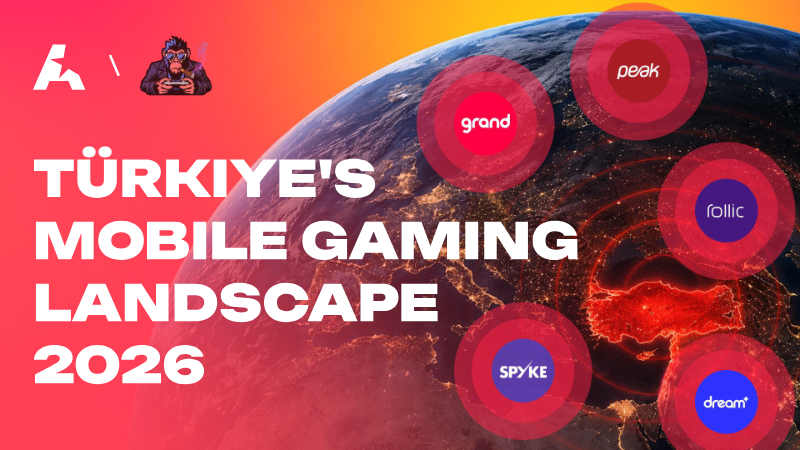
Dream and Rollic as an examples is what I love most about gaming is that there's not one right way to succeed. There's the mountain and there's multiple paths towards the mountain. As long as you keep your own path and not try to switch it around and follow somebody else and do exactly what they're trying to do. Because there's ton of companies that try to do what Not ton. There's some companies that try to do what Rollic does and ton of companies that try to do what Dream does and nobody succeeds and they they don't find their own path like you did.
Fully agree, fully agree. There is not I don't think there is like a one single really great path. I think that everybody has their own path. Everybody has their own characteristic and also everybody has their own learning. So you try to make sure that you you are using all of them and find your own path, yeah.
What does our UI look like at your run rate today?
Yeah, since we are still growing from day zero, I don't think it made sense for us to go into profitability yet. And uh we are spending more than like uh close to like a 1.5 million daily today. And as you might have guessed from the revenue, it's pretty similar. I mean
And for us, I think the name of the game has changed over the years. So, I worked at marketing back then at Good Job. Back then, growth was really essential part of the job. So, you had a lot of tips and tricks that nobody else knew about. I don't think today that's the case. I think today there are like minimum amount of net effort and also minimum amount of optimization, room for optimization. Because most of the campaigns are ROAS campaigns or uh really optimized campaigns. There is a black box element that you don't you don't know about. You don't anymore look at targeting, that's all done by ad networks. So, they they only thing is just pushing as many creatives as possible. They give you all the AI tools, give me 2,000 variations, and I'll find you the audience, and this is the box you feed in those creatives into. That is the current current world, yeah.
The life of a UA manager today.
[laughter]
Feed the machine.
Feed the machine, but I think the decisions are still the same like LTV to CAC or version, yeah. I think these these remain the same, but the
importance of creative is much more compared to what it was 5 years ago.
And so, that puts more pressure on the creative that is also like a almost like an extension of your first-time user experience. And it puts more pressure on the core product that needs to stand out because the distribution is kind of the black box that has been handled.
I think so as well. If I were to rank among these three, I would say the product is the first thing. I think in order to have a success in today's world, you need to have the the best product in any genre that you are going to enter. And the second thing would be the creatives, and the third thing would be the growth.
Mhm. And how has your growth machine changed when you went from 100 million run rate to 500 million run rate? Again, that's probably like few months difference, but but but what worked at 100, let's put it this way, what worked at 100 that doesn't work at 500?
First of all, I was doing the UA when it when we were doing the 100 million run rate. So, right now we have a team that
is much more capable of doing it compared to me. So, I think that changed on our benefit. And on the second part, I think you can get away with a lot of guerrilla actions. And when you're at like 100 million run rate, but when you're trying to make this into a machine, you need to have some structures, you need to have some dashboards, you need to have some really talented people looking into the, let's say, UA spend because it affects the overall fate of the company. Any mistake here can lose a lot of money and also the fate of the company. So, I think that changed and mostly it's talent. So, yeah.
Well, let's let's move on from there. Um, what does "Made in Turkey" mean for Grand Games?
As you know, I'm Turkish and I'm taking a lot of pride in doing something that I love within my own country and I don't have to leave overseas in order to make that happen. I think it's it's an amazing feat and we all feel that as any part of Grand. So, I think we take joy in that. And coming back to your
question, "Made in Turkey" means for us and also most of the studios would agree is the highest quality. I think we produce really polished, really high quality games and we take pride in that as a country as well.
Back in the days, not so far along, I'm from Helsinki, we used to be the the capital of mobile gaming. Still some good companies, but um what meant to me that that it was made in Finland was that we, as a small country, were able to produce game for global entertainment and that felt like the companies that paved the road felt that like it's possible, even though I'm here, far away from the Hollywoods of the world, from the New Yorks and the Londons, you're still able to do something that is equally or even higher of the quality because somebody paved the road.
I think for us it was Peak.
Yeah, it was Peak. Exac- Peak showed Peak Peak showed the way. Gram pushed it and then Peak showed what's possible and Dream is like 5x of whatever Peak
achieved, which was already the peak.
Exactly. I think before Peak and Gram Peak Games, many successful Turkish startups were focusing on internal domestic markets. What Peak and Gram and Peak showed us is that you can do amazing things here and publish it overseas and you'll have amazing benefits from that.
Yeah. Yeah, they've they've really set the bar so high that that you don't have to leave. You don't have to even think about outside markets. You can go as far as you can inside Istanbul.
And 10 years ago I think his challenge was he had to create the talent. He had to create Unity developers. He had to create 2D artists. He had to create the product managers. That is focusing on feeling side. I think what he did was amazing and he paved the road for us. He built the ecosystem. Yes.
The other Turk of the of the Turkish ecosystem. Um, what makes what makes Turkish developer then different than anybody else? Have you hired anybody else than a Turkish developer?
We didn't. We didn't. Yeah.
You didn't?
Yeah. Of course since we are operating as really small teams and we take pride in impact and
also ownership. Any non-native speaker is like a problem for our culture. So we try to since every role doesn't speak English, it's a bit hard for us to hire from overseas but it's not a big problem because Turkey has the best talent in today's world. I understand why gaming companies like I'm not going to name drop them but have other offices outside of Turkey. It has of course some advantages.
Marketing.
Marketing and also branding. I think these aspects are known much better overseas rather than compared to us. I think we have the best talent in terms of product and development side. What separates us from let's say Western or other developers is I think the ambition level is really high. The will to produce something that is really high quality, that is user-oriented is huge compared to any other gaming company overseas and what sets us apart, I think passion and thanks to Sidar's talent-wise, we are doing amazingly well.
And what's really powerful in this ecosystem is that the
government is supporting it fully and actually be evolving in the support. Can you talk a little bit about the other subsidies that the government uh gives to Turkish developers?
I think in the early days, there are a lot of support mechanisms when you are starting your own business in Turkey and these support mechanisms actually increase the runway of any given company. Increasing runway every time means increasing the chances of success. So, it's good to feel the support of Turkish government when you're starting the business.
And it's it's not only like support in terms of somebody clapping your back and saying good good job and and keep the flag high. It's
Financial support.
It's financial support that helps you to take bets and shots on goal, which is very unique for these type of subsidies is that they want you to give it a try. They de-risk your try so you can have more tries. They give 50% off from different types of tools and and App Store payments just to increase your runway so that you find your success. But once you find your success, the
subsidies kind of end. It's only to accelerate you till the till the level and make sure you take the bet.
Exactly, yeah. And most of the most of the beneficial ones are the ones that you have listed like 50% of the marketing costs, etc.
If people want to read them to details, deconstructoroffun.com, I've wrote them already so you can find what they have. But but uh but we don't have to go through line by line, but they are they are a benchmark for any country on supporting gaming, but also for other ones. It's clearly they are developed by listening to founders and entrepreneurs and asking them what would be the right type of a system rather than trying to create some more convoluted or using consultants to create some kind of a convoluted system for subsidies. I think that's that's a key part, yeah.
Yeah. Okay. Uh let's talk about a little bit about your role models and where are you looking to take Grand Games because you're building Grand Games two and a half years magnificent growth. What is the type of company you look as a reference or a benchmark? It doesn't
have to be in gaming, but what's your model?
I think resilience-wise Nvidia is the role model for us because I'm not sure if you heard any any of the speeches of Jensen, but he talks a a lot about pain and suffering and also resilience that is building character for the company and we take pride in that as well. So we also see pain and resilience pain and suffering as something good rather than just the bad stuff. I think that's a really good example for us. Dream sets the bar in terms of product quality. We are trying to learn from that in terms of that aspect as well. And I think the last year I would say which is the foundation of our culture, Supercell. Supercell's ownership and also providing it like multiple studios, multiple games, these are really amazing examples for us.
Resilience and tolerance of [snorts] pain uh in terms of Jensen's Nvidia the long game, then you mentioned Dream in terms of focus on detail on product quality,
and Supercell in the importance and the foundational work of having a strong culture. That's a good trio. That's a very powerful trio. Um is there a founder inside or outside gaming that has changed the way you think about building a company?
Going back to my foundation, like foundation of Grand Yeah, Nvidia CEO really changed how how I look into the things because for me personally it was a bit rough time. I was going through a divorce. I was trying to raise money living in hotel rooms. I Well, I was just trying to make sure that companies run on good hands. I was trying to uh make the best decision in terms of product. I was the product owner of Magic Sword back then.
So, you're product owner that is divorcing and trying to get funding all at the same time while not having a whole homeless at the same time.
Exactly.
Sounds fun.
Really fun.
Yeah.
Really fun. I call that chapter like
pain and suffering and yeah. Yeah. I learned a lot from Yancey back then because I think usually we treat pain and suffering as something bad. We don't see the outcome or the person we become at the end of the day. And his uh speeches and also vision enabled me to see the good side in living all through that. And made me who I am today. So.
So, obstacle is the way.
Yeah. Unfortunately, it is.
So, that's the belief that you've adopted that obstacle is a good thing because it molds you to the other type of a person and the type of company you need to have. Is there a belief that you've rejected?
From other founders.
Yeah. Something that you maybe had and then you had to reject it.
For me, I think personally I heard that in order to be successful you need to be a villain.
Villain?
Villain.
A bad guy.
You need to put pressure on every employee. You need to be really tough. I don't think it makes sense in today's world. I don't think it is something that can be done long-term. Of course,
I'm not name-dropping any anybody but I've heard that couple of times from really successful people as well. There is a chance that you can be successful and of course, everybody has their own path but that is something that I don't believe in. In order to be successful I think you need to be understanding your employees. I think you need to show empathy. I think you have to understand that like yourself they can be going through somethings and also being a support mechanism rather than just being the one that's shouting at them should be the correct choice. That's the thing that I'm
So, be just.
Be just. I'm not saying avoid conflict. I think you have to have conflict. But, you don't have to be a about it.
I think your own suffering has shaped your way of thinking that there might be something going on and that that creates that empathy. Again, obstacle is the way. You learn from your own
Yeah. The capacity for empathy just skyrockets. Yeah, you're right.
So, you're now at the again 500 million run rate. Goal is of course to increase that. If the growth flattens, what's
most likely the reason?
To be honest, it didn't flatten for like 2 years and I'm hoping it doesn't. If it happens, I think it's lack of focus. It always is for us. If it happens, I think the first to blame from my end would be like, "Okay, what should we focusing on and what are we focusing on now?" I think we need to have some adjustments in order to do that. It can be like a cap on our games. If that's the case, we can find new games.
Like focus is the most important thing and if you feel that the main thing that would put you out of trajectory is your own internal, which I love. It's not what happens outside. It's like it's internally. So, if you lose the focus, how would you lose the focus? What would be like when you suddenly start talking about, "Let's make a TV show and and a merchandising line and maybe invest into AI tool development." That Is that like what you see as as focusing away?
Exactly. Exactly. Our job is to make games and our job is to make games that
the people love and also we love. And if we try to divert from that or try to find some new new stuff to work on, I think that could cause it. We have Magic Sword. We have Karma. We have Local Artist successful titles. These titles require attention. And if we were to let's say go into okay, even though we have these, let's make some three new games from these studios. I think that's like a suicide for us. So, I think we need to have that focus of okay, let's grow these games as well and just focus on games.
Kick-ass live ops need kick-ass tools. That's where Heroic Labs comes in. They just released a massive update to their Satori live ops platform. And having done my research, I can say with confidence that it's second to none.
[clears throat]
In a single product, you get everything you need including event capture, player segmentation, feature flags, remote configuration, AB [music] testing, experimentation, live events calendar,
messaging, retention, graphing, analytics, and so much more. If you're serious about running live services in a game, get serious about the tools you use. Connect with Heroic Labs and make some serious cheese with your live ops.
Eiffel Tower, iconic. Tower of London, historic. The two towers, simply epic. But none of them tell you anything about mobile app intelligence. Downloads, revenue, active users, and my personal favorite, weekly cohort of retention. Get the real story, get the real data, get Sensor Tower today.
Let's be honest. You're tired of chasing installs across the same crowded networks. We all are. That's why Vibes built a new Play Bop. They're the fastest growing game and fight awards platform and they are helping studios scale smarter, not just bigger. Their AI powered targeting means you will finally hit the audience you want and with their new raw ass optimization engine, performance doesn't just grow, it
actually levels up. So, if you're looking for growth with a fresh angle, check out Vibes. It's built different. It's designed for growth and it's powered by good vibes. So, head over to vybs.co and get yourself some good vibes.
Which skills or capabilities do you feel Grand is currently missing?
We have shipped six games in two years, right? So, I think our strongest muscle is finding a underserved genre and converting it into like a naturally like feeling premium and amazing game, right? So, I don't think we have either seen this in our previous companies or we have seen a good example of what needs to be done in making a game reach its full potential. We are on the learning phase of that stuff. So, I think the the room for growth for us is the optimization of the existing games rather than just shipping new games because we know we can do that, but we
don't know how to fully optimize a game that is like live ops. Live ops can be the one. Still level design can also be the one.
So, you feel that the existing games that have already put you at a significant run rate are under optimized.
Yes, I do believe that.
How big of a teams do you have running them?
For a successful hit, it's like 12 people.
12 people.
Yeah.
That's like Supercell in 2012.
Yes.
It's 2026 now.
I think they also suffered from this because they're really entrepreneurial company because of the ownership and the culture. And he also said that launching a game and optimizing for a game requires completely different personalities and also completely different mindset. So, I think for us we need to either learn or hire amazing people that is really good at this in order to make that happen.
Mhm. And restructure the company again from the people who build to people who optimize.
Having both.
Having both is the best way.
And then moving the products between those teams.
Exactly. Our premise is ownership. And if you are really data oriented person that wants to grow the game rather than just shipping a new one, I think you'll have amazing ownership with us. And if you want to do like a new game every 3 months, you are that kind of maniac, then you'll also have the tools and availabilities like
Yeah, where you won't be forced to run live ops on that game for the next 3 years. What what capabilities and skills are you missing personally?
I mean, to be honest, I think I'm always in the conflict of am I doing the right thing for the company? Because I can In any given day, I can find myself level designing. I can find myself replying to investor emails. I can do marketing stuff as well. Of course, hiring takes a lot of my business and also my day. And I'm always in the question of what is needed from the company today.
[snorts]
Sometimes I may be going into my passion and designing levels rather than just going into like investor decks or
raising money or trying to find the next product owner. And I'm trying to avoid that.
Who tells you that you should not do that?
I think everybody does.
You haven't listened to them and you're 2 and 1/2 years at a $500 run rate.
You're correct.
By not doing what everybody tells you.
I think they have a point because at [snorts] the start of my your journey at Grand, I was fully focused on product. Then the the percentage decrease over time. I think the overall conception is it should drop to zero. I don't think it makes sense.
Your focus on on game.
Yeah, I think the overall conviction is like a CEO's job once the company grows should be only on motivation and hiring. And that is the thing that I'm hearing, but I don't think I'm the kind of guy that can does this because I have a huge passion for gaming and I love designing levels.
Let me take this to the previous answer that you gave. You mentioned three companies that you look up to. Supercell, clearly. Ilkka is a very different type of a CEO. He doesn't come
from game making, self-proclaimed multiple times says it. He's more of a culture builder, capital raiser.
Yes.
But the other two that you mentioned, Jentsen Long and CEO of Dream, do they do anything on the product side?
I think they do, yeah. Again, the just like we talked about the successful companies, there are multiple ways to the top and I think you carve your own path and I think the path you've been taking is the right path. And somebody would say, "Look, there's another path that you could take." You'd be like, "What What's wrong with this path? Seems to be going mighty fine."
You're right.
Why would I I I understand that. I hear that a lot and I had heard it in my own position where somebody would say, "But you're CEO, you should not touch the product. You should be building culture and raising money."
Mhm.
But isn't you building a culture by leading from the front and doing the things that you feel are most beneficial for the company and that is the culture? Do the things that help the company the most.
By the way, I needed that. Thank you. Thank you, Misha. Yeah, I think the overall conception is what you heard and also what I'm hearing is the is the thing you mentioned. I think having the room to be authentic leaders is the why we did this in the first place. So, I think I can find a good balance of okay, I can help product teams, I can help marketing teams, but also I can do the job of a CEO as well. I think I'll need support doing so in order to make that happen. And probably that's the way I'm going for as well. I always push
founders to build a company around yourself. Meaning that hire the type of people that support you the best and and and are in the right position. If you feel that you're in the right position and you're being pulled to a different position where you need to do investor updates, there are people who can probably do better investor updates than you do. And you're probably more than happy to let them do investor updates and then you have to find like are there better people who can, let's say, make levels at the moment that I do. And somebody would say, "Making levels, that's easy."
And I would say, "Well, there's probably like 20 really good level designers in the world."
Correct, yeah. I think as a founder, you always have the thing like "Am I the best one doing this job?" And probably the answer is no. But you are trying to, let's say, optimize for short-term needs, which is probably you are going to do it today, but also not forgetting about the long-term vision of okay, I have to delegate this to someone because in in favor of the company's benefit, not from my end. Like you built this. You wanted to have it. Don't change it to a place where you don't want to be at because you're listening and changing your own work to something that you don't feel that passionate about, which passion again you said multiple times is the most important thing. And you're switching your daily job to do things that you actually don't want to do and not are passionate about. Then you lose the passion and then you're wrong the person for the company.
Have you ever considered mentorship?
[laughter]
Um
Apart from the podcast. Why not?
I I actually I do that a lot. I don't work with founders. Anyways, uh so
let's talk about your investor just a little bit. Latest round with Balderton. Balderton is a phenomenal investor, a large one, US one. And because they're so large, they probably have a very specific return expectations that are 100% starting with a B and with multiple B's. How aligned are you with your investor?
I think in terms of overall satisfaction at every investor that we have is like fully fully happy, I would say, in today's world. Of course, Balderton being like investors at Dream, Back Ventures previous investment at Peak, I think the expectation is really high from them towards us. But we already have that expectation towards ourselves as well. So, I don't think we feel the pressure of having an investors return pressure. And they have been supportive of what we do from the day so I don't feel that fully. But, knowing that we have investors and knowing that this is a company that they want return,
we are also keeping an eye on, okay, we have to make something happen for them in the, let's say, future. I'm not going to say near or the future, but in the future there has to be an exit opportunity for them to make money. We are aware of that. But, that is not something we think about it in our daily lives. The building of the games and making the company the best company in the Turkey in terms of workplace is the thing that we optimize for daily.
Um investors, VCs, venture capitalists want you to exit in about 5 years. Bankers want you to exit at peak. And your buyers want to acquire you before you reach the peak, well before you reach the peak. What do you want?
Having investors is like, of course, the the the road is going to end for them one way or the other, but I understand. And for us, it was never about the acquisition day. Actually, we want to be acquired someday. And the VC exit as an enabler of this rather than just the end of the path for us. Because the
goals we are chasing is still the same. Okay, we have shown that Magic Sword can be a success. We have shown that Block Blast can be a success. Car Match is a success. But, we still want to prove to the world that these games can make huge amounts of revenue. So, these games can be compared to like a really evergreen genres that has been talked about ever since the foundation of mobile gaming. And in order to do that, we need the investors and we need the money and the support they provide.
Let me be more frank. What does Grand Games look like in 20 36 as an independent company?
I think for us, 10 years of lifetime, that is probably going to mean like we have close to 10 studios internally. We have
[snorts]
at least five to six external studios that we either partner with or also invested fully. And our culture is still the same. Our people are still happy and having
the impact that they have feel today.
Is there a number I'm talking about money for you personally to change that direction?
The dream that I mentioned is already motivating enough for me. I I'm not even thinking about any number to put some restraints over myself or or the whole company.
Cuz it's your passion.
It is.
That's a very mature way of thinking about it. Without naming the other founder, I had a pleasure of having a breakfast with this person. They said
[laughter]
that in um they did two mistakes in their career overall. First one was IPO and the second one was selling the company. I was This is like Again, those two things are, you know, it already means certain type of a scale. For founders, kind of like giving away your baby for money is kind of sad.
I fully agree with you there, but I think that both ends of the spectrum is wrong. I think both ends is leading you to a dark place. Doing this whole for the money is like you're probably not
going to be successful if you are doing this only for money. If you are doing this for your own personal benefits and you are using company as a tool, I don't think it also makes sense because you are more than the company that you just founded. And I'm trying to find still again the middle way of that spectrum of okay, I'm doing this because I love it, but it has to end with a let's say monetary benefit for myself, investors, employees, and everybody working there. So that we all have our happy ending, but we all do it because we we love it.
Yeah, liquidation event is just a part of the game.
Exactly.
But there are multiple of those.
Yeah.
Yeah. If you would meet a 25-year-old founder in Istanbul wants to build the next Grand Games And they're asking you for advice. What's the type of advice that you would give them that would allow them to avoid the first two years of mistakes and mishaps that you may have had. Apart from getting divorced and raising and being homeless at all at the same time.
Apart from don't do it. Don't don't
found the
[laughter]
Jensen Huang version of like don't do it.
I think first one would be the don't do it, but I know they're not going to listen to the first advice. So, first of all, being a founder is like means carrying a lot of weight on your shoulders that you because you are making life or death decisions daily. But, I noticed that even though we make these decisions, which is life or death, we treat every decision we make as life or death decisions, and most of them are not that kind of decisions. So, actually 90% of the decisions are two-way doors. So, you can go in and you can go out. So, it's like uh it's changeable, right? But, you treat them as like okay, I have to make this right or the company goes to bust. So, this is putting unnecessary pressure on yourself, and you already have a lot of pressure. So, I think in order to avoid that, you have to identify which decisions are two-way doors and which decisions are one-way doors and put a lot of focus on the
one-way doors. Go easy on yourself on the two-way doors. The second one is it's it's a bit sadder compared to the first one. I think as you know, the world works that way is you get clapped or you get celebrated or you get rooted for when you don't even need them. So, yesterday at Latam Summit, we heard a lot of claps for grand games. We had a lot of praises. But, we didn't needed them yesterday. I think we needed them two years ago. So, everybody is on your back. Everybody supports you when you have something to show. You have results. You have the achievements, but you don't need them at your highest day. You need them at your lowest end in order to survive these days. I think you need to find the internal mechanism to provide you that support and provide you that clap on your back, which is like, "Okay, you are doing great. You are going to do this. You are going to do this." Just keep going and in order to achieve that, I think you have to go for like things apart from the results,
processes, hirings. So, you have to celebrate the small things, which is like, "Okay, I hired this great person. He or she is going to be the next phase of Grand Games." Okay, that is something that you should celebrate. You have done a tweak in process. That is probably going to enable a lot of good things in the future. So, you have to find these small wins and celebrate yourself until you find the results because nobody's going to do it for you. And momentum matters a lot in success.
That's a really good advice. Celebrate the small things on your path and you'll carry longer.
Yeah, I think you know
this. Uh by the way, it's uh it's it's again your second time on the podcast. I was very impressed on the first time, even more impressed on the second time. Like, I really believe, not even think, I believe that you are going to build a fantastic company. And I think it will be harder than you believe. But, you are you are equipped to weather the storm. You've had a such an amazing launch and I'm I think you're fully prepared for a little bit of a stagnation, for finding what works, but
you truly have a passion for this and and even off the record as we've talked, you know, this is what you want to do. There's nothing else and and I'm admirer of you and Grand Games. So, um kudos to to everything that you're doing and I can't wait to uh talk to you over these years and see how the company grows.
Let's sync every year. Let's sync every year. It's been a pleasure for me and as well and I take what you have told us as like the whole Grand team because we are doing this together. I don't think any anybody matters a lot in our company in today's world and everybody is a huge part of the success that we are building and I'll carry that praises to them as well.
Yeah. Congrats to Gram Games and and to Turkish gaming industry.
Thank you, man.
On that note, thank you everybody for listening and hope you learned a lot. And by the way, I will not answer your questions cuz he's building games. He's focused.
So, uh
DM DM Gurkan for for answers.
Gurkan is the best one, yeah.
[laughter]
All right. Thank you so much.
Take care.
You did it. You made it to the end of the episode. As a fan [music] of the
show, it would help us out if you'd subscribe and leave us a review on the podcast service of your choice. Those stars and likes, while a small action on your part, mean a lot to us and help to grow the show. More importantly, are you a member of the Deconstructor of Fun Slack group? If you have [music] five years or more of games industry experience, go to deconstructoroffun.com/slack and apply to join. [music] Join the games industry's best professional community filled with peers always willing to lend a hand. Or, subscribe to our newsletter [music] to get all the latest insights from the Deconstructor of Fun content creators. Thanks for listening.
Auto-generated captions from YouTube — names and numbers may be misheard.
Grand Games has achieved a $500 million annual run rate within two years by implementing a decentralized, multi-studio organizational structure. By maintaining small, autonomous teams of approximately ten people, the company fosters high levels of accountability and creative ownership. This operational model relies on a talent-dense ecosystem in Turkey, bolstered by government subsidies that mitigate early-stage financial risk. Leadership emphasizes a culture of passion and empathy, rejecting authoritarian management in favor of a reaction-based approach that balances strategic oversight with the creative freedom necessary for rapid, high-quality development.
The company distinguishes itself from competitors through a sniper-like, hypothesis-driven development strategy. Rather than pursuing the high-volume prototyping common in the hybrid-casual sector, the studio focuses on identifying specific market pain points and validating them through rigorous analysis before committing resources. This methodology prioritizes product quality and creative assets over traditional user acquisition tactics, which are increasingly managed by automated ad network algorithms. By benchmarking against industry leaders like Supercell and Nvidia, the studio maintains a focus on organizational resilience and product excellence.
Looking ahead, the strategic priority is shifting from the rapid release of new titles toward the optimization of existing products through enhanced live-ops capabilities. Founders remain deeply embedded in the creative process, distinguishing between reversible operational decisions and critical, one-way strategic choices to ensure long-term independence. By resisting the pressure for immediate exits and avoiding non-gaming distractions, the studio aims to sustain its growth trajectory. This approach underscores a commitment to long-term creative vision, where financial success serves as a tool to support, rather than define, the company’s core development objectives.

Deconstructor of Fun · 2026

Deconstructor of Fun · 2026

Deconstructor of Fun · 2026

Deconstructor of Fun · 2026

Deconstructor of Fun · 2026

Deconstructor of Fun · 2026

Deconstructor of Fun · 2026

Deconstructor of Fun · 2026

Deconstructor of Fun · 2026

Deconstructor of Fun · 2026

Deconstructor of Fun · 2026

Deconstructor of Fun · 2026
Deconstructor of Fun · 2026
Deconstructor of Fun · 2025

Deconstructor of Fun · 2026

Deconstructor of Fun · 2026
AppMagic · 2026

Naavik · 2026
Deconstructor of Fun · 2026

Deconstructor of Fun · 2026

Naavik · 2026
Deconstructor of Fun · 2026

Deconstructor of Fun · 2026
The Game Business · 2026
Comments