Game Development reports and market data
Documents


State of the Industry 2019: Mental Health in the Game Industry
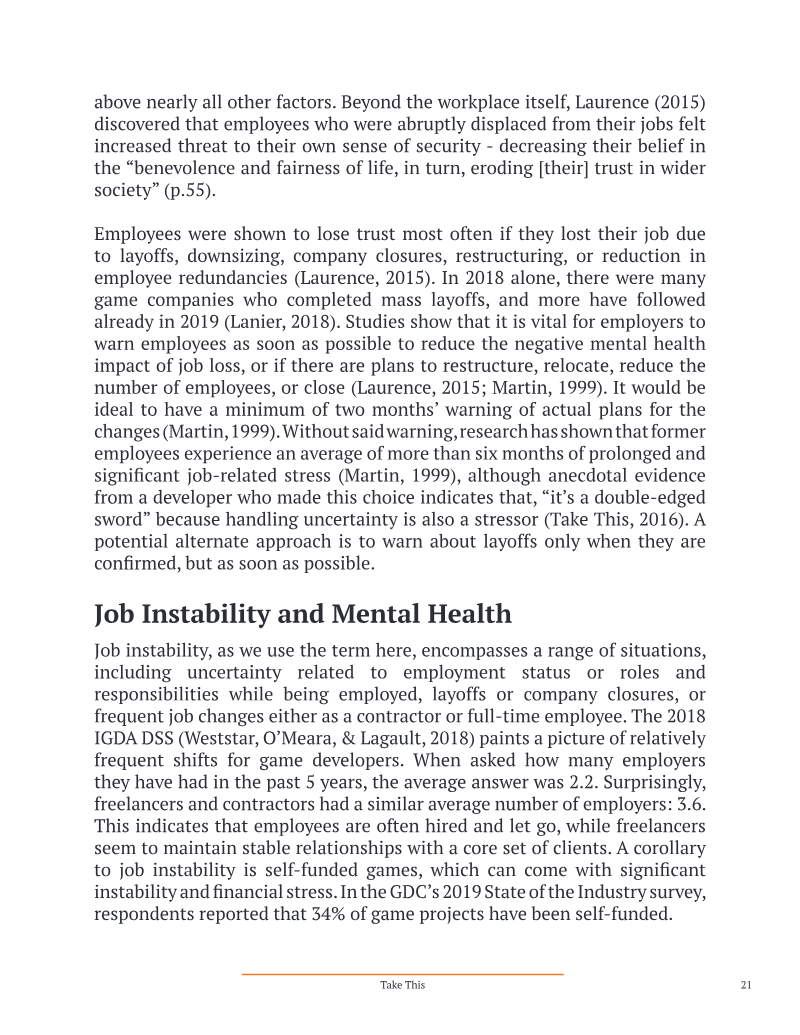
The 2019 assessment of the global game industry identifies systemic organizational failures as the primary drivers of a pervasive mental health crisis among developers.
- Systemic organizational failures, specifically the normalization of chronic overwork known as crunch, are the primary drivers of a pervasive mental health crisis and burnout among game developers.
- Job instability caused by frequent layoffs and a lack of professional security creates a high-stress environment that threatens the long-term sustainability of the industry workforce.
- Exclusionary workplace cultures—characterized by harassment and microaggressions toward women, LGBTQ+ individuals, people of color, and neurodivergent employees—stifle team creativity and degrade the quality of game content.

State of the Industry Report 1999
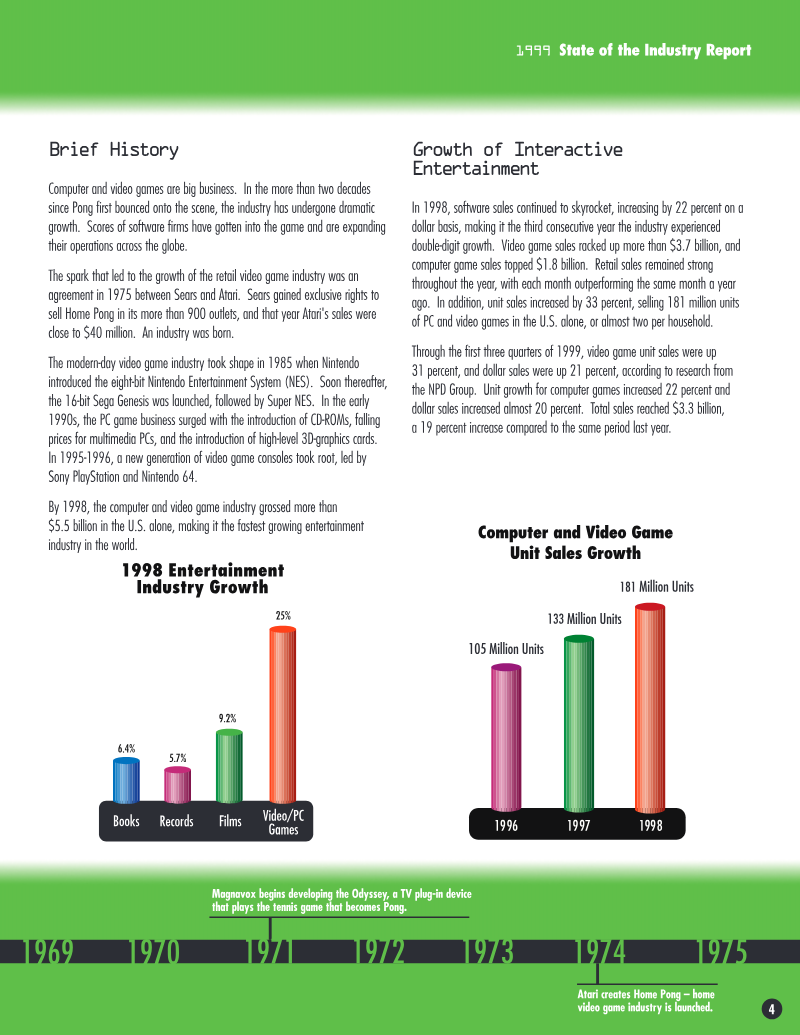
The 1999 State of the Industry Report provides a comprehensive overview of the interactive entertainment sector, documenting its rapid evolution into a dominant force in the global home entertainment market.
- The U.S. interactive entertainment industry reached $5.5 billion in sales by 1998, marking three consecutive years of double-digit growth and positioning software revenue to rival motion picture box office receipts by the end of 1999.
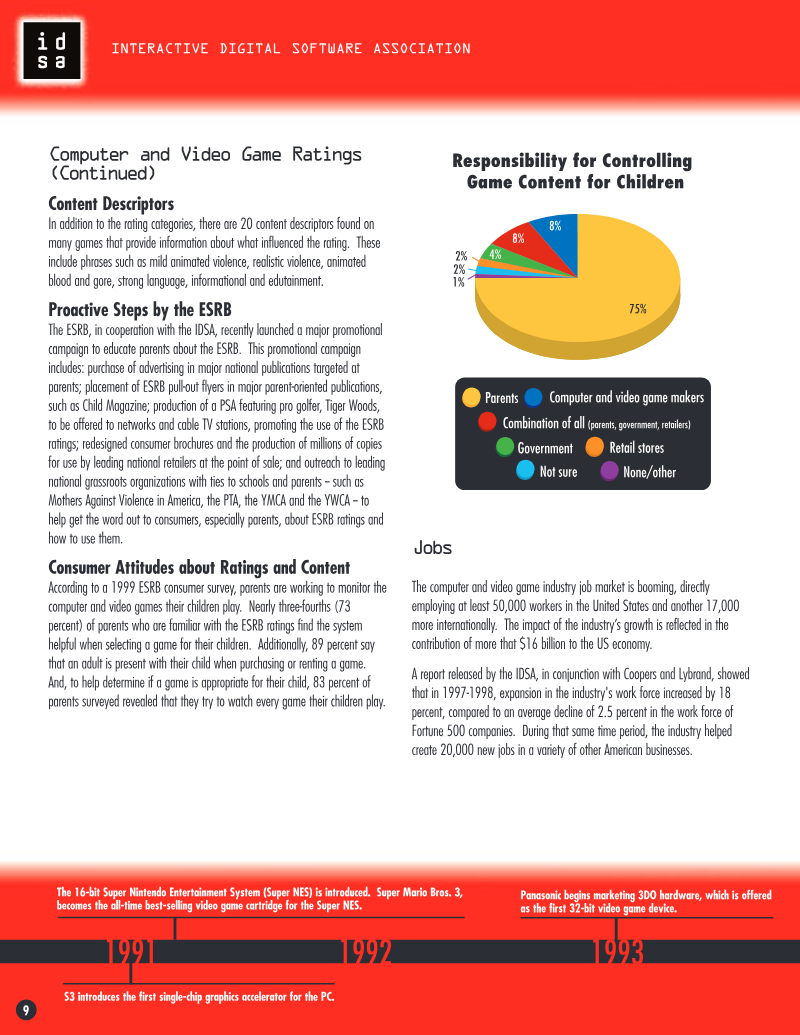
- The industry is a significant economic driver, directly employing 50,000 workers in the U.S. and contributing over $16 billion to the national economy.
- Gaming has shifted to a mainstream adult demographic, with individuals aged 18 or older now comprising 69 percent of PC players and 54 percent of console players.

Video Games in the 21st Century: The 2026 Economic Impact Report
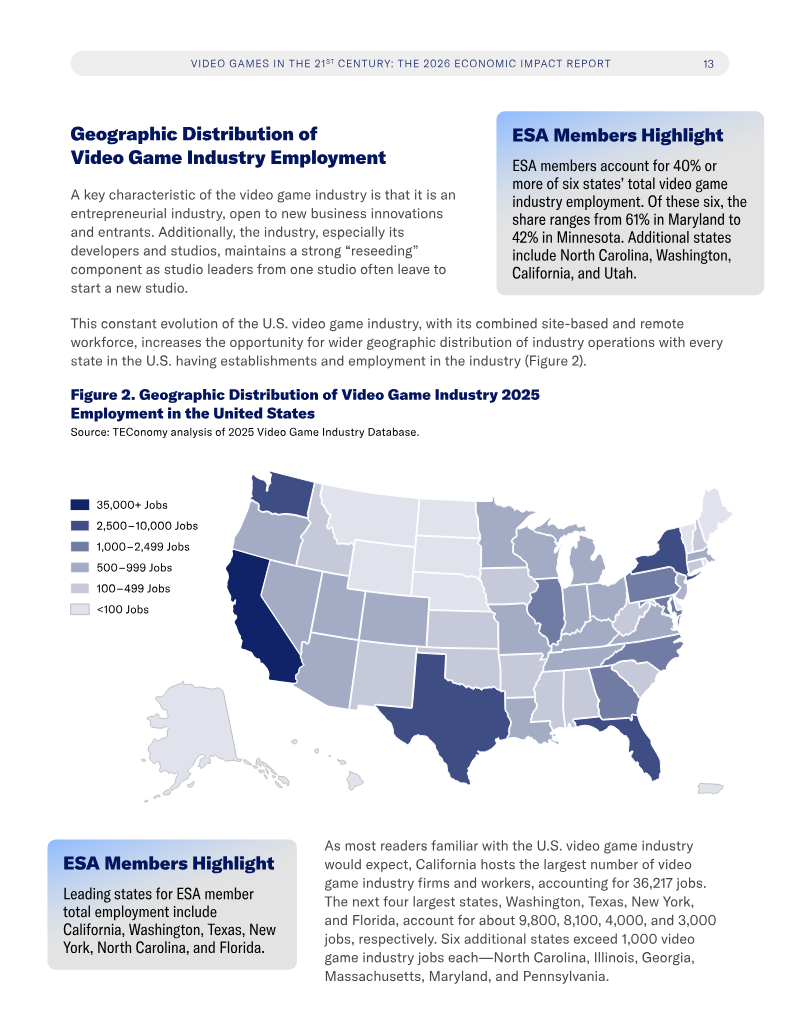
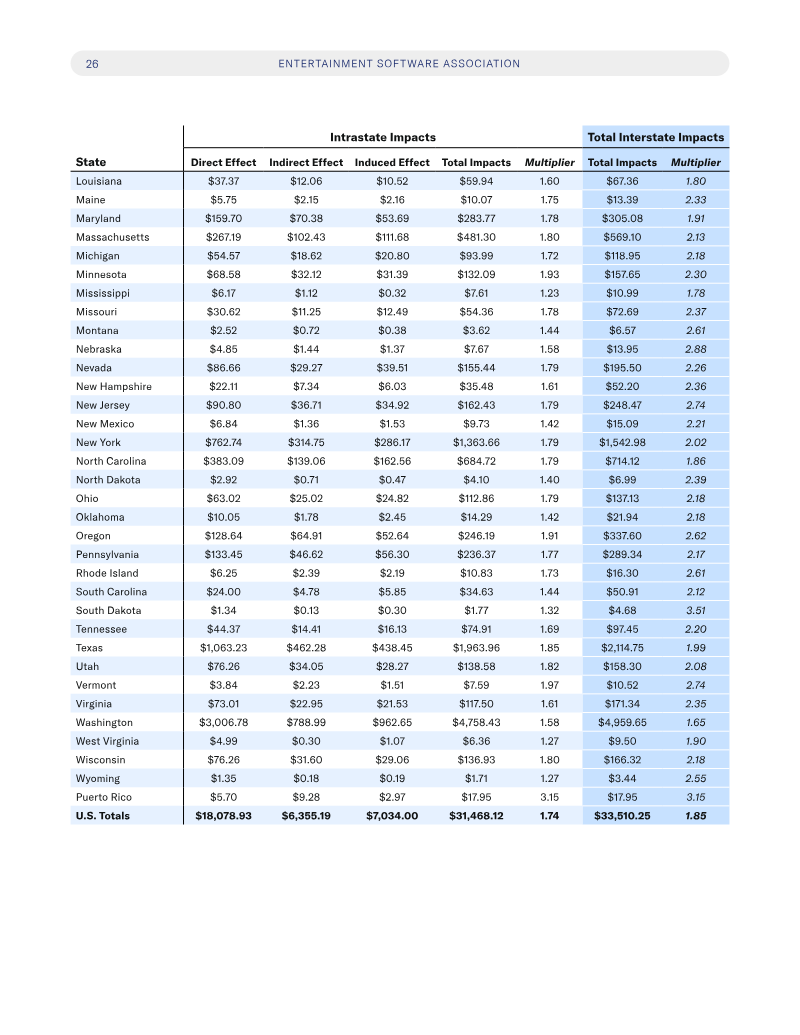
The United States video game industry serves as a robust engine for national economic growth, generating a total economic impact of $95.8 billion and contributing $65.5 billion to the national GDP as of 2025.
- The U.S. video game industry generated a total economic impact of $95.8 billion and contributed $65.5 billion to the national GDP in 2025.
- The sector supports over 250,000 jobs nationwide, with each direct position sustaining approximately two additional roles in the broader economy.
- The industry contributes over $12 billion in combined federal, state, and local tax revenues annually.


New York City Digital Games Industry: 2021 Economic Impact Study
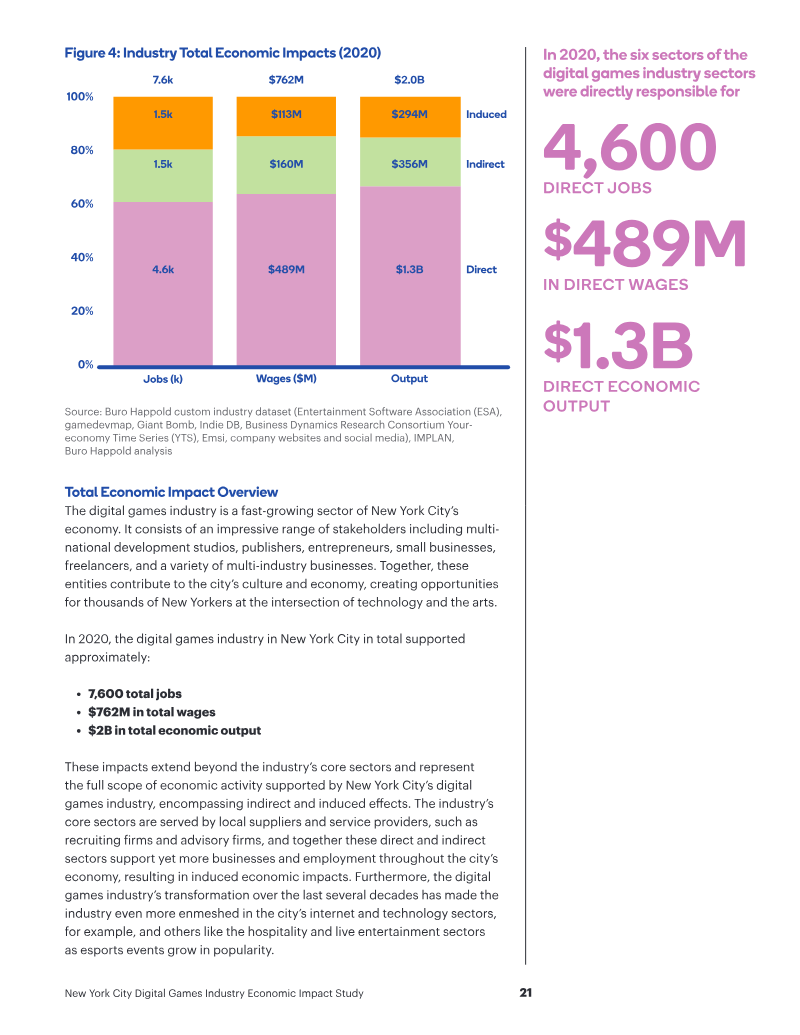
New York City’s digital games industry has emerged as a significant economic engine, generating $2 billion in total output and supporting 7,600 jobs as of 2020.
- New York City’s digital games industry generated $2 billion in total economic output and supported 7,600 direct jobs as of 2020.
- The sector has tripled in size since 2008 and is supported by an ecosystem of over 200 development and publishing studios.
- Venture capital investment in the industry reached $774 million in 2020, representing a 105% year-over-year increase.

European Video Games Industry Insights Report: 2019
The European video games industry generated approximately €12 billion in combined developer and publisher revenue during 2019, reflecting a robust and expanding economic landscape.
- The European video games industry generated approximately €12 billion in combined developer and publisher revenue during 2019.
- France, Sweden, and Finland served as the primary revenue drivers, while Eastern European markets represent significant untapped growth potential.
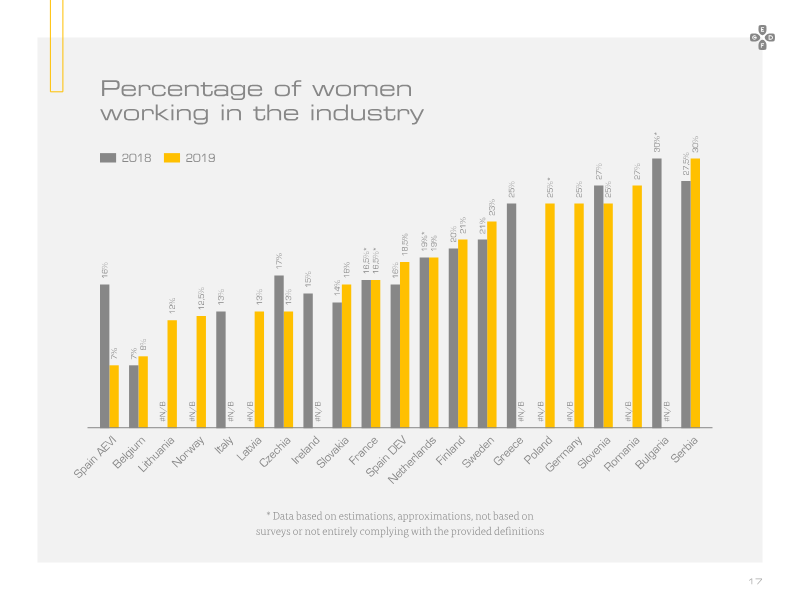
- Gender diversity remains a systemic challenge, with no European nation reporting a female workforce participation rate exceeding 30 percent.
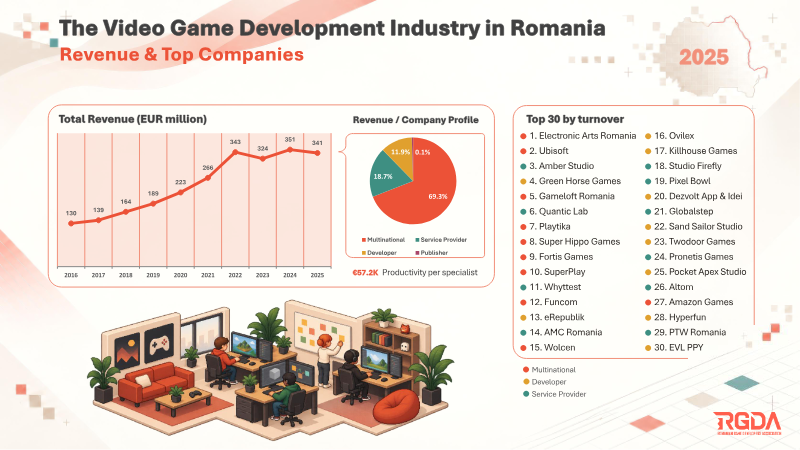
Revenue & Top Companies: Romania 2025
The Romanian video game industry has demonstrated significant resilience and structural evolution, reaching a total revenue of 351 million EUR by 2025.
- The Romanian video game industry reached a total revenue of 351 million EUR in 2025, supported by a workforce of 6,000 professionals.
- The sector has shifted from a service-heavy model to a balanced mix of development and publishing, resulting in a 2.5-fold increase in game releases over the last two years.
- The industry is comprised of 234 active studios, with major international players like Electronic Arts Romania, Ubisoft, and Gameloft ranking among the top 30 companies by turnover.
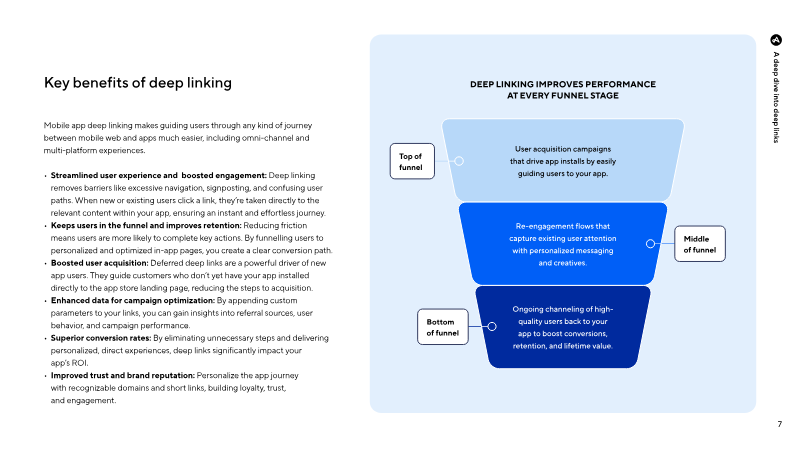


A Deep Dive into Deep Links: The All-in-One Handbook for Mobile App Marketers, Developers, and Product Managers
Adjust's handbook explains deep linking as the mobile equivalent of website URLs, routing users from ads or external sources to specific in-app content, and makes the case for its TrueLink product as the solution for marketers, developers, and product managers.
- Deep linking significantly improves app performance, with CleverTap data showing that users attributed to deep links achieve 81% higher activation rates, 2.5x higher retention rates, and 2x higher conversion rates compared to those using standard links.
- Deep linking technology functions by routing users directly to specific in-app content or screens upon clicking an ad or link, utilizing standards such as Apple Universal Links, Android App Links, and URI schemes.
- Deferred deep linking drives user acquisition by directing individuals who have not yet installed the app to the appropriate app store landing page, thereby reducing friction in the installation process.



La Industria del Videojuego en España: Anuario 2025
The Spanish video game industry in 2025 stands as a vital cultural and technological pillar, characterized by a maturing ecosystem that balances robust consumer engagement with complex economic and regulatory challenges.
- The Spanish video game industry generated 2.293 billion euros in 2025, a 3.2% year-over-year decline driven by a contraction in digital content spending.
- Digital sales remain the primary revenue driver, accounting for 61.9% of total market income.
- The sector serves a player base of 22.8 million people, with mobile devices being the most popular platform, reaching 18 million users.
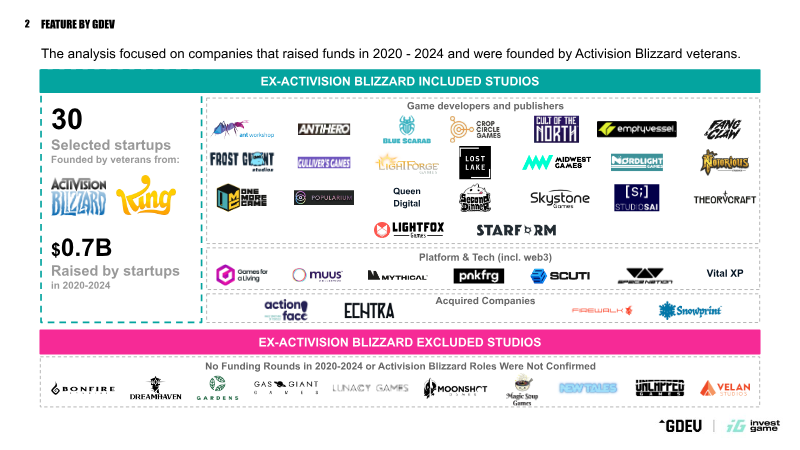
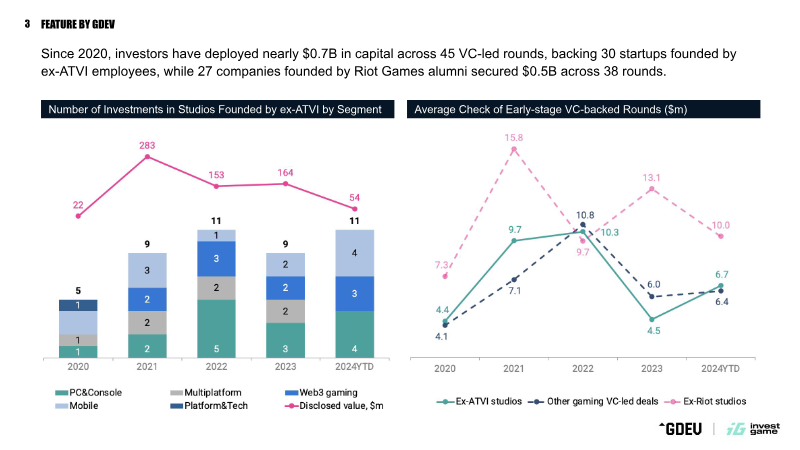

The Alumni Effect: Studios Founded by Ex-Activision, Blizzard, and King Employees
The analysis examines venture capital activity directed toward studios founded by former Activision Blizzard employees between 2020 and 2024.
- Between 2020 and 2024, 30 studios founded by former Activision Blizzard employees secured approximately $0.7 billion in venture capital across 45 funding rounds.
- Ex-Activision studios demonstrate a 'first-round momentum' effect, being roughly four times more likely than peer startups to secure a second round of financing within the same calendar year.
- Investor confidence in alumni teams peaked in 2021, when 43% of ex-Activision studios raised a subsequent round compared to only 9% of broader gaming startups.


Game Data: Building vs Buying
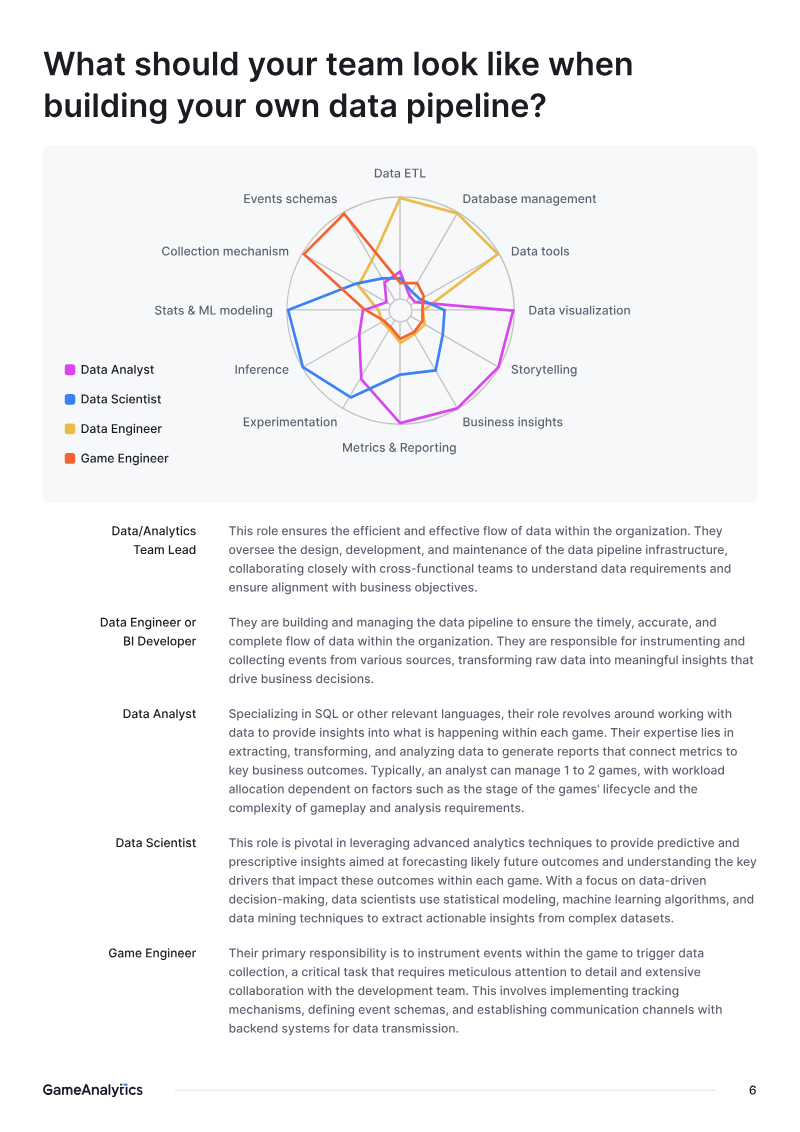
The document evaluates the trade-offs between building an in-house data pipeline and purchasing a third-party solution for game analytics, using GameAnalytics’ PipelineIQ Pro as the primary example.
- Building an in-house data pipeline for a studio with 5 million MAU costs approximately $50,000 per month, compared to $5,900 per month for a third-party solution like GameAnalytics’ PipelineIQ Pro.
- Human capital is the primary cost driver for both approaches, accounting for 89% of the budget for in-house builds and 78% for vendor-managed pipelines.
- Third-party solutions offer significantly faster deployment timelines, ranging from hours to days, whereas custom in-house pipelines typically require months to implement.

Game Analytics 100: The Retention Curve
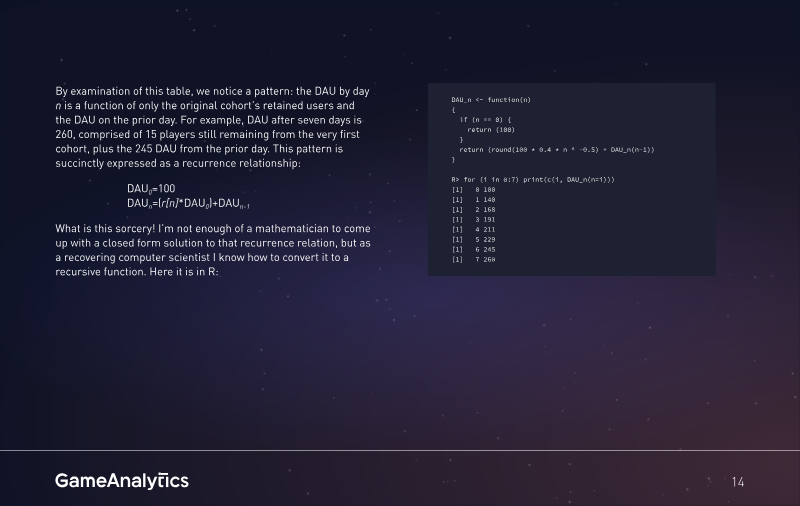
The analysis demonstrates that player retention in mobile games can be accurately modeled with a power-law curve, expressed either as \(r(n)=a\,b^n\) or \(r(n)=a\,n^{b}\).
- Mobile game retention follows a predictable power-law curve, modeled as r(n)=an^b, which allows analysts to forecast long-term player behavior using only day-1, day-3, and day-7 cohort data.
- Fitting retention curves enables precise lifetime value (LTV) projections; for example, an average revenue of $1.00 per daily active user results in an LTV90 of 7.65 and an LTV180 of 10.17.
- Analysts can derive the initial retention level (a) and decay exponent (b) by applying the LINEST function to logged cohort values in Excel, yielding representative curves such as r(n)=0.396n^-0.472.


A Shortcut to Your Own Game Insights Platform
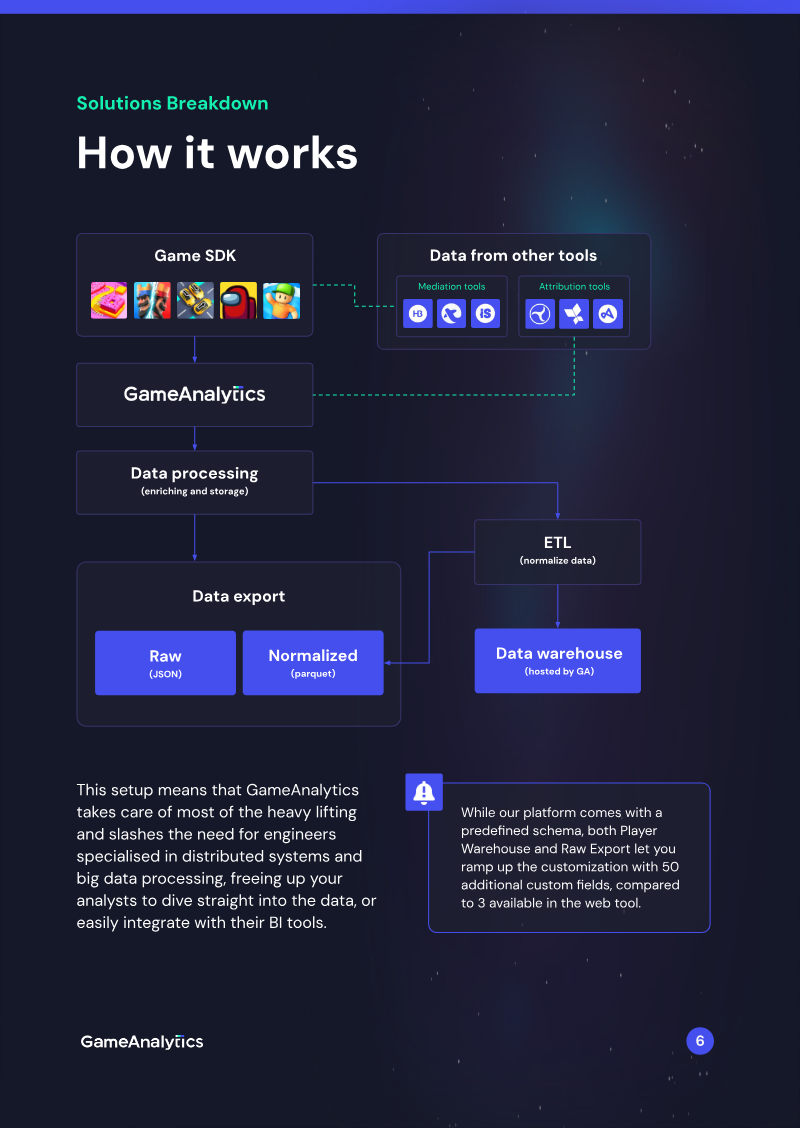
The guide presents a turnkey solution for game studios to build an in-house data pipeline without the high costs of custom engineering.
- GameAnalytics provides a turnkey data pipeline that eliminates the need for custom ETL development, proprietary SDKs, and ongoing infrastructure maintenance.
- The platform offers two primary data delivery methods: Player Warehouse for daily refreshed, SQL-ready event tables and Raw Export for real-time JSON streaming.
- A publisher utilizing Raw Export achieved a 50% increase in lifetime value (LTV) across 19 titles, while a VR MMO leveraged Player Warehouse to improve player engagement.