Game Culture reports and market data
Documents
1-Bit Skin: Materializing Abjection in World of Horror (2023)
This extended abstract, presented at DiGRA 2024, proposes an interdisciplinary study of how the videogame World of Horror (Ysbyrd Games, released October 2023) materializes abjection, drawing on Julia Kristeva's theory from Powers of Horror (1980).
- The paper is a DiGRA 2024 proposal-stage abstract analysing World of Horror (Ysbyrd Games, released October 2023) through Julia Kristeva's theory of abjection from Powers of Horror (1980).
- Its central argument is that videogames, unlike film or text, let players interact with grotesque imagery rather than merely react to it, and that this interactivity reshapes the experience of the abject.
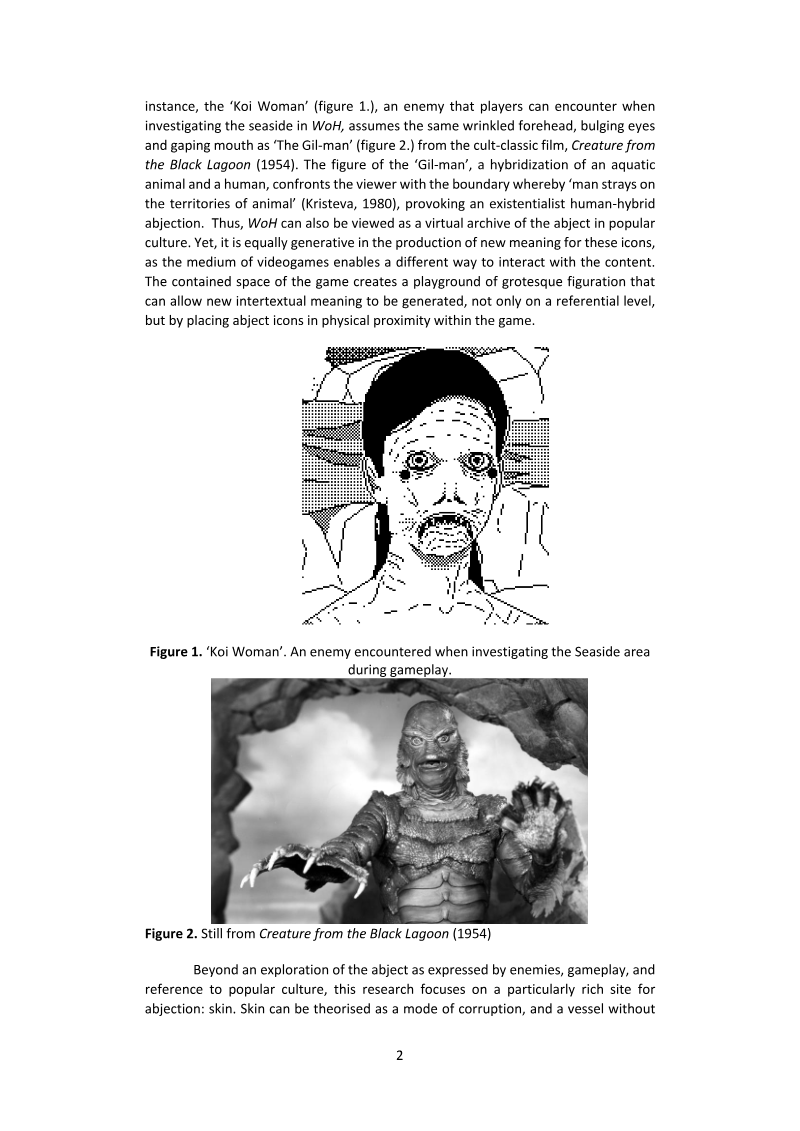
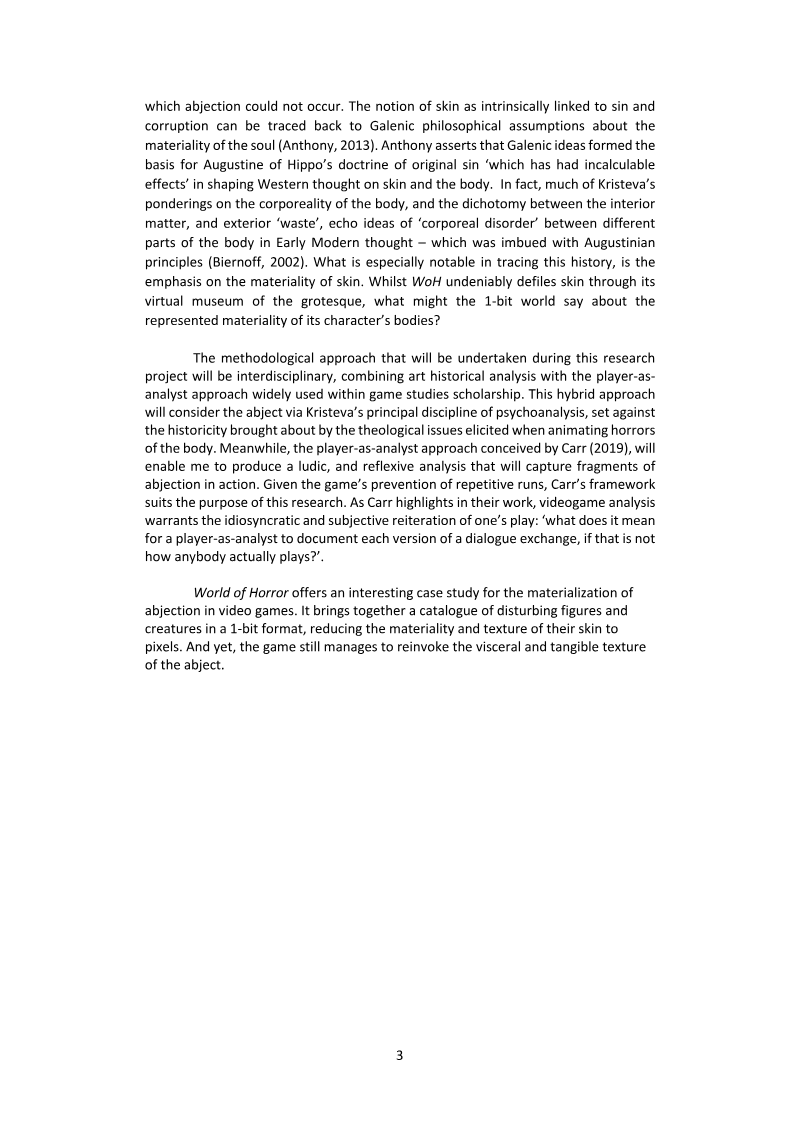
- The author treats the game as a virtual archive of cosmic and body-horror references, including Junji Ito, H.P. Lovecraft, and the 1954 film Creature from the Black Lagoon, where these icons gain new meaning through proximity.
Order in Chaos: Toward a Theory of Videoludic Noise
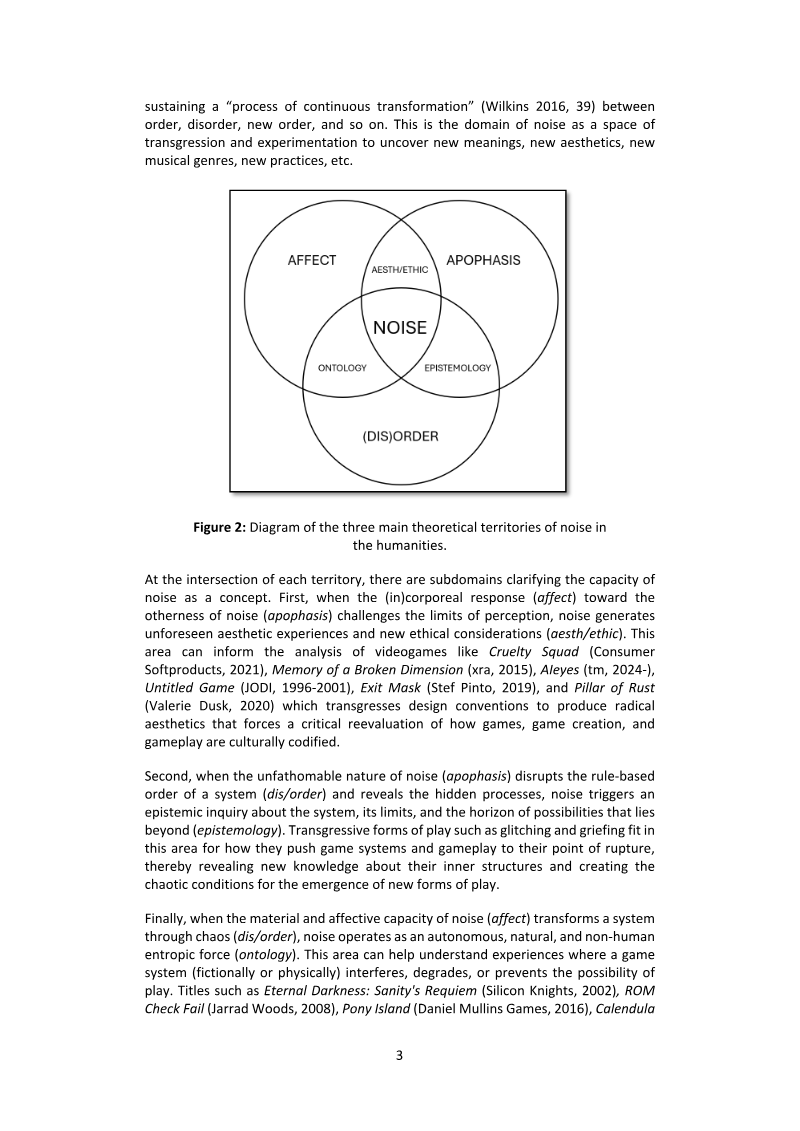
This paper proposes a theoretical framework for understanding "noise" within video game studies, arguing that the field has only begun to engage with a concept that has long been central to information theory and the humanities.
- The paper argues that 'noise' in video games should be treated as a productive analytical category that can generate new knowledge about games, play, and game culture, rather than merely as a technical error or game-breaking nuisance.
- The authors aim to bridge emerging game-studies discussions of noise, such as Salen and Zimmerman's treatment of chaos within rule systems and Consalvo's typology of cultural, semantic, and technical noise in online multiplayer spaces, with more developed transdisciplinary theories from media, sound, film, and philosophical scholarship.
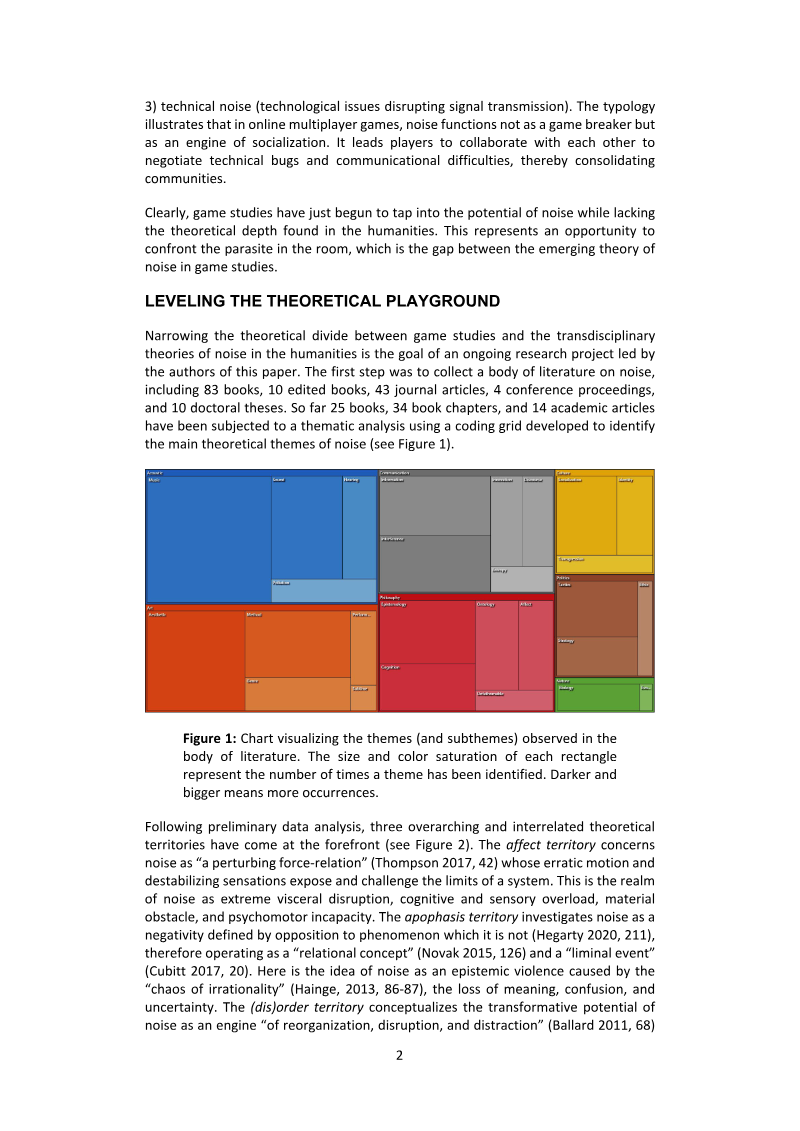
- The research is based on a corpus of 83 books, 10 edited volumes, 43 journal articles, 4 conference proceedings, and 10 doctoral theses, of which 25 books, 34 book chapters, and 14 academic articles were thematically coded.
Poverty (Is All Fun) and Games
This paper examines how poverty and minimalism are represented in digital games, arguing that games simulating financial hardship occupy an ambiguous space between social education and playful entertainment.
- The paper argues that games simulating financial hardship, such as Spent, Ayiti: The Cost of Life, Broke: the game, and Nanopesos, can build empathy and awareness of privilege, but risk trivializing poverty when played purely for pleasure.
- The author links the trivializing risk to 'slumming' and to the exploitative genre of 'poornography,' cautioning against treating poverty as entertainment.
- Most of the poverty-themed games analysed are 'broken games' that make victory difficult or impossible, a design choice the paper suggests serves their didactic purpose.
A Stray Autoethnography: Becoming-Animal, or Anthropomorphic Humanism?
This paper, by Poppy Wilde of Birmingham City University, examines whether the player's empathy for the cat avatar in the 2022 videogame Stray represents a genuinely posthuman relation or instead reinforces anthropocentric humanism through anthropomorphism.
- The paper asks whether players' empathy for the cat avatar in Stray (2022) is a genuinely posthuman relation or reinforces anthropocentric humanism through anthropomorphism.
- The author argues that the game's emotional force depends heavily on the primacy of human feeling, which complicates claims that becoming-animal experiences in videogames fully escape anthropocentrism.
- The analysis draws on Braidotti's critique of anthropomorphising animals, Deleuze and Guattari's becoming-animal, and Haraway's companion species framework.
Who Owns the Gamespace? Negotiating Spatial Agency in Video Games
This paper examines spatial agency in video games, defining it as the degree of ownership a player can assert over the gamespace once a game becomes publicly available.
- The paper defines 'spatial agency' as the degree of ownership players can assert over the gamespace of a location-based game once it is publicly available, and asks whether player alterations of game maps amount to modding, vandalism, or cheating.
- Its central case study is Pokémon GO and Niantic's 2017 switch from Google Maps to the crowdsourced OpenStreetMap, after which Reddit players edited OpenStreetMap with false inputs (such as relabeling residential backyards as parks or lakes) to attract rare in-game items.
- Niantic treats such map manipulation as cheating and penalizes it, while cartographers regard it as vandalism, producing friction among players, cartographers, and the company.
Observant Play and Modding: The Postcolonial, Environmentalist Playthrough of Minecraft
This autoethnographic extended abstract by J. M. L. Whittington examines an alternative, non-extractive way of playing Minecraft that resists the colonial and industrial logics the author sees embedded in sandbox crafting games.
- The paper is an autoethnographic extended abstract by J. M. L. Whittington that reads Minecraft's depopulated, post-civilization Overworld as a postapocalyptic landscape, drawing on Melissa Kagen's "postapocalyptic pastoral" and Rachael Hutchinson's "observant play."
- Its central argument is that players can choose a non-extractive, anti-colonial, environmentalist way of playing a sandbox crafting game, heeding the lessons of resource exploitation embedded in the game world.
- The evidence rests entirely on the author's own reflexive play through a Minecraft Java Edition 1.18.2 / Forge modpack with one other player, with no survey or quantitative data.

The Subject of Games: Cartesian Anxiety in Game Cultures, Game Studies, and Gameplay
Gerald Voorhees's argument in "The Subject of Games" is that game studies is divided by a "Cartesian anxiety" over whether the player is a self-coherent, rational agent in control of play or a relational, malleable subject shaped by the games and social structures around them.
- Voorhees argues game studies is split by a "Cartesian anxiety" between viewing the player as a self-coherent, rational agent in control of play versus a relational, malleable subject shaped by games and social structures.
- The author traces the rational Cartesian cogito to Western colonial and imperialist traditions and proposes Lacan's split subject as a more productive alternative.
- The core thesis is that the field should develop a theory of the subject that is self-coherent yet lacks a stable foundation, rather than resolving the tension toward sovereign player agency or dissolving the player into posthuman or structural accounts.

gamevironments: Pirating Platform Studies and Other Essays
Phillip Penix-Tadsen's article argues that Latin American clone consoles, active from roughly 1973 to 1994, deserve a central place in platform studies and game history.
- Informal practices such as reverse engineering, cloning, and hardware localization, not formal industry channels, were the dominant means by which most players in Latin America accessed games between roughly 1973 and 1994.
- The article's catalogue documents roughly ninety clone consoles derived from the Magnavox Odyssey, Pong, Atari VCS, Sega Master System, and Nintendo Famicom/NES, with Brazil accounting for the majority of entries.
- Brazil's 1980s informatics market reservation encouraged domestic clone production under protectionist conditions, and many Brazilian clones were tied to this policy.

gamevironments: Narrative
This report presents an interim update on a postdoctoral research project examining religion within the tabletop miniature wargame Warhammer 40,000 (40K), produced by Games Workshop.
- The report is an interim update on a postdoctoral study of religion in Games Workshop's tabletop wargame Warhammer 40,000, asking whether painters experience flow states, what sacred experiences players have with the game's religious content, and how its problematic elements (an ironic theocratic dictatorship and Chaos deities) are interpreted.
- Based on semi-structured interviews with 12 participants recruited from Warhammer Facebook groups, each required to paint at least two hours weekly, interviewed three times over six months and keeping reflective painting journals.
- All participants reported flow states consistent with Csikszentmihalyi's criteria, and painting appeared to reduce anxiety and improve mental health.
Gamification of Gothic
Tanya Krzywinska's "Gamification of Gothic" argues that a Gothic critical lens offers sharper insight into videogames than has previously been applied, despite the frequent appearance of Gothic themes across game genres.
- Krzywinska's "Gamification of Gothic" argues that a Gothic critical lens yields sharper insight into videogames than prior scholarship has applied, fusing Game Studies with Gothic Studies and treating gamification as a form of remediation.
- The work proposes five coordinating nodes for evaluating Gothic in games: character and story patterns, mise-en-scène and style, affect, entropy, and the sublime, with the "false hero" protagonist serving as the initial benchmark.
- The analysis contends that most mainstream games, built around progression, winnable conditions, and temporary death, resist the entropy that defines authentically Gothic experience.
Nordic Larp as a Method in Mental Health Care and Substance Abuse Work: Case SÄRÖT
The SÄRÖT project establishes Nordic larp as a viable, innovative methodology for supporting individuals navigating mental health challenges and substance abuse recovery.
- Nordic larp functions as an effective experiential therapy tool for mental health and substance abuse recovery by allowing participants to process trauma through immersive, character-based role-play.
- The methodology relies on a combination of realistic scenarios and structured post-game reflection to increase participant self-awareness and engagement with professional healthcare services.
- Rigorous safety protocols, including expert facilitation and comprehensive debriefing workshops, are essential to mitigate the emotional intensity and potential triggers inherent in the larp experience.
Teaching with Games: Formative Gaming in Religion, Philosophy and Ethics
Playing to Grow examines whether video games can serve as meaningful instruments of character education, social and emotional learning (SEL), and moral instruction.
- A 2023 roundtable of game scholars and educators argues that player-choice games may offer richer pathways to character development than extrinsically rewarded systems such as PBIS and MTSS, positioning games as conversation openers rather than standalone solutions.
- The most concrete empirical evidence is a UNESCO MGIEP study of the interactive fiction game Bury me, my Love with students in Dubai and New Delhi, which found a positive correlation between empathy and compassion, with compassion gains attributed to players translating empathy into action.
- Beyond the UNESCO MGIEP study, supporting evidence is largely qualitative and anecdotal, drawing on titles such as Lost Words: Beyond the Page, Quandary, This War of Mine, Sky: Children of the Light, and the Lost & Found series, a limitation participants openly acknowledge.