1 free read left. Create a free account for unlimited reading + AI research.
Create free accountWhitepaper DiGRA
1 free read left. Create a free account for unlimited reading + AI research.
Create free accountWhitepaperDiGRA
The author, J. M. L. Whittington, draws on Melissa Kagen's "postapocalyptic pastoral" and Rachael Hutchinson's "observant play."
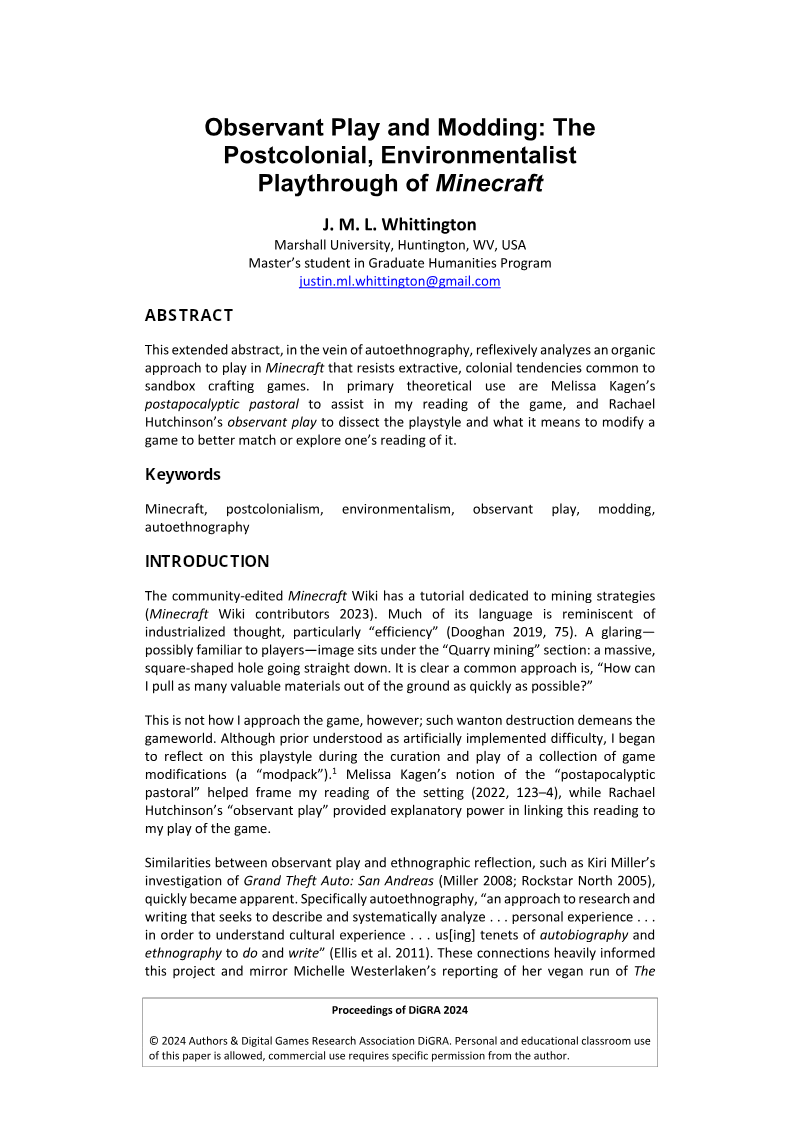
This autoethnographic extended abstract by J. M. L. Whittington examines an alternative, non-extractive way of playing Minecraft that resists the colonial and industrial logics the author sees embedded in sandbox crafting games. Drawing on Melissa Kagen's concept of the "postapocalyptic pastoral" and Rachael Hutchinson's notion of observant play, the paper argues that the game's depopulated Overworld, with its scars of past civilization and undead remnants, can be read as a postapocalyptic landscape whose lessons about resource exploitation a player may choose to heed. The analysis is grounded in the author's personal play experience rather than in survey or quantitative data, and it situates itself within the broader literature on game modding, ecocriticism, and postcolonial readings of games.
The central evidence is the author's own play through a modpack built on Minecraft Java Edition 1.18.2 and Minecraft Forge, played with one other person. Key moments include the introduction of charcoal in Beta 1.2, which allows renewable fuel through tree farming and reduces the need to strip-mine the landscape, and the Alchemistry mod, which enables breaking materials into base elements and recombining them, producing renewable sources of otherwise finite resources such as iron. The paper also notes that these mechanics introduce new challenges, such as powering machinery, and that players retain agency in how far they limit their own engagement with such options.
The scope is therefore narrow and interpretive: a single player's reflexive account, with a focus on the Minecraft Wiki's mining tutorial as a counterpoint representing efficiency-oriented play. The author frames the work as a starting point, identifying further research into this methodology and into how players manipulate game structures for political ends.
Each row is a game or company this document names, each column a document, oldest first. A mark means that document names it. Select a row to see those documents.

DiGRA · 2026

DiGRA · 2026



DiGRA · 2026



DiGRA · 2026



DiGRA · 2026



DiGRA · 2026



DiGRA · 2026



DiGRA · 2026



DiGRA · 2026

DiGRA · 2026



DiGRA · 2026



DiGRA · 2026
gamevironments · 2026