Finland reports and market data
Documents

Supercell CEO Ilkka Paananen talks humble success
The mobile gaming industry is characterized by a unique paradox where intense global competition coexists with a highly collaborative and friendly developer community.
- Supercell maintains a rigorous innovation strategy where the frequent cancellation of underperforming projects is a standard, expected component of the development lifecycle.
- The company’s commitment to high standards is evidenced by a high failure-to-launch ratio, exemplified by the cancellation of four projects in the same year that only two successful titles were launched.
- Supercell prioritizes long-term stability by dedicating the majority of its company resources to refining and supporting existing flagship titles rather than focusing solely on new releases.

The industry is still learning about F2P says PlayHaven's Ville Heijari
The free-to-play business model represents a significant evolution in game accessibility, shifting the industry toward a framework that prioritizes user engagement and lifetime value maximization.
- The free-to-play model functions by segmenting users into non-paying players and high-value spenders, allowing developers to sustain operations through tiered engagement strategies like ad-supported gameplay or optional purchases.
- While industry leaders such as Supercell, Gung-Ho, and King have achieved significant commercial success, the broader development community is still in a formative learning phase regarding sustainable monetization.
- The primary challenge for developers is moving beyond simple revenue extraction to creating high-quality game experiences where monetization is integrated naturally into the gameplay.

Everyplay talks about its new gamer face-sharing feature
Everyplay, a video-sharing service developed by Applifier, is expanding its platform capabilities to enhance social engagement for mobile gamers.
- Everyplay is expanding its mobile social gaming platform by allowing users to record and overlay front-facing camera footage of their reactions and commentary directly onto gameplay.
- The service currently supports 75 live titles, with an additional 120 games in the integration pipeline.
- High-profile integration in the game Bad Piggies resulted in over 120,000 replays recorded within the first 30 days of the feature's availability.
Word-of-mouth virality drives 57% of discovery, says Everyplay's Laakkonen
Word-of-mouth communication serves as the primary driver for mobile game discovery, accounting for 57% of new user acquisition.
- Word-of-mouth communication is the primary driver of mobile game discovery, accounting for 57% of new user acquisition.
- Peer-to-peer validation is critical to app store performance, with nearly 50% of store-based discovery effectiveness attributed to user reviews.
- Gameplay video is the most effective medium for driving viral growth because it captures the dynamic nature of interactive experiences better than static text or images.
Suomen Pelitoimialan Strategia 2010-2015: Visio 2020
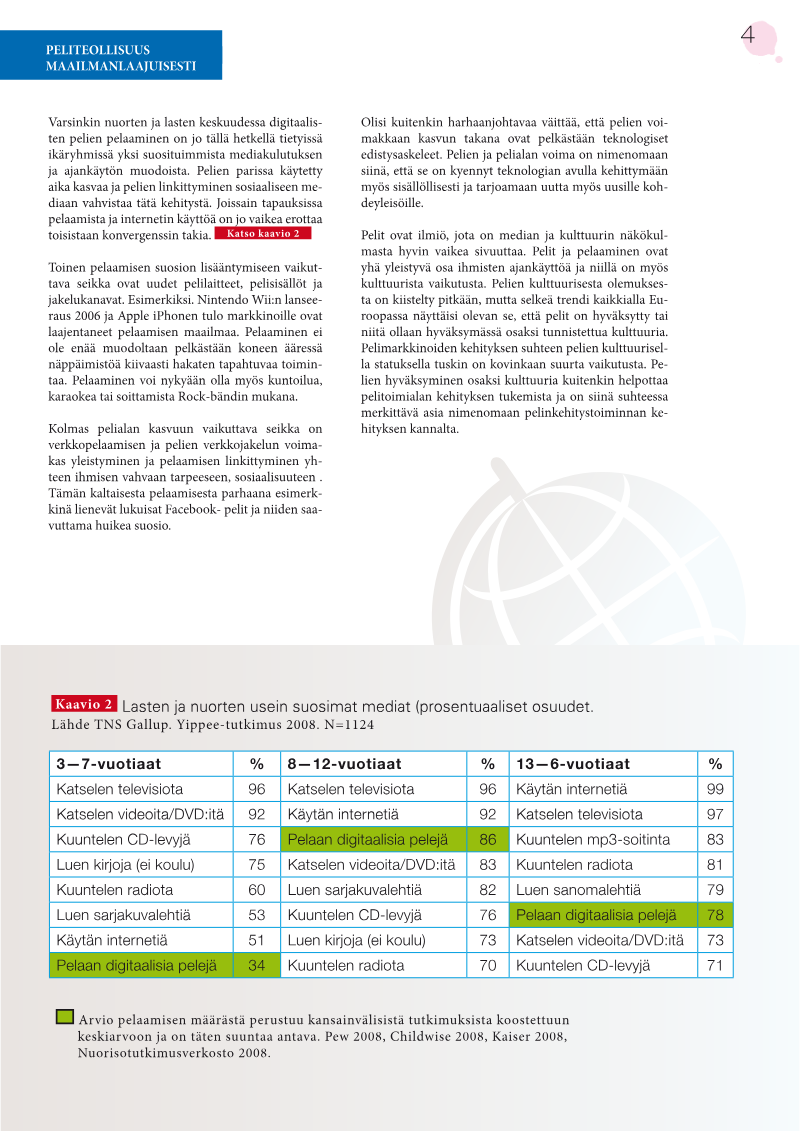
The Finnish gaming industry represents a high-growth cultural export sector that consistently outperformed global market benchmarks between 2004 and 2008.
- The Finnish gaming industry targets a 2020 vision of 6,600 employees and €540 million in annual revenue, with €380 million derived from exports.
- The sector is shifting away from traditional, publisher-led models toward digital distribution and online services to secure intellectual property rights and independence.
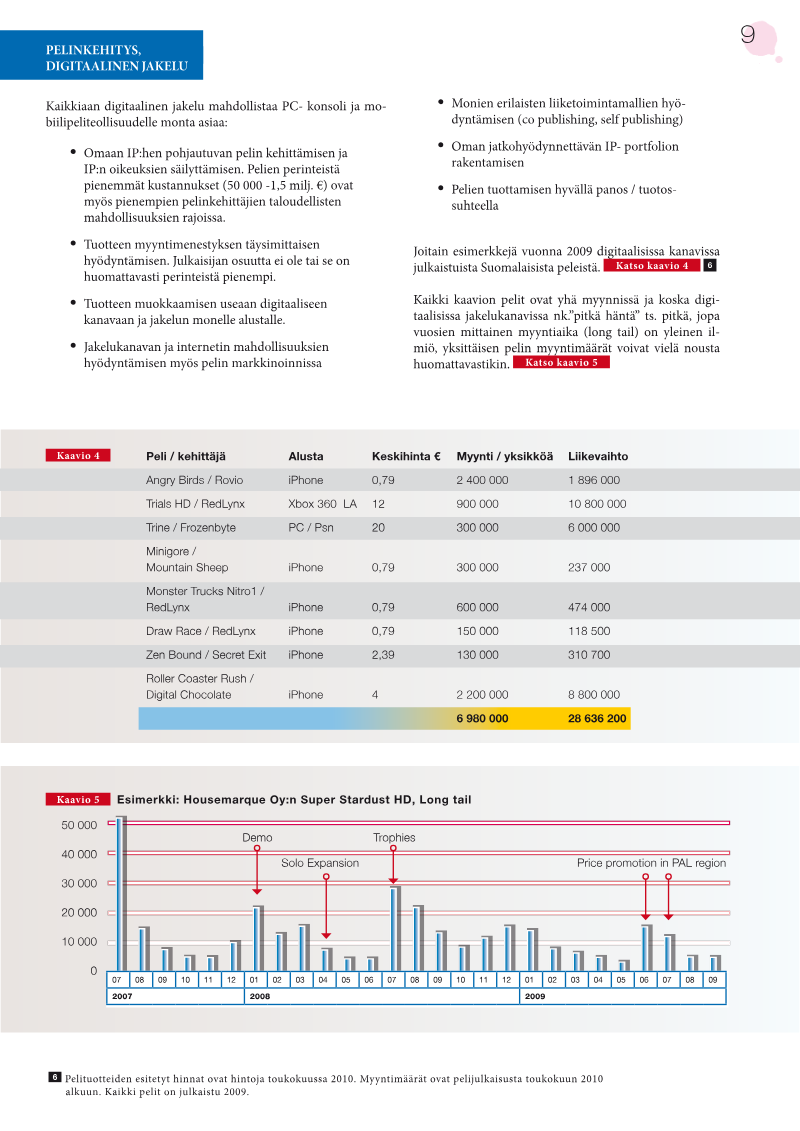
- Digital distribution is identified as the primary catalyst for growth, enabling lower production costs and direct engagement with global consumers.

Suomen pelialan koulutus ja sen kehittämistarpeet
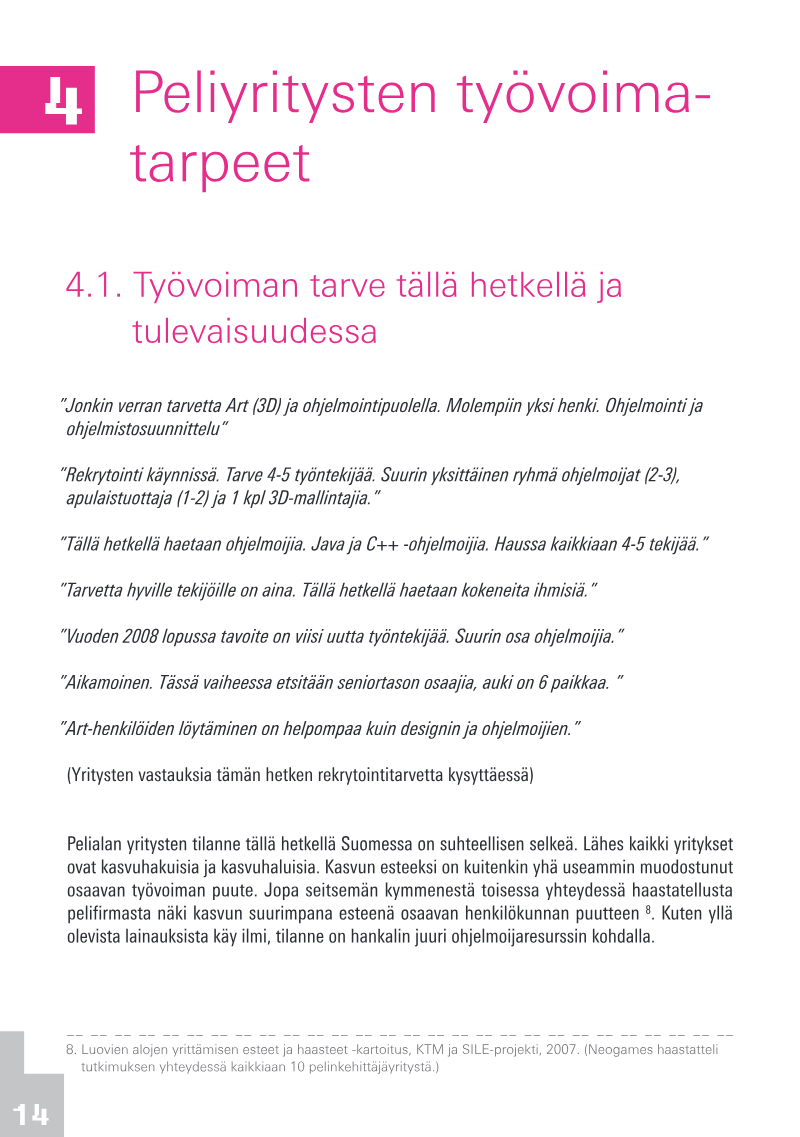
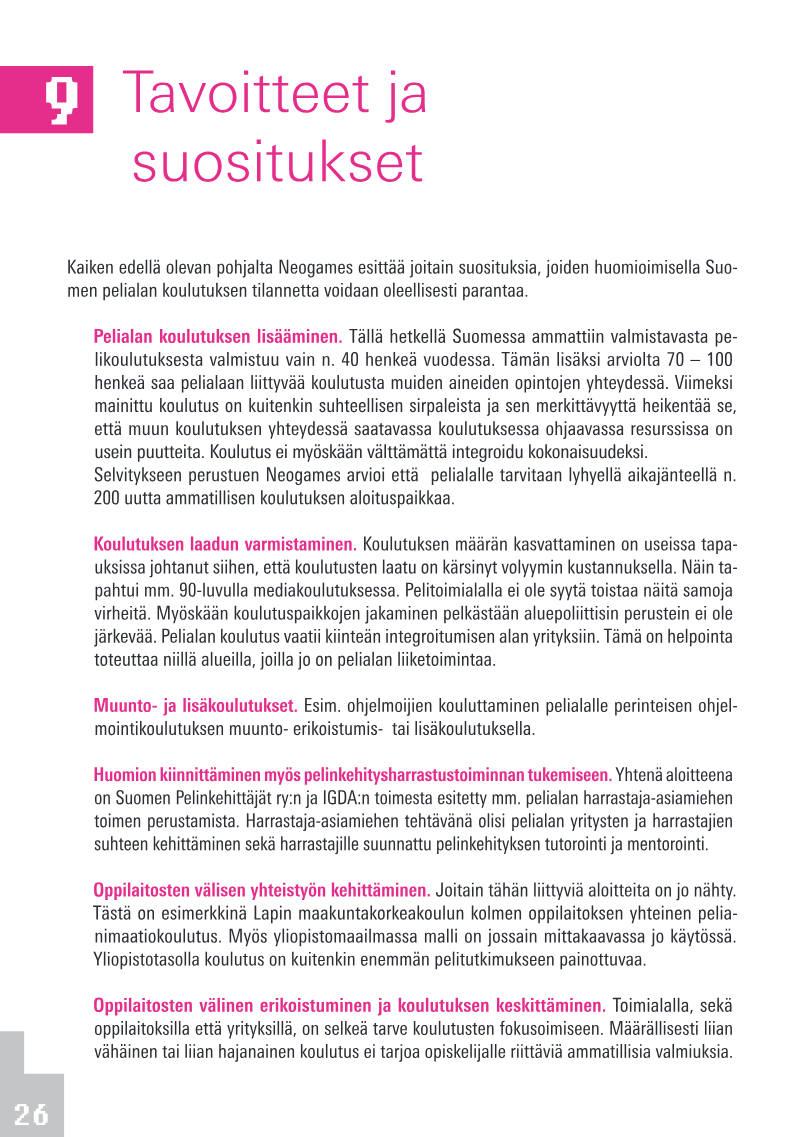
The Finnish game industry stands at a critical juncture where robust growth potential is increasingly constrained by a systemic labor shortage and a misalignment between academic output and professional requirements.
- The Finnish game industry faces an annual labor shortage of 150 to 200 professionals, while academic institutions currently produce only 40 graduates per year.
- A critical misalignment exists between academic output and industry needs, specifically regarding a lack of business and marketing expertise alongside technical programming roles.
- The current educational landscape is too fragmented and geographically dispersed, forcing companies to spend significant resources on internal training to bridge the skill gap.
The Finnish Games Industry 2010-2011
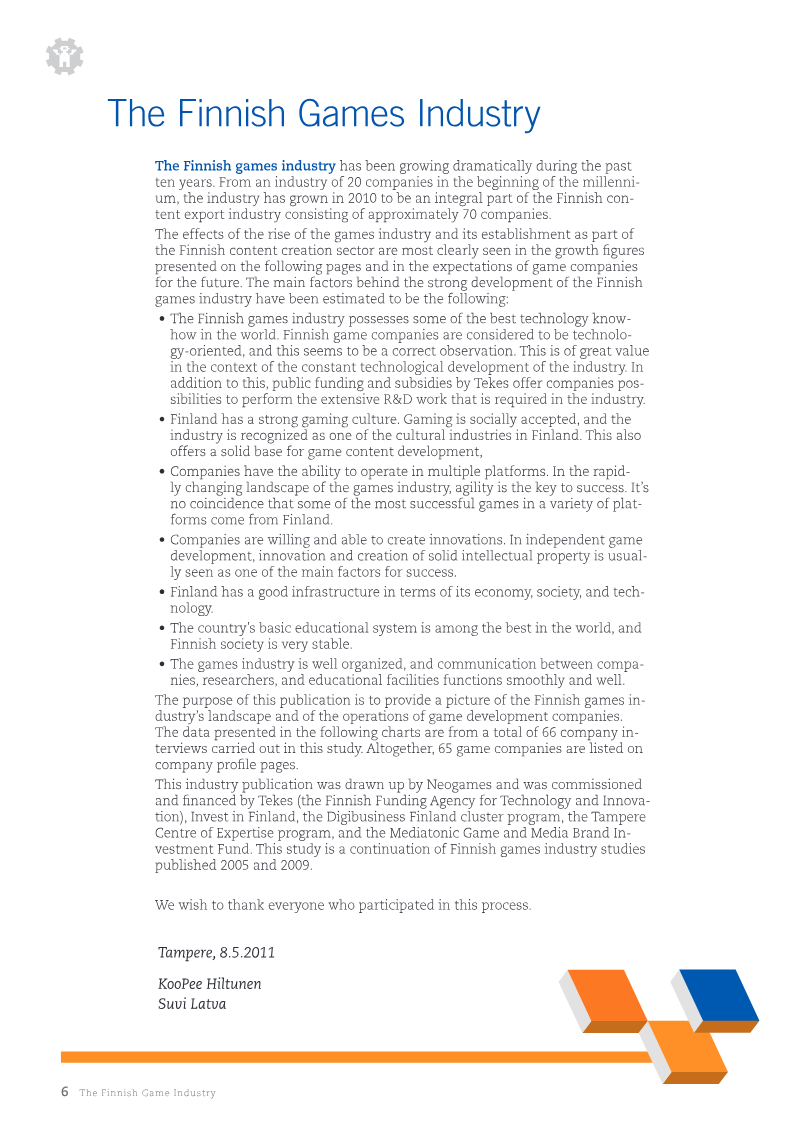
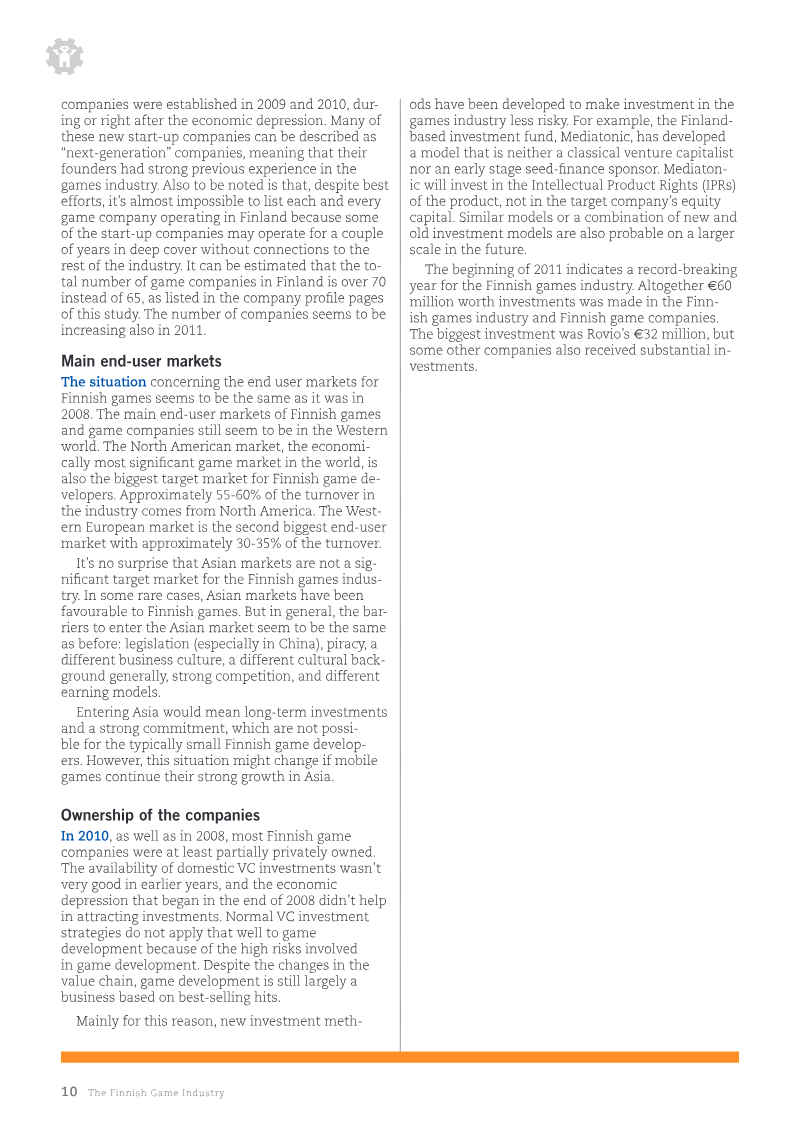
The Finnish games industry underwent a period of rapid expansion between 2010 and 2011, transitioning from a post-recession recovery phase into a state of hyper-growth.
- The Finnish games industry experienced rapid growth between 2010 and 2011, with annual turnover increasing from approximately €105 million to €165 million.
- The sector's economic expansion was primarily driven by a strategic pivot toward mobile platforms and digital distribution, highlighted by the global success of Angry Birds.
- The industry is highly export-oriented, with 85 to 95 percent of total revenue generated from North American and Western European markets.

The Finnish Games Industry: 2008
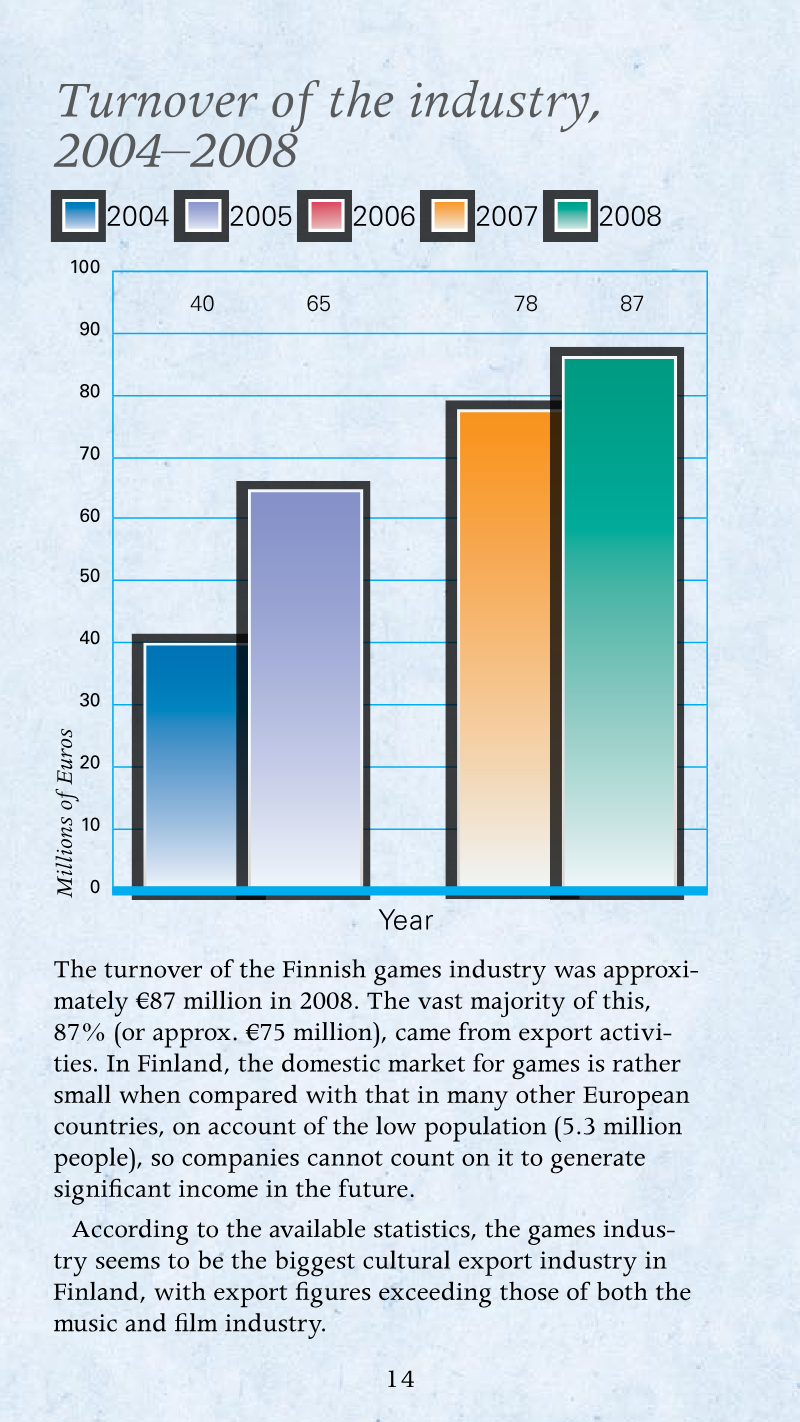
The Finnish games industry emerged by 2008 as a primary cultural export sector, generating a total turnover of €87 million.
- The Finnish games industry generated €87 million in total turnover in 2008, with 87 percent of revenue derived from international markets.
- Public funding was critical to innovation, with Tekes subsidies covering nearly 30 percent of the €22 million invested in research and development during 2007.
- The sector employed over 1,100 people across 32 active development firms, including established entities such as Remedy Entertainment and Sulake Corporation.
Finnish Gaming Industry: 2007
The Finnish gaming industry in 2007 stands as a rapidly expanding sector, characterized by high technical proficiency and a strong international orientation.
- The Finnish gaming industry generated approximately EUR 70–80 million in net sales in 2006, supported by a workforce of over 1,200 professionals.
- The sector is shifting from a mobile-centric focus toward a diversified portfolio that includes PC, console, and online platforms.
- Industry growth is being driven by a strategic transition toward digital distribution and service-oriented models, specifically utilizing micro-payments, in-game advertising, and user-generated content.
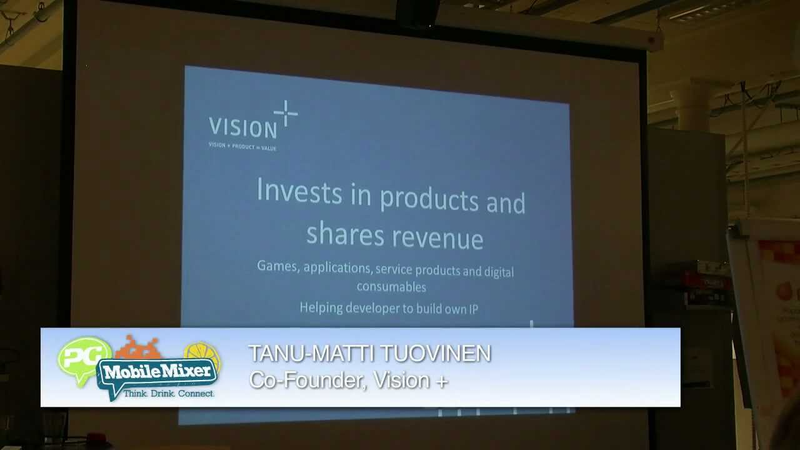
Pocket Gamer's Mobile Mixer 2012 - Tanu Matti Tuovinen from Vision +
Vision+ operates as a strategic investment firm focused on supporting game developers by providing capital while allowing creators to retain full ownership of their intellectual property.
- Vision+ utilizes a revenue-sharing investment model that allows game developers to retain full ownership of their intellectual property without diluting their equity.
- The firm provides individual investments ranging from 50,000 to 500,000 euros, typically covering 50% of a project's average one-million-euro production budget.
- Backed by Microsoft and Nokia, the fund is designed to support up to 200 distinct intellectual properties across web, mobile, PC, Mac, and console platforms.
Pocket Gamer's Mobile Mixer 2012 - Ville Tuominen from Symbio
The development landscape for Windows Phone in 2012 presents a strategic opportunity for mobile developers despite the platform’s smaller market share compared to industry leaders.
- Microsoft’s massive annual R&D investment, which exceeds that of major competitors, signals a long-term commitment to the Windows Phone ecosystem.
- Windows Phone is experiencing rapid growth, with adoption curves currently outpacing those of the Android market as of 2012.
- Microsoft provides robust, mature tooling and high-quality documentation that enables rapid application development and high levels of abstraction.
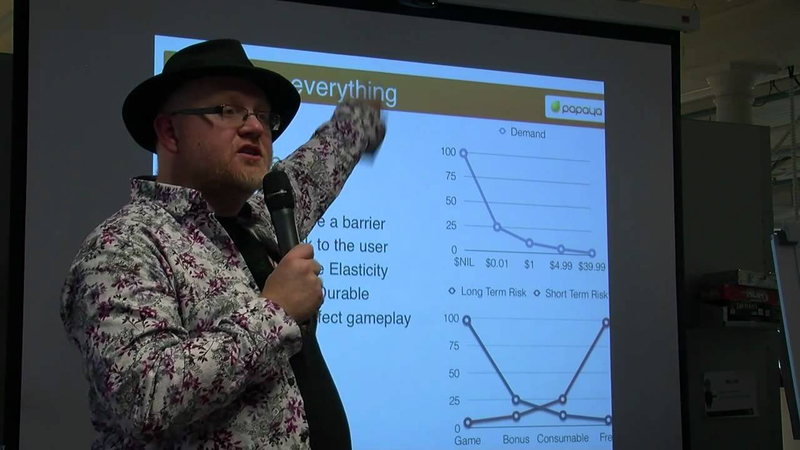
Pocket Gamer's Mobile Mixer 2012 - Oscar Clark from Papaya Mobile
The presentation outlines a strategic framework for mobile game design, emphasizing that successful monetization is inextricably linked to social integration and player psychology.
- Developers should treat free players as a vital pipeline, as 'whales' typically engage with a game for 8 to 12 days before making their first purchase.
- The industry saw a rapid shift toward free-to-play models between 2012 and the preceding period, with premium-style monetization adoption increasing from 37% to 65% in six months.
- Cross-game monetization is a significant revenue driver, evidenced by XCity data showing 42% of paying players spent money in multiple titles with an average revenue per paying user of $12.73.