1 free read left. Create a free account for unlimited reading + AI research.
Create free account
Pocket Gamer's Mobile Mixer 2012 - Oscar Clark from Papaya Mobile
Key insights
6 takeaways- 01Long-term player lifetime value is maximized by avoiding 'purchase hangovers,' where players experience regret, and by designing games that foster trust and self-expression.
- 02The industry saw a rapid shift toward free-to-play models between 2012 and the preceding period, with premium-style monetization adoption increasing from 37% to 65% in six months.
- 03Social features function as a force multiplier for organic growth by leveraging the network effect, which allows players to track friends' progress and increases overall engagement.
- 04Monetization strategies should offer a mix of durable and consumable virtual goods to capture the full revenue curve rather than relying on a single, rigid price point.
- 05Developers should treat free players as a vital pipeline, as 'whales' typically engage with a game for 8 to 12 days before making their first purchase.
- 06Cross-game monetization is a significant revenue driver, evidenced by XCity data showing 42% of paying players spent money in multiple titles with an average revenue per paying user of $12.73.
Ask AI about this video
Transcript
uh for those of you who do know me I um used to do all sorts of fun things like running the uh uh game service for three where we were quite successful um for those of you who don't you might have heard of something called PlayStation home I was home architect for three years I've also spent some time at Nvidia real networks and all sorts of other things um what I'm here to do is to tell you all about the joys of social game design um I don't think I'm going to plug things at you too hard I'll try not to to what I want to try and do is leave you thinking that actually there's more to this uh game design thing than I used to think actually there out the people out there and how do we connect those and how do we use that to help us make lots of money out of the games that we want to create but rather than just making games that are free and dull let's make games that are better because people are there so what's going to be important to you to be able to do that is I think understanding the psychology of players and if turns out we' be looking
at psychology of people who buy things for a very long time uh there's a guy called maslo in the 50s is a particular model used by anyone who's ever done any marketing and I apologize for boring and uh basically patronizing you if you are a marketing guy because you've seen this for probably every year of your career um but it's a model that works and it's surprisingly useful when you apply it to game design so what on Earth does this mean well we start off trying to understand what what people want by their basic needs and in the context of games our basic needs aren't heat light you know shelter which is what we need if we're human beings in the real world in a game we want to be entertained but as one as that we're actually interested in safety once we've got a house and we're alive and we're able to stay alive and we're now feeling safe we also then want to belong and then having belonged to something we want to be able to show off and then having the ability off then gives us the
chance to actually make the most of our Lives as long as all of these needs are satisfied we can actually do things in life now how does that apply to games well what I'm going to try and do is give you a sense of that so keep me entertained if we don't keep our users entertained they go away build my trust if people don't think that they're willing to part with their credit card details to buy your game to go through the extraordinary amount of effort it takes to get through Google Checkout that's a problem so we have to build trust if we're going to get people to do that to actually spend money with us they need to know who else is playing this game to make sure that they know that this thing has a sense of value and quite a lot of this is done every day just by you talking to your friends and saying oh this is a great game and that's a great game I've played Angry Birds a few times why don't you play it well actually we can do that in a social context as well we can do that within the game and increasingly doing this Within theame the game being able to see
the footprints in the sand the the play of other people having an impact on our game experience a meaningful impact on our game experience is increasingly important but once I've seen that once I know that's happening let me show off and what we found is by looking at the data of how people spend money people go through this stage the very first part of spending money in a premium game they start by doing something with their Avatar or doing something that lets them show off or doing something that lets them have some creativity so it's a really interesting first stage but it's not where the real money comes from it comes from when they start getting fully and deeply involved in the game it comes from them spending money on the accelerators that make the game more interesting now why am I saying all this I'm saying this because there's been a dramatic shift in the way people spend
money on games on phones in particular last year according to the flurry data I'm sure they've got more up- to-date data than this now but according to that data in January went from about 37% uh being premium to about 65% being premium by June last year June last year six months a massive change complete reversal of the relationship between games which are paid for up front and games which are paid for once you've started started playing and enjoying the game that doesn't happen magically for no reason that happens because we've kept them entertained we've built their trust we've shown them who else is playing the game we've let them show off and then we've let them get involved in the game plan so there's more to it than that there's also a network effect if you succeed in marketing your game effectively and you have socialized your game what does that mean I've allowed
people to see other people other friends of mine who are playing this game there's a network effect which means that the game can become infectious that virality can be a real experience where we see each new user gaining more new users and this particular example was a game a zombies Lane Style game created on mobile on the pap platform there was only 3 days of pil it's a an internal promotion tool had a little bit of effect on the surface not particularly But after those 3 days we saw this dramatic ongoing rise and there was no other marketing activity at the time so we know that there's this network effect that basically multiplies whatever marketing effort you put into a gaming space so social has a massively important role to play involving other players in your game experience meaningfully can affect the business model but it can also affect the way it's adopted but it does have an effect on the way we think about
pricing and there's a little trick here that I learned back in the days of three uh those of you who remember that long ago will know that I did this thing called rent and buy if I'm entirely honest it was my biggest screw up I absolutely made a colossal mistake introducing rent because what happened is I was getting people to pay 50p every time they wanted to play the game that's 50p for three days every time they wanted to play the game had their license come up they have to pay another 50p and it didn't do very well at all it was terrible so we thought oh we're going to we're going to change it all we're going to fix it so we introduced buy games by the way there was another issue which is that developers had to do a lot of work to make the rent bit work but we'll skip over that for now but the we then introduced by there was a magic thing that happened when we introduced by obviously lots of people bought the games but the really magic thing was we saw the games which had also been available as rent so there games that
you could rent and buy people bought three times as much of people bought three times as much of the game as a purchase where there was a rent game what's that about what it's about is that we offset the long-term and short-term risk to the user we allowed them to have a choice on the type of purchase they were going to make and why so they were able to make an intelligent decision about what they were willing to do at that point in enjoying the game we're actually seeing the same thing happening but of course the price has gone from being 50p to three the price has gone from six pound by the game to 59p in some cases but we're now seeing that other options are coming along as well other ways of offsetting the risk to the user offsetting the risk to the developer but also maximizing the opportunity for us to make even more money out of games because we're finding ways of entertaining people that matches the game purchased swing models so we can sell virtual Goods we can sell them
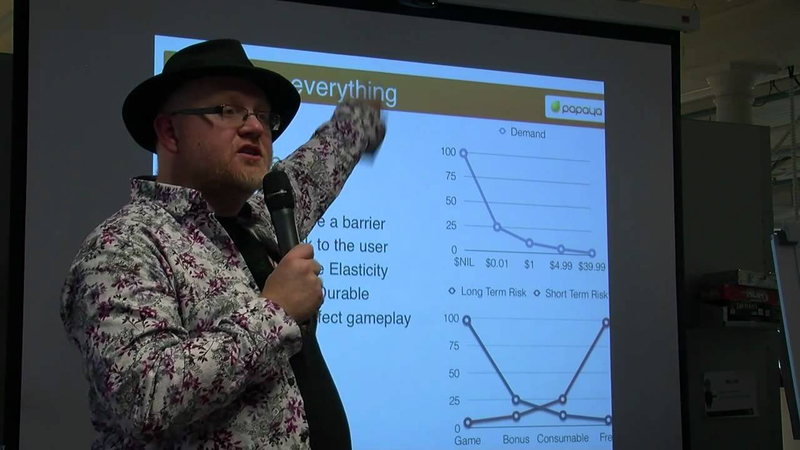
consumable items that run out when you've used them we can sell them durable items that give them an ongoing bonus to play we can create this Balancing Act this a game design decision not just a commercial decision something which we can look at the data and we can see the impact of adding a new object and we can make a game design decision of how we want to use that so basically what we're trying to do is if we just have a normal stand standard model we spend money we decide we're going to charge a penny or or a cent rather for something then that's how much money that purple block is how much money we get from that item but what we want to do instead is get that whole curve everything under the curve because if people can spend money as much as they're willing to on the game then what we end up with is more revenue for the game but the bottom graph
is something slightly different that's the short-term versus long-term risk and again we want to get the whole area under the curve these slides will be available on slideshow we want to maximize our potential opportunity of revenue from everybody who wants to play our game we're not going to get everybody but we can decide how we're going to pitch that so that they feel as willing as they could possibly be to spend money with our game let's not forget advertising but advertising is just one of those many things that add some value it's not going to be buying you your next mortgage but it is something that can be very valuable so shouldn't be ignored but one I think really interesting is we're finding the shift towards incentivized download being quite important in terms of the revenue for the game receiving it but also for the marketing of that typle as well because I think free is very fast becoming not enough to get people interested in your
game so we talked about a couple of things and I I'm very conscious I could talk for hours and hours and hours about this stuff and I'm going to try not to what I'm going to try and do is just skip through a lot of these slides because fact let's just talk about this one very briefly and then skip through a few there's a really important player in the game it might be 1% of your audience it might be 4% of your audience depends on how well integrated socialized your Gamers but those people are there because they probably spent something like 8 to 12 days not paying any money but still get to love and engage with your game if you're able to keep those people engaged interesting thing turns out that they tend to be the people who spend the most money they tend to be the whale they true fan whatever you want to call it and they spend their money as I said before initially tinkering with the virtual Goods that lets them alter their character or show offs in some way but when they're hooked they spend money on
making the game better and better and better for themselves to be a to succeed deeper and deeper and deeper and the really interesting thing is if you balance your if you put all your focus into just them you miss out on putting enough effort into the free users free users have to be there for you to get any true fans because remember true fans only come after they spent some time not pay you've got to invest in all types of players the free players the people who spoke for the first time and how you get them past that first dollar purchase and then the people are going to spend a lot of money and some people spend an awful lot of money we refer to a whale or a true fan as someone who spends more than $100 but there are some people out there who spend thousands of dollars in the time playing a particular game even tens of thousands of dolls maybe not quite we haven't seen the zingus numbers quite yet but we've seen numbers pretty similar on mobile but we want to avoid The Hangover what does a hangover mean well this is a
an article I wrote for gamer not that long ago um there's a point where if we just look at the averages of her data we forget the people behind the data we forget that they're all going on a life cycle or a journey of play and if we forget their journey of play they end up feeling bitter and resentful about the purchases they've made and we want to avoid that and the way that we avoid that is by looking at the balance between consumable and durable items and the way that they feel entertained as a result of playing the game and why do we do that we do that because look at xity one of our games it's making about $1,000 a day uh okay it's not in Angry Birds Le but it's it's pretty good Sor it's not loud enough is that any better okay right I will try talking a little louder so um the interesting thing about exity is if you look at X
City's players about 42% of the players have spent money on more than one game by looking after the players by making sure that you've entertained them and you handle the transition from one game to another which is inevitable you can get them to spend money on more than one game and 7% of players have spent money in five games or more and when you've got an average revenue per paying user as we do of $12.73 that becomes really important I'm not going to talk about compulsion Loops because that takes a lot of time but I will do a brief kind of uh this is what we do as a company in case you didn't realize so papaya is a social company we provide a social graph for mobile we do that through a number of techniques we have a social SDK which you can use go to papy mobile.com developer go use it you can use our game engine if you want to use a game engine it's pretty fun it's going to have quite
a lot of Sprites on the screen at the time it's quite an easy thing to develop for you simply need flash skills and you can basically use a variation of action script to make your game work in Android or if you're still using flash or want to use HTML 5 you can use our social Splash conversion tool so we have a whole bunch of tools you can use malade you can use Unity we've got plugins for both of those our aim is to make it as easy as possible for developers who want to make social games where they can engage with other people in the game and so you can go and visit your friends farm City Trophy Room whatever it might be we enable that to happen with a virtual currency system that means that we can monetize that audience on Android that's all I'm going to talk about today uh if anyone's got any questions feel free to uh shout out or uh get me to shout louder
Summary
The presentation outlines a strategic framework for mobile game design, emphasizing that successful monetization is inextricably linked to social integration and player psychology. The core thesis posits that developers must move beyond basic entertainment to create social environments that foster trust, belonging, and opportunities for self-expression. By applying a hierarchy of needs to game design, developers can guide players through a lifecycle that begins with engagement and culminates in long-term monetization.
Key findings highlight a significant industry shift toward free-to-play models, with data showing a transition from 37% to 65% premium-style monetization within a six-month period. The analysis identifies a "network effect" where social features—such as allowing players to see friends’ progress—act as a force multiplier for marketing efforts, driving organic growth. Monetization strategies should balance short-term and long-term risks by offering diverse purchasing options, such as durable versus consumable virtual goods. This approach aims to capture the full potential revenue curve rather than relying on a single, rigid price point.
The discussion emphasizes that "whales" or "true fans" are not created in isolation; they typically engage with a game for 8 to 12 days without spending money before committing to purchases. Consequently, developers must invest in the entire player base, including free users, to cultivate a pipeline of high-value spenders. Data from the game XCity illustrates the potential for cross-game monetization, noting that 42% of paying players spent money in more than one title, with an average revenue per paying user of $12.73. The presentation concludes that by prioritizing player experience and avoiding "hangovers"—where players feel regret over past purchases—developers can maximize lifetime value and sustain long-term engagement across their portfolios.












Comments