Remedy Entertainment
Game Co.9 documents
Documents
Financial22 pages
Half-Year Financial Report: January-June 2026
Remedy Entertainment experienced a period of financial contraction during the first half of 2026, characterized by a decline in total revenue and an operating loss of 2.9 million EUR. Revenue for the second quarter fell to 10.2 million EUR, a 40 percent decrease compared to the same period in the previous year. This downturn is primarily attributed to the absence of launch-related accruals that bolstered prior-year figures, compounded by elevated marketing expenditures in anticipation of the upcoming release of Control Resonant. Despite these immediate fiscal pressures, the company maintains its full-year outlook, projecting growth in both revenue and EBITDA as it pivots toward the September 24th launch date.
The company’s balance sheet remains fundamentally stable, supported by an equity ratio of 65.3 percent and total assets valued at 85.1 million EUR. Financial statements indicate a disciplined approach to asset management, with 25.1 million EUR in capitalized development costs as of June 30, 2026, alongside consistent investments in equity funds and convertible bonds. While the net loss for the half-year reached 2.8 million EUR, the organization continues to navigate the inherent volatility of the gaming sector.
Strategic risks persist as the company transitions further into a self-publishing model. Management remains focused on mitigating challenges associated with complex development schedules and the retention of specialized personnel. By prioritizing the successful execution of its upcoming title, the company aims to stabilize its financial trajectory and leverage its existing intellectual property to offset the current period of reduced liquidity and increased operational investment.
- Remedy Entertainment reported an operating loss of 2.9 million EUR and a net loss of 2.8 million EUR for the first half of 2026.
- Q2 2026 revenue fell to 10.2 million EUR, representing a 40 percent year-over-year decline due to the absence of prior-year launch accruals and increased marketing spend for 'Control Resonant'.
- The company maintains its full-year outlook for growth in revenue and EBITDA, anchored by the scheduled September 24, 2026, launch of 'Control Resonant'.
- The balance sheet remains stable with an equity ratio of 65.3 percent and total assets valued at 85.1 million EUR.
- As of June 30, 2026, the company holds 25.1 million EUR in capitalized development costs.
+3
Remedy Entertainment
Financial34 pages
Financial Statements: January–December 2024
The financial statements for the calendar year 2024 present a comprehensive view of Remedy Entertainment’s performance, highlighting significant revenue growth and strategic shifts toward self‑publishing. Revenue rose 49.3 % to €50.7 million, driven largely by development fees from the Max Payne 1 & 2 remake and robust sales of Alan Wake 2, which exceeded two million units and fully recouped its development and marketing costs. EBITDA improved to €2.5 million, representing 5.0 % of revenue, while operating profit moved to a negative €4.3 million with an operating margin of –8.4 %. Cash flow from operations turned positive at €12.3 million, reflecting improved working‑capital management and the impact of a €15 million convertible loan from Tencent.
Key developments include Remedy’s acquisition of full rights to the Control franchise, a strategic partnership with Annapurna Pictures, and the launch of FBC: Firebreak slated for self‑publication in 2025. The company has built robust self‑publishing capabilities across marketing, community engagement, and monetization, enabling greater control over revenue streams and accelerated development velocity. The transition to self‑publishing is expected to reduce financial investment needs and increase the share of sales retained by Remedy.
Looking ahead, Remedy targets a doubling of revenue by 2027 and an EBITDA margin of 30 % by the same year, with a focus on sustainable, profitable growth. The board has decided to forego dividend payments for 2024, allocating capital toward these strategic initiatives.
- Remedy Entertainment achieved a 49.3% revenue increase to €50.7 million in 2024, driven by development fees for the Max Payne 1 & 2 remake and the commercial success of Alan Wake 2.
- Alan Wake 2 surpassed two million units sold, successfully recouping all associated development and marketing costs.
- The company is aggressively transitioning to a self-publishing model, supported by the acquisition of full Control franchise rights and a partnership with Annapurna Pictures to launch FBC: Firebreak in 2025.
- Financial performance showed mixed results with EBITDA reaching €2.5 million (5.0% of revenue), while operating profit remained at a negative €4.3 million.
- Operational cash flow improved to €12.3 million, bolstered by enhanced working-capital management and a €15 million convertible loan from Tencent.
+3
Remedy Entertainment
Financial21 pages
Half-Year Financial Report: January–June 2025
Remedy Entertainment reported a robust first‑half performance for 2025, with revenue climbing 43.4 % to €30.3 million. The surge was largely driven by sales and royalties from its flagship titles Control and Alan Wake 2, alongside the launch of its inaugural self‑published game, FBC: Firebreak. EBITDA improved markedly to €6.8 million from a loss of €3.6 million in the prior year, and operating profit turned positive at €0.8 million; however, cash flow from operations remained negative (€–3.5 million) due to the timing of development‑fee receipts and investment outflows.
The balance sheet at June 30, 2025 shows total assets of €97.5 million and liabilities of €27.9 million, yielding an equity ratio of 72.8 % and a net gearing of –14.4 %. Cash and equivalents stood at €10.0 million, while other current assets were €17.5 million. Equity increased to €69.6 million, supported by a €1.0 million net rise in share‑based and cash equity transactions during the period. The workforce expanded to 385 employees, a 6.6 % year‑over‑year increase, and the company’s market capitalization reached €202 million at year‑end.
Operating cash outflows of €3.48 million and net investment outflows of €6.66 million were largely attributable to capitalised development costs of €6.10 million. Revenue for the half‑year rose to €16.9 million from €13.4 million in H1 2024, with development fees comprising the majority of sales. Overall, Remedy’s shift toward self‑publishing has begun to pay off, as more than half of its revenue now derives from game sales and royalties rather than external development fees.
- Remedy Entertainment’s revenue grew 43.4% to €30.3 million in H1 2025, driven by the performance of Control, Alan Wake 2, and the launch of FBC: Firebreak.
- The company achieved a positive operating profit of €0.8 million and an EBITDA of €6.8 million, a significant turnaround from the €3.6 million EBITDA loss recorded in H1 2024.
- A strategic shift toward self-publishing has succeeded, with over 50% of total revenue now generated from game sales and royalties rather than external development fees.
- Despite improved profitability, the company reported a negative operating cash flow of €3.5 million, primarily due to the timing of development-fee receipts and €6.1 million in capitalized development costs.
- The balance sheet remains strong with an equity ratio of 72.8%, total assets of €97.5 million, and €10.0 million in cash and equivalents as of June 30, 2025.
+1
Remedy Entertainment
Financial20 pages
Business Review: January–March 2026
Remedy Entertainment Plc reported a profitable first quarter of 2026, with revenue falling 1.9 % to EUR 13.1 million compared to the same period in 2025, while EBITDA rose to EUR 2.9 million and operating profit reached EUR 1.0 million, reflecting a 7.8 % margin. Cash flow from operations improved markedly to EUR 8.3 million, reversing a negative cash flow in the prior year. The decline in revenue was offset by stronger game sales and royalties, particularly from Alan Wake 2 and the launch of FBC: Firebreak, while development fees from Max Payne 1&2 remake and CONTROL Resonant contributed significantly. Personnel expenses increased 5.1 %, driven by a 4.8 % headcount growth to 391 employees, whereas materials and services costs fell 52.5 %. Capital expenditures were modest at EUR 3.3 million, and the balance sheet remained solid with a net cash position of EUR 14.4 million and an equity ratio of 68.6 %. The company’s net gearing turned negative at –27.7 %, indicating a strong liquidity cushion.
Geographically, Remedy operates globally with a focus on core markets and expanding presence in China and Latin America through targeted marketing campaigns for CONTROL Resonant. The quarter’s marketing spend is set to intensify ahead of the game’s 2026 launch, with multilingual localization and partnership initiatives. Remedy maintains a self‑publishing strategy for its IPs, aiming to double 2024 revenue by 2027 and achieve a 30 % EBITDA margin. CEO Jean‑Charles Gaudechon emphasized continued focus on creative identity, franchise expansion, and commercial discipline. Risks highlighted include development failures, partner contract breaches, self‑publishing financial exposure, talent retention challenges, and currency volatility. The company’s outlook remains positive, with expectations of full‑year revenue and EBITDA growth relative to the previous year.
- Remedy Entertainment achieved a profitable Q1 2026 with an operating profit of EUR 1.0 million (7.8% margin) and EBITDA of EUR 2.9 million, despite a 1.9% year-over-year revenue decline to EUR 13.1 million.
- Operational cash flow improved significantly to EUR 8.3 million, contributing to a strong balance sheet with a net cash position of EUR 14.4 million and an equity ratio of 68.6%.
- Revenue was supported by royalties from Alan Wake 2 and the launch of FBC: Firebreak, alongside development fees from the Max Payne 1&2 remake and CONTROL Resonant.
- The company is pursuing a self-publishing strategy with a long-term goal to double 2024 revenue by 2027 while achieving a 30% EBITDA margin.
- Headcount grew by 4.8% to 391 employees, driving a 5.1% increase in personnel expenses, while materials and services costs were reduced by 52.5%.
+1
Remedy EntertainmentMay 2026
Financial25 pages
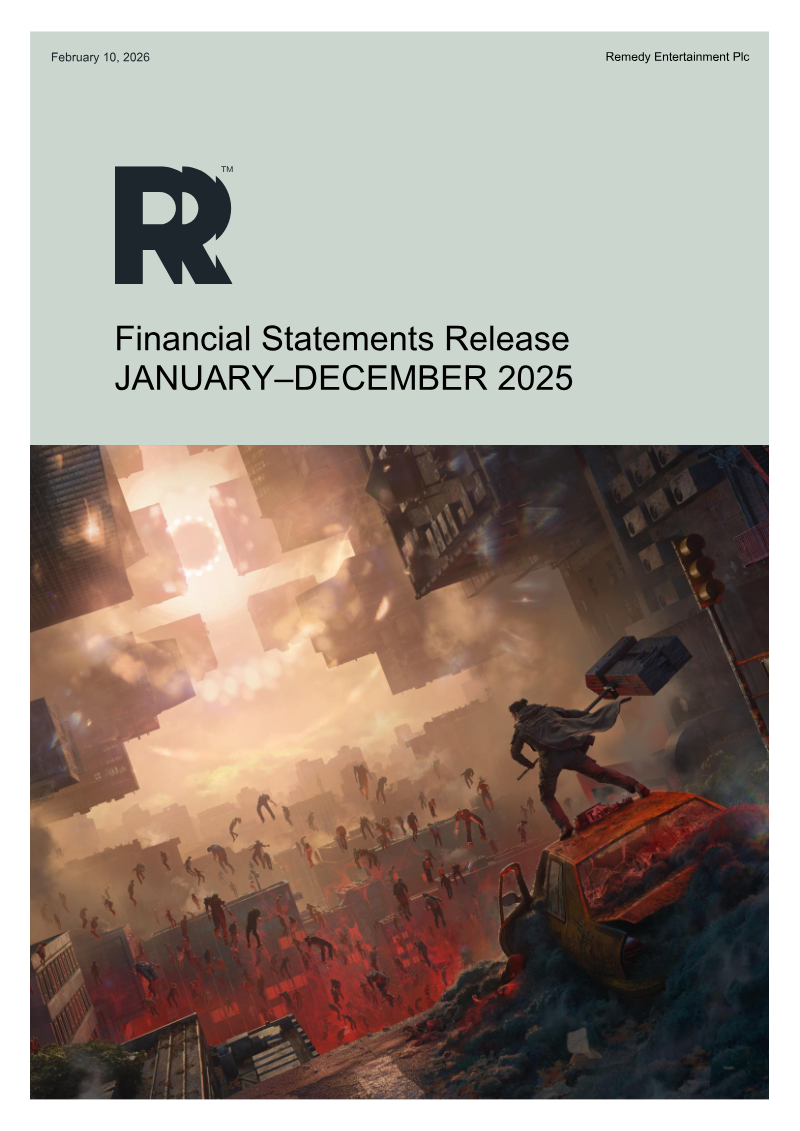
Financial Statements Release 2025: Remedy Entertainment
Remedy Entertainment delivered a robust fourth‑quarter performance in 2025, with revenue rising 46.3 % to €17.0 million and EBITDA reaching €3.9 million, largely driven by sales of Control, Alan Wake 2, and FBC: Firebreak royalties. Full‑year results showed a 17.5 % revenue increase to €59.5 million, yet operating profit turned negative at €‑14.9 million due to a €14.9 million impairment on FBC: Firebreak and elevated self‑publishing expenses. The company announced the 2026 launch of CONTROL Resonant, plans for substantial marketing investment, and a long‑term objective to double 2024 revenue by 2027 while targeting a 30 % EBITDA margin.
The balance sheet at year‑end 2025 reflected an asset base of €87.5 million, with non‑current assets reduced to €42.8 million mainly because of the FBC: Firebreak impairment. Capitalised development costs stood at €20.2 million, predominantly for CONTROL Resonant. Cash of €9.6 million offset liabilities of €31.0 million, yielding a strong equity ratio of 67.4 % and negative net gearing of –19.7 %. Operating results improved to a €401 thousand profit from the prior year’s loss, driven by higher development fees and game sales, though operating losses remained significant.
Profitability contracted sharply in 2025, with a €13.03 million loss versus a €3.60 million loss in 2024, and total equity fell from €68.53 million to €56.59 million as retained earnings dropped to €11.34 million. Total assets declined from €99.33 million in 2024 to €87.55 million, largely due to a €12.23 million reduction in cash and equivalents and a €9.13 million drop in intangible assets, while liabilities stayed near €30.95 million. Operating cash flow fell to €4.51 million, leaving a net cash position of €9.64 million at year‑end, indicative of significant investment outflows and a shift toward higher debt financing.
- Remedy Entertainment reported a 17.5% annual revenue increase to €59.5 million in 2025, though the company recorded a net loss of €13.03 million, significantly wider than the €3.60 million loss in 2024.
- Operating profit for the full year was negative at €-14.9 million, primarily due to a €14.9 million impairment charge related to the FBC: Firebreak project and increased self-publishing expenditures.
- The company maintains a strong balance sheet with an equity ratio of 67.4% and negative net gearing of -19.7%, despite total assets declining from €99.33 million to €87.55 million year-over-year.
- Fourth-quarter performance was strong, with revenue rising 46.3% to €17.0 million and EBITDA reaching €3.9 million, supported by royalties from Control, Alan Wake 2, and FBC: Firebreak.
- Remedy has set a long-term financial objective to double 2024 revenue by 2027 while achieving a 30% EBITDA margin.
+2
Remedy EntertainmentFeb 2026
Legal13 pages
Corporate Governance Statement 2024
Remedy Entertainment Plc, a Finnish public limited liability company listed on Nasdaq Helsinki, operates under the Finnish Corporate Governance Code 2020. Governance is distributed between the shareholders, the Board of Directors, and the Chief Executive Officer. The Board is responsible for strategic oversight, financial targets, and the appointment of senior management, while the CEO, supported by a Core Management Team, manages day-to-day operations.
As of December 31, 2024, the Board consists of five members, including three men and two women, satisfying diversity recommendations. The composition includes two members independent of both the company and its major shareholders, two independent of the company but not major shareholders, and one non-independent member who serves as the Chief Product Officer. In 2024, the Board held 17 meetings with 100% attendance across all active members. The Core Management Team saw several leadership transitions during the year, including the appointment of a new Chief Financial Officer and Creative Director.
The internal control framework is managed through four main processes: financial reporting, risk management, control mechanisms, and compliance. While the company does not maintain a separate internal audit function due to its relatively simple organizational structure, audit tasks are integrated into the responsibilities of the Finance, Legal, and HR departments. Risk management is embedded through five sub-processes covering strategic, operative, and financial risks. In 2024, the company paid its auditor, KPMG Oy Ab, approximately EUR 102,000 for audit services and EUR 18,000 for non-audit services. Insider administration is governed by a written policy that includes a 30-day closed window prior to financial reports to prevent market abuse.
- Remedy Entertainment operates under the Finnish Corporate Governance Code 2020, with governance split between shareholders, a five-member Board of Directors, and the CEO.
- The Board of Directors achieved 100% attendance across 17 meetings in 2024 and maintains a gender-diverse composition of three men and two women.
- The company lacks a dedicated internal audit function, instead integrating audit responsibilities across the Finance, Legal, and HR departments.
- KPMG Oy Ab served as the company auditor in 2024, receiving EUR 102,000 for audit services and EUR 18,000 for non-audit services.
- The Core Management Team underwent leadership changes in 2024, including the appointment of a new Chief Financial Officer and a new Creative Director.
Remedy EntertainmentMar 2025

Financial72 pages
Report of the Board of Directors and Financial Statements 2024
Remedy Entertainment demonstrated a significant financial recovery in 2024, with revenue growing 49.3% to €50.7 million. This growth was primarily driven by a 58% increase in development fees for high-profile projects, including the Max Payne 1&2 remake and Control 2. While the company recorded an operating loss of €4.3 million, this represents a substantial narrowing from the €28.6 million loss reported in 2023. This improvement was supported by the absence of major project write-downs and a reduction in personnel expenses to €24.7 million, even as the average headcount increased to 351 employees.
Strategically, the year was defined by a shift toward a self-publishing model and franchise ownership. Key milestones included the acquisition of full rights to the Control franchise and a partnership with Annapurna for multimedia expansions. To fund these initiatives and maintain liquidity, the company secured a €15 million convertible bond from a Tencent subsidiary and maintained a solid equity ratio of 70.9%. Despite the narrowed loss and a cash position of €21 million, the Board of Directors proposed no dividend for the fiscal year, prioritizing capital allocation for ongoing development projects.
The company’s long-term outlook targets a doubling of 2024 revenue by 2027, with an expectation to reach positive operating profit in 2025. Management continues to utilize share-based incentive programs to align key personnel with these growth objectives, recently implementing Option Plan 2024. Operating primarily through its Finnish parent company and a Swedish subsidiary, the group remains focused on managing high customer concentration and foreign exchange risks as it transitions into its next phase of commercial independence.
- Remedy Entertainment grew revenue by 49.3% to €50.7 million in 2024, driven by a 58% increase in development fees for projects like the Max Payne 1&2 remake and Control 2.
- The company significantly narrowed its operating loss to €4.3 million in 2024, down from a €28.6 million loss in 2023, and expects to reach positive operating profit in 2025.
- Management is transitioning toward a self-publishing model, highlighted by the acquisition of full rights to the Control franchise and a new multimedia partnership with Annapurna.
- To support development and liquidity, the company secured a €15 million convertible bond from a Tencent subsidiary and maintains a cash position of €21 million with a 70.9% equity ratio.
- The Board of Directors has proposed no dividend for 2024, prioritizing capital allocation for ongoing projects to meet the long-term goal of doubling 2024 revenue by 2027.
Remedy EntertainmentMar 2025
Legal8 pages
Remuneration Report 2024
The Remuneration Report 2024 for Remedy Entertainment Plc details the compensation framework and specific payments made to the Board of Directors and the Chief Executive Officer for the 2024 financial year. The primary objective of the compensation policy is to align executive interests with the company’s strategic goals, long-term financial performance, and shareholder value. The report covers the Finnish company’s operations and provides a five-year comparative analysis of executive pay relative to financial performance and average employee salaries from 2020 to 2024.
Financial data indicates that Remedy experienced significant revenue growth in 2024, reaching EUR 50.7 million compared to EUR 33.9 million in 2023. Despite this growth, the company reported an operating loss (EBIT) of EUR 4.3 million, though this was a notable improvement from the EUR 28.7 million loss in the previous year. During this period, the average salary of a Remedy employee remained stable at EUR 63,907.
Remuneration for the Board of Directors is strictly fee-based, with the Chairman receiving EUR 54,000 and other members receiving EUR 36,000 annually. Board members do not participate in share-based incentive schemes. However, Chairman Markus Mäki also serves as Chief Product Officer, receiving an additional EUR 92,490 in fixed salary for that role. CEO Tero Virtala’s total compensation for 2024 was EUR 290,060, consisting of a EUR 210,240 fixed salary and EUR 79,820 in long-term incentive rewards. The CEO’s incentive structure includes six active option plans with subscription periods extending through 2030, though no options were exercised or sold during the 2024 financial year. The report concludes that all payments were made in accordance with the resolutions of the Annual General Meeting and the company’s established Remuneration Policy.
- Remedy Entertainment’s 2024 revenue grew to EUR 50.7 million from EUR 33.9 million in 2023, while the operating loss narrowed significantly to EUR 4.3 million from the previous year's EUR 28.7 million loss.
- CEO Tero Virtala received total compensation of EUR 290,060 in 2024, comprising a EUR 210,240 fixed salary and EUR 79,820 in long-term incentive rewards.
- Chairman Markus Mäki received EUR 54,000 in board fees plus an additional EUR 92,490 fixed salary for his role as Chief Product Officer.
- The average salary for a Remedy employee remained stable at EUR 63,907 throughout the 2024 financial year.
- Board members receive fixed annual fees of EUR 54,000 for the Chairman and EUR 36,000 for other members, with no participation in share-based incentive schemes.
Remedy EntertainmentMar 2025
Financial46 pages
Remedy Entertainment Annual Report 2024
Remedy Entertainment achieved a significant financial turnaround in 2024, with revenue growing 49.3% to €50.7 million and EBITDA improving to €2.5 million. This recovery was driven largely by the commercial success of Alan Wake 2, which surpassed 2 million units sold and fully recouped its development and marketing costs. The company is currently executing a major strategic shift toward a self-publishing model for its owned intellectual properties, a move bolstered by reacquiring the full rights to the Control franchise and securing strategic financing through a partnership with Annapurna and a convertible loan from Tencent.
The long-term strategy for 2025–2030 aims to double 2024 revenue by 2027 while achieving a 30% EBITDA margin. To reach these targets, the studio is focusing on a disciplined production pipeline managed through a six-stage gate process. Key upcoming projects include the multiplayer spin-off FBC: Firebreak, budgeted at €30 million, and Control 2, budgeted at €50 million. Both titles are scheduled to enter full production by early 2025. Additionally, the Max Payne 1&2 remake, fully funded by Rockstar Games, moved into full production at the end of 2024.
Operating primarily from Finland with a global reach, the studio grew its headcount to 367 employees to support its portfolio of four major projects. Beyond game development, the partnership with Annapurna is designed to expand the Alan Wake and Control franchises into film and television, evolving these IPs into world-class brands. This expansion occurs within a global games market projected to reach $213.3 billion by 2027, positioning the studio to maximize royalty potential and commercial alignment through its new self-publishing capabilities and steady release cadence.
- Remedy Entertainment achieved a financial turnaround in 2024 with revenue growing 49.3% to €50.7 million and EBITDA reaching €2.5 million, driven by Alan Wake 2 surpassing 2 million units sold.
- The company is transitioning to a self-publishing model for its owned IP, supported by the full reacquisition of the Control franchise and strategic financing from Annapurna and Tencent.
- The studio aims to double 2024 revenue by 2027 while achieving a 30% EBITDA margin through a disciplined six-stage production pipeline.
- Major upcoming projects include the €30 million multiplayer title FBC: Firebreak and the €50 million Control 2, both entering full production by early 2025.
- The Max Payne 1&2 remake, fully funded by Rockstar Games, entered full production at the end of 2024 to support the studio's four-project portfolio.
+1
Remedy EntertainmentMar 2025