AI reports and market data
Documents

Growing in a Mature Market with Josh Wilson, CEO of SciPlay
The mobile gaming industry currently faces a period of stagnation, necessitating a strategic shift from aggressive user acquisition toward operational efficiency and long-term retention.
- Developers should establish proprietary web shops to bypass platform fees, increase profit margins, and regain control over customer relationships in a mature market.
- The period between late November and mid-February, known as Q5, is a critical window for growth due to higher consumer leisure time and lower user acquisition costs.
- Sustainable profitability requires shifting from aggressive, high-churn monetization to building interconnected game networks that prioritize long-term player retention and cross-pollination.

Week in Mobile Games E47 - GDC 2025 final thoughts
GDC 2025 served as a barometer for a gaming industry currently navigating a period of significant transition and structural contraction.
- The gaming industry is shifting away from high-risk, ballooning AAA budgets toward sustainable 'triple-I' projects to mitigate the market dominance of established 'forever games'.
- GDC 2025 exhibited a reduced physical footprint with fewer corporate booths and sparser show floors, reflecting ongoing industry-wide layoffs and constrained travel budgets.
- Industry sentiment has moved toward cautious optimism, with publishers beginning to resume project investments while maintaining a skeptical approach to venture capital funding.
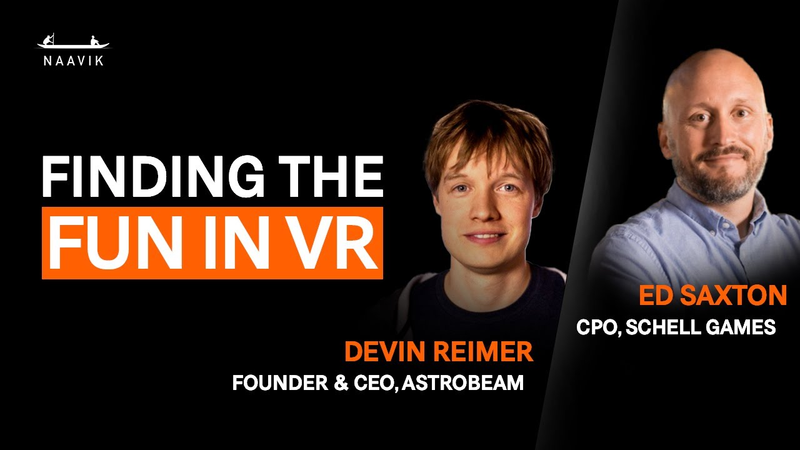
Finding the Fun in VR with AstroBeam and Schell Games
Successful virtual and mixed reality development relies on first-principles thinking that prioritizes intuitive, user-driven interactions over traditional controller-based logic.
- Successful VR design relies on first-principles thinking, such as the approach used in Job Simulator, which constrained players to stationary positions to solve the problem of movement-based motion sickness and controller complexity.
- Generative AI in gaming is currently overhyped as a 'magic' solution for instant development, but it is underhyped regarding its potential to evolve NPC behavior and voice-based interaction when paired with significant manual design effort.
- Designing for VR requires strict adherence to accessibility; for example, developers at Alchemy Labs found that avoiding complex button combinations like simultaneous trigger and grip usage significantly improved the mainstream user experience.

GDC 2025 Recap: Industry Insights & Market Trends
The gaming industry is currently navigating a period of profound contraction, defined by an age of austerity that has fundamentally altered the landscape of major professional gatherings.
- The gaming industry is currently in an 'age of efficiency' characterized by austerity, with many high-profile studios facing severe financial instability and limited runway through 2026-2027.
- Investment in gaming has significantly contracted, as evidenced by major venture capital firms like A16Z shifting focus away from the sector despite maintaining large funds.
- GDC 2025 attendance was noticeably lower than in previous years, with the event shifting toward smaller, exclusive, executive-focused gatherings rather than broad industry participation.

Personalization in Gaming: The Holy Grail of User Experience (and
Personalization represents the next frontier in gaming user experience, moving beyond static, rule-based segmentation toward dynamic, AI-driven environments.
- Gaming is shifting from static, rule-based segmentation to dynamic, AI-driven environments using contextual multi-armed bandit algorithms to automate difficulty, pricing, and ad frequency in real time.
- Machine learning replaces manual A/B testing, allowing studios to simultaneously optimize for conflicting goals like player retention and monetization without repetitive manual configuration.
- The mobile casual puzzle sector is currently the primary adopter, using these tools to refine rewarded video placements and prevent revenue cannibalization.

Revolutionizing Video Production & AI UGC with Poolday.AI
Modern video production for the gaming industry is undergoing a fundamental shift from high-cost, low-volume creative strategies toward rapid, high-volume testing.
- Adopting AI-driven production platforms reduces video creation timelines by six to eight times by automating labor-intensive tasks like localization, captioning, and aspect ratio adjustments.
- Performance deltas between top-tier and underperforming creatives can reach seven to nine times, highlighting the necessity of high-volume testing to identify winning assets.
- Video production is shifting toward a modular 'Video Relationship Management' model, where base edits are broken into interchangeable components like hooks and actors to generate hundreds of variations.

"Unity's AI AD Platform Vector is Total Vaporware"
Unity’s recent announcement of its new artificial intelligence advertising platform, Vector, is characterized as a strategic misdirection intended to distract investors from poor quarterly guidance.
- Unity’s 'Vector' AI advertising platform is characterized as a strategic misdirection intended to stabilize stock prices following poor quarterly guidance rather than a functional technological breakthrough.
- Unity significantly trails industry leader AppLovin, which successfully captured market share by leveraging fingerprinting techniques after the deprecation of IDFA.
- The platform faces a 'garbage in, garbage out' data deficit because major third-party developers are unlikely to grant Unity access to the proprietary user data required to train competitive AI models.

Breaking Silos & Boosting Growth: Metica’s AI-Driven Edge
Metica provides an AI-driven platform designed to accelerate mobile game growth by integrating user acquisition (UA) and in-game monetization into a unified, data-centric ecosystem.
- Studios implementing Metica’s integrated growth loops, which unify user acquisition and in-game monetization, have reported revenue uplifts ranging from 16% to over 40%.
- The platform utilizes contextual multi-armed bandits to test multiple game variants simultaneously, significantly accelerating production cycles compared to traditional A/B testing methods.
- By predicting individual player lifetime value (LTV) and feeding that data back into ad networks, the system improves targeting precision and assists financial teams in creating more accurate long-term forecasts.

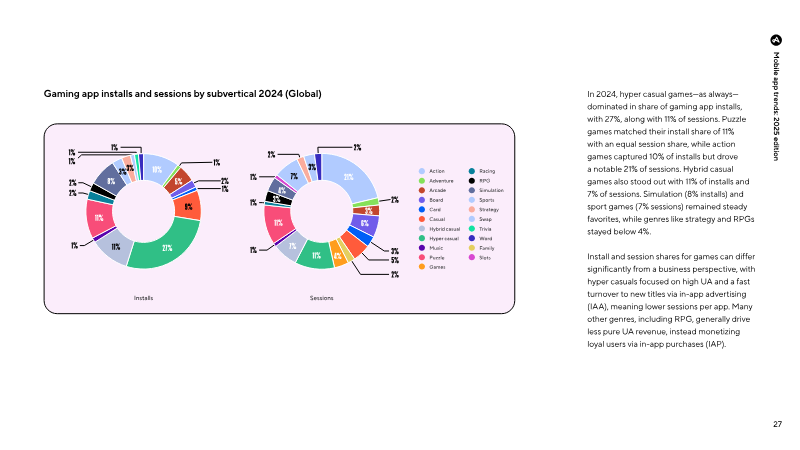

Mobile App Trends: 2025 Edition
The mobile app economy is entering a significant scaling phase, with global consumer spending projected to reach $626 billion by 2030.
- Global mobile consumer spending is projected to reach $626 billion by 2030, supported by a 2024 surge in app installs and a 35% App Tracking Transparency opt-in rate.
- Mobile commerce accounts for 73% of global e-commerce sales, with 2025 revenues expected to hit $2.5 trillion despite rising acquisition costs averaging $3.44 per install.
- The mobile gaming sector is projected to reach $126.1 billion in 2025, with strategy games experiencing an 83% growth in installs and global session lengths exceeding 30 minutes.

Why Your Game's Ads Need to Evolve–Fast | AI-Powered Creative Intelligence Platform to Unlock Scale
Modern game marketing requires a fundamental shift from intuition-based strategies to a rigorous, data-driven framework that treats creative assets as quantifiable variables.
- AI-driven creative optimization allows studios to 10x human compute by deconstructing competitor ads into granular data points like colors, music, emotions, and call-to-action messaging to identify high-win-rate patterns.
- Treating creative production as a science rather than just art enables studios to reduce failure rates, which can otherwise exceed 95% when ads are not aligned with specific audience preferences across different regions and platforms.
- Data-backed creative adjustments can lead to significant performance gains, such as a 5x increase in win rates for a sports-related advertiser after optimizing messaging to better resonate with the target audience.
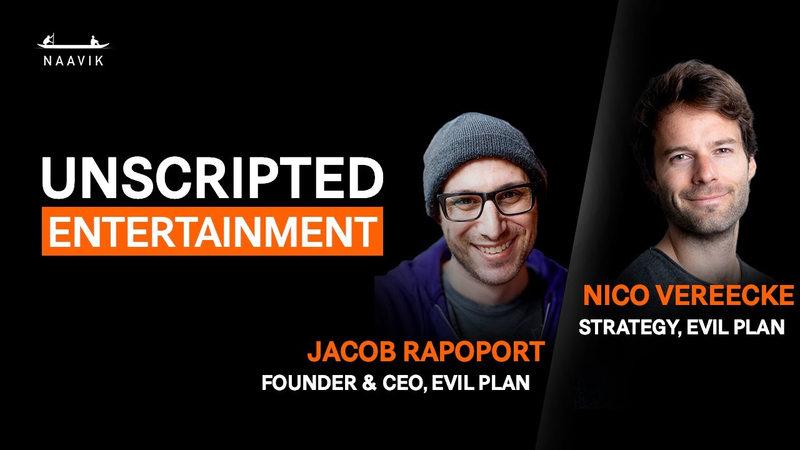
The Future of AI Unscripted Entertainment
The emergence of AI-native entertainment platforms represents a fundamental shift in how digital narratives are produced, consumed, and monetized.
- Evil Plan is developing an AI-native platform for unscripted, interactive entertainment that allows community influence to drive narrative outcomes in real-time.
- The company aims to solve the 'cost problem' and 'manpower problem' in entertainment, where high production costs and human resource limitations currently restrict the development of new intellectual property.
- The platform seeks to combine the unpredictability of sports, the emergent narrative structures of reality television, and the interactivity of gaming to create perpetual, AI-driven story worlds.

The #1 AI Skill You NEED to Succeed in Marketing (Hint: It’s Not Data Crunching)
Artificial intelligence is fundamentally reshaping the landscape of user acquisition by functioning as a critical force multiplier that enhances creative production and strategic decision-making.
- Prompt engineering is the critical skill for 2025, as marketers must learn to write effective creative briefs, storyboards, and narratives to direct AI tools rather than relying on full automation.
- AI acts as a force multiplier for User Acquisition (UA) teams, enabling individuals to perform the work of five people by leveraging AI for data analysis, decision-making, and creative generation.
- Strategic implementation of AI in creative production can significantly improve performance metrics, with one expert reporting an increase in creative win ratios from 10% to 50%.