Report134 pages
Annual Report 2019: 11 bit studios S.A.
RAPORT ROCZNY 11 BIT STUDIOS S.A. ZA 2019ROK. Szanowni Akcjonariusze i Inwestorzy Zapraszamy Was do zapoznania się z Raportem Rocznym 11 bit studios S.A. za 2019 rok. Dla naszej Spółki był to bardzo dobry rok, zarówno od strony biznesowej jak i finansowej. Wypracowaliśmy 71,2 mln PLN przychodów ze sprzedaży, 30,3 mln PLN wyniku EBITDA, blisko 23,9 mln PLN zysku operacyjnego i ponad 21,7 mln PLN zysku netto.
- 11 bit studios S.A. experienced significant financial growth in 2019, with total liabilities increasing from 19,351,248 PLN in 2018 to 35,928,089 PLN, and total assets (PASYWA RAZEM) rising from 109,262,821 PLN to 155,668,388 PLN.
- The company's financial assets grew substantially, with total financial assets increasing from 70,897,588 PLN in 2018 to 99,962,014 PLN in 2019, driven by a significant increase in bank deposits over 3 months (from 27,000,000 PLN to 67,328,563 PLN).
- International sales constituted a dominant portion of 11 bit studios S.A.'s revenue, accounting for 97.9% of total revenues in 2019, an increase from 96.5% in 2018.
- 11 bit studios S.A. invested 5,126,422 PLN in 2019 for the renovation and modernization of its new headquarters at Brzeska 2 in Warsaw, which it occupied in March 2020.
- The global video game market grew by 9.6% in 2019 to 152.1 billion USD and is projected to continue growing, reaching 164.6 billion USD in 2020 and 196 billion USD by 2022.
11 bit studios
Report139 pages
Raport Roczny 11 bit studios: 2022
RAPORT ROCZNY 11 BIT STUDIOS ZA 2022 ROK (wszystkie kwoty podane są w złotych o ile nie podano inaczej) SZANOWNI AKCJONARIUSZE I INWESTORZY Serdecznie zapraszamy Państwa do lektury Raportu rocznego 11 bit studios S.A. za rok 2022. Był to dla nas, z uwagi na trudne otoczenie makroekonomiczne (spowolnienie gospodarcze, wysoka inflacja) i geopolityczne (wojna na Ukrainie), bardzo intensywny, wymagający rok.
- 11 bit studios S.A. aims to be an "alternative to the mainstream" in gaming, focusing on high-quality, distinctive titles with increasing production and marketing budgets, targeting one new proprietary game release annually in the medium term.
- The company plans to expand its publishing activities, releasing 3-4 titles from external studios annually in the medium term, alongside its own games, to stabilize financial results.
- 11 bit studios S.A. is developing three internal development teams to work on three parallel titles, aiming for releases every few quarters and optimizing resource utilization.
- The company's functional and reporting currency is the Polish Złoty, and it recognizes revenue from PC/console and mobile games after platform deductions, while acting as a principal for games published from external developers.
- In 2022, the company's net cash flow from operating activities was 32,931,559 PLN, a decrease from 40,942,289 PLN in 2021, despite a lower profit for the year (22,889,816 PLN in 2022 vs. 28,685,582 PLN in 2021).
11 bit studios
Report132 pages
Annual Report of 11 bit studios S.A.: 2023
ANNUAL REPORT OF 11 BIT STUDIOS S.A. FOR 2023 (all amounts in PLN unless stated otherwise) DEAR SHAREHOLDERS AND INVESTORS, Please be invited to read 11 bit studios S.A.’s 2023 This past year has brought significant achievements in both sales and game production. We launched a number of major titles that had been in development for some time.
- 11 bit studios S.A. generated PLN 21,147,406 in cash flows from operating activities in 2023, a 37.97% decrease from 2022, despite no new game releases significantly contributing to financial performance. This was driven by strong sales of older titles like Frostpunk, Moonlighter, Children of Morta, This War of Mine, and The Invincible.
- The company significantly increased capital expenditure in 2023, spending PLN 58,813,599 on property, plant, and equipment and intangible assets (up from PLN 45,679,530 in 2022), primarily for new proprietary games (Frostpunk 2, The Alters, Project 8) and publishing division games.
- Contract liabilities surged to PLN 13,355,194 as of December 31, 2023, from PLN 1,128,700 in 2022, representing advance payments from trading partners, including Microsoft Corporation, for future game sales, payable within 24 months.
- The global gaming industry is projected to return to growth, with Newzoo forecasting spending of USD 205.4 billion by 2026 (11.6% more than 2023) and the number of gamers reaching 3.675 billion by 2026 (a CAGR of 3.7% from 2021-2026).
- 11 bit studios S.A. aims to fund its development and publishing activities internally for at least the next few quarters, reducing reliance on external funding or funds from trading partners.
+2
11 bit studios
Report127 pages
Annual Report: 11 Bit Studios S.A. 2024
ANNUAL REPORT OF 11 BIT STUDIOS S.A. FOR 2024 (all amounts in PLN unless stated otherwise) DEAR SHAREHOLDERS AND INVESTORS, It is with great pleasure that we present to you our Annual Report for 2024. During this period, 11 bit studios S.A. generated revenue of PLN 140.54 million, marking a 168.9% increase year on year and representing an all-time record for the Company.
- 11 Bit Studios S.A. is a computer game developer and publisher, with Frostpunk 2 (PC version) being a major recent success, selling 350,000 copies within three days of its September 20, 2024 launch and reaching 592,000 total unit sales by the end of 2024.
- The company's equity has grown significantly, from PLN 42.13 million in 2017 to PLN 229.92 million in 2024, reflecting a higher net profit in 2024 compared to 2023.
- Cash resources increased by 29.56% to PLN 70,463,596 at the end of 2024, up from PLN 54,386,466 in 2023, and total financial assets reached PLN 91,543,938.
- Total liabilities increased by 3.59% to PLN 32,384,084 in 2024, with current liabilities rising 12.66% to PLN 27,830,893, including PLN 11,002,109 in contract liabilities for future game sales and DLCs.
- The company has a multi-purpose credit facility of PLN 20,000,000 with PKO BP S.A. until June 25, 2025, which had no drawdowns as of the reporting date, and an investment credit facility with PKO BP S.A. of PLN 5,040,000 outstanding as of December 31, 2024.
+4
11 bit studios
Report27 pages
Quarterly Report of 11 Bit Studios S.A.: Q1 2019
portfolio of proprietary games) is expected to help stabilise the Company's financial results, which in the video games industry are typically highly volatile. The Company's revenue sources should also be considerably impacted by further development of its publishing division (11 bit publishing), which in 2018, driven primarily by the very successful release of Moonlighter, contributed 18% of the LETTER FROM THE MANAGEMENT BOARD ...
- 11 bit studios S.A. experienced a significant revenue increase of nearly 632% in Q1 2019 compared to Q1 2018, reaching PLN 14,183,796, primarily driven by strong sales of Frostpunk and This War of Mine.
- Operating expenses rose by 267.5% to PLN 8,524,924 in Q1 2019 (from PLN 3,186,555 in Q1 2018), with major items being salaries and wages (PLN 3,306,961), services (PLN 3,367,572, including Moonlighter royalties), and a non-cash provision for the Incentive Scheme (over PLN 2.05m).
- The company's publishing division, 11 bit publishing, contributed 18% of total revenue in 2018, largely due to the successful release of Moonlighter, and is expected to considerably impact future revenue.
- The porting of Beat Cop to PS4, Xbox One, Nintendo Switch, iOS, and Android, released in Q1 2019, proved profitable and supported the company's financial performance.
- 11 bit studios S.A. aims to stabilize its typically volatile financial results through its portfolio of proprietary games and plans to launch third-party games every quarter through its publishing arm.
+2
11 bit studios
Report49 pages
Semi-Annual Report of 11 bit studios S.A. for H1 2018
LETTER FROM THE MANAGEMENT BOARD LETTER FROM THE MANAGEMENT BOARD Dear Shareholders and Investors Dear Shareholders and Investors It is our great pleasure to present to you the half-year report of 11 bit studios S.A. for the first half of 2018. It was a Property, plant and equipment 3.9 715,168 814,332 very important period for our Company.
- 11 bit studios S.A. released Frostpunk in H1 2018, its largest and most expensive game to date, selling 250,000 copies in 66 hours and covering development costs. The company expects Frostpunk to be a significant revenue source for multiple quarters.
- The company's revenue increased by 427.4% in H1 2018 compared to H1 2017, driven by the successful launches of Frostpunk (April 24, 2018) and the published title Moonlighter (May 29, 2018).
- Moonlighter, a game published by 11 bit studios S.A., became a bestseller on Steam, demonstrating the company's strong publishing capabilities for independent developers. A Nintendo Switch version of Moonlighter is planned for later in 2018.
- 11 bit studios S.A. plans to continue supporting This War of Mine with two more add-ons and a Nintendo Switch release by the end of 2018, and Beat Cop will also launch on PS4 and Nintendo Switch by year-end.
- The company is developing a new game, 'Project 8,' which is in an advanced prototype stage, aiming for a team size and budget comparable to Frostpunk. In the medium term, 11 bit studios S.A. plans to have at least three comparable development teams to increase release frequency and stabilize financial results.
+3
11 bit studios
Report48 pages
Semi-Annual Report of 11 bit studios S.A.
Signed by: LETTER FROM THE MANAGEMENT BOARD Dear Shareholders and Investors Przemystaw Marszat Michat Drozdowski President of the Management Board Member of the Management Board Member of the Management Board Please be invited to read the Half-Year Report of 11 bit studios S.A. for the first half of 2019. During the period, we recorded over PLN 30.7m in revenue. Operating profit came in close to PLN 8.7m, with net profit above PLN 6.4m.
- 11 bit studios S.A. reported H1 2019 revenue of over PLN 30.7m, operating profit near PLN 8.7m, and net profit above PLN 6.4m, despite PLN 4.1m in non-cash provisions for their incentive scheme.
- The company's financial assets (cash, bank deposits, financial instruments, trade receivables) grew by PLN 13m from the end of 2018 to nearly PLN 84m by June 30, 2019, supported by almost PLN 20m in net cash flows from operating activities.
- Strong sales of Frostpunk and Moonlighter, both over a year old, along with continued contributions from This War of Mine, were the primary drivers of H1 2019 financial performance.
- Moonlighter, developed by Digital Sun, had over one million players by early Q3 2019, with Nintendo Switch becoming its leading sales platform since Q1 2019, especially after a successful Japanese launch.
- Children of Morta, a new publishing title, is set to launch for PCs on September 3, 2019, and consoles on October 15, 2019, with strong pre-release interest on Steam suggesting significant commercial potential.
+2
11 bit studios
Report28 pages
Interim Financial Report: Nine Months Ended September 30th 2018
These interim condensed financial statements have been prepared on a historical cost basis. They do not include all information and disclosures required in full-year financial statements and should be read in conjunction with the Company's full-year financial statements for 2017, including notes, for the period of 12 months ended December 31st 2017, prepared in accordance with the IFRS as endorsed by the EU.
- 11 bit studios S.A. reported a net profit of PLN 28,518,085 for the nine months ended September 30th, 2018, a significant turnaround from a loss of PLN 559,317 in the same period of 2017.
- Revenue for the nine months ended September 30th, 2018, increased substantially to PLN 59,620,481, up from PLN 11,401,961 in the prior year, primarily driven by strong sales of "Frostpunk" and "Moonlighter" (released in Q2 2018) and continued sales of "This War of Mine."
- The company's cash and cash equivalents, including bank accounts, deposits, and bonds, totaled PLN 61,672,165 as of September 30th, 2018, a substantial increase from PLN 31,229,866 at the end of 2017.
- 11 bit studios S.A. plans to release "Children of Morta" in early 2019, further develop "Frostpunk," and continue monetizing "This War of Mine," "Moonlighter," and "Beat Cop," with "TWoM: Stories – The Last Broadcast" and a Nintendo Switch version of "TWoM" released in November 2018.
- The company made a significant donation of PLN 648,755 to the War Child Foundation in the reporting period, continuing its long-standing support for the charity.
11 bit studios
Report29 pages
Interim Financial Report: Nine Months Ended September 30th 2019
These interim condensed financial statements have been prepared on a historical cost basis. They do not include all information and disclosures required in full-year financial statements and should be read in conjunction with the Company's full-year financial statements for 2018, including notes, for the period of 12 months ended December 31st 2018, prepared in accordance with the IFRS as endorsed by the EU.
- 11 bit studios S.A. reported revenue of PLN 49,430,023 for the first nine months of 2019, a 17.09% decrease year-on-year.
- Basic earnings per share significantly dropped from PLN 12.47 in the nine months ended September 30, 2018, to PLN 4.38 in the same period of 2019.
- The company is actively developing "Projekt 10" and aims to release one proprietary game annually, while its publishing division plans for three to four external game debuts each year.
- Moonlighter and Children of Morta (PC version) were financial successes, boosting the company's position as a global game publisher; Moonlighter sales were particularly strong on Nintendo Switch, especially in Japan.
- 11 bit studios S.A. is expanding its workforce, projecting approximately 140 employees by the end of 2019 and potentially 180-200 in 2020, coinciding with a move to new offices in Warsaw with space for up to 300 employees.
+2
11 bit studios
Report2 pages
11 bit studios — Quarterly Report Q1 2020: Letter from the CEO
11 bit studios S.A. reported a record‑breaking first quarter of 2020, with revenue surpassing PLN 30.52 million and EBITDA reaching PLN 19.61 million, both up 114.3% and 168.3% year‑on‑year respectively. Net profit climbed nearly PLN 14.51 million, a 226.9% increase, though non‑cash provisions related to the 2017–2019 Incentive Scheme reduced the figure by more than PLN 2.05 million; the company elected to defer IP Box tax relief until the annual return. The surge was driven largely by the launch of Frostpunk’s second paid DLC, “The Last Autumn,” on 21 January 2020, which not only boosted DLC sales but also lifted demand for the base game. Combined revenue from Frostpunk and its DLCs exceeded PLN 100 million between April 2018 and March 2020, surpassing the cumulative sales of This War of Mine. Publishing titles Moonlighter and Children of Morta contributed 24% of total revenue in the quarter.
Operating cash flow exceeded PLN 24.3 million, allowing total financial assets to cross the PLN 100 million threshold for the first time. The company plans to expand its workforce from 140 to 190–200 employees by year‑end, focusing on new projects under development (Projekt 8, 9, and 10) and a growing publishing portfolio that now includes three promising titles. Operations continue amid COVID‑19 restrictions, with the company relocating to a new Warsaw office that supports its scaling ambitions. The report covers Poland‑based activities for Q1 2020, highlighting strong performance across development and publishing segments.
- 11 bit studios achieved record Q1 2020 financial results, with revenue reaching PLN 30.52 million (up 114.3% YoY) and net profit rising 226.9% to PLN 14.51 million.
- The launch of the 'The Last Autumn' DLC for Frostpunk on 21 January 2020 served as the primary growth driver, boosting both DLC and base game sales.
- Frostpunk and its associated DLCs generated over PLN 100 million in revenue between April 2018 and March 2020, officially surpassing the cumulative lifetime sales of This War of Mine.
- Total financial assets exceeded the PLN 100 million threshold for the first time, supported by an operating cash flow of over PLN 24.3 million.
- The company is scaling its workforce from 140 to 190–200 employees by the end of 2020 to support three new internal projects (Projekt 8, 9, and 10) and an expanding publishing portfolio.
+4
11 bit studios
Report85 pages
Half-Year Report of 11 Bit Studios S.A.: First Half of 2020
HALF-YEAR REPORT OF 11 BIT STUDIOS S.A. FOR THE FIRST HALF OF 2020 Dear Shareholders and Investors, Please be invited to read 11 bit studios S.A.’s report for the first half of 2020. We, as the Management Board, are extremely satisfied with the Company’s financial performance in the In the first six months of 2020, 11 bit studios S.A. reported revenue of nearly PLN 50.2m, up 63.2% year on year, and delivered a net profit of more than PLN 25.0m, up 237%.
- 11 Bit Studios S.A. achieved significant financial growth in H1 2020, with revenue increasing by 63.2%, operating profit by 172.25% to PLN 26,376,046, and net profit by 241.31% to PLN 25,330,511, marking its second-highest half-year net profit in company history.
- The strong financial performance was driven by excellent sales of games released in previous periods, including Frostpunk and Moonlighter (Q2 2018), Children of Morta (Autumn 2019), and continued strong sales of This War of Mine (November 2014).
- Operating expenses increased at a slower rate (12.92%) than revenue, partly due to a change in accounting for the 2017–2019 Incentive Scheme costs, which were fully recognized by the end of 2019 instead of Q2 2020.
- The company's headcount as of the report's issue date was 148 employees, working under employment contracts or civil law contracts.
- The COVID-19 pandemic had no adverse effect on the company's revenue from game sales and is not expected to threaten liquidity in the next 12 months, with the company successfully transitioning to remote work and offering a safe return-to-office option.
+1
11 bit studios
Report54 pages
Quarterly Report for Nine Months Ended September 30th 2020
STUDIOS S.A.<sub>FOR </sub>NINE QUARTERLY REPORT OF 11 BITSTUDIOS S.A. FOR NINE MONTHS ENDED Dear Shareholders and Investors, It is our pleasure to present to you the report of 11 bit studios S.A. for the nine months ended September 30th 2020. The results for this period, which proved better than we assumed in the budget, clearly demonstrate that the consistent implementation of the Company's growth strategy is bringing measurable financial results.
- 11 bit studios S.A. generated PLN 68,159,127 in revenue from sales of computer games in the nine months ended September 30th, 2020, a significant increase from PLN 49,430,023 in the same period of 2019.
- The launch of Frostpunk: The Last Autumn on January 21st, 2020, was highly successful, driving sales of both the add-on and the base game, including the Frostpunk: Game of The Year edition.
- Revenue from third-party developed games, primarily Moonlighter and Children of Morta, accounted for approximately 28% of the Company's total revenue in the nine months ended September 30th, 2020.
- The US was the largest market for 11 bit studios S.A., contributing PLN 52,087,826 in revenue in the nine months ended September 30th, 2020, followed by Japan with PLN 10,072,823.
- 11 bit studios S.A. is developing a mobile version of Frostpunk in a free-to-play model with Chinese gaming giant NetEase, and a Frostpunk board game which successfully raised EUR 2,496,308 on Kickstarter.
+2
11 bit studios
Report52 pages
Quarterly Report: 11 bit studios S.A. Q1 2021
11 BIT STUDIOS S.A.<sub>FOR</sub> QUARTERLY REPORT OF 11 BIT STUDIOS S.A. FOR THE FIRST QUARTER OF 2021 Dear Shareholders and Investors, It is our pleasure to present to you this report of 11 bit studios S.A. for the first quarter of 2021. During the first three months of the year, 11 bit studios S.A. generated more than PLN 14.84m in revenue. Our EBITDA came in at PLN 6.38m, operating profit was PLN 3.44 m, and net profit reached almost PLN 3.56m.
- 11 bit studios S.A. experienced a significant 72.7% increase in salaries, wages, and employee benefits in Q1 2021, reaching PLN 2,490,307, primarily due to a PLN 1,039,104 non-cash provision for the 2021–2025 Incentive Scheme, alongside steady headcount growth and rising pay levels.
- The company's game development spending increased to PLN 7,928,100 in Q1 2021, driven by an intensive recruitment campaign to expand its three internal development teams (currently 45, 20, and over 50 people) to 60-70 individuals each within a few quarters.
- 11 bit studios' publishing portfolio includes four games: "Vitriol" (Fool’s Theory), "Foxhole" and "Botin" (Digital Sun Games), and "Ava" (Chibig), with active acquisition efforts expected to result in new contracts by year-end.
- The cost of services decreased year-on-year in Q1 2021 to PLN 5,450,345 from PLN 6,990,292, mainly due to a decline in revenue from third-party games like Moonlighter and Children of Morta, leading to lower royalty payments (PLN 3,281,790 in Q1 2021 vs. PLN 5,213,801 in Q1 2020).
- Ongoing development work, an intangible asset, significantly increased its carrying amount to PLN 32,275,827 as of March 31, 2021, up from PLN 25,545,704 at the end of 2020, with no risk of impairment identified.
11 bit studios
Report75 pages
Half-Year Report of 11 Bit Studios S.A.: First Half of 2021
HALF-YEAR REPORT OF 11 BIT STUDIOS S.A. FOR THEFIRST HALF OF 2021 Dear Shareholders and Investors, Please be invited to read 11 bit studios S.A.’s report for the first half of 2021. We, as the Management Board, are clearly satisfied with the Company’s financial performance, which was far better than assumed in the budget for the period. In the first six months of this year, our Company posted revenue of nearly PLN 35.78m.
- 11 Bit Studios S.A. experienced a significant decrease in operating profit in H1 2021, falling 45.04% to PLN 14,495,759 from PLN 23,943,648 in H1 2020, with the operating profit margin dropping from 52.57% to 40.51%.
- EBITDA also declined in H1 2021 to PLN 19,760,614, down from PLN 31,220,900 in H1 2020, resulting in an EBITDA margin decrease from 62.23% to 55.23%.
- Cash flows from operating activities in H1 2021 were PLN 22,490,664, a 26.92% decrease compared to PLN 30,775,715 in H1 2020, despite the absence of new game releases.
- Total assets increased to PLN 201,184,432 (EUR 44,501,954) as of June 30, 2021, up from PLN 186,339,222 (EUR 40,378,613) on December 31, 2020.
- The company's share capital as of August 11, 2021, was PLN 236,542.1, comprising 2,365,421 shares, with 1,710 Series G shares subscribed and paid for on that date for PLN 176,779.80.
+2
11 bit studios
Report54 pages
Quarterly Report of 11 bit studios S.A.: Q1 2022
BIT STUDIOS S.A.<sub>FOR</sub> QUARTERLY REPORT OF 11 BIT STUDIOS S.A. FOR THE FIRST QUARTER OF 2022 Dear Shareholders and Investors, It is our pleasure to present to you this report of 11 bit studios S.A. for the first quarter of 2022. During the first three months of the year, 11 bit studios S.A. generated more than PLN 17.75m in revenue. Our EBITDA came in at PLN 5.32m, operating profit was PLN 3.75m, and net profit exceeded PLN 3.77m.
- 11 bit studios S.A. reported a net profit of PLN 3,773,730 for Q1 2022, an increase from PLN 3,558,934 in Q1 2021. Revenue also increased to PLN 17,745,553 in Q1 2022 from PLN 14,836,980 in Q1 2021.
- The company's cash and cash equivalents significantly increased to PLN 50,404,801 as of March 31, 2022, up from PLN 26,748,530 as of December 31, 2021.
- 11 bit studios S.A. raised USD 850,000 (PLN 3,670,405) in Q1 2022 from the sale of "This War of Mine" and its DLCs, which was donated to the Ukrainian Red Cross in April 2022 and recognized as revenue and other expenses.
- The company's financial performance in Q1 2022 was strongly influenced by sales of "Frostpunk" and its DLCs, indicating a long monetization potential similar to "This War of Mine."
- 11 bit studios S.A. is actively expanding its publishing portfolio, with new contracts expected by year-end, and aims to manage 9 to 12 third-party projects simultaneously in the medium term. They also increased their workforce to 222 employees and contractors as of March 31, 2022.
11 bit studios
Report51 pages
Quarterly Report for 11 bit studios S.A.: Nine Months Ended September 30th 2021
QUARTERLY REPORT OF 11 BIT STUDIOS S.A. FOR NINE MONTHS ENDED Dear Shareholders and Investors, It is our pleasure to present to you the report of 11 bit studios S.A. for the nine months ended September 30th 2021. The results for that period, which proved much better than we assumed in our budget both in terms of revenue and profits, clearly demonstrate that the consistent implementation of the Company's growth strategy is bringing tangible financial results.
- 11 bit studios S.A.'s revenue for the nine months ended September 30th, 2021, was PLN 49,196,100, a 27.82% decrease year-on-year, primarily due to a high comparative base from the successful 2020 release of Frostpunk: The Last Autumn DLC.
- The company's total equity increased to PLN 185,464,601 as of September 30th, 2021, up from PLN 164,648,124 at December 31st, 2020.
- Salaries, wages, and employee benefits significantly increased by 74.63% to PLN 8,938,472 for the nine months ended September 30th, 2021, largely due to workforce growth and PLN 2,916,714 in non-cash provisions from the 2021–2025 Incentive Scheme.
- Basic earnings per share decreased to PLN 7.36 for the nine months ended September 30th, 2021, from PLN 13.90 in the corresponding period of 2020.
- The company is developing new games, including a new IP and a Frostpunk universe project, and has three third-party developed games in its publishing pipeline, all utilizing Unreal Engine instead of their previous Liquid Engine.
+2
11 bit studios
Report5 pages
Akt Notarialny: 11 Bit Studios
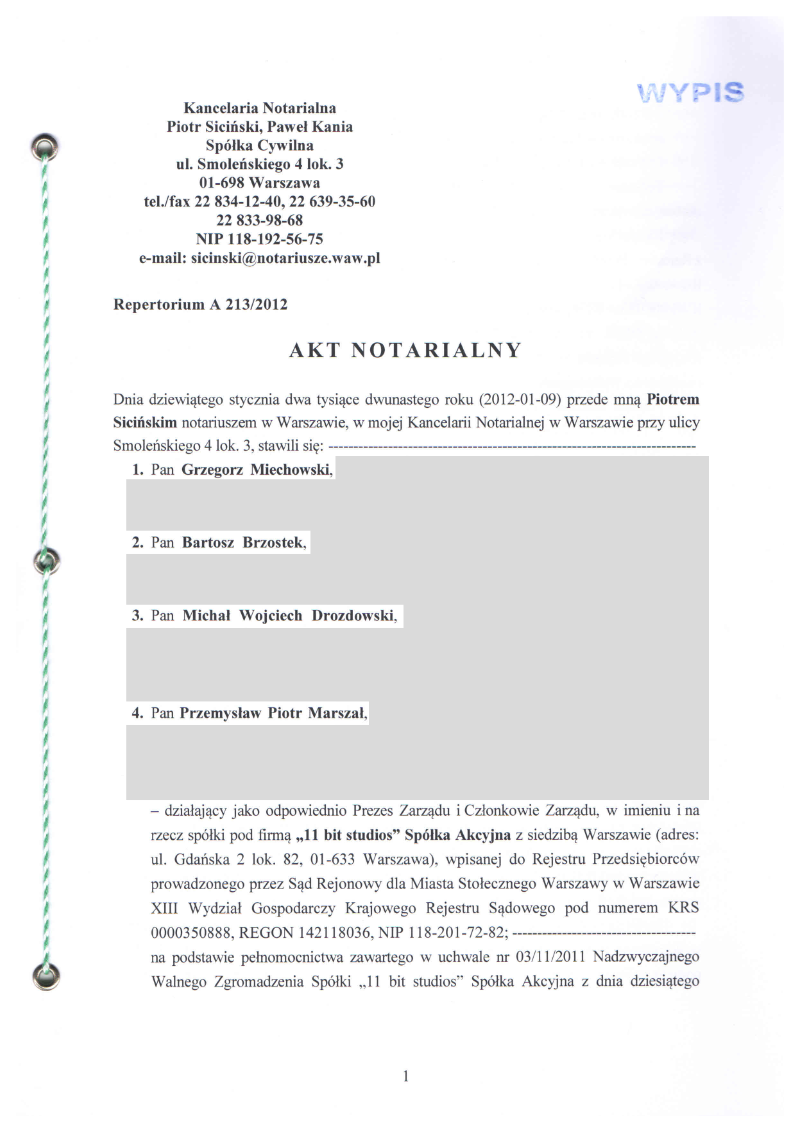
The notarized act dated January 9, 2012 records the formal approval by 11 Bit Studios’ board—Grzegorz Miechowski, Bartosz Brzostek, Przemysław Marszal, and Michał Drozdowski—of a capital increase for the Warsaw‑based public limited company. The board, empowered by Extraordinary General Meeting resolutions of November 10, 2011 (notary file A 7671/2011), authorized the issuance of up to 500,000 new ordinary shares (Series D) at a nominal value of PLN 0.10 each, raising the share capital from PLN 187,076.10 to a maximum of PLN 237,076.10. The resolution also amended the company’s statute to reflect a new share structure: 1,000,000 Series A shares, 494,200 Series B shares, 376,561 Series C shares, and up to 500,000 Series D shares.
By December 31, 2011 the board confirmed that 10 subscription agreements had been executed for a total of 40,938 Series D shares, amounting to PLN 4,093.80 in subscription proceeds. The act further specifies that the capital increase was fully paid in cash, with shares deposited into the company’s account before registration. It outlines provisions for voluntary share cancellation and issuance of utility certificates, as well as the allocation of costs: notarial fees, VAT at 23 %, and a civil‑law transaction tax.
The document is limited to Warsaw, Poland, covering the period from the November 2011 resolutions through the January 2012 notarization. It relies on statutory provisions under Polish commercial law (articles 431 §7, 310 §2, and related tax statutes) to validate the corporate actions. The act concludes with notarized signatures and fee details, confirming compliance with legal formalities for the capital increase.
- On January 9, 2012, 11 Bit Studios formally notarized a capital increase authorized by the board to issue up to 500,000 new Series D ordinary shares at a nominal value of PLN 0.10 each.
- The capital increase expanded the company's share capital from PLN 187,076.10 to a potential maximum of PLN 237,076.10.
- As of December 31, 2011, the company successfully executed 10 subscription agreements for 40,938 Series D shares, generating PLN 4,093.80 in cash proceeds.
- The company’s updated share structure now comprises 1,000,000 Series A shares, 494,200 Series B shares, 376,561 Series C shares, and the newly authorized pool of up to 500,000 Series D shares.
- The board of directors, including Grzegorz Miechowski, Bartosz Brzostek, Przemysław Marszal, and Michał Drozdowski, ratified these changes following resolutions passed at an Extraordinary General Meeting on November 10, 2011.
11 bit studios
Report76 pages
Half-Year Report: 11 bit studios (H1 2022)
HALF-YEAR REPORT OF 11 BIT STUDIOS S.A. FOR THE SIX MONTHSENDED Dear Shareholders and Investors, Please be invited to read 11 bit studios’ report for the six months ended June 30th 2022. It was a time of hard work for us. Despite the unfavourable macroeconomic headwinds, the Company’s financial performance in that period was much stronger than in the previous year and far better than we assumed in our budget.
- 11 bit studios S.A. reported a profit of PLN 15,083,775 for the period ended June 30, 2022, an increase from PLN 13,308,096 in the same period of 2021.
- The company's total assets increased by 10.48% to PLN 242,514,237 as of June 30, 2022, up from PLN 219,512,964 at December 31, 2021.
- Cash provided by operating activities rose to PLN 28,377,470 in H1 2022 from PLN 22,490,664 in H1 2021, with net cash from operating activities at PLN 24,080,772.
- Depreciation and amortisation expenses decreased by 41.63% year-on-year to PLN 3,072,760 in H1 2022, mainly due to lower amortisation of intangible assets as certain products completed amortisation.
- 11 bit studios acquired a 40% interest in Fool’s Theory Sp. z o.o. for an initial payment of PLN 2,619,215.50 in March 2022, with a second payment contingent on the sales and user ratings of their game, Vitriol.
+2
11 bit studios
Report77 pages
Half-Year Report of 11 bit studios S.A.: First Six Months of 2023
HALF-YEAR REPORT OF 11 BIT STUDIOS S.A. FOR THE SIX MONTHS ENDED JUNE 30TH DEAR SHAREHOLDERS AND INVESTORS, We are pleased to share with you our half-year Gamescom, the largest European trade fair held in report for the first six months of 2023. We invite you Cologne, Germany, where they are garnering highly to read it, and we believe it will provide you with a favourable feedback. wealth of compelling and valuable insights .
- 11 bit studios S.A.'s net profit for the first half of 2023 was PLN 4,013,206, a significant 73.39% decrease from PLN 15,083,777 in the same period of 2022, with the net profit margin falling to 16.20% from 32.96%.
- Total revenue for the first six months of 2023 was PLN 24,775,454, down 45.87% from PLN 45,769,806 in the corresponding period of the previous year, primarily due to the natural aging of proprietary and publishing portfolios and a high comparative base from H1 2022.
- The US market was the largest revenue contributor in H1 2023, generating PLN 18,144,825, though this was a decrease from PLN 35,936,180 in H1 2022.
- Cash and cash equivalents increased to PLN 38,951,881 as of June 30th, 2023, up from PLN 30,585,991 at the end of 2022, with 66.47% deposited with Powszechna Kasa Oszczędności Bank Polski S.A.
- The company's publishing division is actively developing five titles, including 'The Thaumaturge' and 'The Invincible,' with a total investment budget of approximately PLN 50 million, and is also working on a mobile, free-to-play version of 'Frostpunk'.
+2
11 bit studios
Report2 pages
Games from 11 bit studios’ Publishing Portfolio Approaching Release: Q1 2023
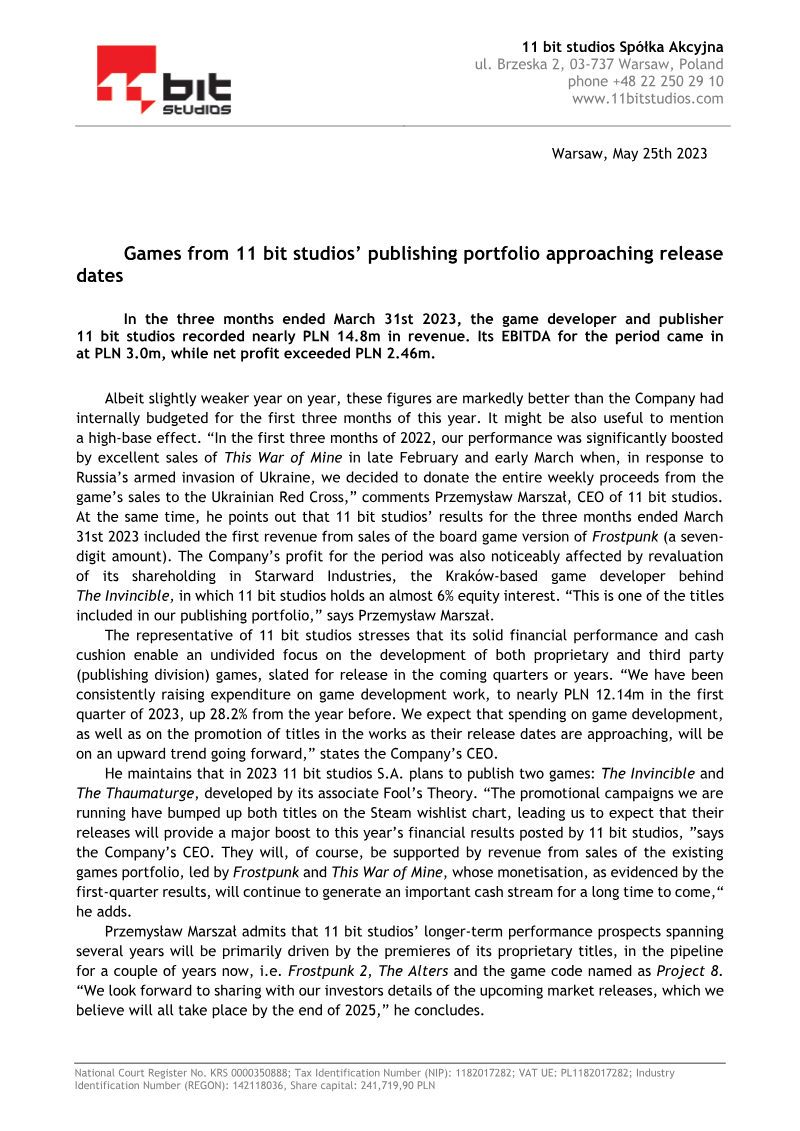
11 bit studios’ first‑quarter 2023 financials show a revenue of PLN 14.8 million, EBITDA of PLN 3.0 million and net profit exceeding PLN 2.46 million, slightly below the same period in 2022 but still above internal forecasts. The decline is partly attributed to a high‑base effect from the previous year’s exceptional sales of This War of Mine during February–March 2022, when the company donated weekly proceeds to the Ukrainian Red Cross. The current quarter’s profit was also influenced by revenue from the board‑game version of Frostpunk and a revaluation gain on an equity stake in Starward Industries, which owns The Invincible.
Investment in development rose 28.2 % year‑on‑year to PLN 12.14 million, reflecting a strategy of increasing spend on both proprietary and third‑party titles as release dates approach. The publishing pipeline for 2023 includes The Invincible and The Thaumaturge, developed by Fool’s Theory, with promotional campaigns boosting their Steam wishlist rankings. The company anticipates that these releases will significantly lift 2023 financial results, supported by ongoing monetisation of established titles such as Frostpunk and This War of Mine.
Long‑term growth is expected to hinge on upcoming proprietary projects—Frostpunk 2, The Alters, and an unnamed “Project 8”—all slated for launch by the end of 2025. The company’s cash cushion and solid Q1 performance underpin its focus on expanding both its own development slate and publishing portfolio across the global video‑game market.
- 11 bit studios reported Q1 2023 revenue of PLN 14.8 million, EBITDA of PLN 3.0 million, and a net profit exceeding PLN 2.46 million, figures that outperformed internal forecasts despite a year-over-year decline.
- Development expenditure increased by 28.2% year-on-year to PLN 12.14 million as the company scales investment in both proprietary and third-party titles ahead of upcoming releases.
- The 2023 publishing pipeline features The Invincible (Starward Industries) and The Thaumaturge (Fool’s Theory), with both titles seeing increased Steam wishlist traction ahead of their scheduled launches.
- The company plans to launch three major proprietary titles—Frostpunk 2, The Alters, and 'Project 8'—by the end of 2025 to drive long-term growth.
- The Q1 2023 profit was bolstered by revenue from the Frostpunk board game and a revaluation gain on the company's equity stake in Starward Industries.
+1
11 bit studios