People Management·Updated Mar 21, 2026 by InGameJob
Report · January 1, 2024
Published by InGameJob
The European games industry in 2024 is characterized by significant volatility and structural transformation, with 15% of the workforce experiencing layoffs and 10% exiting the sector entirely. This instability disproportionately affects junior professionals, nearly a third of whom have left the industry over the past year. While 44% of those who switched jobs secured career gains, a notable 24% accepted lower pay or seniority to remain employed. Job satisfaction and employee loyalty follow a U-shaped trajectory, typically bottoming out between three and five years of experience before rebounding as professionals prioritize stability and mature corporate processes. Technological integration and workplace culture are central to current industry shifts. AI adoption has surged by 17% year-over-year, with 54% of professionals now utilizing these tools. Despite this modernization, the sector struggles with persistent systemic issues, including a gender pay gap driven by a lack of female representation in leadership and technical roles. Discrimination remains prevalent, as 32% of respondents reported personal experiences with gender-based bias and 26% cited ageism. Furthermore, a significant gap in professional development exists; 55% of workers received no formal training in the past year, forcing 65% of those seeking advancement to self-fund their education. Operational pressures continue to impact well-being, with 28% of the workforce reporting stagnant career development and 7% working overtime almost daily. High dissatisfaction is closely linked to professional burnout, poor management, and a lack of work-life balance. However, certain segments show resilience; the outsourcing sector saw a significant rise in employee net promoter scores, and hybrid work models remain a primary driver of retention. While free-to-play studios generally offer higher compensation than premium developers, long-term stability perks and profit-sharing remain the most effective tools for maintaining a committed workforce in an increasingly precarious market.
# BIG GAMES # INDUSTRY # EMPLOYMENT # SURVEY # 2024 SALARIES, COMPENSATION TRENDS AND STATE OF THE GAMES SECTOR IN EUROPE VALUES VALUE INGAMEJOB
# 01 # Highlights of 2024 - 15% were laid off and have found a new job in 2023-2024, with 5% still searching. - 10% of respondents changed their job last year and switched from gamedev to another industry. - Localization and Sound Specialists, Artists, QA, and Project Managers feel the most vulnerable to potential layoffs. - Top laid off roles: HR & Recruiters, QA, Artists. - 39% of game developers have pet projects. - Only $1 \%$ of developers working on Hyper Casual projects would like to continue developing games in this genre. - Average income satisfaction by level of seniority: Juniors - 2.2 out of 5, Mid-level - 2.9 out of 5, Seniors - 3.6 out of 5. - 16% of respondents say that they are feeling a slowdown in personal development in their current position. - Some of the most common cases of discrimination among the respondents are: Gender Discrimination (32%), Age Discrimination (21%), and National Origin Discrimination (17%). - 54% of game developers use AI in their daily work and find it helpful. Last year, this figure was $17\%$ lower. - Professional burnout, unprofessional management, and poor work-life balance are the top three issues respondents experience at their current workplace. - Most wanted employers: CD Projekt Red, Larian Studios, Activision Blizzard, Supercell, Rockstar Games, Riot Games, Ubisoft.
# 02 # Introduction & Research Methodology # Who conducted the study? This study was conducted for the eighth time and the second on an international level, and represents a survey of the European video games industry. A collaboration between Values Value and InGame Job, it explores trends in wages, job satisfaction, and career growth. - Values Value is a recruitment expert in hiring top game development talent. - InGame Job is an online platform for finding career opportunities in the gaming industry. # How was the study conducted? The research was conducted anonymously from March to June 2024. A total of 1,832 respondents from 57 countries worldwide participated in the study. The data was cleansed of invalid and anomalous salary responses. We analyze only the European region in order to represent valid data for this report. We divide Europe into two regions (European Union and Non-European Union) because there are significant differences in the cost of living, income, expenses, and taxes. This way, we present more accurate figures in the salary charts. For the sake of clarity, the following countries were grouped together as the region "Europe (EU+UK+Switzerland)": Austria, Belgium, Bulgaria, Croatia, Cyprus, Czech Republic, Denmark, Estonia, Finland, France, Germany, Greece, Hungary, Ireland, Italy, Latvia, Lithuania, Malta, Netherlands, Poland, Portugal, Romania, Slovakia, Slovenia, Spain, Sweden, Switzerland, and the United Kingdom. The size of the sample – 692 respondents. The following countries were grouped together as the region "Europe (Non-EU)": Armenia, Belarus, Georgia, Moldova, Bosnia and Herzegovina, Montenegro, North Macedonia, Serbia and Ukraine. The size of the sample – 695 respondents.
# 03 # Introduction & Research Methodology # Who participated in the study? - 58% male, 24% female, 19% other or prefer not to answer - 9% Junior, 29% Middle, 30% Senior, 28% Lead/Top - 19% have over 10 years of experience in games Europe (EU+UK+Switzerland) Europe (Non-EU)
# 04 # Content - 02 INTRODUCTION & RESEARCH METHODOLOGY - 05 SALARY DATA 2024 - 15 SATISFACTION WITH CURRENT SALARY - 17 COMPENSATIONS AND BENEFITS - 22 ENPS: WHAT MAKES EMPLOYEES LOYAL & ENGAGED - 32 GENDER PAY GAP - 36 WORK ARRANGEMENT TRENDS - 39 AI ADOPTION - 40 FREELANCE AND PET PROJECTS: EXTRA INCOME BEYOND FULL-TIME JOBS - 45 JOB CHANGE AND LAYOFFS - 54 WELL-BEING: HOW GAME DEV PROFESSIONALS FEEL AND WHAT CHALLENGES THEY FACE - 74 WHICH GLOBAL COMPANIES DO OUR RESPONDENTS WANT TO WORK FOR? - 75 USEFUL LINKS
# 05 # Salary Data 2024 # Important note: Median salary is the median value of salaries in euro. The median value divides the sample into two equal parts: one-half of respondents receive salaries less than the median, and the other half more than the median. All salaries are gross, annual and in euros. # Median Annual Salary By Roles And Regions Based On The Level Of Seniority
The game development industry is currently navigating a period of profound structural instability, characterized by widespread workforce reductions and a pervasive sense of professional anxiety. Despite the rapid integration of artificial intelligence, the primary driver of current career displacement remains studio restructuring rather than technological replacement. While the majority of the workforce remains employed in hybrid or remote roles, a significant portion of professionals are actively reassessing their career trajectories. This climate of cautious realism is reflected in market sentiment, where nearly 40 percent of industry participants anticipate further decline, leading to increased emotional fatigue and a shift in priorities toward time-based benefits, such as the four-day workweek, over traditional office perks. Geographically, the industry maintains a clear hierarchy in compensation, with North America consistently commanding the highest salary tiers across all seniority levels. In contrast, Central and Eastern Europe continue to function as the most cost-effective hubs for talent acquisition. This regional disparity underscores a broader trend of geographic diversification, as studios balance the need for specialized expertise with the economic realities of global operations. Although the workforce remains mobile, the prevalence of remote work has effectively anchored many professionals, creating a distinct divide where on-site employees demonstrate a significantly higher propensity for international relocation compared to their remote counterparts. The current landscape is defined by a maturing workforce dominated by mid-to-senior level professionals, accompanied by a concerning decline in new entrants. This demographic shift, coupled with the ongoing volatility in employment, has necessitated more flexible recruitment strategies. Studios are increasingly moving away from traditional hiring models, favoring diverse solutions that range from subscription-based flat-fee packages to comprehensive recruitment process outsourcing. As the industry continues to evolve, these data-driven benchmarks serve as a critical framework for both studios and professionals attempting to navigate the complexities of global compensation and shifting labor market dynamics.
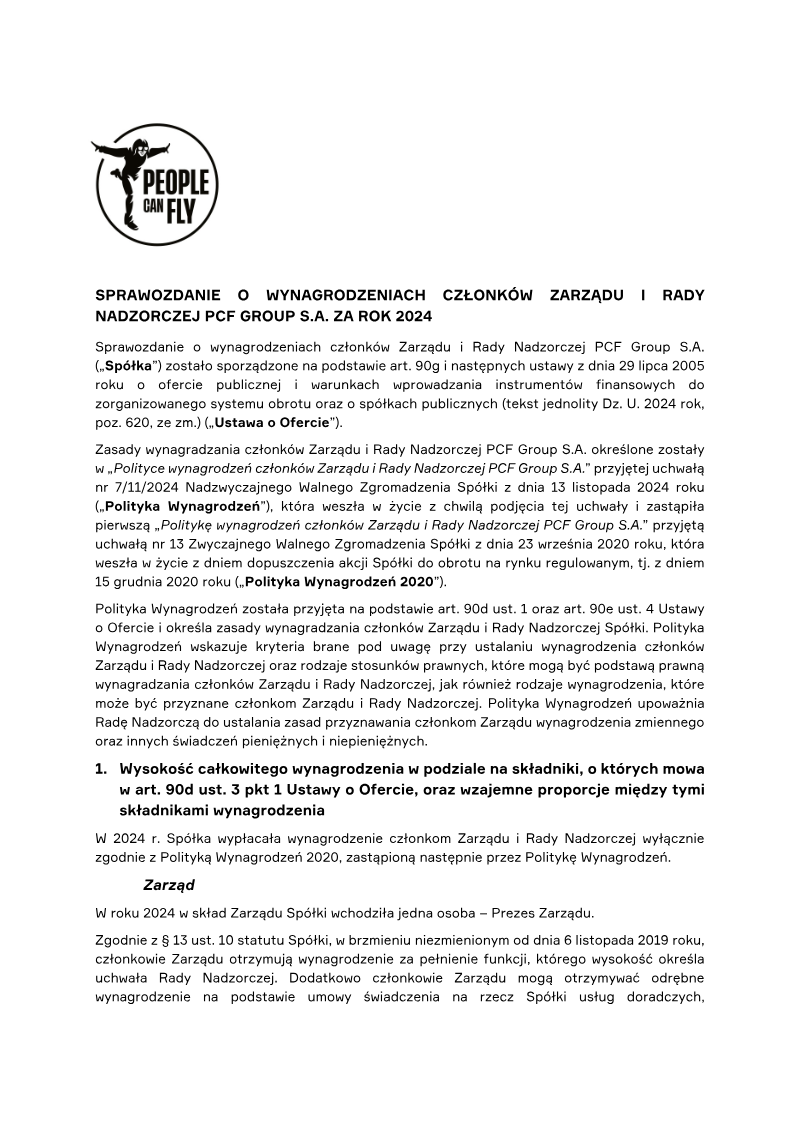
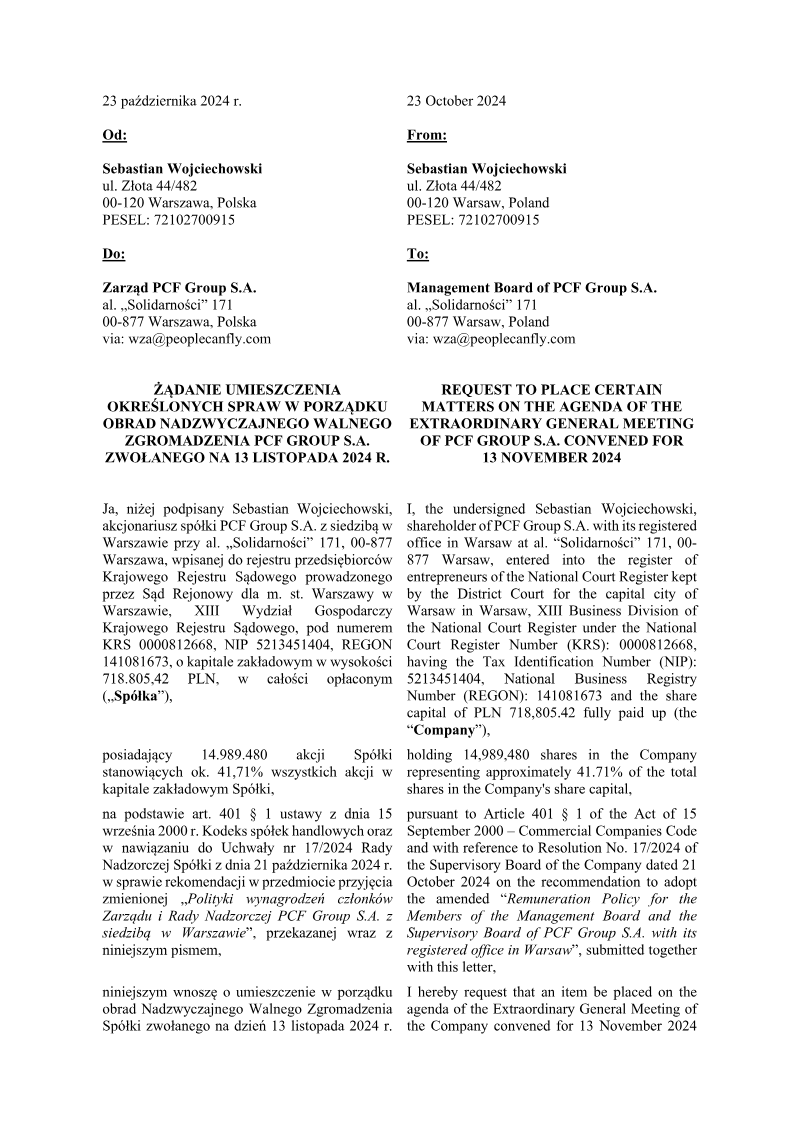
The internal division of tasks and responsibilities within PCF Group S.A. establishes a governance framework aligned with the Best Practice for GPW Listed Companies 2016. The primary purpose of this structure is to define the legal and operational accountability of the management board in relation to the company’s diverse business activities. At the time of drafting, the management board consists of a single member, the President of the Management Board, who holds comprehensive authority over all judicial and extrajudicial activities of the company. The scope of responsibility covers the entirety of the Group’s operations, including strategic management, financial oversight, and legal and accounting compliance. Specific emphasis is placed on the President’s role in driving growth through M&A transactions and the acquisition of new production and publishing contracts for video games. Operational duties extend to the planning and supervision of production activities, the management of development teams, and the establishment of new production units. Furthermore, the President maintains critical relationships with licensors and oversees the internal audit function, including the appointment of auditors and reporting on audit results. While the President currently exercises sole authority, the framework is designed to accommodate future expansions of the board. The board operates under the regulations approved by the Supervisory Board and remains subject to limitations established by the Commercial Companies Code, the Company’s Articles of Association, and resolutions from both the Supervisory Board and the General Meeting. This structure ensures that all aspects of the game development lifecycle—from initial team formation to final publishing agreements—are under direct executive supervision within a regulated corporate governance environment.
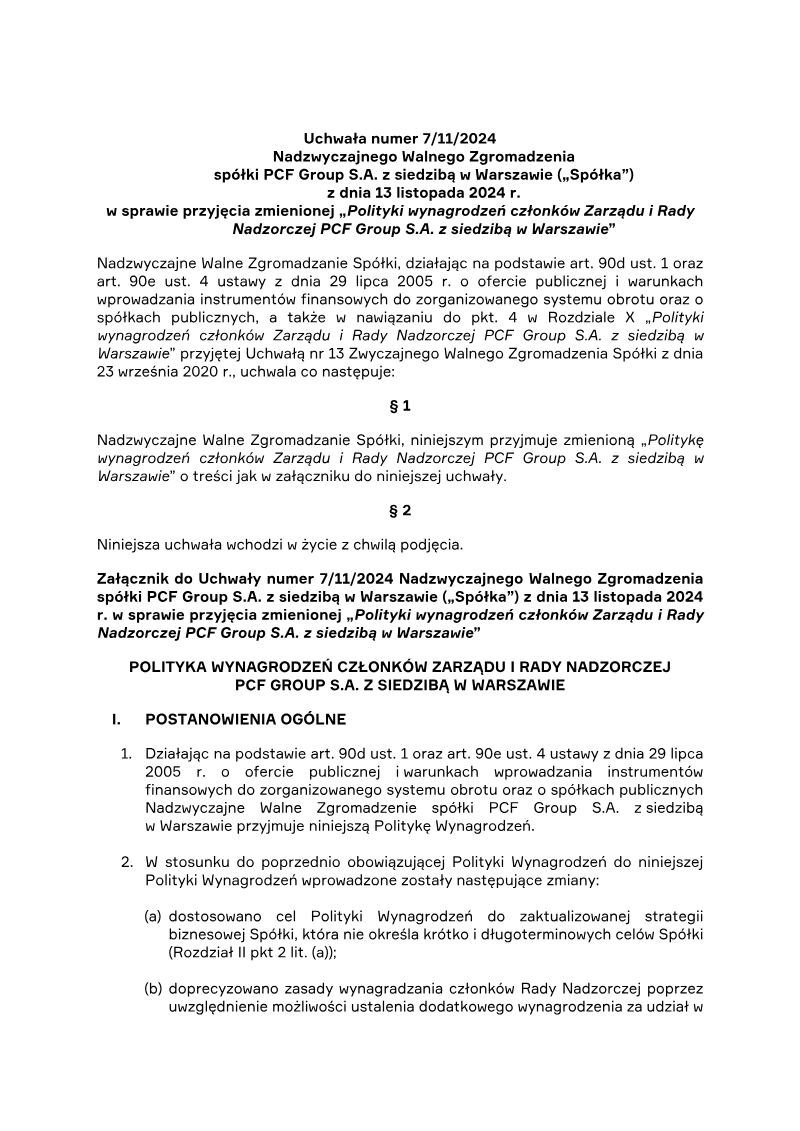
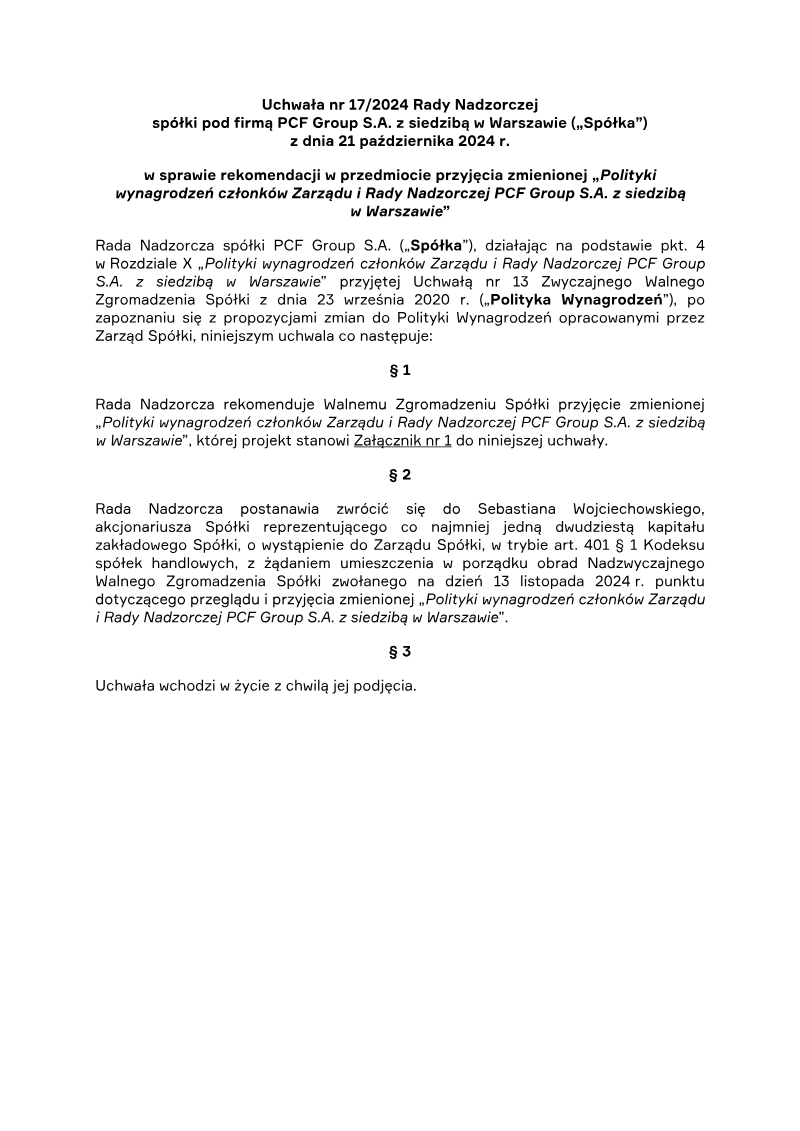
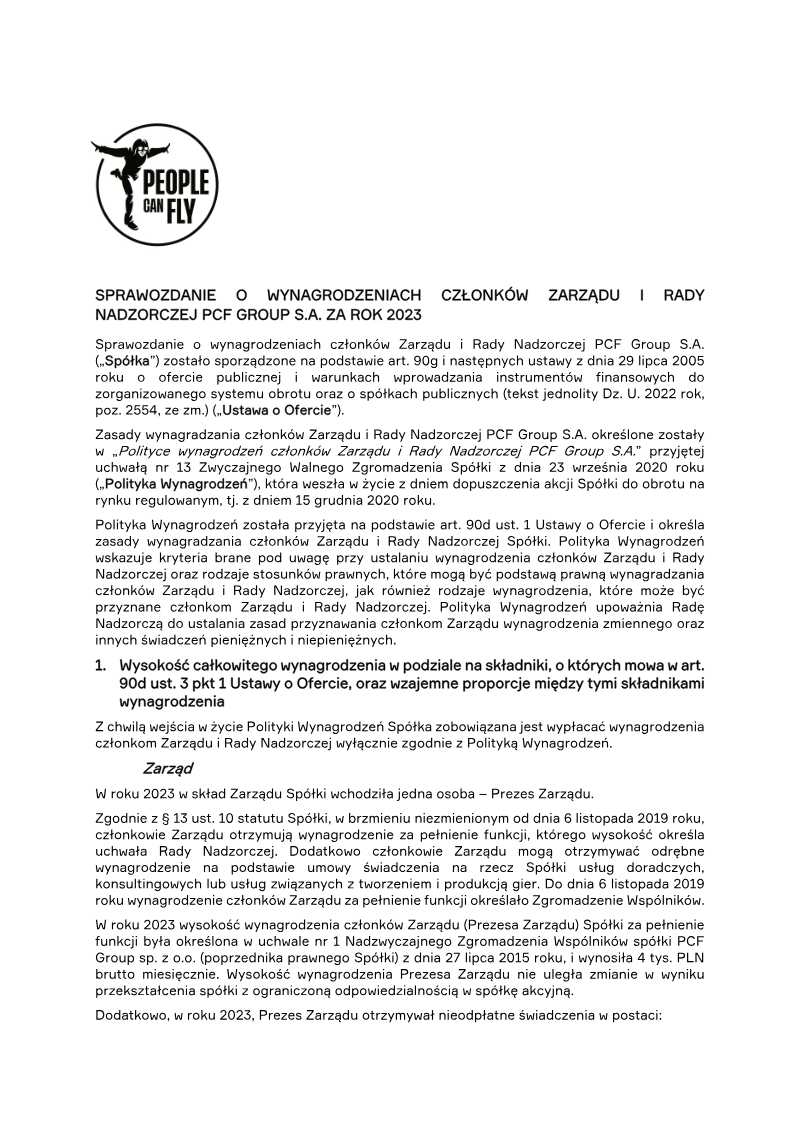
The 2024 fiscal year for PCF Group S.A. was characterized by a strict adherence to established remuneration policies during a period of significant financial contraction. The primary objective of the compensation framework was to align executive pay with market standards and long-term stability while maintaining the independence of the Supervisory Board. Total compensation for the Management Board, represented solely by President Sebastian Wojciechowski, amounted to 1,434,863.82 PLN. This figure reflects a 21% decrease compared to the previous year, driven largely by the absence of variable performance bonuses. The President’s earnings were primarily derived from a service agreement for production leadership and a U.S.-based employment contract, supplemented by a fixed monthly corporate fee and minor non-monetary benefits such as private medical care. In contrast to the reduction in executive pay, the average salary for the Group’s employees rose by 10.67% to 116,932 PLN. This divergence occurred against a backdrop of substantial financial challenges, as the Group reported a net loss of 175.3 million PLN for the year. Supervisory Board members received fixed annual compensation ranging from 36,000 PLN to 75,500 PLN, consisting of monthly fees and meeting stipends. These payments were designed to ensure objective oversight, and as such, included no variable components, non-monetary benefits, or compensation from subsidiary entities. The Group maintained high levels of transparency and regulatory compliance throughout 2024, reporting no deviations from its Remuneration Policy. No financial instruments, such as stock options or shares, were granted or offered to any board members during this period. Furthermore, the governance of these compensation structures remained stable, following the shareholder approval of the previous year’s remuneration statement without objection. This fiscal approach emphasizes a commitment to policy consistency and cost management during a period of negative net earnings for the organization.
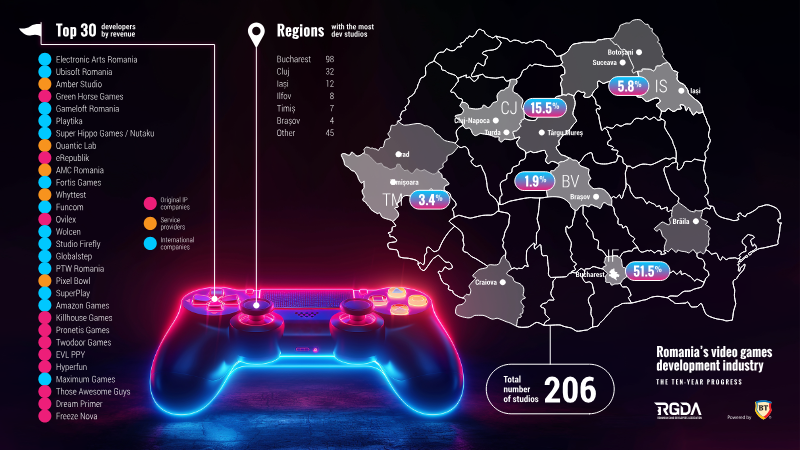
The analysis presents a comprehensive overview of Romania’s video‑game development sector, focusing on revenue performance, geographic concentration, and workforce trends over the past decade. Its central thesis is that the industry has experienced rapid expansion, with total turnover rising from roughly €119 million in 2015 to more than €340 million in 2024, while the number of active studios grew by 70 % within the same period. Revenue concentration is illustrated by a ranking of the top thirty developers, highlighting that multinational publishers such as Electronic Arts Romania (Bucharest) and Ubisoft Romania (Cluj‑Napoca) dominate the market, together accounting for a substantial share of the €340 million total. Mid‑size studios—including Amber Studio (Iași), Green Horse Games (Ilfov), and Playtika (Brașov)—contribute notable percentages, ranging from 5 % to 15 % of overall earnings. The data also maps studio locations, revealing a strong clustering in Bucharest, Cluj‑Napoca, Iași, and Brașov, with emerging hubs in Timișoara, Turda, and Arad. Workforce figures show headcount increasing from 279,986 employees in 2015 to a projected 343,160 in 2024, reflecting a 12 % annual growth rate in personnel. Productivity, measured as turnover per employee, rose by 7.4 % over the ten‑year span, indicating that revenue gains are not solely driven by hiring but also by higher efficiency. Service‑oriented companies and international providers together represent 51.5 % of the sector, underscoring the importance of outsourcing and cross‑border collaborations. The scope encompasses the entire Romanian market, covering all development, publishing, and service activities from 2015 through 2024. Figures appear to be compiled from company‑reported revenues, employee registers, and regional studio counts, suggesting a mixed methodology of financial reporting and industry surveys. Overall, the evidence points to a robust, diversifying ecosystem that is increasingly integrated with the global video‑game supply chain.