Second Life
Game
10 documents in the library are about Second Life, from writers such as Naavik, DiGRA and Game Developers Conference. Each has a summary and key insights with the page they come from.
Connections
Each row is a game or company named alongside Second Life, each column a document, oldest first. A mark means that document names it. Select a row to see those documents.
Key figures from the reports
Second Life maintains a stable economic model through the LindeX exchange, where Linden Labs charges a ~3.5% commission on transactions, generating approximately $16,000 in daily fee revenue.
Naavik, 2023 · Gaming Marketplace Case Studies
The digital fashion market is projected to reach a valuation of $2.5 billion by 2028, fueled by the growing importance of virtual identity among younger demographics on platforms like Roblox, Zepeto, and Second Life.
Naavik, 2023 · Digital Fashion Houses, p. 1
Documents about Second Life
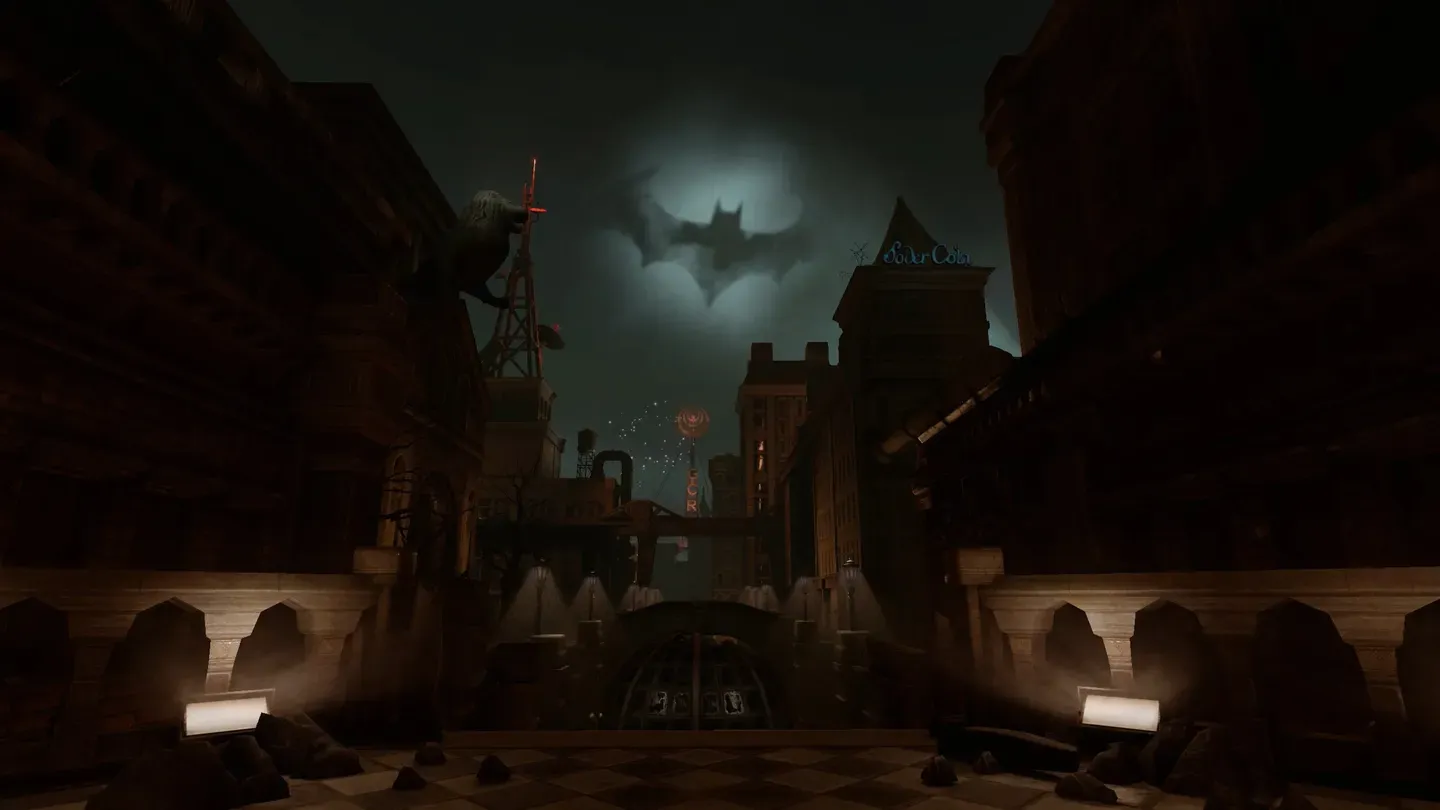
Dark Night
The virtual reality gaming sector faces a critical decline as Meta significantly reduces its investment in the Reality Labs division.
- Meta has initiated significant budget cuts and layoffs within its Reality Labs division, effectively signaling a retreat from its long-term metaverse and VR gaming strategy.
- The VR gaming market is struggling to sustain itself, as evidenced by data showing that only one paid game released in 2025 reached the top 20 grossing list on Meta's Quest platform.
- Meta has closed its subsidiary Twisted Pixel Games, leaving only a small cohort of studios—including Beat Games, BigBoxVR, Camouflaj, and Ouro Interactive—under its VR umbrella.

Global Mobile Apps in August 2025
The analysis focuses on August 2025 mobile app performance across advertising spend, downloads, and revenue for both the App Store and Google Play.
- RocNovel dominates global advertising spend with 580,000 creatives, a 123.1% month-over-month increase, and captures 89% of the U.S. market share using AI comic-style imagery.
- Bigo Live maintains significant scale with $355 million in total revenue, driven by month-over-month growth of 6.5% in Europe and 3.9% in Southeast Asia.
- Short-form content remains a major advertising driver, with ShortMax deploying 189,000 creatives across 81 regions and WebNovel leveraging IPs like 'Solo Leveling' through a video-heavy (84%) strategy.

From MMOs to Web3: James Hursthouse on What’s Next in Gaming
The gaming industry is undergoing a fundamental transition from passive consumption toward a model of co-ownership, where players function as active stakeholders in the intellectual property they engage with.
- Mobile gaming currently dominates the industry, accounting for 51 percent of the total market and serving as the primary driver of consumer spending.
- The industry is shifting from a passive consumption model toward player co-ownership, utilizing Web3 frameworks like smart contracts and tokenization to grant fans equity and royalty streams.
- Technological convergence, including cloud-based access and AI-driven user-generated content, is dismantling traditional industry silos and allowing smaller development teams to compete with established gatekeepers.

Gaming Marketplace Case Studies
The evolution of virtual economies within the gaming industry reveals a critical tension between platform-level revenue extraction and the maintenance of a healthy, player-driven ecosystem.
- Valve’s Steam Community Marketplace, launched in 2013, successfully monetizes cosmetic items for games like DOTA2 by utilizing real-money pricing without allowing players to cash out, effectively keeping value within the Steam ecosystem.
- Facebook Credits, introduced to centralize payments across social games, allowed Facebook to capture a 30% transaction fee, though developers reported mixed results with conversion increases of only 5–10% rather than the projected 15–20%.
- Second Life maintains a stable economic model through the LindeX exchange, where Linden Labs charges a ~3.5% commission on transactions, generating approximately $16,000 in daily fee revenue.

Digital Fashion Houses
The digital fashion market is undergoing a rapid evolution, with projections estimating a valuation of $2.5 billion by 2028.
- The digital fashion market is projected to reach a valuation of $2.5 billion by 2028, fueled by the growing importance of virtual identity among younger demographics on platforms like Roblox, Zepeto, and Second Life.
- Digital-first fashion houses, such as House of Blueberry, act as specialized B2B partners that translate brand intellectual property into virtual assets while managing platform-specific technical requirements and data-driven trend forecasting.
- Unlike physical apparel, digital fashion is unconstrained by real-world physics or human anatomy, allowing for the creation of fantastical accessories and non-human avatar designs.
Open vs Closed Economies in Web3 Games - The Metacast by Naavik
Web3 gaming represents a fundamental shift from the closed, developer-controlled ecosystems of traditional gaming toward open economies where players retain ownership of fungible tokens and non-fungible assets.
- Web3 gaming economic stability requires developers to act as central banks, meticulously managing token inflows and outflows to prevent systemic instability.
- Sustainable models must prioritize core gameplay utility over speculative financial incentives to ensure player engagement remains high even if external market rewards fluctuate.
- Developers should shift away from unsustainable play-to-earn models toward systems that mirror traditional free-to-play spending motivations.
A Brave New (Virtual) World: Ethics and Governance of XR and the Metaverse
The metaverse represents a critical juncture in digital evolution, forcing a choice between centralized corporate control and a decentralized, interoperable future.
- The metaverse currently faces a significant adoption hurdle, with approximately one-third of respondents in the GDC State of the Game Industry report expressing doubt that the technology will deliver on its promised potential.
- Governance models within decentralized autonomous organizations (DAOs) are prone to plutocracy when voting power is tied to token ownership, which risks centralizing wealth and influence rather than fostering democratic participation.
- The future of the metaverse will likely mirror the evolution of the early internet, where walled gardens eventually lose relevance as users demand greater interoperability and the freedom to move their digital assets between platforms.
Game Audience Profiles
The primary objective of this analysis is to establish a framework for profiling video game audiences by correlating specific game titles with player demographics and psychological motivations.
- Quantic Foundry analyzed data from over 100,000 gamers to create specific audience profiles by mapping demographic data and motivation scores against individual game titles.
- The audience for Europa Universalis IV is predominantly male and scores high on strategy-based motivations while scoring very low on excitement-based, fast-paced gameplay.
- Candy Crush players are primarily female and older than the average gamer, with a strong focus on completion-based motivations and low engagement with other gaming factors.
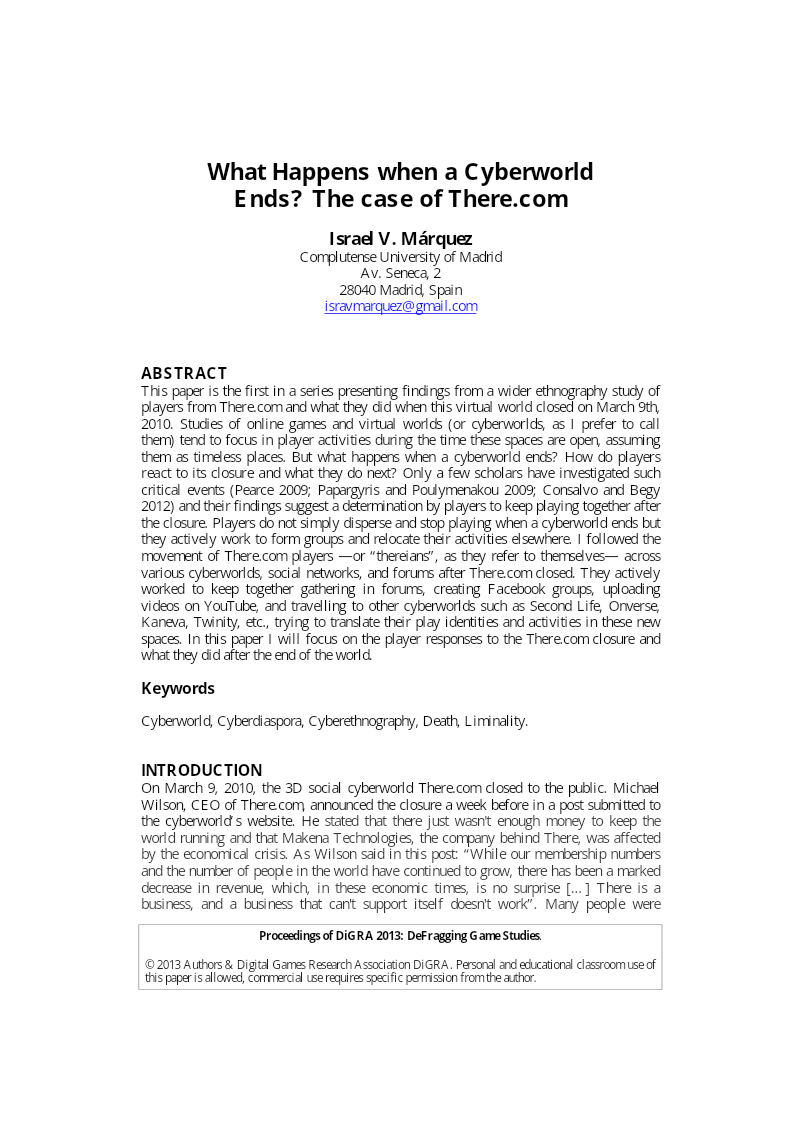
What Happens When a Cyberworld Ends: The Case of There.com
The closure of There.com, a 3D social cyberworld that shut down on March 9, 2010, after its CEO cited insufficient revenue amid the economic crisis, serves as the focus of this analysis of how virtual communities respond to the loss of their digital homes.
- There.com, a 3D social cyberworld, shut down on March 9, 2010, after its CEO cited insufficient revenue amid the economic crisis, and the analysis treats this as the loss of a real community rather than a mere product.
- Displaced users responded with the language of death and mourning, grieving their avatars and searching for a new home across social networks and rival platforms.
- The community dispersed to Facebook groups, Thumdar, and YouTube, while rival cyberworlds such as Second Life and Kaneva offered free accounts and currency exchanges to attract the displaced population.
Player as Author: Conjecturing Online Game Creation Modalities and Infrastructure
This paper argues that the videogame industry has entered a period of creative stagnation, characterized by sequels, familiar genre templates, and tight control over production, and that the producer-consumer dichotomy limits innovation.
- The paper argues the videogame industry has entered creative stagnation, marked by sequels, familiar genre templates, and tight production control, and that the producer-consumer dichotomy limits innovation.
- Its central thesis is that players should be recognized and enabled as authors who create game content, scenarios, mods, and entirely new games, framed as an emancipatory movement.
- Cited examples of player authorship include user-generated machinima, photo-novel stories produced from The Sims, object scripting in Second Life, and modding communities supported by Valve and id Software.