Pony Island
Game
10 documents in the library are about Pony Island, from writers such as DiGRA, GameDiscoverCo and Journal of Games Criticism. Each has a summary and key insights with the page they come from.
Connections
Each row is a game or company named alongside Pony Island, each column a document, oldest first. A mark means that document names it. Select a row to see those documents.
Documents about Pony Island

Opening Night Live 2026: A Disappointing Night for Fans
Opening Night Live 2026, Geoff Keighley's showcase at gamescom in Cologne, is judged one of the weakest in years, with a news-light, heavily padded running order that left the thousands of fans who queued all day underwhelmed.
- Opening Night Live 2026 was widely perceived as a disappointment due to a lack of significant new game reveals and a heavily padded two-and-a-half-hour runtime.
- The showcase's headline announcements relied heavily on established IP, specifically a Gears of War prequel, a Final Fantasy VII: Revelation reboot, and a remaster of The Witcher 3.
- New game reveals included the open-world adventure Ananta from NetEase (January 2027 release), the co-op title Age Twisters, and the action game 1001: Threads of Mizan funded by MBC.
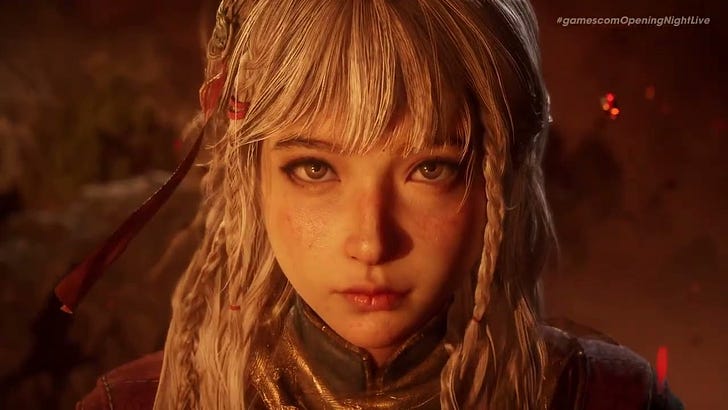
China Flexes at Gamescom
Stephen Totilo's Game File newsletter argues that Chinese studios were the dominant presence at Gamescom's Opening Night Live showcase on August 25, 2026, even though the two-hour show closed with segments from Japan (Final Fantasy VII Retribution, due next spring) and Poland (a Witcher 3 remaster arriving September 29).
- Chinese game studios dominated the GamesCom Opening Night Live showcase, featuring prominent reveals from developers like miHoYo, NetEase, TiGames, and Hoothanes.
- Major Chinese-led projects include miHoYo's dark fantasy co-op game 'Nodusfall', NetEase subsidiary Naked Rain's 'Ananta' (releasing January 15, 2027), and a remake of 'Heroes of Might and Magic III' led by Ubisoft’s Chengdu and Shanghai studios.
- Take-Two is pursuing a subpoena against YouTube and X to identify the source of 14 recent 'GTA VI' leaks, with plans to request personal information for members of targeted Discord groups.
Ludic Composites and Playable Silvas
Silvicity functions as a critical framework for analyzing heterogeneous videogames that resist traditional classification as simple minigame collections.
From Paper to Pixels: Horrific Remediation in Inscryption
The analysis of Inscryption (2021) posits that the game masterfully employs remediation theory to construct a uniquely horrific and immersive player experience.
- The report argues that Inscryption solves the problem of conveying dread in a digital medium, which lacks tactile presence, by remediating the comfort of playing a card game at a physical table and then subverting that comfort into unease.
- Its analysis draws on Bolter and Grusin's remediation theory and oscillates between immediacy and hypermediacy, focusing on the cabin environment of Act One.
- The authors use Dolan's hauntological framework to explain how the game's low-poly, nostalgic aesthetic corrupts familiar formats into something unknowable.
Which New Games Made the Biggest Splash at The Game Awards?
This document analyzes the impact of new game announcements at The Game Awards, focusing on media coverage and Steam follower growth, and also evaluates the initial performance of Epic Games' new Fortnite experiences.
- LEGO Fortnite achieved a peak of 1.2 million concurrent users in December 2023, signaling Epic Games' successful transition of the title into a multi-game platform.
- Black Myth: Wukong led all titles in new Steam follower growth following The Game Awards 2023, driven primarily by strong performance in Asian markets.
- Consumer sentiment toward sequels has improved, with 'sequel fatigue' dropping from 39% in 2016 to 27% in 2023, reflecting a market increasingly driven by established franchises.
"Our Player Friend Here... They Already Hold the Key...": Redefining Genre Limits in Inscryption
This paper analyzes how the video game Inscryption redefines genre limits through its use of intermediality and genre-blending, extending its narrative beyond the in-game universe.
- The paper argues that Inscryption's blend of deckbuilder and escape room genres, plus embedded interactive fiction and transmedia elements, produces a layered story whose full meaning emerges only through repeated play, code exploration, and communal online investigation.
- The analysis uses N. Katherine Hayles's concept of remediation as its interpretive anchor and draws a comparison with House of Leaves, arguing that Inscryption sustains player engagement in a similar way.
- The study sorts the game's mechanics and narrative elements into three tiers: immediately present content, material hidden or clarified through multiple playthroughs, and material embedded in the game's code.
Plus: Why Did Inscryption Blow Up?
Devolver Digital's roguelite card game Inscryption, from Pony Island developer Daniel Mullins, is the standout performer in this weekly Steam, Switch and Xbox sales roundup from late October 2021.
- Inscryption achieved breakout success with 100,000 units sold and 12,500 concurrent Steam users, driven by the developer's established reputation, a pivot to the popular roguelite card battler genre, and high streamer visibility.
- Publisher Devolver Digital’s platform-wide following provides a significant marketing advantage for indie titles, acting as a force multiplier for initial launch performance.
- Recent momentum is a more reliable indicator of commercial success than long-term follower accumulation, as evidenced by titles like Spire of Sorcery failing to convert high historical interest into active players.

Gameplay, Emotions and Narrative: Independent Games Experienced
"Gameplay, Emotions and Narrative: Independent Games Experienced" examines how independent digital games function as sophisticated artistic mediums, capable of evoking deep emotional and intellectual engagement through the complex interplay of narrative and mechanics.
- The report analyses independent (non-Triple-A) games, ranging from free or pay-what-you-want releases to products from small teams or small publishers with limited budgets, arguing these titles use game mechanics to explore emotion and narrative.
- Chapter One examines Hellblade: Senua's Sacrifice (2017), arguing it renders the mindscape of a person who is mentally ill through ludic mechanics, with particular focus on belief and imagination as central to its portrayal of mental and emotional states such as shame, guilt, despair and terror.
- In Hellblade, the 'darkness' is visualised as progressive decay that the Narrator calls 'rot'; although the game warns it will kill Senua, the rot only frightens her and the player rather than actually killing her, mirroring how Zynbel's abusive claims prove untrue within the narrative.
Games You Might Not Have Tried - ep 10 - Find New Games - Extra Credits
This analysis explores a curated selection of video games that offer unique design perspectives, ambitious mechanics, or unconventional genre blending.
- Game design innovation often requires balancing mechanical experimentation with overall polish, as seen in titles like The Way where variety can compromise execution.
- Genre-mashing, such as combining deck-building with city planning in Concrete Jungle or card mechanics with roguelike shooters in Forced Showdown, creates novel experiences but carries significant execution risks.
- Some innovative mechanics, particularly in games like Forced Showdown, require a substantial time investment from the player before the core design intent becomes fully apparent.

“There’s No Point In Saving Anymore”: Diegesis And Interactional Metalepsis In Pony Island And Doki Doki Literature Club
Video games increasingly employ metalepsis—the transgression of boundaries between narrative levels—to dismantle the traditional fourth wall and foster a sense of ontological disorientation.