Time
Company
Documents about Time
How To Make Games With No Experience w/ Mark Brown @GMTK — Full Time Game Dev Podcast Ep. 026
Transitioning from game design analysis to active development requires a fundamental shift in mindset, moving away from theoretical perfectionism toward the practical necessity of shipping projects.
- Prioritize finishing small, tightly scoped projects over theoretical perfectionism, as the act of shipping a game provides more professional growth than years of study.
- Mitigate risk in a saturated indie market by targeting specific niche communities rather than attempting large-scale titles that lack a clear, unique hook.
- Bridge the gap between internal vision and player reality through frequent, rigorous playtesting, as creators cannot objectively evaluate their own work.
How To Make Money From Your Game In 2025 w/ Chris Zukowski — Full Time Game Dev Podcast Ep. 025
The indie game development landscape in 2025 is characterized by high saturation and increased risk, necessitating a shift toward disciplined, iterative production models.
- To gain traction on Steam, developers should aim for a baseline of 7,000 wishlists before launch to trigger the platform's algorithm effectively.
- Marketing success is not achieved through social media posts or tweets, but by securing access to established audiences through influencers and industry gatekeepers.
- Developers should prioritize building their own owned audience (like an email list) rather than relying solely on Steam wishlists, as the latter is a platform-dependent asset that could be subject to change.
How To Make Indie Games In 2025 w/ Jonathan Blow — Full Time Game Dev Podcast Ep. 024
The contemporary game development landscape faces its most precarious period since the 1980s, defined by a saturated, "red ocean" marketplace where high-quality titles struggle for visibility amidst a deluge of low-effort releases.
- The current game market is a 'red ocean' characterized by extreme saturation, where high-quality titles are frequently obscured by a high volume of low-effort releases.
- Modern game engines like Unity and Unreal have lowered barriers to entry but introduced significant technical overhead, including software bloat and performance inconsistencies.
- Developers should consider building custom engines to regain technical control and efficiency, despite the increased labor and operational demands this approach requires.
Does Game Marketing Even Matter In 2025? — Full Time Game Dev Podcast Ep. 023
The modern game development landscape is defined by a critical tension between creative integrity and the harsh realities of a saturated market.
- Organic reach on legacy social media platforms like X is declining, forcing developers to pivot toward YouTube funnels and influencer partnerships to secure visibility.
- Success in 2025 is increasingly driven by engineered marketing and paid influencer content rather than organic discovery.
- Developers are abandoning the high-fidelity graphics arms race in favor of minimalist, stylized art directions to differentiate products in a saturated market.
How To Make Games ALONE In 2025 — Full Time Game Dev Podcast Ep. 022
The contemporary landscape for solo game development has transitioned from an era of speculative funding toward a rigorous, meritocratic environment that demands early market validation.
- Solo developers must treat game development as a disciplined business, prioritizing data-driven market validation over creative intuition to ensure financial sustainability.
- Steam wishlists serve as the primary key performance indicator for market interest, and projects failing to meet early wishlist benchmarks should be abandoned rather than polished.
- The industry has shifted away from speculative funding and subscription service payouts, necessitating a strategy focused on building an organic audience directly on platforms like Steam.

Now Is the Time! Workers in Games Are Ready to Form Unions
The game industry currently faces a critical juncture where widespread layoffs, precarious job security, and unilateral management decisions have necessitated a shift toward collective labor organization.
- Game industry workers are increasingly pursuing unionization to transition from individual advocacy to a structured, democratic system of negotiation that secures legally binding contracts.
- Collective bargaining is being utilized to address systemic issues such as widespread layoffs, job insecurity, and unilateral management decisions regarding remote work and unpaid testing.
- Strategic organizing efforts, supported by the International Alliance of Theatrical Stage Employees (IATSE), prioritize building studio-level supermajorities to establish industry-wide labor standards.
How This Game Dev Got 150,000 Wishlists In A Month — Full Time Game Dev Podcast Ep. 021
Transitioning to full-time independent game development requires a strategic balance between creative ambition and financial pragmatism.
- Developer David Wehle achieved 150,000 wishlists for his upcoming game, 'We Harvest Shadows,' within one month by leveraging a high-quality, standalone demo.
- The game's marketing strategy relied on a 'genre-bending' approach that combined farming simulation with horror, a niche identified by analyzing market trends and player fatigue toward 'soulless' games-as-a-service titles.
- Strategic exposure through high-profile influencers, including Jacksepticeye (30 million subscribers) and Gab Smolders, significantly accelerated wishlist growth after they praised the demo's emotional depth and unique mechanics.
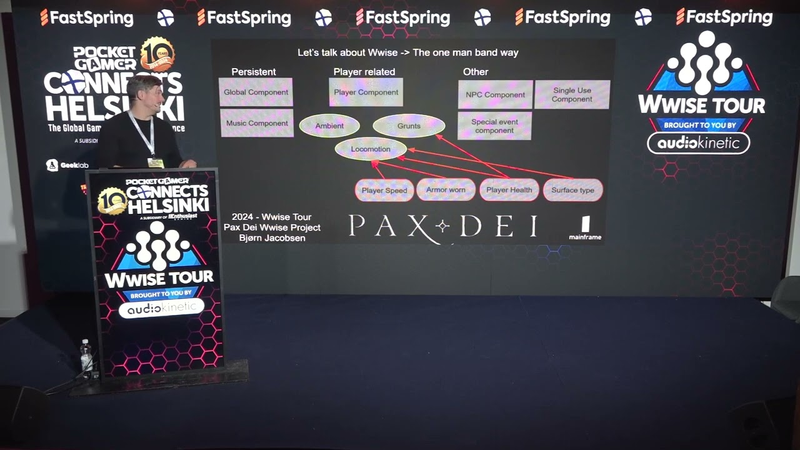
Session: One Man Band AAAudio Department - Bjørn Jacobsen, Mainframe Industries.
Managing the audio landscape for a massive, systemic open-world title like Pax Dei requires a shift from manual asset triggering to a highly automated, data-driven architecture.
- A solo audio lead can achieve AAA-level fidelity in a systemic open-world game by prioritizing a data-driven Wwise architecture over manual asset triggering.
- The system utilizes global RTPCs, states, and switches that update every half-second to dynamically adjust audio based on variables like altitude, weather, time of day, and terrain slope.
- Performance in dense environments is maintained through component pooling, persistent audio components, and strict voice management that limits active virtual voices to the player's immediate biome.
How He Made $3,000,000 From His Indie Game — Full Time Game Dev Podcast Ep. 020
The indie game industry offers significant financial potential for developers who prioritize unique creative visions and sustainable production models.
- Early Access is a viable strategy for long-term development, as evidenced by Lens Island growing to ten times its initial scope during a three-year Early Access period.
- Steam treats an Early Access launch and a 1.0 full release as two distinct opportunities for store visibility, providing developers with two separate chances to gain traction and exposure.
- The conversion rate of wishlists decreases over time, meaning a large pool of wishlists accumulated over several years may be less effective than a smaller, more recent pool generated during a Steam Next Fest.
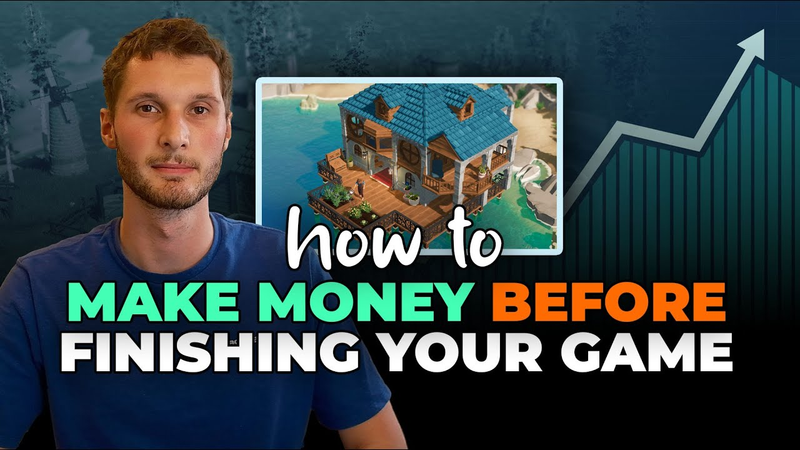
How To Make Indie Games Full Time (Before Finishing Your Game)
Transitioning to a full-time career in independent game development requires a strategic, multi-stage approach to funding that often necessitates personal financial sacrifice and diversified income streams.
- Julian Ball funded the development of Lens Island through a combination of personal savings, a pre-existing YouTube channel, and a $60,000 Kickstarter campaign.
- Lens Island has achieved significant commercial success, selling approximately 200,000 copies and generating roughly $3 million in gross revenue over three to four years.
- The studio's financial requirements scaled significantly over time, moving from a lean operation supported by personal savings to a peak burn rate of $100,000 per month.
How To Make Money As A Game Dev — Full Time Game Dev Podcast Ep. 019
Achieving financial sustainability as an independent game developer requires shifting away from the high-risk, single-project model toward a high-frequency release strategy.
- Shift from a high-risk, single-project model to a high-frequency release strategy to mitigate the dangers of market oversaturation and individual project failure.
- Optimize revenue for smaller, niche titles by pricing them between $2.99 and $9.99, with a specific sweet spot identified at $4.99 to $5.99.
- Prioritize console development over Steam to leverage higher natural discoverability and avoid the burnout associated with the massive marketing efforts required to succeed on the Steam marketplace.
He Knew Nothing.... But Got His Indie Game Published — Full Time Game Dev Podcast Ep. 017
Transitioning from a background in video production to indie game development requires a fundamental shift in perspective, moving from the linear control of film to the complex, non-linear demands of player agency.
- Securing publishing partnerships provides essential funding and access to professional resources like voice talent, but developers must vet these partners as long-term collaborators rather than just financiers.
- Developers should stabilize the long-term development cycle by diversifying capital through a combination of government tax credits, grants, and crowdfunding.
- Successful game design requires mastering subtle signposting to guide player agency through non-linear environments without breaking the sense of discovery.