Oculus
Company
Documents about Oculus

The Mobile vs Web User Acquisition: What Nobody's Talking About
The gaming industry is undergoing a fundamental shift toward a unified marketing infrastructure that bridges the historical divide between mobile, web, and console platforms.
- The gaming industry is shifting toward a unified marketing infrastructure that standardizes attribution metrics across mobile, web, and console platforms to eliminate fragmented, platform-specific tools.
- Developers are increasingly applying mobile-centric performance optimization strategies to web-based direct-to-consumer shops to diversify acquisition channels beyond mobile-only environments.
- AI-driven automation is transitioning from simple rule-based campaign management to handling complex, large-scale data synthesis and repetitive tasks like reporting and creative production.

Naughty Dog co-founder Jason Rubin on Crash Bandicoot, trying to save THQ, and the state of VR
The evolution of the video game industry is defined by a persistent tension between creative autonomy and the logistical constraints of corporate oversight.
- The success of the Crash Bandicoot franchise demonstrates that high-quality design and strategic platform targeting can overcome restrictive management environments and manufacturing bottlenecks.
- Efforts to revitalize legacy publishers like THQ reveal that deep-seated operational and financial systemic issues often negate the output quality of individual development teams.
- The industry-wide shift toward edgier content and increased production budgets was largely driven by the competitive pressure to match the market success of titles like Grand Theft Auto.

Building an Expansive 'Star Wars' World in Mobile VR
The development of Star Wars: Tales from the Galaxy’s Edge for mobile virtual reality platforms, specifically the Oculus Quest and Quest 2, required extensive technical optimization to maintain high-fidelity interactive storytelling within constrained hardware environments.
- To overcome mobile CPU bottlenecks, the team implemented a custom object pooling system to eliminate hitches caused by spawning and despawning actors.
- Engineers optimized complex component hierarchies by replacing scene components with actor components and utilizing skeletal mesh detachment to allow animation graphs to function independently.
- The team developed a custom, automated pre-computed visibility system using navigation mesh geometry to limit cell placement, which significantly reduced computation time compared to standard occlusion methods.
Porting Your Title to Oculus Quest
Transitioning a virtual reality title to the Oculus Quest necessitates a fundamental shift toward mobile-first development principles.
- Maintain a strict 72 FPS performance target by aggressively optimizing draw calls and vertex counts to accommodate the Quest’s mobile-first, tile-based rendering architecture.
- Manage the 2.75 GB RAM constraint by utilizing ASTC texture compression and shifting from static dependencies to dynamic asset loading.
- Avoid GPU-intensive features such as Z-passes, alpha testing, and dynamic lighting, opting instead for texture atlases, shader-based optimizations, and faked lighting effects.
Launching Spaceteam VR PG Connects Digital #2
The development and launch of Spaceteam VR represent a strategic adaptation of a classic mobile cooperative experience into the immersive virtual reality landscape.
- Spaceteam VR launched in May 2020, requiring a shift to remote development workflows and digital-only community engagement due to the global pandemic.
- The project successfully implemented cross-play functionality between Steam and Oculus Quest to maintain the original game's cooperative social dynamics.
- Technical challenges, specifically synchronization discrepancies and low player density, hindered initial user conversion rates and long-term retention.

Unreal Engine 5 Reactions, And Last of Us 2 Ending a Generation | Game Dev Unchained Roundtable News
The introduction of Unreal Engine 5 marks a pivotal shift in game development, primarily driven by the integration of Nanite geometry and Lumen real-time global illumination.
- Unreal Engine 5 introduces Nanite geometry and Lumen real-time global illumination to automate light-baking and eliminate traditional optimization bottlenecks for high-fidelity assets.
- Despite technological advancements, Unreal Engine 5 does not remove the need for rigorous character animation, physics simulation, and efficient asset management in full-scale production.
- Industry experts view high-end tech demonstrations as aspirational marketing tools rather than immediate standards, as most studios continue to prioritize cohesive art styles over raw photorealism.
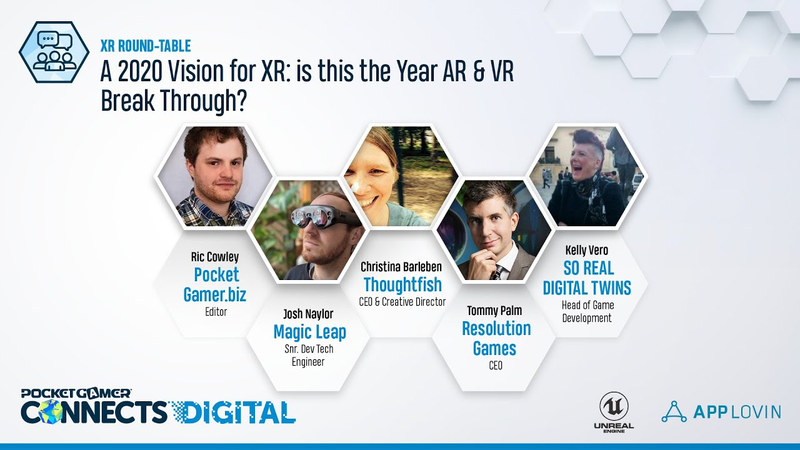
A 2020 Vision for XR: is this the Year AR & VR Break Through? | PGC Digital #1
The year 2019 marked a critical transition for extended reality, moving the industry away from low-end mobile VR toward high-quality, standalone hardware like the Oculus Quest.
- The industry is shifting from short-form mini-games toward deep, persistent, and social multiplayer experiences, which experts identify as the primary catalyst for mass adoption.
- The transition from low-end mobile VR to high-quality standalone hardware like the Oculus Quest has successfully expanded the user base beyond early adopters to include families and casual players.
- The COVID-19 pandemic has accelerated demand for immersive digital solutions in remote collaboration and cultural archiving, while driving record engagement for high-fidelity titles like Half-Life: Alyx.

PocketGamer.biz Podcast Episode #5: Garena Free Fire 80m DAUs, Gamescom goes digital, and more!
Garena’s Free Fire has solidified its position as a dominant force in the mobile gaming sector, reaching 80 million daily active users and surpassing $1 billion in lifetime revenue in under three years.
- Garena Free Fire has reached 80 million daily active users and surpassed $1 billion in lifetime revenue in under three years by utilizing a mobile-first design focused on short, action-oriented matches.
- Minecraft continues to demonstrate long-term franchise viability, recording 200 million lifetime sales and 126 million monthly active users more than a decade after its initial release.
- The Oculus Quest has become a market leader in the VR hardware space, generating over $100 million in user spending due to its wireless functionality and content ecosystem.

CoVID 19 Updates, Magic Leap Scam, Stadia, VR, PS5, Valorant CS GO | Game Dev Unchained Episode 223
The global game industry is currently navigating a period of significant transition, characterized by the normalization of remote work environments and a critical re-evaluation of high-profile technological ventures.
- The industry is shifting away from speculative, hype-driven hardware models toward sustainable, content-led growth, as evidenced by Magic Leap’s failure to meet consumer expectations and its subsequent pivot to enterprise applications.
- High-quality, first-party exclusive content is now the primary driver for platform adoption, superseding artificial marketing hype in securing long-term consumer engagement.
- Virtual reality is reaching a maturation point, with titles like Half-Life: Alyx successfully driving hardware adoption for platforms such as the Valve Index and Oculus Quest.
Game VR/AR: Make Your Game Run on Quest (and Look Pretty Too)
Achieving high-quality virtual reality experiences on the Oculus Quest requires a rigorous commitment to performance optimization, as maintaining a consistent frame rate of 60 to 72 frames per second is essential to prevent user discomfort.
- Maintain a consistent frame rate of 60 to 72 frames per second to ensure user comfort and prevent motion sickness on the Oculus Quest.
- Limit draw calls to fewer than 120 per frame to stay within the hardware's strict mobile performance budget.
- Prioritize efficient rendering pipelines by utilizing forward rendering, single-pass stereo, and fixed foveated rendering.

OpenXR News: Converging on a Widely Accepted VR API Standard
The OpenXR initiative, spearheaded by the Khronos Group, seeks to resolve the persistent fragmentation within the virtual and augmented reality sectors by establishing a universal, vendor-agnostic application programming interface.
- The Khronos Group's OpenXR initiative establishes a universal, vendor-agnostic API to eliminate the need for developers to build custom integrations for every individual VR/AR hardware platform.
- Major industry stakeholders, including Valve, Oculus, Google, and Epic Games, are collaborating to ensure content compatibility across diverse runtimes and hardware configurations.
- The 1.0 release utilizes a core feature set supplemented by an extension-based model, allowing for vendor-specific innovations like gesture recognition while maintaining a unified standard.

Maarten Noyon's Pecha Kucha about 2016 trends
The year 2016 is defined by a spirit of mercy, a theme projected to influence global cultural and political discourse.
- The gaming industry is entering a pivotal phase in 2016 marked by the commercial launch of the Oculus Rift for virtual reality and Nintendo’s strategic expansion into the mobile gaming market.
- The gaming sector is experiencing a significant push for increased gender diversity and equitable representation as it continues to grow its global footprint.
- The United States faces a critical domestic challenge in mass incarceration, holding 25 percent of the global prison population despite representing only 5 percent of the world’s total inhabitants.