Infinity
Company
Documents about Infinity
Two & a Half Gamers Session #12: Metacore, Niantic, and Industry Conference Guide
Episode #12 of the "two & a half gamers" podcast, published April 15, 2022 by Matej Lancaric, is a roughly 52-minute informal discussion of recent games industry news followed by an industry conference guide.
- Metacore incurred a $65 million loss despite a $20 million investment in television advertising, highlighting the challenges of scaling user acquisition through traditional media.
- The Ronin Network bridge exploit resulted in a $600 million loss for Axie Infinity, with investigations linking the heist to North Korean actors.
- CD Projekt Red reported $207 million in revenue for the 2021 fiscal year, reflecting the financial performance of major industry players during that period.

Sony's Epic Strategy
Sony's $1 billion investment in Epic Games, alongside an equal contribution from LEGO parent Kirkbi, values Epic at $31.5 billion and brings Sony's total commitment to $1.45 billion across three rounds (2020, 2021, and 2022) for roughly a 3% stake.
- Sony invested $1 billion in Epic Games, bringing its total stake to $1.45 billion and valuing the company at $31.5 billion to secure a 3% share.
- The partnership centers on integrating Sony’s intellectual property into Fortnite and leveraging Unreal Engine 5’s technical features, such as Lumens, Nanite, and MetaHumans, to improve production efficiency.
- Sony is shifting its business model from hardware-dependent sales to a service-based ecosystem, aiming to increase user lifetime value through a diversified portfolio of interrelated properties.

Breaking Point
Ubisoft's decision in April 2022 to end active development on Ghost Recon Breakpoint, rendering the game's Quartz NFT cosmetics effectively worthless, anchors an argument that blockchain gaming remains small-time despite evangelist predictions of imminent dominance.
- Ubisoft has ended support for Ghost Recon Breakpoint, effectively rendering its NFT-based 'Quartz' cosmetics worthless shortly after the company claimed it was seeing the 'endgame' for the platform.
- Major blockchain gaming projects are experiencing significant user declines, with Axie Infinity daily average users falling 30% in one month to approximately 107,000, and The Sandbox reporting a 29% drop to just 1,180 daily active users.
- Activision Blizzard is transitioning temporary QA staff to full-time contracts with pay increases, though the company has excluded the unionized cohort at Raven Software from this offer, citing legal obligations.
Axie Infinity NFT Sales Jump 350% Amid Game’s Reported Struggles to Retain Players
Axie Infinity's NFT sales surged more than 350% within 24 hours in early April 2022, even as the blockchain game showed signs of weakening player retention.
- Axie Infinity NFT sales volume surged over 350% in a 24-hour period following developer Sky Mavis' announcement of a $150 million fundraising effort to address a $625 million Ronin Network hack.
- Despite the spike in NFT sales, Axie Infinity experienced a 30% decline in daily active users (DAU) over the month leading up to April 2022, falling to approximately 107,240 players.
- The volatility in player retention highlights a structural reliance on financial earnings rather than organic gameplay engagement, distinguishing blockchain titles from traditional games like Fortnite or Candy Crush.
LIVE | Worker's Right in the Game Industry
The global game industry is currently navigating a period of profound instability, defined by the intersection of speculative financial technologies and a fundamental restructuring of labor relations.
- The game industry is experiencing a fundamental restructuring of labor relations, marked by widespread unionization and walkouts at major firms like Activision Blizzard to combat crunch and toxic management.
- A generational divide has emerged between younger workers prioritizing workplace culture and flexibility and industry veterans concerned that eroding traditional hierarchies may undermine mentorship and project stability.
- Blockchain-based gaming remains highly vulnerable to security risks, exemplified by the $600 million theft from Axie Infinity, where human error and social engineering often bypass technical safeguards.
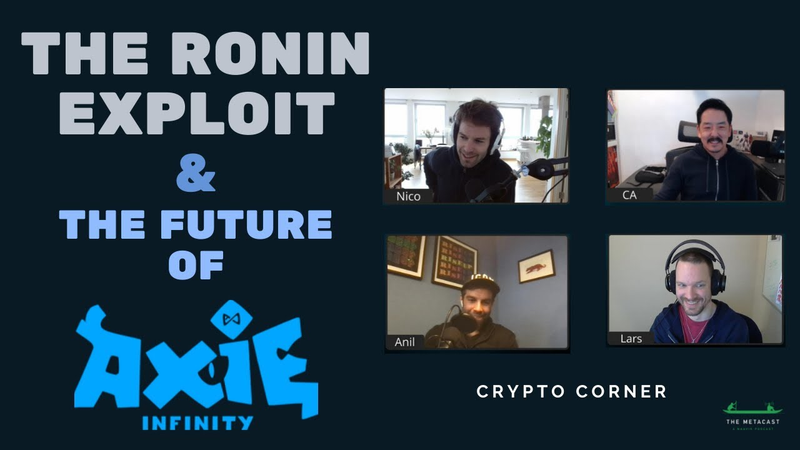
The Ronin Exploit & The Future of Axie Infinity - The Metacast by Naavik
The $625 million exploit of the Ronin network serves as a critical case study in the vulnerabilities inherent to blockchain bridge architecture and operational security.
- The $625 million Ronin network exploit, involving the theft of 170,000 ETH and 25 million USDC, was caused by a compromise of five out of nine validator nodes.
- The breach highlights a critical failure in IT security and internal monitoring rather than a fundamental flaw in blockchain technology, emphasizing the risks of centralized infrastructure in decentralized gaming.
- Axie Infinity is pivoting its business model away from speculative, growth-based revenue toward a 'fun-first' approach focused on long-term engagement and entertainment value.
BreederDAO: The NFT Factory
BreederDAO, a Philippines-based organization, positions itself as an "NFT factory" aimed at solving the supply-side constraint in the play-to-earn economy.
- BreederDAO operates as a specialized 'NFT factory' that uses a proprietary 'Breeding & Crafting Optimization Engine' to supply high-utility in-game assets to play-to-earn guilds and players.
- The organization aims to scale its operations to support 5,000 guilds and over 10 million players by providing assets optimized for specific game metas and economies.
- The company utilizes a tech stack comprising market analytics, tokenomics data, and asset pricing models to automate the breeding and crafting process, which currently serves over 10 partner guilds.
PlayStation Subscriptions: The Good, the Bad and the Strategy - The Metacast by Naavik
The Web3 gaming sector faces a critical inflection point following the $620 million Ronin network hack.
- The $620 million Ronin network hack highlights a critical need for Web3 developers to prioritize decentralized infrastructure and rigorous security audits over rapid development cycles.
- Sony’s PlayStation Plus strategy focuses on user retention through a curated library of legacy content, deliberately avoiding day-one access to new exclusives to protect the traditional console model.
- Microsoft’s Game Pass strategy pursues a platform-agnostic, Netflix-style model that prioritizes cross-device accessibility and immediate release value over traditional console exclusivity.
NFT games: Future or Crisis?
NFT games sit at the center of a debate in early 2022 over whether blockchain gaming represents the future of the industry or an overhyped speculative bubble.
- NFT sales reached approximately $25 billion in 2021, driven by significant capital inflows and an 800% valuation increase for major marketplaces like OpenSea following a $300 million funding round.
- Despite the financial surge, only 30% of game studios express interest in developing NFT-integrated projects.
- Consumer adoption remains cautious, with a survey of 1,500 console and PC gamers showing that only 56% of hardcore players are willing to earn NFTs through gameplay.
Mobile Game Trends in 2022: It’s Now or Never
Mobile game growth that had been fueled by pandemic-era stay-at-home spending was slowing and stabilizing by 2021, and the outlook for 2022 centers on six trends that developers and advertisers must adapt to.
- Apple’s privacy updates have significantly increased user acquisition costs, forcing developers to pivot from traditional targeting toward influencer marketing and live-streaming on platforms like TikTok, Twitch, and YouTube.
- The Play-to-Earn (P2E) model is becoming a mainstream revenue stream and employment alternative in underdeveloped markets, with some players in regions like the Philippines earning up to $3,000 monthly from titles such as Axie Infinity.
- Non-gaming giants including Netflix, Amazon, TikTok, Google, and Apple are aggressively entering the gaming space, evidenced by Amazon’s 'New World' reaching 700,000 concurrent players and TikTok campaigns like #GiftOfGame generating 2.5 billion views.

PlayStation's Game Pass: Making Sense of Sony's Subscription Strategy
Sony's March 2022 reveal of a three-tier PlayStation Plus subscription, priced between $9.99 and $17.99 and launching in June, is the focus of this newsletter analysis.
- Sony is shifting to a tiered subscription model to stabilize revenue against macroeconomic pressures like inflation and supply chain volatility, moving away from the debt-heavy cycles of traditional hardware launches.
- Sony’s gaming division currently generates $2.8 billion in quarterly digital revenue, which accounts for approximately 50% of the division's total earnings.
- While Sony’s subscription service offers a larger library of 400 titles compared to Microsoft’s 100+, its reliance on 40-hour single-player campaigns creates a retention challenge compared to Microsoft’s live-service model.
PlayStation's Plus Reboot: The Pluses and Minuses
Sony's March 2022 announcement of its revamped PlayStation Plus, due to launch in June, is the lead subject of this GameDiscoverCo newsletter analysis.
- Sony’s 2022 PlayStation Plus restructuring maintains a traditional premium sales model by explicitly excluding first-party titles from the service on their release dates to protect high-budget studio investment.
- Subscriptions currently account for only 4% of total gaming revenue in North American and European markets, totaling $3.7 billion compared to $81 billion from traditional retail sales.
- The three-tier subscription system ranges from $59.99 to $119.99 annually, with the Premium tier costing $17.99 per month, which is 20% more expensive than the $14.99 monthly price of Xbox Game Pass Ultimate.