indie
CompanyUnited States
Documents about indie
Romanian Game Development Industry Report: 2020
The Romanian game-development sector has emerged as a rapidly expanding component of the national digital economy, delivering €218.5 million in revenue in 2020—a 19.1% year-on-year increase that pushed total earnings beyond the €200 million threshold.
- The Romanian game development industry generated €218.5 million in revenue in 2020, marking a 19.1% year-on-year growth rate.
- The broader IT sector, bolstered by state-aid schemes and tax exemptions, employed over 113,000 people and contributed approximately 6.8% of Romania's GDP in 2020.
- Major AAA support studios including EA Romania, Ubisoft, and Gameloft employ roughly 750 developers in the country, contributing to global franchises like FIFA and Assassin’s Creed.
Embracer Group Acquires Vertigo Games
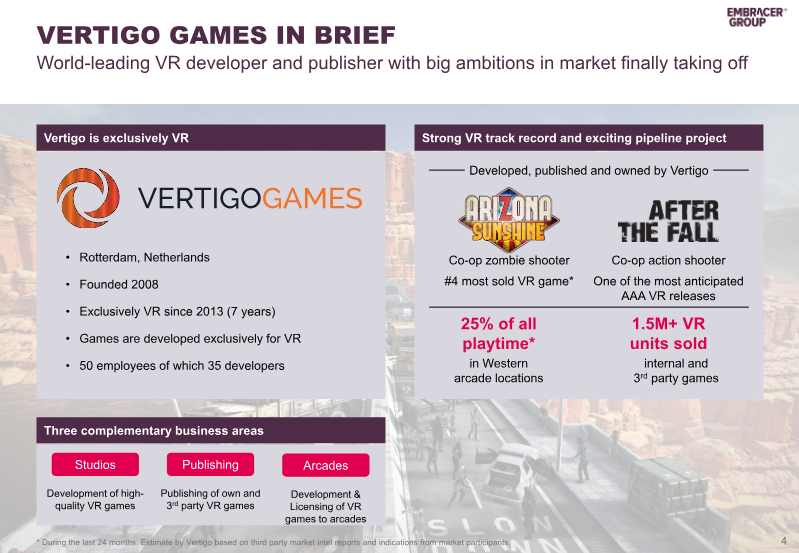
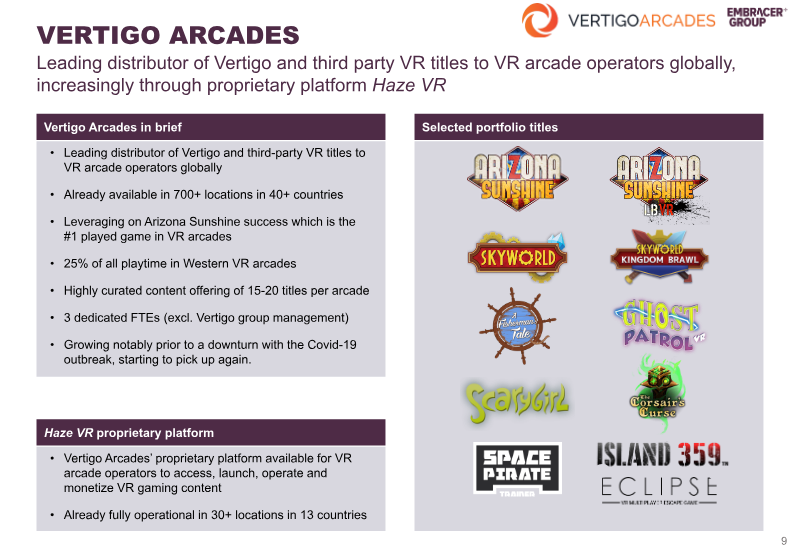
Embracer Group has acquired Vertigo Games, a Rotterdam-based developer and publisher specializing exclusively in virtual reality (VR) content.
- Embracer Group acquired VR specialist Vertigo Games for an upfront consideration of €50 million, consisting of €40 million in cash and €10 million in shares.
- The deal includes a performance-based earnout package of up to €65 million, payable based on operational and financial targets over a ten-year period.
- Vertigo Games will operate as an autonomous entity under Embracer’s Koch Media subsidiary, focusing on scaling its internal development, third-party publishing, and Haze VR arcade distribution platform.
Finland Games Industry: 2018 Year in Review
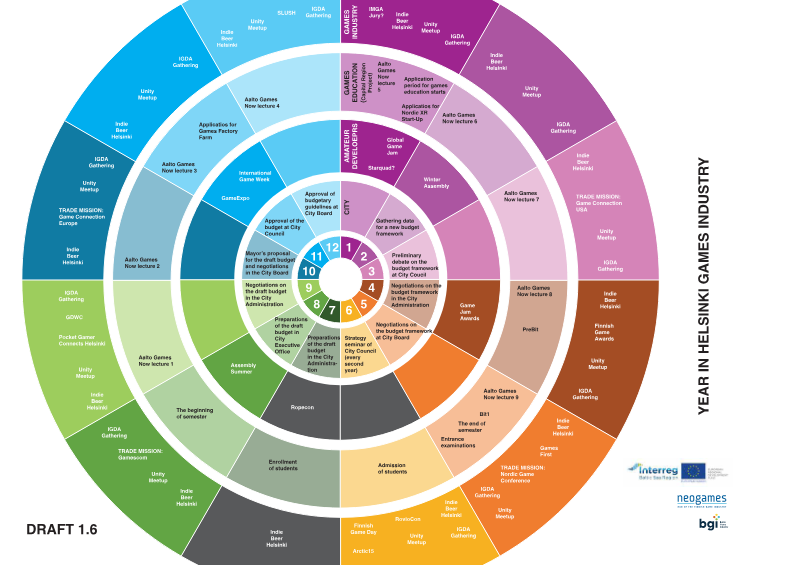
The Helsinki games industry ecosystem in 2018 functioned through a dense, highly integrated network of academic institutions, professional organizations, and municipal governance.
- The Helsinki games industry in 2018 operated through a highly integrated ecosystem connecting municipal governance, academic institutions, and professional organizations.
- Municipal support was a primary driver of stability, with the Helsinki City Council and City Board aligning budgetary cycles and long-term planning with industry needs.
- Aalto University and specialized Unity-focused programs served as the primary talent pipeline, with the industry's professional rhythm dictated by the academic calendar.
Gaming Industry Report: Serbia 2020
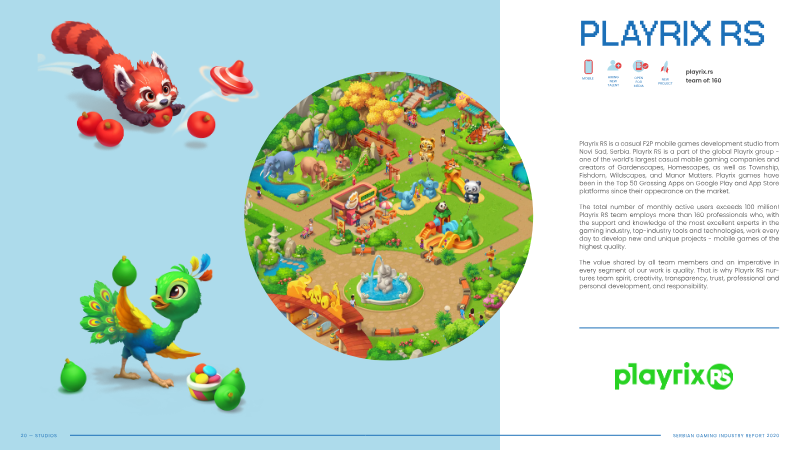
The 2020 assessment of Serbia’s video-game sector presents a rapidly expanding ecosystem that has moved beyond a modest, paper-based association to become a central hub for nearly one hundred companies.
- Serbia’s video-game industry reached over €100 million in revenue in 2020, marking a 20 percent year-over-year growth across 120 development teams.
- The sector employs approximately 2,100 people, with women accounting for one-third of the workforce and a majority of firms planning to increase staff in 2021.
- Educational infrastructure expanded significantly with new programs at the University of Kragujevac and the University of Arts in Belgrade, supported by partners like Epic Games and Nordeus to serve over 1,500 students.


Impact of Cloud Gaming and Other Trends in the Indie Ecosystem: Spain
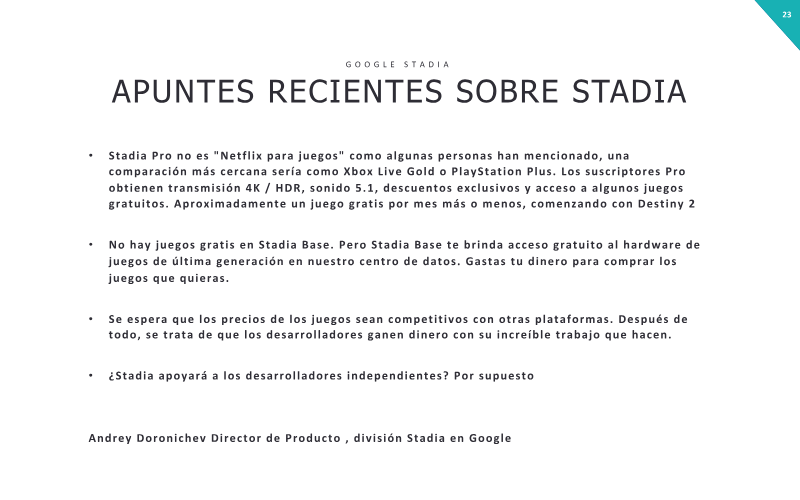
The analysis evaluates how cloud-gaming and emerging distribution models are reshaping the Spanish indie game ecosystem, arguing that while the broader gaming audience is expanding across new platforms and financing structures, cloud-gaming remains experimental and will not achieve mass-market penetration for several years due…
- Cloud gaming is currently an experimental niche that will not reach mass-market penetration for three to five years due to bandwidth limitations and consumer readiness.
- Indie studios should adopt hybrid monetization models that combine direct sales with subscription or free-to-play (GaaS) approaches to maximize revenue potential.
- The most viable target audience for cloud-based indie titles consists of price-sensitive console users and latency-tolerant mid-core players, including the growing female demographic.
Gamer Motivation Model: Updated Reference Sheets
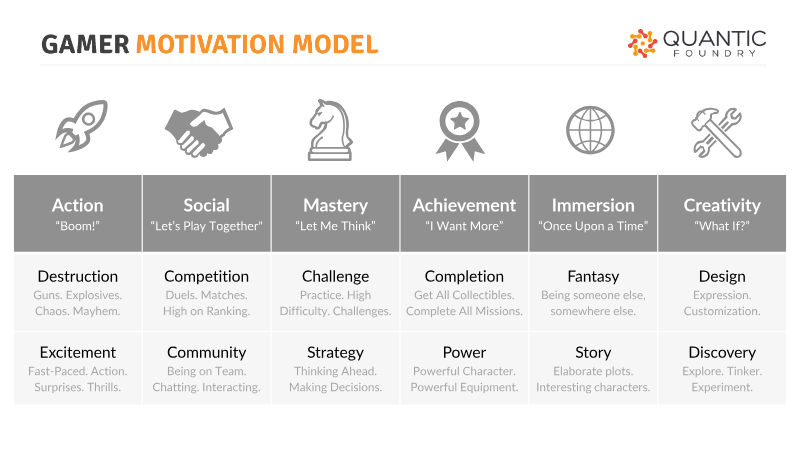
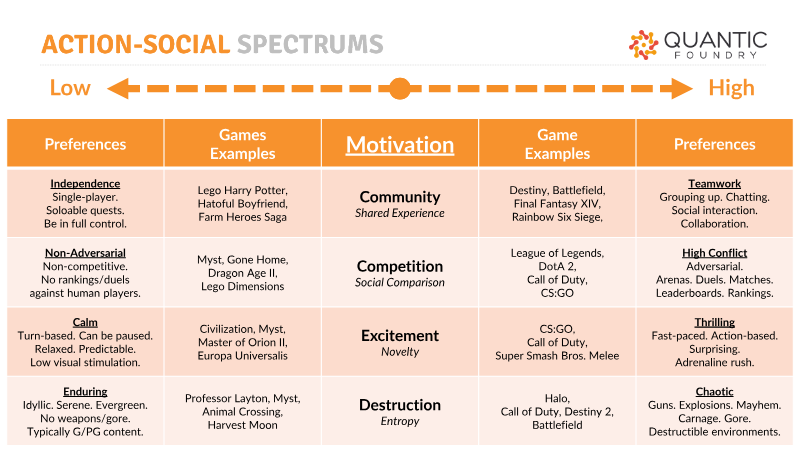
The Gamer Motivation Model provides a comprehensive framework for understanding player behavior by categorizing gaming preferences into three primary clusters: Action-Social, Mastery-Achievement, and Immersion-Creativity.
- The Gamer Motivation Model categorizes player behavior into three primary clusters: Action-Social (Bright), Mastery-Achievement (Tall), and Immersion-Creativity (Wide).
- Player preferences are defined by six core sub-categories—Action, Social, Mastery, Achievement, Immersion, and Creativity—which function as sliding scales rather than binary choices.
- The model uses specific spectrums, such as Destruction versus Excitement and Completion versus Power, to diagnose how individual game mechanics align with player psychological drivers.
Serbian Gaming Industry Report 2018
The inaugural Serbian Games Association report maps a rapidly expanding national gaming ecosystem that now comprises more than 60 members across indie development, esports, visual-effects houses and internationally linked studios, employing over 1,500 skilled professionals.
- The Serbian gaming industry comprises over 60 member entities and employs more than 1,500 professionals, anchored by major players like Nordeus, Ubisoft Belgrade, and 3Lateral.
- Funding for the sector is diversified, with 40% sourced from angel investors, 30% from crowdfunding, and 20% from venture capital, with the largest single investment reaching €650,000.
- A robust pipeline of technical talent is supported by approximately 30,000 university students in IT-related programs and the integration of programming into primary-school curricula.
Romanian Game Development Industry Report 2019
The 2019 Romanian Game Development Industry Report establishes that Romania’s gaming sector is rapidly maturing, delivering a notable economic contribution and expanding its global footprint.
- The Romanian game development industry generated $188.5 million in 2018, representing a 19.2% year-over-year growth.
- The sector employs over 6,000 professionals across approximately 103 active entities, primarily concentrated in Bucharest, Cluj-Napoca, and Timișoara.
- 77% of industry firms focus exclusively on game development, while the remainder provide ancillary services like quality assurance, testing, and publishing for international clients.
Mobile Gaming Benchmarks: 2018
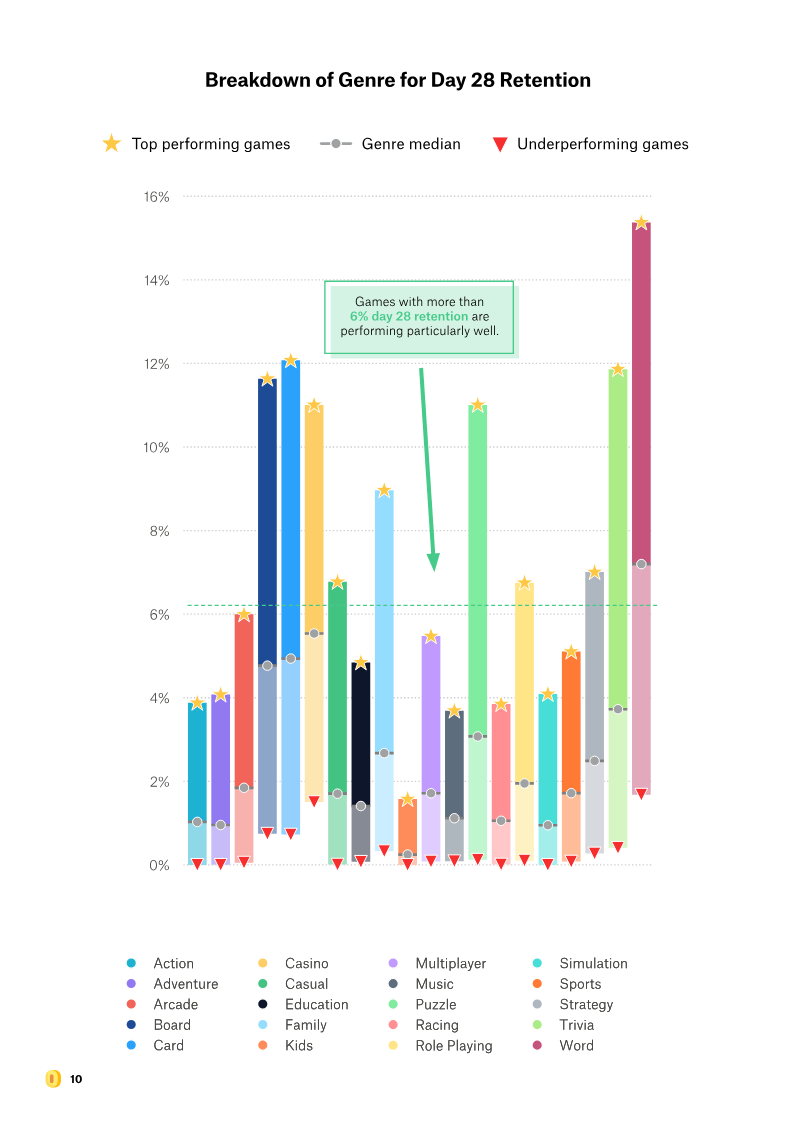
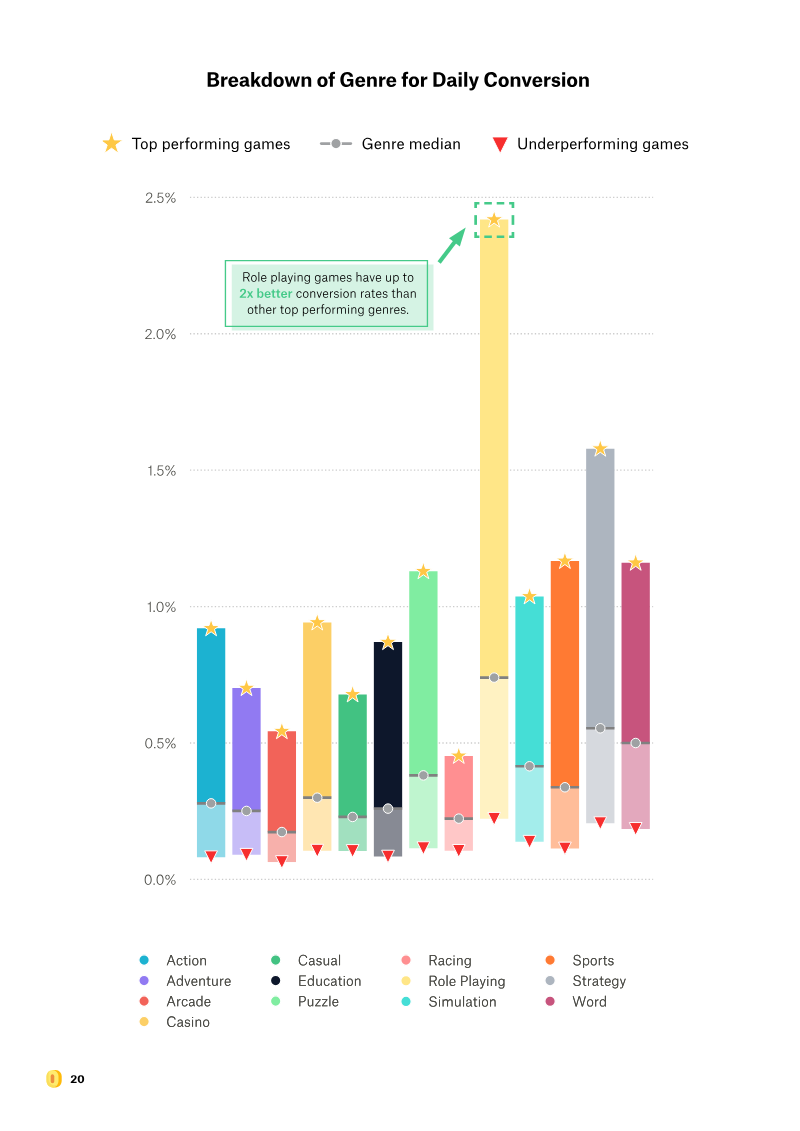
The 2018 mobile gaming benchmark study analyzes performance across more than 60 000 titles that each attract at least 1,000 daily users, drawing on data from 850 million monthly active players over a full calendar year (July 2017-June 2018).
- Top-tier mobile games achieve day-28 retention rates of 6.5–7% during the winter months, significantly outperforming the industry median of 1.5%.
- Role-playing games lead the market in ARPDAU, with top titles generating 6–7 times the revenue of the median performer.
- Strategy games consistently outperform the broader market, achieving double the ARPDAU and conversion rates of average mobile titles.

Stillfront Group Q3 Report: 2017
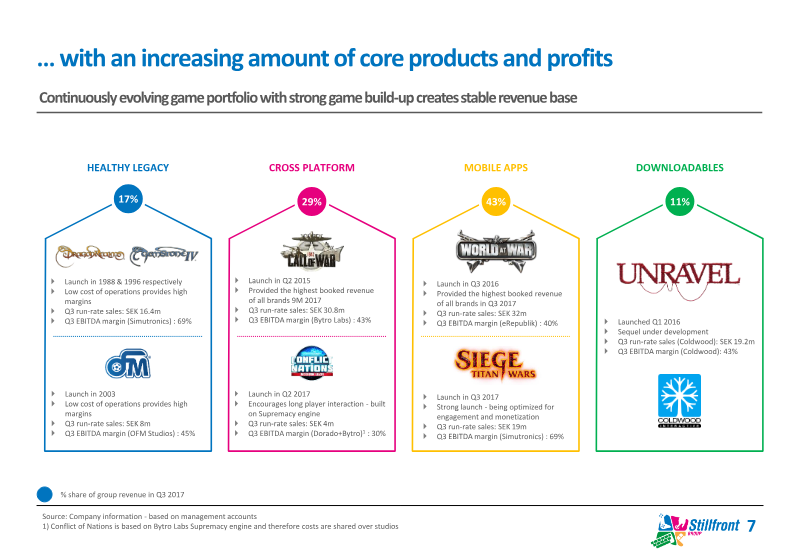
Stillfront Group’s Q3 2017 report outlines a strategic objective to become the leading global group of independent game studios by balancing high-growth potential with risk-mitigating diversification.
- Stillfront Group achieved 45.4 million SEK in net revenue for Q3 2017, maintaining a consistent 22–24% quarter-over-quarter growth rate for three consecutive quarters.
- The company reported a rolling 12-month revenue of 137.3 million SEK and an EBITDA of 43.7 million SEK.
- The portfolio of core products grew by 275% over the 16-month period preceding Q3 2017, driven by the acquisitions of eRepublik Labs and OFM.
Stillfront Group Q2 2017 Presentation
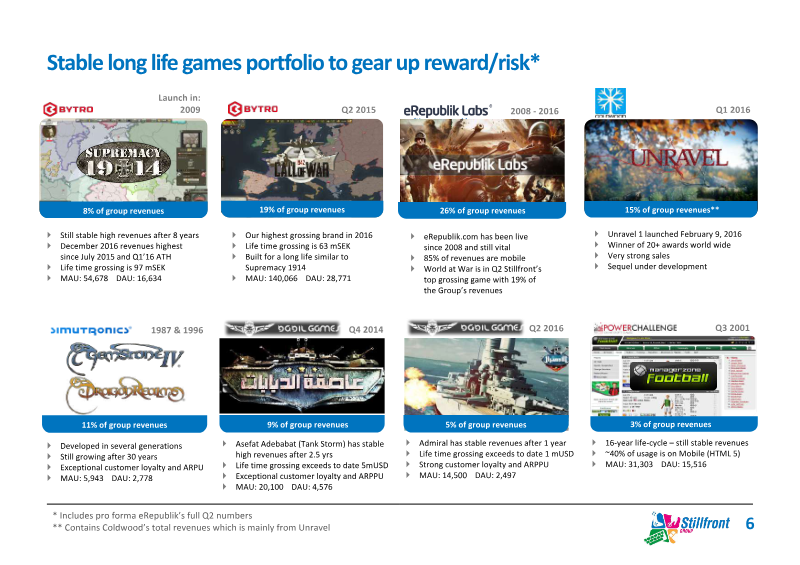
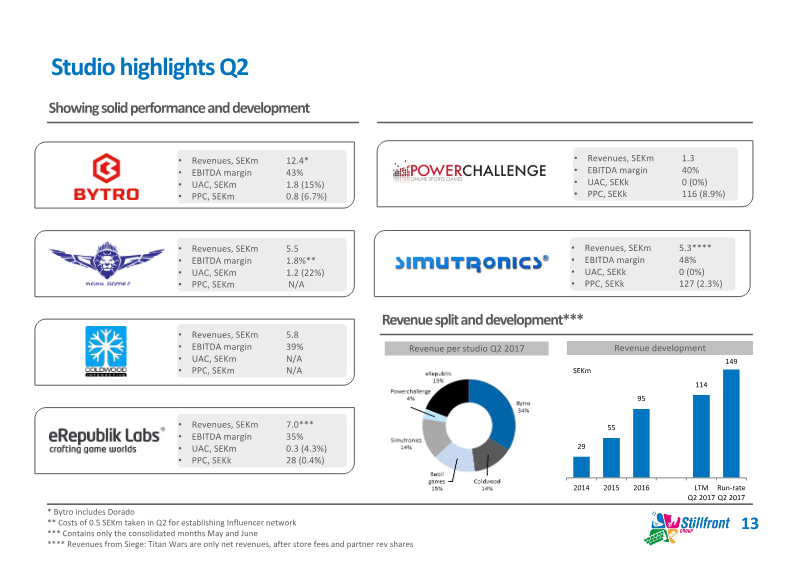
Stillfront Group, a developer and publisher of free-to-play strategy games, aims to become a leading group of independent studios by combining the agility of small indie developers with the stability of a professional public structure.
- Stillfront Group achieved 37.3 million SEK in net revenue for Q2 2017, marking a 24% increase over the previous quarter.
- The company maintains a rolling 12-month EBITDA of 31 million SEK, with operational profitability consistently between 25% and 35%.
- Mobile platforms now account for 46% of run-rate revenues, contributing to a 53% CAGR recorded between 2012 and 2016.
Stillfront Group Presentation: Q1 2017 Report
Stillfront Group’s Q1 2017 report outlines a business model centered on acquiring and managing a portfolio of small, independent gaming studios to achieve high-growth, low-risk profitability.
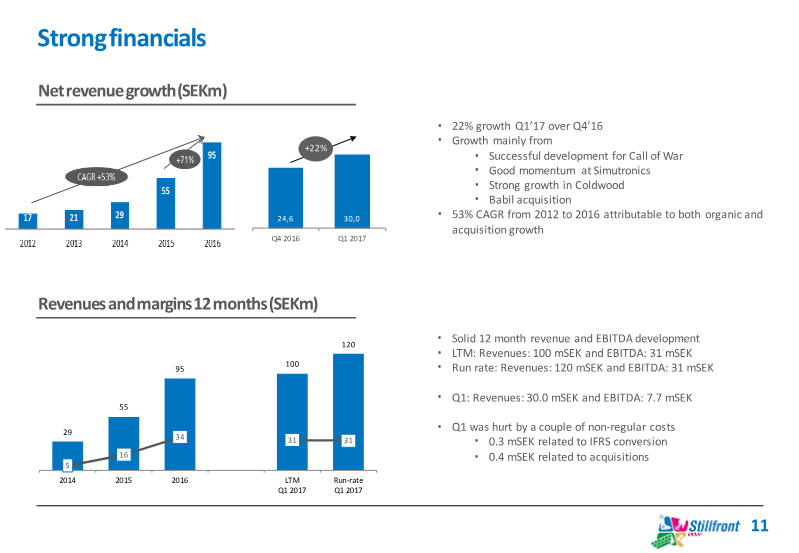
- Stillfront Group achieved a 53% compound annual growth rate between 2012 and 2016, maintaining EBITDA margins between 25% and 35% since listing.
- Q1 2017 net revenues reached 30 million SEK, marking a 22% increase over the previous quarter driven by acquisitions and existing title performance.
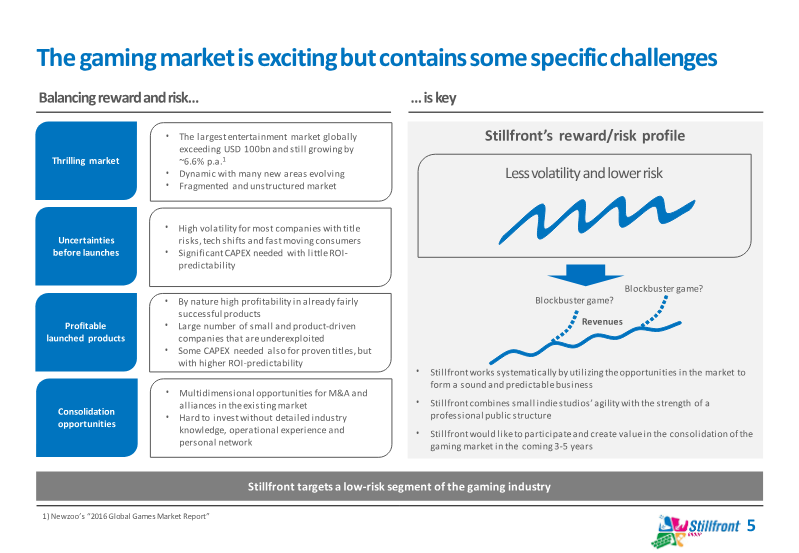
- The business model focuses on acquiring independent studios to manage a portfolio of long-lived, free-to-play strategy games, mitigating the volatility of blockbuster-driven development.