Discovery
CompanyJapan
Documents about Discovery


NEXON Q3 2021 Earnings Prepared Remarks
Nexon’s third-quarter 2021 earnings report outlines a strategic transition period characterized by the stabilization of core franchises and the preparation for a significant expansion of the company’s creative pipeline.
- Nexon reported Q3 2021 revenue of 75.9 billion yen, a 4% year-over-year decline, while operating income rose 8% to 29.8 billion yen and net income surged 132% to 37.9 billion yen.
- The company is prioritizing long-term growth through a 100 billion yen share repurchase program scheduled for completion by November 2023.
- Management is focused on stabilizing core franchises, specifically China Dungeon&Fighter and Korea MapleStory, to maintain a stable revenue foundation for new investments.
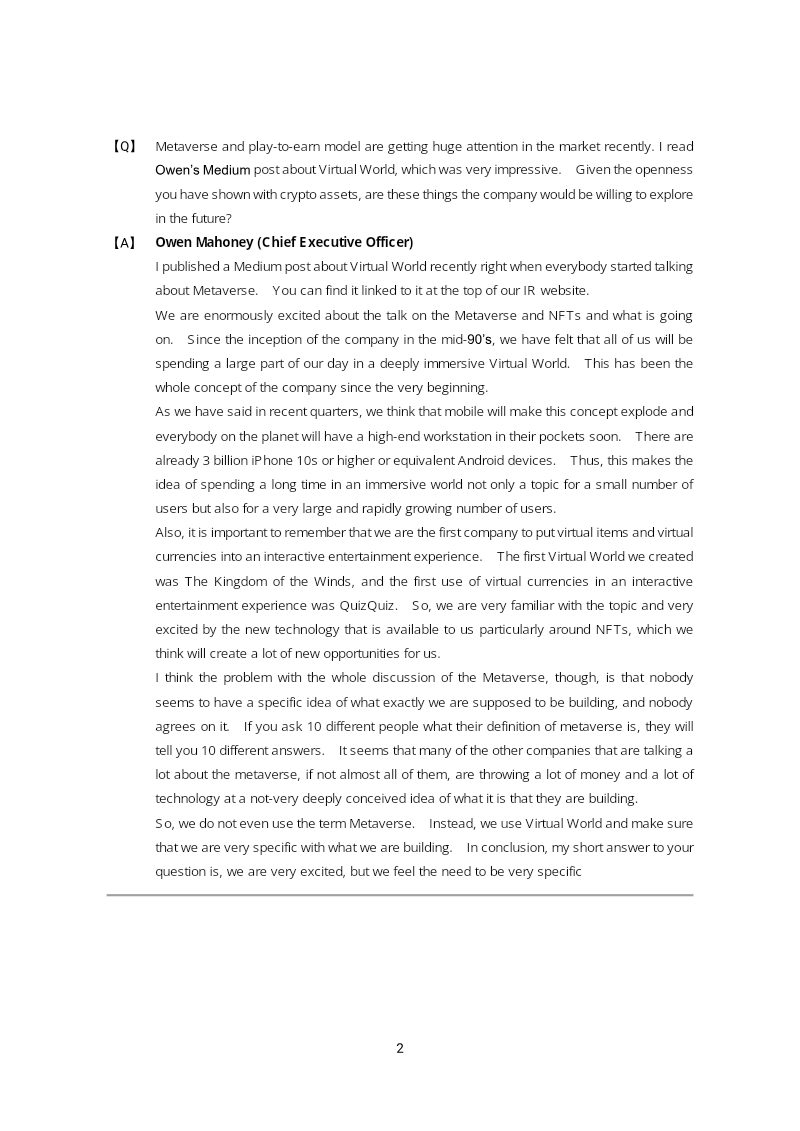
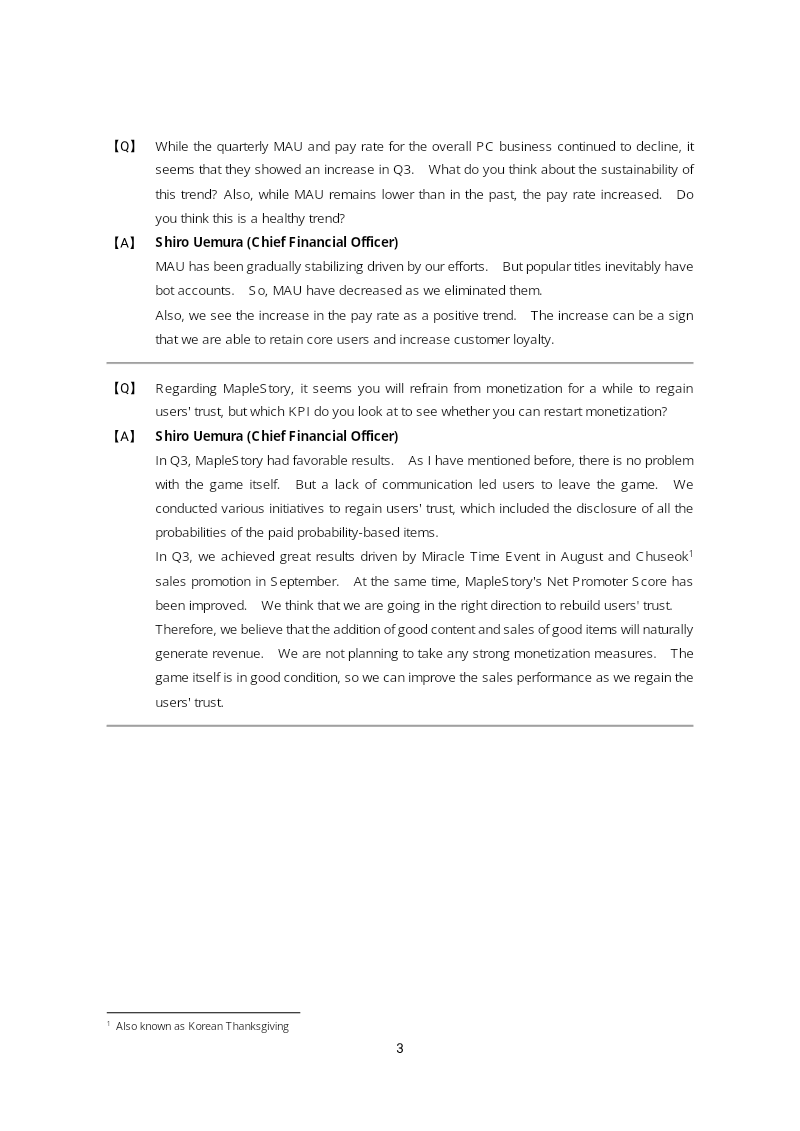
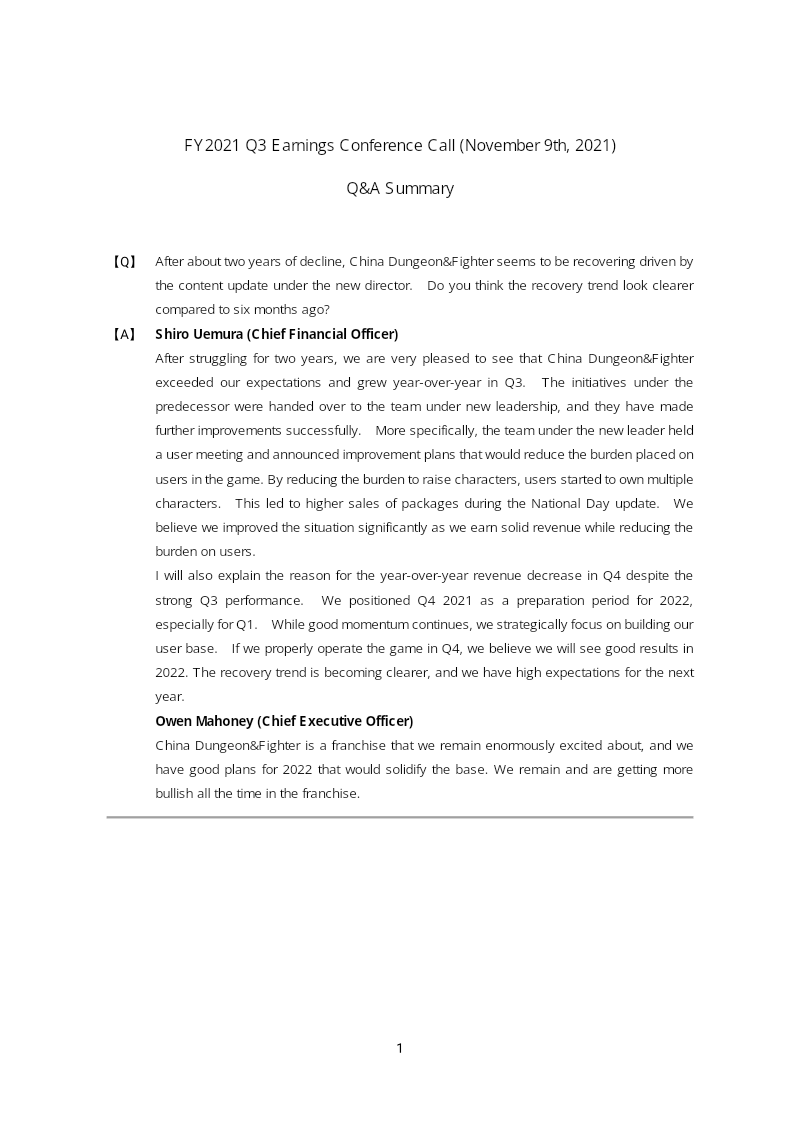
NEXON FY2021 Q3 Earnings Conference Call: Q&A Summary
The NEXON FY2021 Q3 earnings conference call provides an overview of the company’s strategic recovery efforts, focus on virtual world development, and updates on key intellectual properties.
- Nexon’s core franchises are stabilizing, with China’s Dungeon&Fighter reporting year-over-year revenue growth in Q3 2021 following leadership changes that reduced player burden.
- MapleStory performance is recovering after the company disclosed probability-based item mechanics, a move that successfully improved Net Promoter Scores and user trust.
- The company reported a 2.8% year-over-year revenue decline for the first nine months of 2021, primarily driven by earlier setbacks in the MapleStory and Dungeon&Fighter franchises.
PC Game Discovery: 5 Big Trends in 2022
The PC gaming landscape in 2021 is defined by a shift toward platform-specific design and the continued dominance of established ecosystems.
- Steam remains the dominant platform for non-AAA titles, frequently generating over 90% of their total revenue.
- Games designed specifically for PC with complex UIs and deep simulation mechanics are currently outperforming titles built for multi-platform parity.
- The market is increasingly saturated, with Steam averaging more than 250 new releases per week, making high quality alone insufficient for commercial success.
15 Years Later: Did Indie Game Discovery Happen Like We Thought?
The independent game industry has undergone a radical transformation in distribution, marketing, and development tools since the dawn of the digital era.
- The 30 percent platform revenue share remains a persistent industry standard, despite early 2007 concerns that digital distribution would fundamentally alter gatekeeper control.
- The democratization of development tools like Unity and Unreal has created a 'Cambrian explosion' of content, resulting in a saturated market where high technical quality is now the baseline requirement.
- Discovery has shifted from traditional review sites to a fragmented landscape dominated by social media and influencer-led platforms like YouTube, Twitch, and TikTok.
How Choo-Choo Charles Earned 90,000 Wishlists in 2 Weeks
The rapid accumulation of 90,000 wishlists for the horror game Choo-Choo Charles within two weeks serves as a case study in effective indie game marketing.
- The Steam Discovery Queue was the primary driver of the game's 90,000 wishlists, acting as the critical engine for visibility once initial viral traffic provided the necessary spark.
- The game's trailer achieved over 20 million views across various platforms, including reuploads by major outlets like IGN and Gamespot, which served as a catalyst for organic growth.
- Product design is the most significant factor in marketing success, as the game's concept—an evil spider train—effectively leveraged existing internet trends and horror sub-genres to ensure high shareability.
Revisiting the Steam Prologue as a Discovery Beat
The analysis examines the strategic utility of Steam Prologues—standalone, free versions of upcoming games—as a primary discovery mechanism.
- Steam Prologues function as a high-impact marketing milestone, with the game Epiphany City seeing daily wishlist additions increase from 1–3 to 10–30 for a month following its launch.
- A successful Prologue can drive significant user acquisition, as evidenced by Epiphany City gaining over 800 new wishlists and 10,000 library additions.
- Developers must account for a high conversion drop-off between users adding a Prologue to their library and actually launching the software.

Case Study: How Localization Amps up Game Discovery
This analysis examines the impact of localization on game discovery and revenue, primarily through a case study of the title Academia: School Simulator.
- Localization ROI varies significantly by region, evidenced by a 331% revenue increase in Thailand following localization, compared to modest 8% gains in Turkish and Polish markets.
- Platform infrastructure is a critical constraint; the Indonesian localization resulted in a 34% revenue decline because Steam lacks a filter for 'Bahasa Indonesia,' making the language support invisible to discovery algorithms.
- Localization is most effective when implemented at launch to capitalize on Steam’s initial visibility boost, though post-launch efforts remain a viable strategy for stabilizing and growing long-tail revenue.
VR Game Discovery, Reddit, Trailers & More
The current landscape of virtual reality (VR) game discovery is undergoing a significant shift driven by the success of standalone hardware.
- The Oculus Quest Store now generates approximately 70% of revenue for major VR titles, establishing it as the dominant platform for commercial success.
- The Oculus Quest 2 accounts for over 30% of all headsets used on Steam, signaling a shift toward standalone hardware as the primary VR experience.
- The global gaming market, including hardware, development tools, and sectors like esports, is valued at $335.5 billion.
Designing for Virality: Choo-Choo Charles Edition
The case study of Choo-Choo Charles illustrates the mechanics of modern game virality and its direct impact on platform algorithms.
- External traffic from TikTok and YouTube triggered the Steam Discovery Queue, resulting in 14,000 wishlists in a single day and 85,000 total wishlists within two weeks.
- Platform algorithms are increasingly dictating game funding and discovery, with services like Google Stadia Pro and Apple Arcade prioritizing daily sessions and high-engagement metrics over traditional sales.
- Netflix’s internal content valuation relies on 'adjusted view share' and 'efficiency scores' to measure production costs against customer acquisition and retention rather than raw view counts.
What Players Wish Nintendo Would Fix for Switch Discovery
User sentiment and developer feedback indicate significant discoverability challenges within the Nintendo Switch eShop.
- The Nintendo Switch eShop ranking algorithm prioritizes unit sales over revenue, allowing developers to artificially inflate chart positions by discounting games to extremely low price points.
- Nintendo’s storefront lacks essential discovery tools, including a persistent user rating system and robust filtering, which prevents consumers from effectively identifying high-quality titles.
- The eShop interface suffers from poor optimization and slow navigation, discouraging organic browsing compared to the sophisticated recommendation engines found on platforms like Steam.

Announcing: The Complete Game Discovery Toolkit eBook
The Complete Game Discovery Toolkit serves as a comprehensive strategic guide for independent game developers and publishers navigating the modern digital marketplace.
- Commercial viability in the 2020s requires a strategic focus on platform-specific algorithms and consumer behavior, particularly within the Steam ecosystem.
- The toolkit provides specific industry benchmarks, including conversion rates for wishlists to purchases, the ratio of Steam reviews to total sales, and the financial delta between gross and net revenue.
- A thirty-page analysis of Steam tags identifies current genre success probabilities by mapping market saturation against player demand.
Nintendo Switch: The State of Player Discovery
The Nintendo Switch ecosystem is characterized by a broadening of player libraries and a continued dominance of first-party software.
- Nintendo Switch users significantly expanded their libraries in 2022, with the median number of owned games rising to 35 titles, up from 20 in 2021.
- First-party Nintendo titles dominate the ecosystem, with ownership rates for major releases like Pokemon Legends: Arceus and Metroid Dread reaching between 39% and 50% among the core demographic.
- Physical media remains a strong force on the Switch, accounting for nearly 47% of user libraries due to collector interest and the perceived value of premium-priced software.