Discovery
CompanyJapan
208 documents in the library are about Discovery, from writers such as GameDiscoverCo, Warner Bros. Discovery and How To Market A Game. Each has a summary and key insights with the page they come from.
- Articles
- 132
Connections
The documents about Discovery on the inner ring, the other games and companies they name on the outer one. Select a cover to see it up close and open it in a new tab; drag to move, pinch or Ctrl + scroll to zoom.
Key figures from the reports
Warner Bros. Discovery reported a significant decline in Studios segment revenue, which dropped from $3.8 billion in Q2 2025 to $2.3 billion in Q2 2026, resulting in a segment Adjusted EBITDA decrease from $863 million to $96 million.
Warner Bros. Discovery, 2026 · Warner Bros. Discovery: Form 10-Q Q2 2026
Apple's new ad placements (March 25, 2026) led to substantial gains for Discovery campaigns in the US: +44.9% impressions, +41.6% taps, and +35.8% installs.
Apptweak, 2026 · What AppTweak's 2026 Report Actually Tells Apps to Fix
Warner Bros. Discovery has shifted its corporate strategy by rejecting a $108 billion takeover bid from Paramount in favor of a $72 billion deal with Netflix, highlighting the growing market dominance of streaming platforms over traditional media.
Two & a Half Gamers, 2025 · 🚨📢 BREAKING NEWS: Unity Fee Drama, Netflix vs WB, Casino Games Everywhere 🤯, p. 7
On Steam
Steam estimates as of 9 Oct 2026. Revenue is premium revenue on Steam only: game sales, without DLC.
- Revenue as publisher
- $24K
- 1 games
- Units sold
- 1,982
- as publisher or developer
- Headquarters
- Japan
Discovery’s best-selling games on Steam
| Game | Released | Share of the best seller | Revenue | Units |
|---|---|---|---|---|
| Shark Week: Operation ApexPublisher | 2017 | $24K | 1,982 |
Documents about Discovery

Should Your Game Discovery Plans Change Due to AI & Decompilation?
The primary purpose of this analysis is to evaluate whether developers should alter their game discovery and release strategies in response to growing concerns regarding AI-assisted code decompilation and game cloning.
- Developers of complex, high-personality games should not delay demos due to AI cloning fears, as these titles are difficult to replicate and rely on established player interest rather than a single, easily copied mechanic.
- Games with simple, meme-worthy, or low-lift concepts are at the highest risk of being cloned within weeks of reveal, necessitating a shorter window between initial announcement and paid launch.
- Steam Next Fest has seen a significant increase in participation, featuring 7,100 playable demos compared to the 5,000 predicted by previous trend lines.

Global Gaming Report: Q3 2026
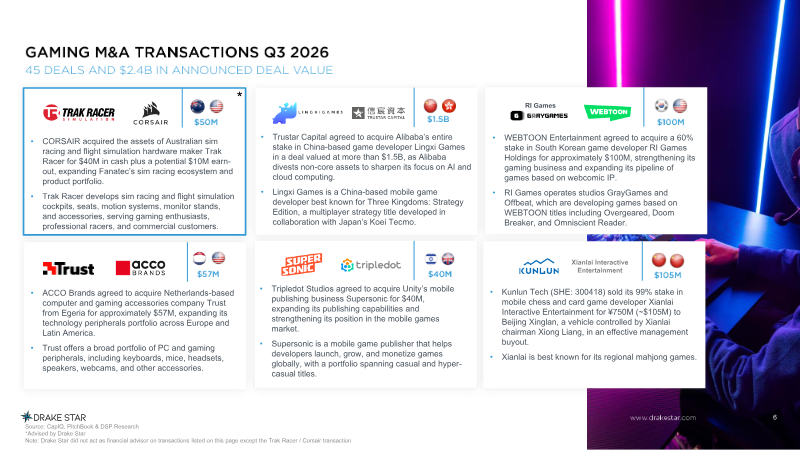
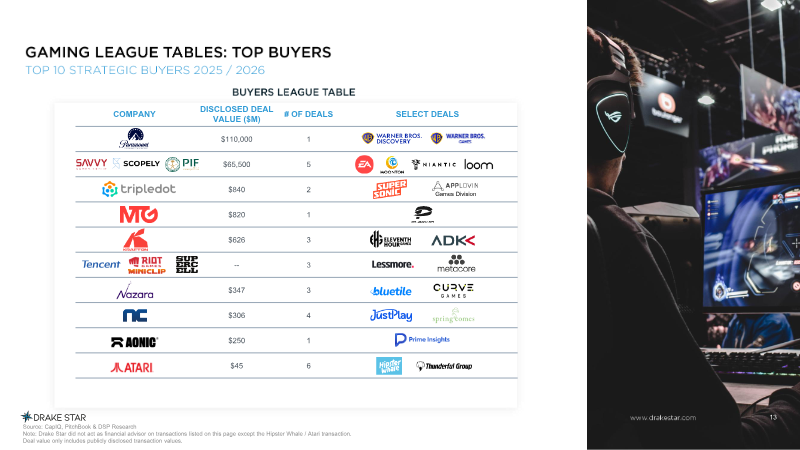
The global gaming industry experienced a period of significant financial revitalization during the third quarter of 2026, characterized by a robust rebound in market valuations and sustained investment activity.
- The gaming industry saw $4 billion in total capital activity in Q3 2026, comprising $2.4 billion across 45 M&A deals and $1.6 billion in private financing.
- Over 80 percent of private funding was directed toward AI-native development, 3D foundation models, and advanced tools, with notable investments in Tripo AI, Nex, and PixVerse.
- The Drake Star Gaming Index reported a 12.4 percent return for the quarter, reflecting a strong recovery in market valuations.



Women Gamers 2026: 9th Annual Edition
The ninth annual edition of the Women Gamers study provides a comprehensive analysis of how women engage with the gaming industry, drawing on nine years of longitudinal research.
- Toxicity remains a significant barrier to engagement, with 51% of all women reporting negative experiences, a figure that spikes to 79% among Gen Z players.
- To avoid harassment, many women are actively hiding their gender or opting out of voice chat, contributing to a broader industry trend where solo play is increasingly preferred over multiplayer experiences.
- While women play an average of six genres, engagement on PC and console platforms has plateaued since 2024 as Gen Z players increasingly prioritize social media over traditional gaming.
The One Game Discovery by Player Age Chart You Need to See
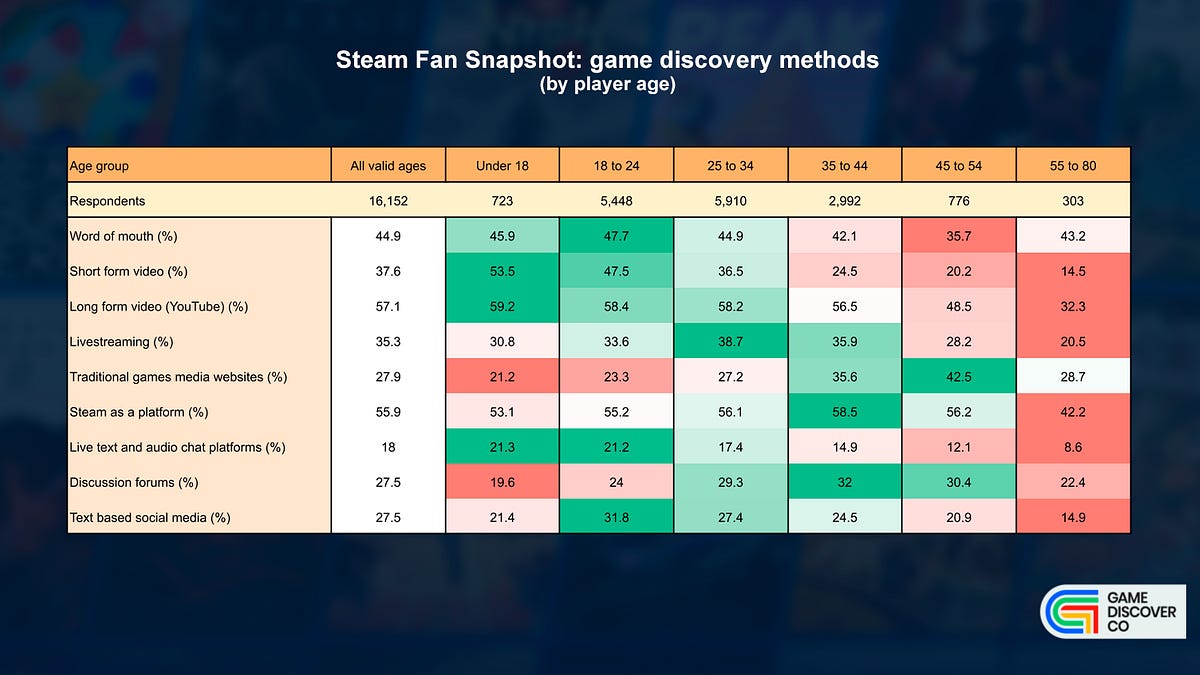
The analysis examines how video game discovery methods vary significantly across different age demographics among PC players.
- Short-form video is the primary discovery driver for younger players, ranking as the second most important method for under-18s at 53.5%, but dropping to 20.2% for the 45-54 age demographic.
- Steam as a platform (55.8%) and long-form video (57%) are the top two discovery methods across all age groups, showing high stability compared to other channels.
- Traditional games media remains a significant discovery source for older audiences, peaking at 42.5% for 45-54 year olds, while falling to 21.2% for those under 18.

Spotify’s GLIDE: Generative Retrieval for Podcast Discovery
Spotify researchers have introduced GLIDE, a generative retrieval framework designed to improve podcast discovery by addressing the inherent tension between user continuity and dynamic intent.
- Spotify researchers have introduced GLIDE, a generative retrieval framework designed to improve podcast discovery by balancing long-term user preferences with the need for new content exploration.
- The framework addresses the challenge that while podcast listening habits are characterized by continuity, user intent remains dynamic and requires more sophisticated recommendation strategies.
- GLIDE aims to solve the inherent difficulty of surfacing unfamiliar content to users who typically default to established listening patterns.

Game Discovery Lessons From 30 Years in the Biz
This analysis examines the evolution of the video game industry over the past three decades, categorizing the progression of game development and discovery into three distinct epochs.
- To trigger Steam’s Discovery Queue recommendations, developers should aim for a sustained pace of 6,000 to 8,000 wishlist adds per day for two to three days.
- Nintendo reported that digital sales now account for 50% of all software with a physical version, marking a new record for the company.
- Nintendo distributed 33.81 million Switch games in the most recent quarter, representing a 39% increase compared to 2025.
Warner Bros. Discovery: Form 10-Q Q2 2026
Warner Bros. Discovery faces a period of profound structural and financial transition as it navigates a $31.00-per-share acquisition by Paramount Skydance Corporation (PSKY).
- Warner Bros. Discovery reported a significant decline in Studios segment revenue, which dropped from $3.8 billion in Q2 2025 to $2.3 billion in Q2 2026, resulting in a segment Adjusted EBITDA decrease from $863 million to $96 million.
- The Streaming segment showed growth, with Q2 2026 revenue rising 10% year-over-year to $3.08 billion and Adjusted EBITDA increasing 75% to $512 million.
- Global Linear Networks revenue fell from $4.8 billion in Q2 2025 to $3.99 billion in Q2 2026, with segment Adjusted EBITDA declining from $1.51 billion to $1.45 billion.

What AppTweak's 2026 Report Actually Tells Apps to Fix
The 2026 AppTweak report on App Store Optimization (ASO) and Apple Search Ads (ASA) trends highlights a significant disconnect between industry best practices and the actual behavior of most mobile app teams.
- 90% of apps do not A/B test their icon or video, and only 35% test screenshots twice or more annually, indicating a widespread underutilization of ASO testing.
- Top 20 apps and top games refresh their metadata and update screenshots significantly more often (games update screenshots ~12 times/year) compared to other apps, suggesting a correlation between frequent iteration and higher ranking.
- Apple's new ad placements (March 25, 2026) led to substantial gains for Discovery campaigns in the US: +44.9% impressions, +41.6% taps, and +35.8% installs.

Epic and Google drop settlement and Pokémon Go revenue skyrockets | Week in Mobile Games podcast
The mobile gaming landscape is currently defined by significant legal volatility and shifting consumer spending patterns.
- Epic Games and Google have withdrawn their attempt to settle their US antitrust lawsuit, leaving the court's ruling that Google maintains an illegal monopoly over Android apps in place.
- Pokémon Go experienced one of its most lucrative days in history on July 11, 2026, driven by a free-to-play Go Fest event that encouraged high spending on raid tickets and limited-time bundles.
- A California-led coalition is attempting to block the Paramount-Warner Bros. merger, citing concerns that the combined entity would control 27% of US theatrical film distribution, 30% of blockbuster releases, and 27% of the basic cable market.

What 1 Million (Immediate!) Wishlists for Dear Passengers Says About Discovery
The rapid accumulation of one million wishlists for the upcoming title Dear Passengers serves as a case study for the current market viability of "friendslop" games—multiplayer, social-focused titles characterized by chaotic, shared-world gameplay.
- The rapid accumulation of one million wishlists for Dear Passengers demonstrates a strong market demand for 'friendslop' games, which prioritize chaotic, social, and shared-world gameplay.
- High-volume viral hits like Dear Passengers exhibit a 35x follower-to-wishlist multiplier, indicating a significantly more casual audience compared to the 11.8x multiplier seen in niche titles like Rogue Carrier.
- Success in the 'friendslop' genre relies on marketing hooks specifically engineered for virality, including clippable gameplay moments, avatar-based humor, and internet-native meme references.

What Game Studios Still Get Wrong About DTC
The mobile gaming industry is undergoing a fundamental shift toward direct-to-consumer (DTC) monetization, a sector that has already reached a $17 billion valuation.
- Direct-to-consumer (DTC) monetization in mobile gaming has grown into a $17 billion market, yet 52% of studios have not made significant changes to their existing monetization strategies.
- Successful DTC implementation requires studios to build dedicated, cross-functional teams that blend marketing, product, and user acquisition expertise rather than relying on traditional app store-focused workflows.
- Moving players to web stores allows developers to capture higher net revenue by bypassing platform fees while simultaneously gaining direct access to player data for better segmentation and personalized offers.

4 Top Health & Fitness Apps With a Discovery Problem: USA
The health and fitness app sector in the United States faces a growing discovery crisis as traditional organic growth strategies fail to adapt to the evolving search landscape.
- Health and fitness apps like Ladder, BitePal, Unrot, and LeanBites are currently successful but are accumulating "discovery debt" due to inadequate web presence and content strategies.
- Effective app discovery now relies on semantic store search, web content that rewards authority over volume, and AI direct answers based on user profiles, moving away from traditional SEO-by-numbers blogs.
- Ladder, despite having a credentialed content blog (last updated February 2022), hosts it on a subdomain, limiting its authority transfer to the main site.