2015
Company
Documents about 2015

Spirits in the Aether: Digital Ghosts in Final Fantasy XIV
Appignani, Kruzan, and Hoch's 2015 study argues that avatars in the MMORPG Final Fantasy XIV: A Realm Reborn function as digital ghosts, continuing a long tradition of ghost rhetoric attached to communication technologies such as the telegraph, telephone, and radio.
- The report argues that avatars in MMORPGs continue a long tradition of technological ghost rhetoric, occupying liminal spaces between server, game world, and player body much as ghosts hover between planes of existence.
- Using multimodal semiotic discourse analysis of Final Fantasy XIV (2013), the authors contend that ghostly themes operate across narrative, visuals, and gameplay mechanics, making them multimodal rather than merely literary.
- The analysis is based on hundreds of hours of expert play and scene-level review by novice researchers, focusing on the game's opening, The Calamity narrative, and aetheric and maritime metaphors linked to historical radio and internet rhetoric.
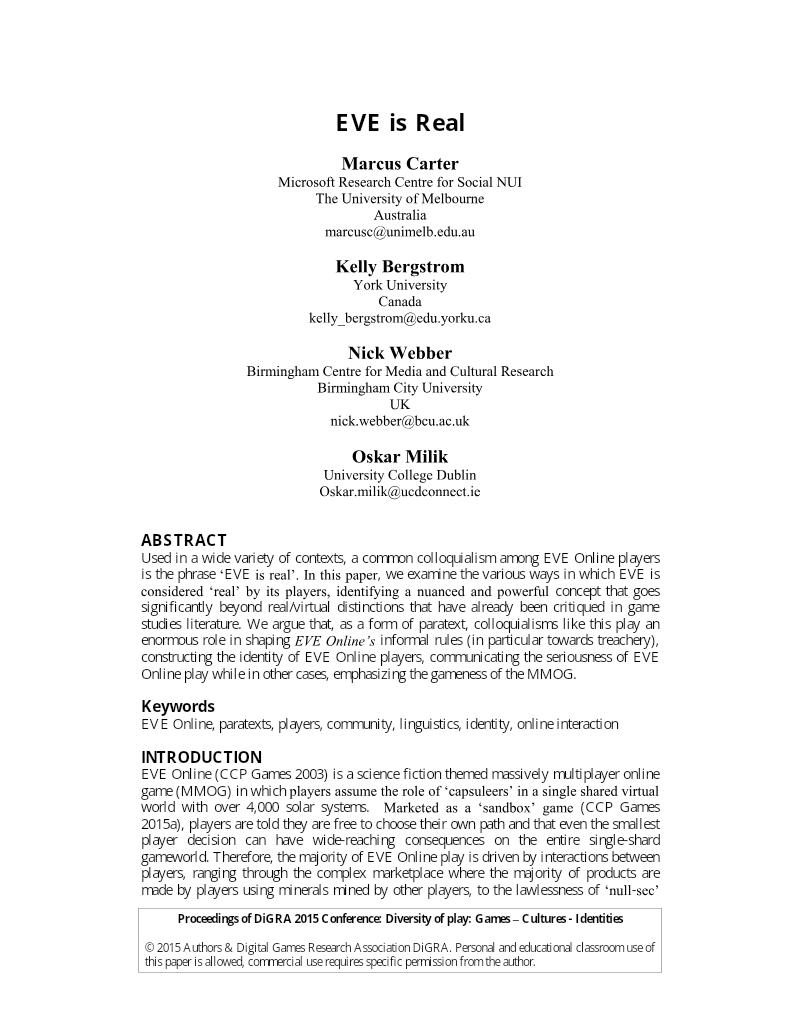
EVE Is Real
The phrase "EVE is real," popularized by CCP Games in 2011, functions as an epitext: a paratext that shapes the informal rules, culture, and identity of EVE Online.
- The phrase "EVE is real" functions as a discursive device that legitimizes scamming, espionage, and sabotage by framing them as authentic social competition rather than cheating, and CCP popularized it in 2011.
- CCP intervenes against technical exploits, staff impersonation, and harassment, but generally leaves social exploits and scams to player-enforced norms.
- The phrase carries several reinforcing meanings at once: emotional investment, a claim to historical authenticity drawn from CCP's "True Stories" project (whose truth claims the authors treat as contested), and the substantial real-world labor players devote to the game.
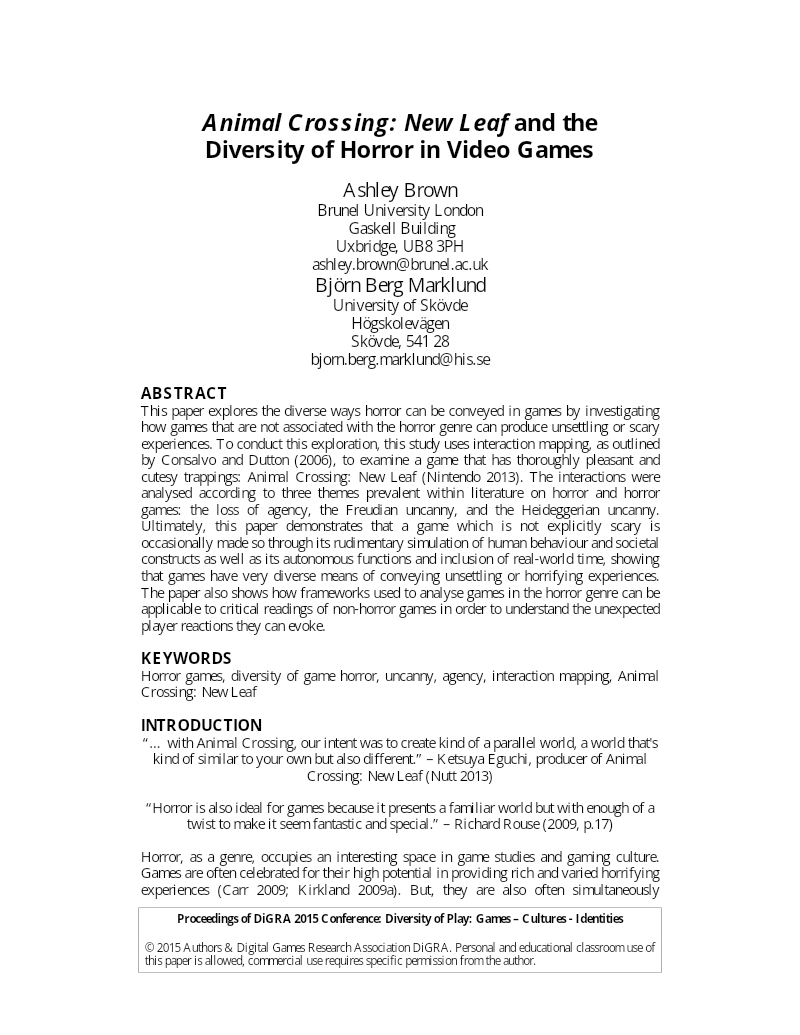
Animal Crossing: New Leaf and the Diversity of Horror in Video Games
Horror in video games can emerge unintentionally from titles never designed to frighten, and the cutesy life simulation Animal Crossing: New Leaf demonstrates this.
- The study argues that horror in a non-horror game like Animal Crossing: New Leaf can arise from its own mechanics rather than from conventions borrowed from horror cinema.
- Interactions are deliberately laborious: selling an item takes thirteen inputs, compared with seven to ten in comparable titles, which fosters a sense of limited and "blind" agency.
- Villagers who cannot be consoled and choices that loop back without consequence, such as Brewster's coffee, reinforce a feeling of hollow control for the player.
Anuario de la Industria del Videojuego 2015
El Anuario de la Industria del Videojuego 2015 es una publicación anual de la Asociación Española de Videojuegos (AEVI), la entidad que representa a publishers, desarrolladores, centros de formación, esports y retail del sector en España.
- The AEVI 2015 Industry Yearbook, originally published on October 9, 2015, serves as the formal annual record for the Spanish video game sector.
- The report provides a comprehensive overview of the Spanish gaming market, covering key areas such as sales rankings, anti-piracy efforts, and available government subsidies for the industry.
- The document includes comparative analysis of the video game industry at both the national Spanish level and the broader international market.

2015 Predictions for Mobile Gaming
Mobile gaming in 2014 was a year in which the rich got richer, and four predictions for 2015 follow from that consolidation.
- Market consolidation intensified in 2014, with just four developers capturing nearly 50% of the top 20 grossing ranks on the US iPhone App Store, up from one-third in 2013.
- Rising mobile marketing costs and the 'unbundling' of app distribution are forcing small developers to seek alternative, non-paid user acquisition channels, such as viral growth and niche platforms like Product Hunt.
- Major platform operators including Apple, Google, and Amazon are commoditizing analytics and attribution tools, which is expected to accelerate consolidation in the third-party ad tech market.
Finishing the Fight, One Step at a Time: Seriality in Bungie's Halo
Jens Bonk examines how seriality operates in Bungie's Halo franchise, which had surpassed $3 billion in lifetime sales by 2013, and argues that the franchise's large-scale transmedia seriality rests on a foundation of low-level serialization built into the gameplay itself.
- The main Halo series is strictly linear, while the broader transmedia storyworld spanning novels, comics, films, alternate reality games, and advertising is largely non-linear.
- Seriality in Halo operates on three levels: intra-ludic (nested fights, traversals, and cinematics within each game), inter-ludic (across the core titles), and para-ludic (across media beyond the games), drawing on Denson and Jahn-Sudmann's framework.
- Within the games, a chain of interrupting events escalates difficulty through what the author calls "outbidding," with reused elements such as the cloaking device tying narrative and gameplay into one tension-building whole.

5 Trends in Mobile Games Marketing for 2015
Eric Benjamin Seufert's presentation "5 Trends in Mobile Games Marketing for 2015" was delivered at the PwC Outlook conference in Amsterdam and published on the Mobile Dev Memo site on October 20, 2014.
- The provided report content does not contain the text of the presentation or the specific trends mentioned in the title.
- The document serves only as a placeholder page for a presentation given by Eric Benjamin Seufert at the PwC Outlook conference in Amsterdam on October 9, 2015.
- No data, growth rates, or specific marketing strategies are included in the provided text.

Why Are Mobile Marketing Costs Rising?
Mobile user acquisition costs climbed sharply in mid-2014, and this analysis argues the cause is the maturation of the app economy rather than reckless spending by venture-backed game start-ups.
- Mobile user acquisition costs are rising, with Fiksu reporting a 9% year-over-year increase in costs to $1.97 by July 2014, and Chartboost noting a 21% jump in iPhone CPI to $2.56 between June and August 2014.
- The rise in marketing costs is driven by the maturation of the mobile economy and increased competition, rather than reckless spending by venture-backed gaming startups, as VC investment in the gaming sector actually declined by 6% in the first half of 2014.
- Large platform operators like Facebook, Google, and Apple are crowding out the Top Downloaded charts with their own apps, which diminishes the effectiveness of paid advertising for achieving top-chart visibility.
China Mobile Game Market: What You Need to Know
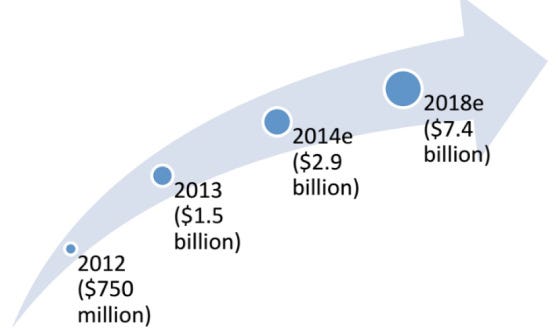
China's mobile game market was growing explosively in 2014, with Niko Partners estimating 93% growth to $2.9B that year and a 37.6% compound annual growth rate from 2013 to 2018.
- The Chinese mobile gaming market is experiencing rapid growth, with projections estimating a 93% increase to $2.9 billion in 2014 and a compound annual growth rate of 37.6% through 2018.
- Entering the Chinese market requires partnering with a local publisher to navigate a fragmented ecosystem that includes over 30 major Android app stores and requires integration with carrier billing systems.
- Successful monetization in China relies on aggressive, service-oriented live operations, with daily events and frequent updates being essential to retain users who are prone to switching games.
Anuario de la Industria del Videojuego 2014: España
El Anuario de la Industria del Videojuego 2014 es la publicación anual de la Asociación Española de Videojuegos (AEVI), que recoge la situación del sector del videojuego en España en 2014.
- The AEVI 2014 Yearbook, published on October 13, 2014, serves as the definitive industry report for the Spanish video game sector during that fiscal year.
- The report provides a comprehensive analysis of the Spanish market, including specific data on top-selling titles and monthly industry releases.
- The document outlines the regulatory and legal landscape for the industry in 2014, with a specific focus on anti-piracy measures and government-backed grants and subsidies.

The Game Industry of Finland 2014
The retrieved text for "The Game Industry of Finland 2014" contains only the web page framework of the European Games Developer Federation (EGDF) site, not the substantive study.
- The provided document serves as a website navigation and metadata page for the European Games Developer Federation (EGDF) and does not contain the actual text, statistics, or data regarding the Finnish game industry in 2014.
- The EGDF is a trade organization representing 24 national associations across 22 European countries, encompassing over 2,500 game developer studios.
- Member studios represented by the EGDF collectively employ more than 40,000 people across the European region.

An Overview of Mobile Gaming in Asia, Part 2: China
China's mobile gaming market, as assessed in March 2013, presents enormous growth potential alongside substantial entry risk for Western developers.
- China has overtaken the U.S. as the world's largest smartphone and tablet market, with mobile gaming revenue projected to grow by 55% in 2013 and maintain over 50% growth through 2015.
- The Chinese mobile market is dominated by Android, which accounted for 70% of devices in Q3 2012 and is expected to represent 80% of mobile gaming revenues in 2013.
- Extreme fragmentation characterizes the ecosystem, featuring over 500 independent app stores and a prevalence of low-end, counterfeit Android devices that often lack SIM ports, making carrier billing impossible.