
DiGRA
The Digital Games Research Association: the international association of academics and professionals who study digital games. Its Digital Library holds the proceedings of the DiGRA conferences since 2002.
Documents
Glitch Horror: BEN Drowned and the Fallibility of Technology in Game Fan Fiction
"Glitch Horror: BEN Drowned and the Fallibility of Technology in Game Fan Fiction" examines a emerging subgenre of horror rooted in anxieties about technological malfunction, using the 2010 4chan creepypasta BEN Drowned, a story about a haunted Majora's Mask cartridge, as its central case study.
- The report defines an emerging "glitch horror" subgenre whose dread comes from real, familiar technological frustrations such as corrupted saves, broken rules, and games behaving in unintended ways, rather than from supernatural invention alone.
- Its central case study, BEN Drowned (a 2010 4chan creepypasta about a haunted Majora's Mask cartridge), is analysed as a key example of how players' close identification with their avatars intensifies unease at malfunctioning technology.
- The analysis draws on Freudian and Mori-derived theories of the uncanny to argue that recognizable malfunctions provoke deep, involuntary unease in players.
Playing with Patriarchy: Fatherhood in BioShock: Infinite, The Last of Us, and The Witcher 3: Wild Hunt
This paper examines fatherhood and masculinity across three acclaimed games, BioShock: Infinite, The Last of Us, and The Witcher 3: Wild Hunt, through close reading and attention to procedural rhetoric.
- The paper argues that violence is the central device through which all three games reconcile hegemonic masculinity with the father role, claiming and sustaining a paternal bond that is not biological.
- Each game pairs its protagonist with an 'anti-father' (Comstock, David, and the Bloody Baron) whose excessive, inward-directed violence and community leadership serve to define what acceptable paternity looks like.
- The author concludes that the distance between protagonist and anti-father, combined with fatherhood consecrated through violence, tends to reinforce patriarchal models rather than prompt critical reflection.
If You Are Feeling Bold, Ask for $3: Value Crafting and Indie Game Developers
Consalvo and Paul's paper examines how indie game developers manage the risks of making, marketing, and pricing their games, a practice the authors term "value crafting."
- Indie games have no industry-standard price point, with prices ranging from free to roughly $30 and developers debating between $5, $10, or free-to-play, often based on anecdote rather than consistent evidence.
- Indie success has shifted from simply making a good game toward "value-crafting," which relies on analytics, pricing research, community engagement, and sustained marketing.
- By 2014 and 2015 Steam dominated indie sales, often accounting for the large majority of units sold, with Valve taking 30 percent of revenue.
Love, Lust, Courtship and Affection as Evolution in Digital Play
Affection games, the digital play centered on kissing, hugging, flirting, and romantic interaction, represent an underexplored genre that this work argues deserves scholarly attention.
- Affection games (digital play centered on kissing, hugging, flirting, and romantic interaction) are framed as an underexplored genre deserving scholarly attention, grounded in courtship research and Maslow's love-and-belonging tier.
- Kissing is the dominant in-game verb in affection games, rising from 209 titles on Google Play and Kongregate in 2015 to 264 in 2017, and it is the only verb showing consistent growth on Google Play.
- Anecdotal reports suggest some adolescents use affection games to rehearse kissing before attempting it offline, but the report notes that systematic evidence for this is absent.
Playing With(out) Power: Negotiated Conventions of High Performance Networked Play Practices
Witkowski and Manning's paper examines high-performance networked play, namely speedrunning and esports, as a contested space where player rights, creative labour, and governance are continually negotiated among players, publishers, and platforms.
- The paper's central argument is that competitive players (speedrunners and esports professionals) hold a precarious position, as their careers depend on franchises they do not control, and power imbalances persist even when publishers promote co-creation rhetoric.
- Super Mario Maker level removals and the 2016 deletion of speedrunner GrandPOOBear's creations and progress by Nintendo, following inconsistent customer-service exchanges, serve as key case studies of opaque publisher control.
- Valve's 2016 ban on in-game coaching at major CS:GO tournaments is read as an exercise of developer control over competitive conditions that diminished player expertise and career sustainability.
Heritage Destruction and Videogames: A Perverse Relation
This paper examines the ethical tension between real-world heritage destruction and its representation in videogames, using the 1992 destruction of Sarajevo's National and University Library (Vijećnica) as a central case.
- The 1992 destruction of Sarajevo's National and University Library (Vijećnica) was deliberate, an attack on collective memory and multicultural identity, and its later reconstruction shifted its meaning toward ethnic fragmentation.
- Sensitive historical content is especially vulnerable to trivialization when placed in interactive entertainment, and the authors judge the pedagogical potential of such titles to be real but limited.
- In Sniper: Ghost Warrior 2, the Vijećnica is rendered as a recognizable heritage site while largely omitting its political and symbolic significance, partly due to first-person shooter gameplay demands and realist simulation's poor handling of change over time.
I Predict a Riot: Making and Breaking Rules and Norms in League of Legends
Donaldson's study examines how League of Legends players judge deviant in-game behaviour when community-established strategic norms, known as the "meta," collide with developer-written conduct rules.
- Riot Games' vague and sometimes contradictory conduct rules left League of Legends players without a shared understanding of what counts as reportable "greed play," so players themselves must interpret deviance, and enforcement based on these unclear standards shapes how the community defines legitimate play.
- The pivotal case involved player AdellaideSkyhart, who used Singed in the Support role to roam and disrupt enemies; threatened with a permanent ban in November 2016, the player was ultimately banned in 2017, becoming a focal point for a community divided between strategic innovation and a predictable, enjoyable match.
- A similar punitive case in February 2017 suggests the tension between developer rulings and player expectations remains unresolved.
Making It Unfamiliar in the "Right" Way: An Empirical Study of Poetic Gameplay
This study investigates whether the defamiliarizing techniques theorized by Mitchell and Ensslin actually produce poetic effects in players, rather than remaining a matter of theoretical argument or close reading.
- Defamiliarization does not reliably produce reflection in players: in The Graveyard and Thirty Flights of Loving, contemplative engagement was often overshadowed by confusion over controls, objectives, and what was happening.
- The decisive factor is integration: difficulties must be meaningfully tied to a work's themes and free of extraneous obstacles that consume cognitive effort.
- The Stanley Parable was the exception, letting players reflect on its form and themes (limited agency, an unreliable narrator) while still experiencing it as a functioning game with clear goals.
The Space Between Debord and Pikachu
"The Space Between Debord and Pikachu" is a conceptual, qualitative analysis of Pokémon Go that argues the game's cultural significance has been overstated as entirely new.
- The report argues Pokémon Go's cultural significance has been overstated as wholly new, positioning it as building on location-based games (Mogi, Ingress, Shadow Cities) and older urban play traditions such as the Surrealist flâneur, the Situationist dérive, orienteering, letterboxing, and geocaching.
- The analysis is primarily conceptual and historical, drawing on theorists De Certeau and Debord and the authors' design experience rather than quantitative data on player populations or geographic usage.
- It proposes three analytical lenses for such games: play as response to environment, play as exploration of alternate reality, and play as decoding infrastructure.
A Typology of Players in the Game Physics Playground
This paper examines whether players of the educational physics game Physics Playground fall into distinct playstyle groups, motivated by the inconsistent learning and engagement outcomes that educators have observed when using games.
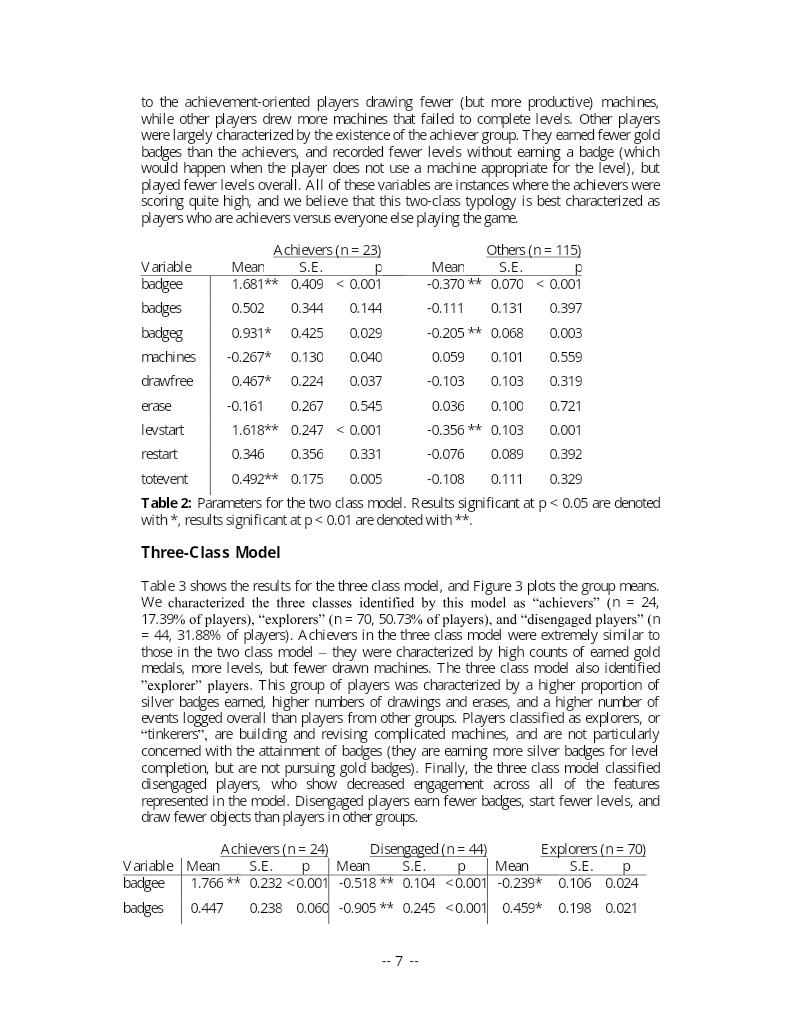
- The study applied latent class analysis to in-game log data from 138 players, covering more than six million individual actions, instead of relying on self-reported questionnaires.
- The three-class solution, which the authors argue best maps onto Bartle's player taxonomy, identified achievers (about 17% of players), explorers or 'tinkerers' (about 51%), and disengaged players (about 32%).
- Tinkerers built and revised complex machines while largely ignoring optimal badge-earning solutions, whereas achievers earned significantly more gold and silver badges and played more levels.
Towards Genre as a Game Design Research Approach
The document argues that video game genre can serve as a scholarly and design-oriented research approach, one that gives generative design research a grounded context rather than leaving it without a stable foundation.
- Genre should be treated as a tractable design language for describing kinds of games rather than as a rigid taxonomy, grouping games that share meaningful likeness in design values, structural patterns, and aesthetics.
- The authors argue that taxonomies suit information science, while game design benefits more from genre plurality and an aesthetic-centered understanding of genre.
- Genre is framed as socially constructed and mutable over time, since scholars disagree on whether gameplay, narrative, or visual style should define a genre.
Modeling and Designing for Key Elements of Curiosity: Risking Failure, Valuing Questions
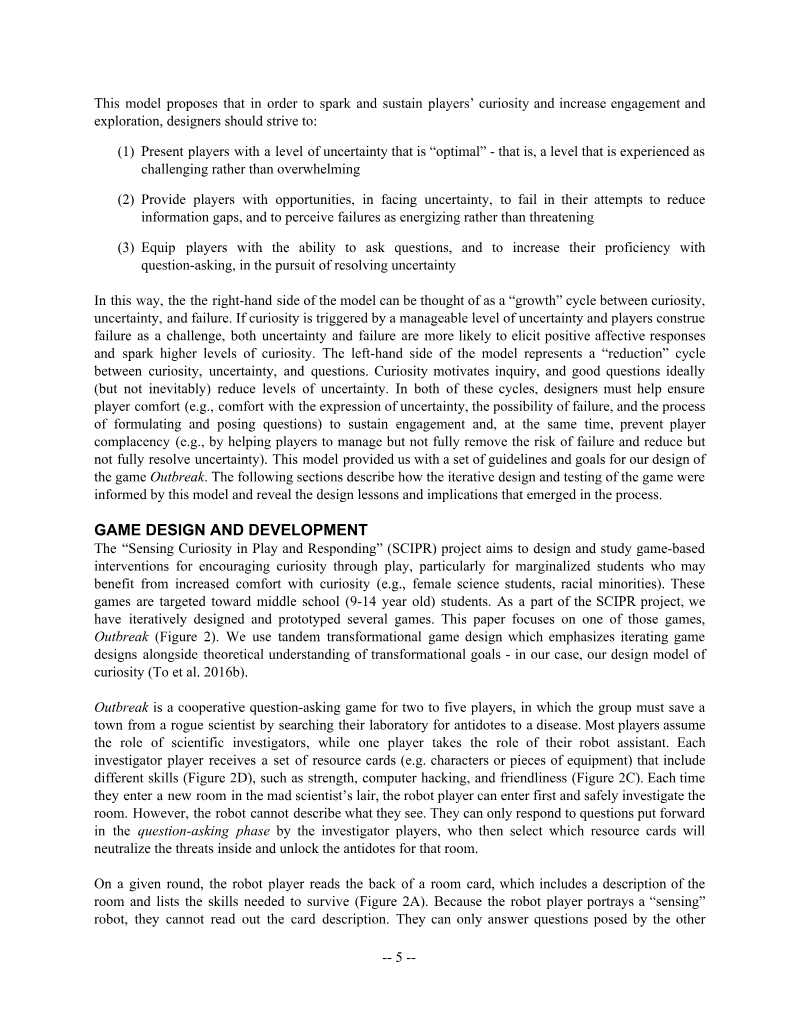
This study develops a design model linking uncertainty, failure, and question-asking to curiosity, and tests it through Outbreak, a cooperative tabletop game for players aged 9 to 14.
- Curiosity-oriented game design hinges on managing players' perceived risk of failure rather than failure itself, since players often feared the risk more than the failure. The authors present this as an argument that could inform other games, though their data were qualitative.
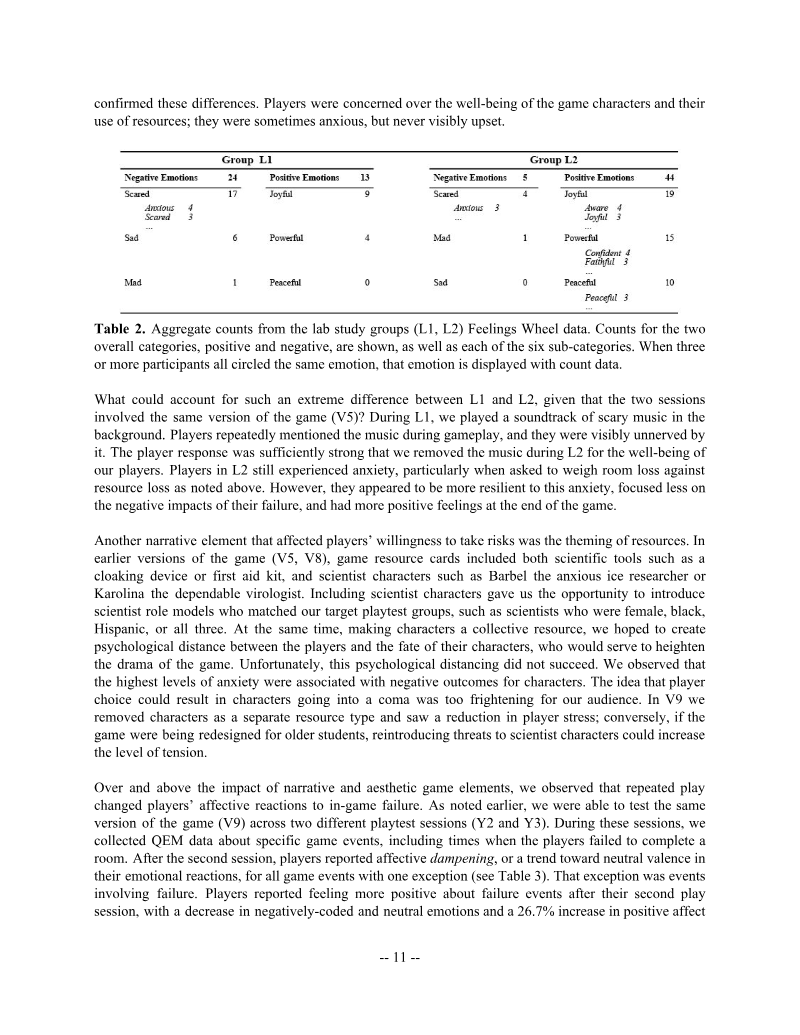
- Aesthetic choices strongly shape anxiety: scary music and named at-risk characters heightened fear, while calmer presentations produced predominantly positive affect.
- Repeated play raised positive emotional responses to failure by roughly 27 percent, suggesting familiarity can ease the fear of failing.