1 free read left. Create a free account for unlimited reading + AI research.
Create free accountArticle DiGRA
1 free read left. Create a free account for unlimited reading + AI research.
Create free accountArticleDiGRA
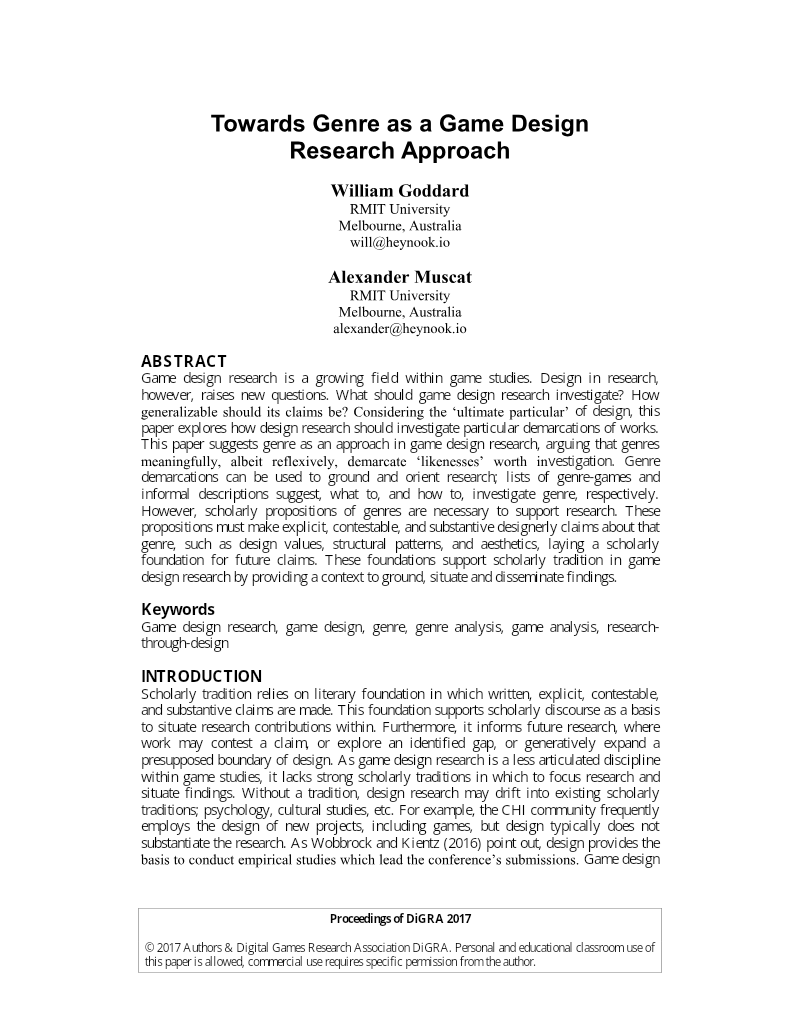
The document argues that video game genre can describe kinds of games without functioning as a rigid taxonomy. Genre groupings bring together games that share meaningful likeness.
The document argues that video game genre can serve as a scholarly and design-oriented research approach, one that gives generative design research a grounded context rather than leaving it without a stable foundation. Its central claim is that genre should be treated as a tractable language for describing kinds of games, not as a rigid taxonomy. Genre groupings, on this view, bring together games that share meaningful likeness in design values, structural patterns, and aesthetics, and they are therefore useful for both design practice and research communication.
The authors situate their position against humanist, structural, and taxonomic approaches to genre, concluding that taxonomies suit information science but that game design benefits more from genre plurality and an aesthetic-centered understanding. Because classification itself is contested, with scholars variously emphasizing gameplay, narrative, or visual style as defining features, the document treats genre as socially constructed and mutable over time. Its methodological proposal is that each genre be explicated through systematic analysis of candidate games, extending Gaver and Bowers' annotated portfolio method, and that the resulting claims be framed as explicit, transparent, and contestable propositions rather than definitive assertions.
The conclusions tailor methodology to each genre's salient features. Party games, for instance, call for attention to social context, while single-player role-playing games warrant investigation of narrative and theme. Grounded in socially perceptible characteristics rather than uncritical popular descriptions, genre is positioned as intermediate-level design knowledge: more specific than broad theory, more general than individual game analysis. The result is a framework intended to communicate design research clearly and to expand the field's scholarly base.
DiGRA · 2022

DiGRA · 2022
DiGRA · 2022
DiGRA · 2022
DiGRA · 2022
DiGRA · 2022
DiGRA · 2022
DiGRA · 2022

DiGRA · 2022
DiGRA · 2022

DiGRA · 2022
DiGRA · 2022












Comments