
DiGRA
The Digital Games Research Association: the international association of academics and professionals who study digital games. Its Digital Library holds the proceedings of the DiGRA conferences since 2002.
Documents


Spectrum: Exploring the Effects of Player Experience on Game Design
Spectrum is a player experience (PX)-focused game design tool that responds to a gap in current practice: most existing approaches treat PX only indirectly or fragment it across facets such as immersion and fun.
- Spectrum is a card-based, double-sided player experience (PX) design tool that consolidates 178 emotion-related terms into 70 groups arranged as opposing pairs, distilled into a minimalist taxonomy of 50 terms that invite subjective interpretation rather than prescribing outcomes.
- In a workshop study of three groups of four designers (averaging four game ideas each), the tool proved productive, but designers consistently translated experiences into mechanics or themes, often dropping experiential vocabulary once a concrete idea emerged.
- Designers engaged with player experience only superficially unless prompted, and several considered intense emotions such as terror or love difficult to achieve in analogue games, citing a shortage of appropriate vocabulary and a restricted view of what PX can encompass.

Two Worlds, One Gameplay: A Classification of Visual AR Games
This paper proposes a four-criteria classification for visual augmented reality (AR) games, addressing what its authors identify as an underexplored and inconsistently studied category.
- The paper proposes a four-criteria classification for visual AR games based on device, tracking technology, setting, and orientation, intended to supplement existing taxonomies and serve as a foundation for future research.
- The framework was developed through a literature review of 181 results, a Delphi process with four expert interviews across four rounds, and an analysis of AR game depictions in 35 films.
- Device categories include handheld, wearable, and spatial systems, while tracking approaches span marker-based, environmental, GPS-based, thermal, and other techniques.

Critically Approaching the Playful and Participatory Genealogy of MOBAs
Josh Jarrett's paper argues that MOBAs, despite their commercial dominance, retain substantial bottom-up, participatory roots that trace back to grassroots modding, most notably Defense of the Ancients (DotA) on Blizzard's Warcraft III.
- DotA, a grassroots modding project on Blizzard's Warcraft III, is presented as the participatory origin of the MOBA genre, and the paper uses Foucault's dispositif and genealogical method to analyse its evolution.
- The paper argues that the move from DotA to League of Legends (released 2009) traded bottom-up creativity for accessibility, with Riot Games redefining the genre through top-down design that resisted DotA's emergent mechanics such as creep denying.
- DotA's competitive play was held back by missing features including reconnect functions, persistent accounts, and skill-based matchmaking, pushing its community toward paratextual clients that were hard for newcomers to access.

Player Rating Systems for Balancing Human Computation Games: Testing the Effect of Bipartiteness
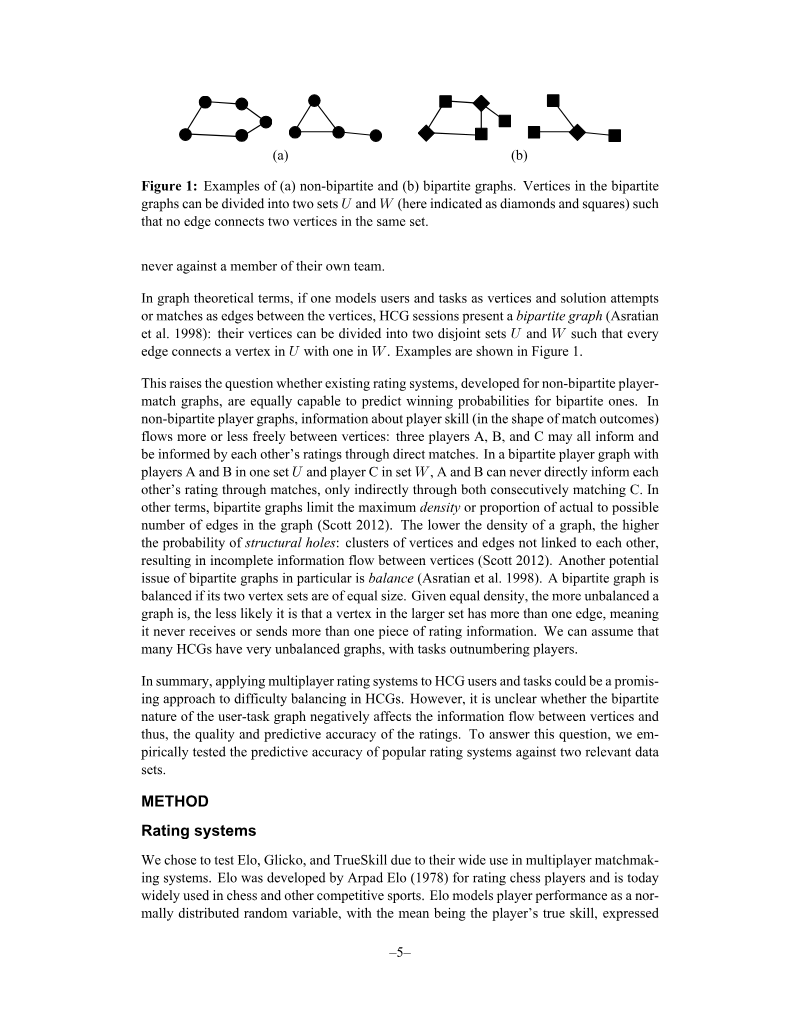
This study examines whether standard multiplayer rating systems can reliably estimate player skill and task difficulty in human computation games, where players and tasks form bipartite graphs with no direct player-player or task-task matches.
- The study tests whether bipartite player-task match graphs, where players and tasks never face each other directly, degrade the accuracy of Elo, Glicko-2, and TrueSkill rating systems used to balance human computation games.
- On FIDE chess data, Elo outperformed a naive always-predict-white baseline by up to 14 percent in median error, and bipartiteness showed no detrimental effect on prediction accuracy.
- Unbalanced bipartite training graphs performed better on bipartite test sets, plausibly because a small number of high-degree players contribute many matches.
Review of Social Features in Social Network Games
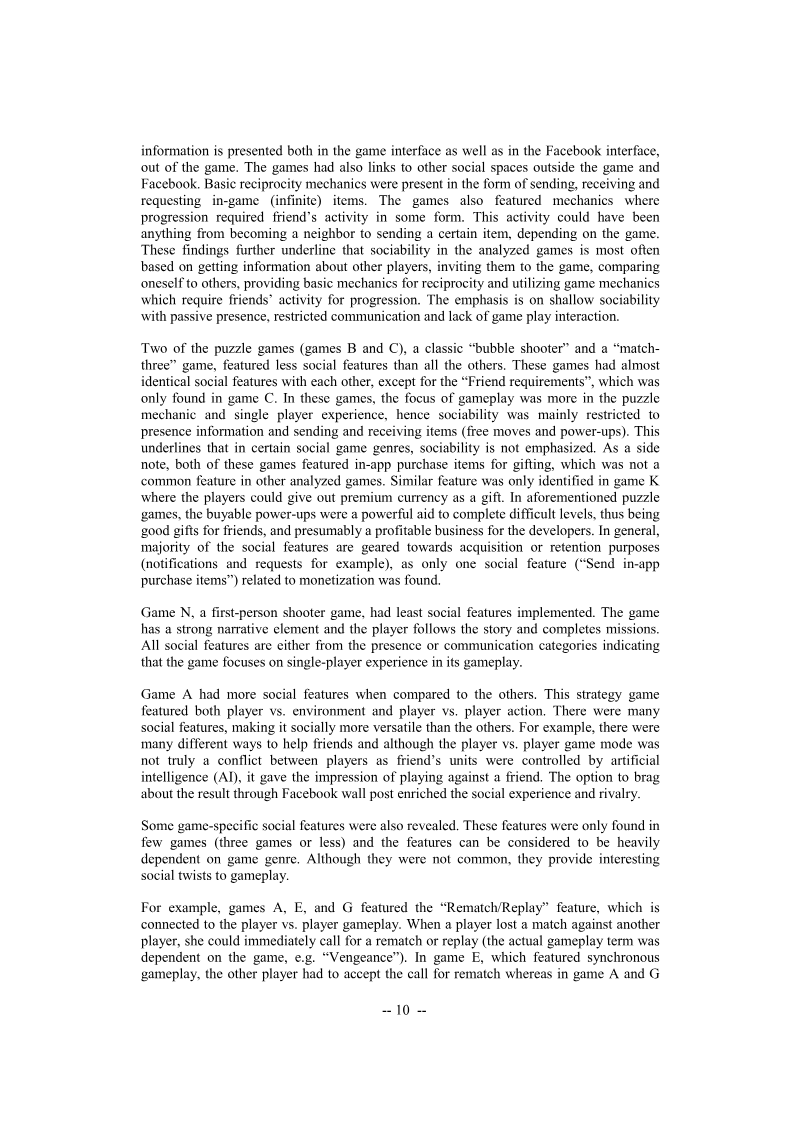
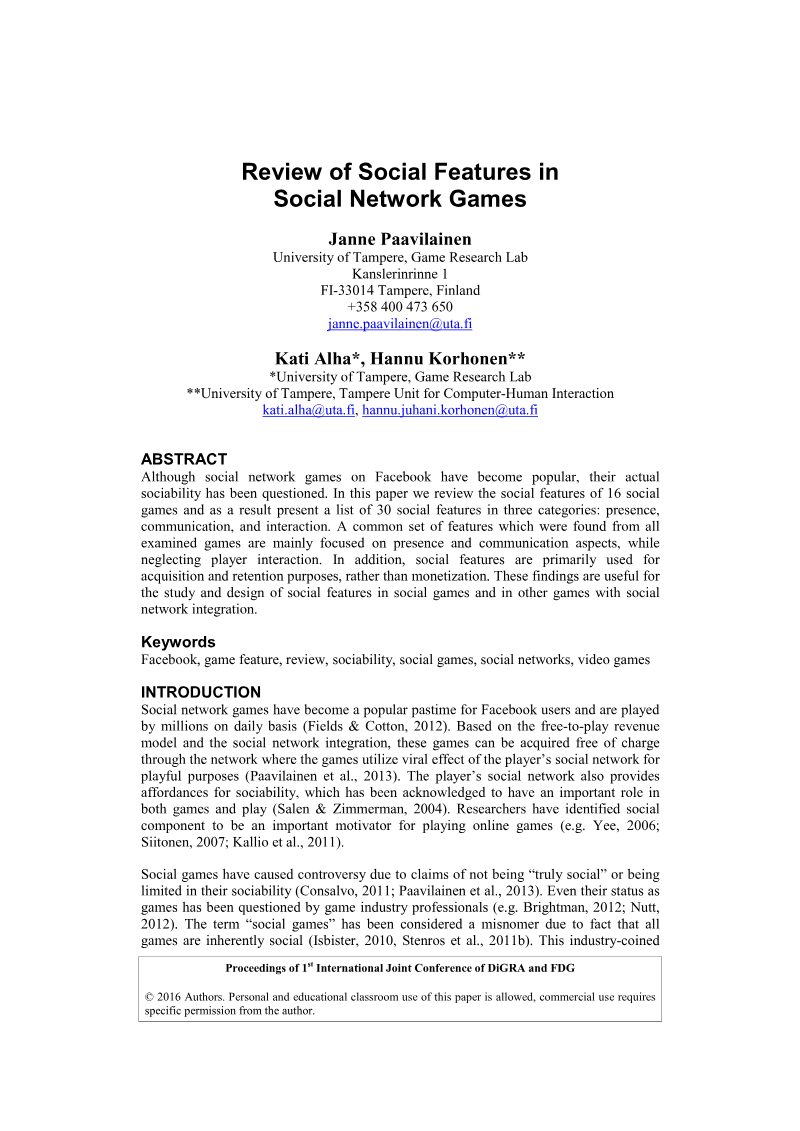
This review examines the social features of 16 Facebook social games, addressing the contested question of whether such games genuinely qualify as social.
- Of 16 Facebook social games analysed, 30 social features were identified, but informational and invitational features (presence indicators, off-game links, Facebook notifications, invite requests) appeared in every title.
- Genuine player-to-player interaction and team formation were largely absent, leading the authors to describe these games as "massively parallel single-player games."
- Gameplay interaction and monetized gifting were comparatively rare, and only one feature was directly tied to monetization.


Using Interactive Social Story Games to Teach Social Skills to Children with Autism
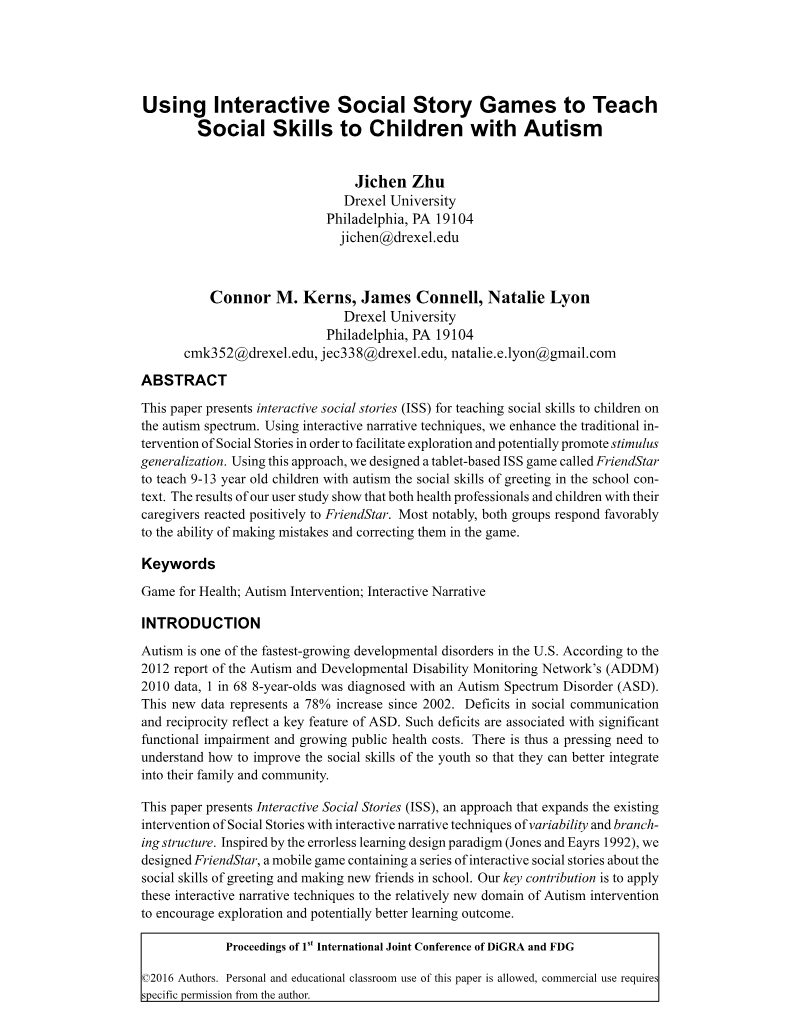
This paper introduces Interactive Social Stories (ISS), an approach that extends the traditional Social Stories intervention for children with autism spectrum disorder (ASD) by adding branching narrative structures and meaningful variability drawn from interactive storytelling.
- The paper introduces Interactive Social Stories (ISS), extending traditional paper-based Social Stories for children with autism with branching narratives and variability, with the aim of improving stimulus generalization, the transfer of learned social responses to varied situations.
- FriendStar, a tablet game for children aged 9 to 13 teaching greeting and friend-making skills at school, was evaluated in a preliminary usability study with five high-functioning children with ASD (ages 12 to 13) and their caregivers, plus four health professionals.
- Children and caregivers rated the game very favorably, with mean IRP-15 item ratings in the 'agree' range and unanimous willingness to recommend it, while professionals were markedly more skeptical, with several item means between 'slightly agree' and 'slightly disagree', mainly over effectiveness beyond greeting and the lack of efficacy data.

Rapidly-Exploring Random Tree Approach for Geometry Friends
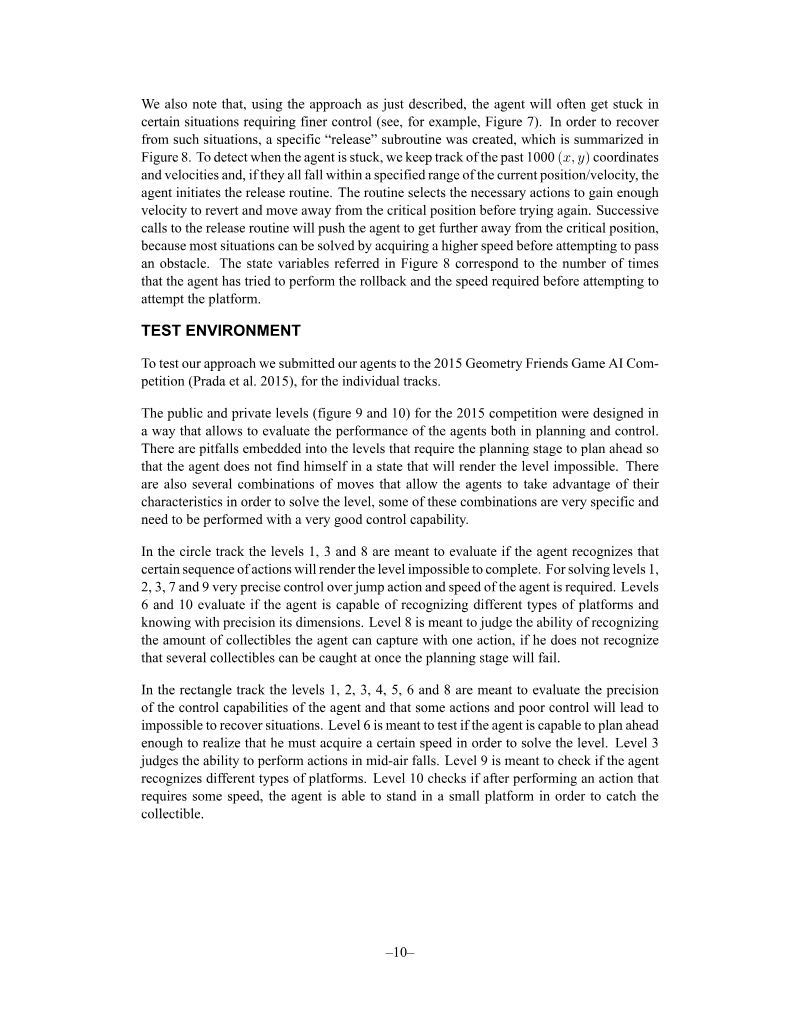
The paper presents a two-stage agent design for Geometry Friends, a physics-based cooperative platform game, using a Rapidly-exploring Random Tree (RRT) for high-level planning and a PID controller for real-time execution.
- The paper proposes a two-stage Geometry Friends agent: a Rapidly-exploring Random Tree (RRT) handles high-level planning and a PID controller handles real-time execution, with the aim of a generic, map-feature-independent method that generalizes to unseen levels.
- The circle agent placed first on the circle track of the 2015 IEEE Computational Intelligence and Games competition with a score of 2096, while the rectangle agent placed third on the rectangle track with 1487.
- Success rates were 0.32 on public circle levels and 0.38 on private levels, which the authors cite as evidence that performance does not collapse on unseen maps.
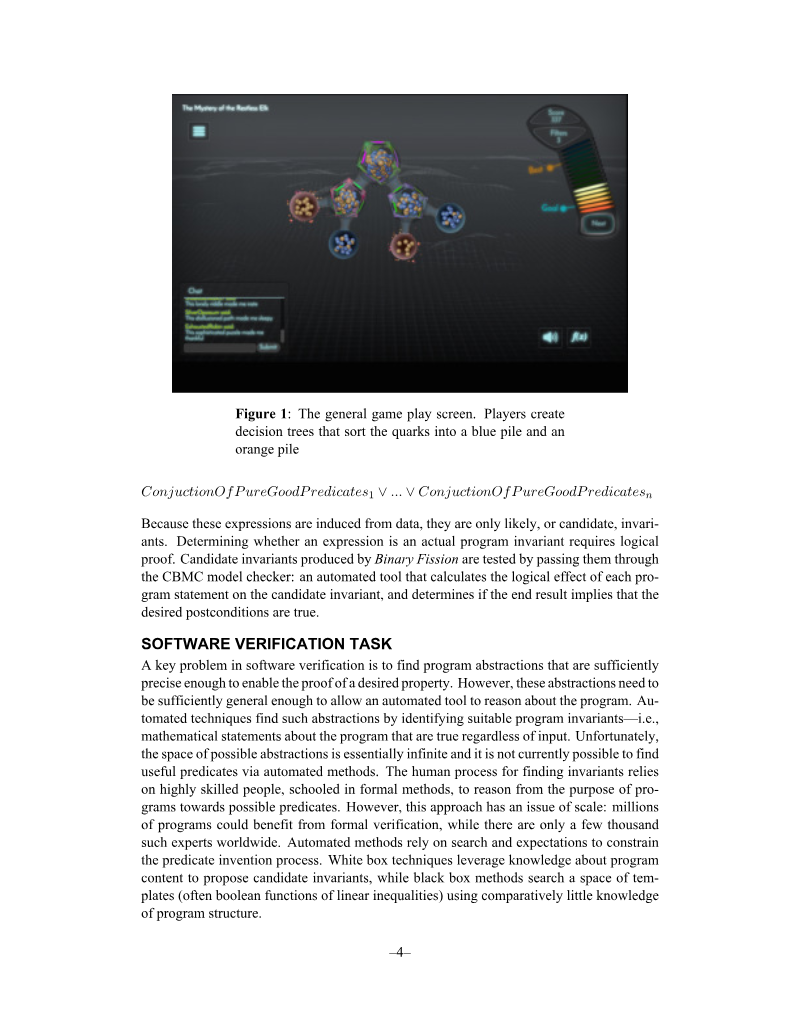

Design Lessons From Binary Fission: A Crowd Sourced Game for Precondition Discovery
Binary Fission is a crowdsourced formal verification game developed at UC Santa Cruz to address a fundamental scalability problem: there are far too few human formal-methods experts to verify the millions of programs that could benefit from it.
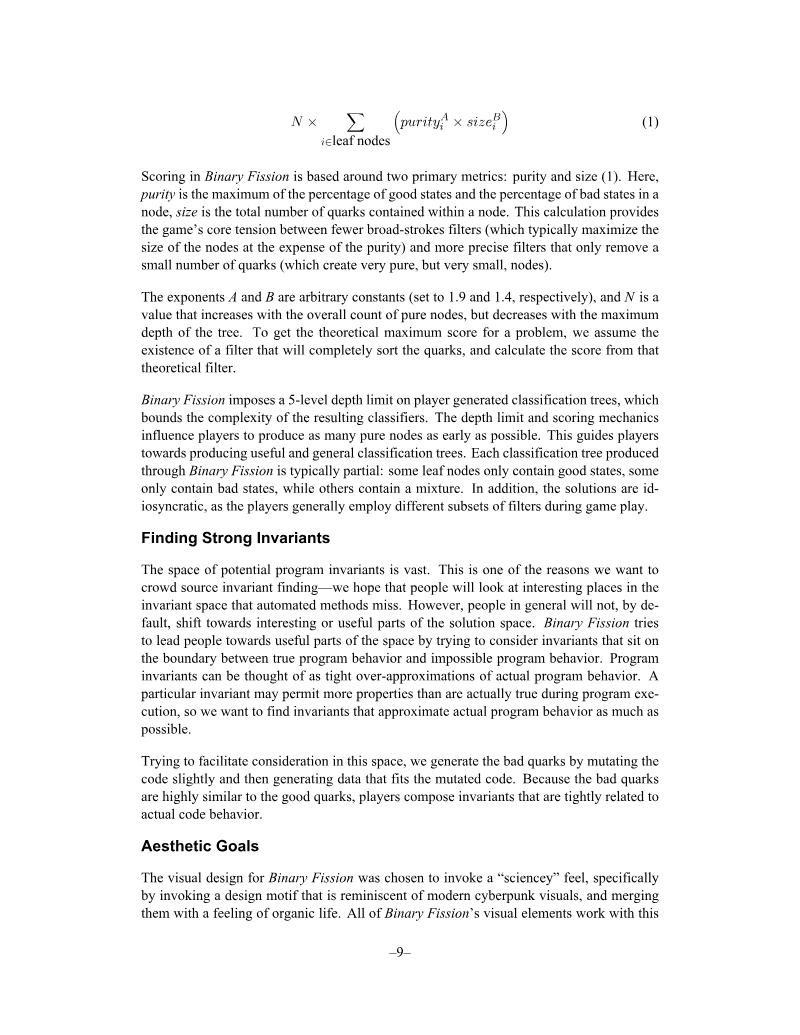
- Binary Fission is a crowdsourced formal verification game from UC Santa Cruz that addresses the shortage of human formal-methods experts by having players discover program preconditions through point-and-click sorting of colored "quarks" with logical filters.
- Among 972 players who produced 2,963 solutions, only 191 of 3,108 player-created clauses qualified as usable function preconditions, about 6%.
- For seven TCAS functions, the player-discovered preconditions accepted between 0% and 53.7% of good test states, showing considerable variation in how general the resulting conditions were.
A Statistical Analysis of Player Improvement and Single-Player High Scores
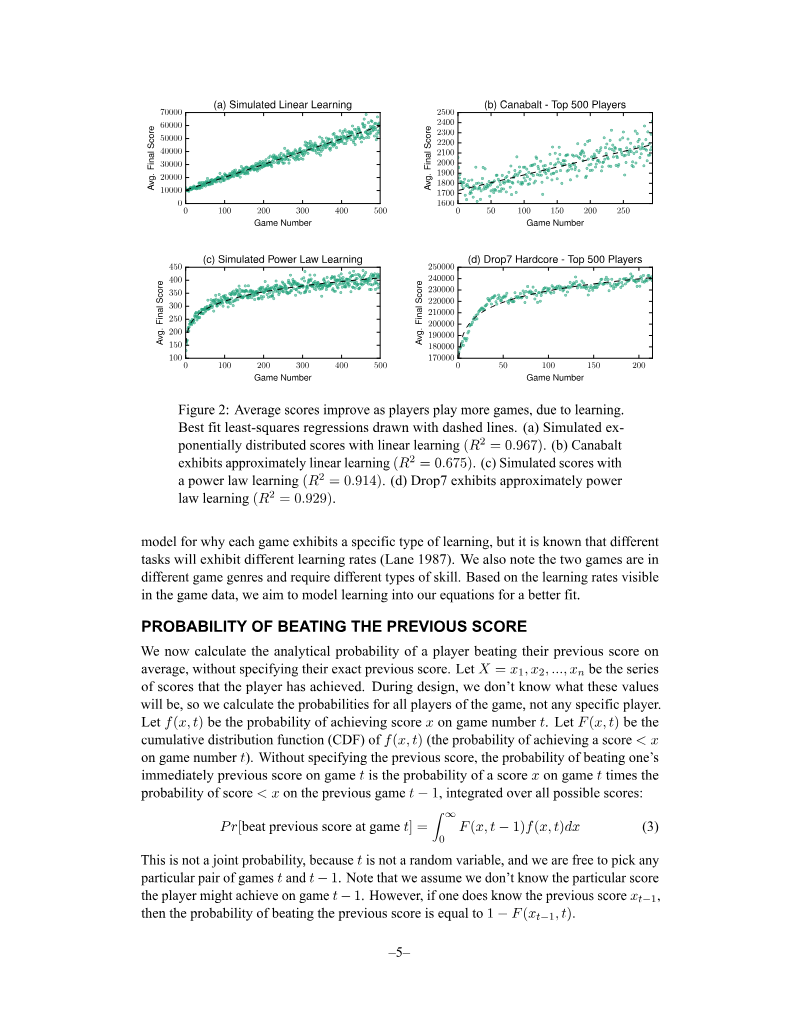
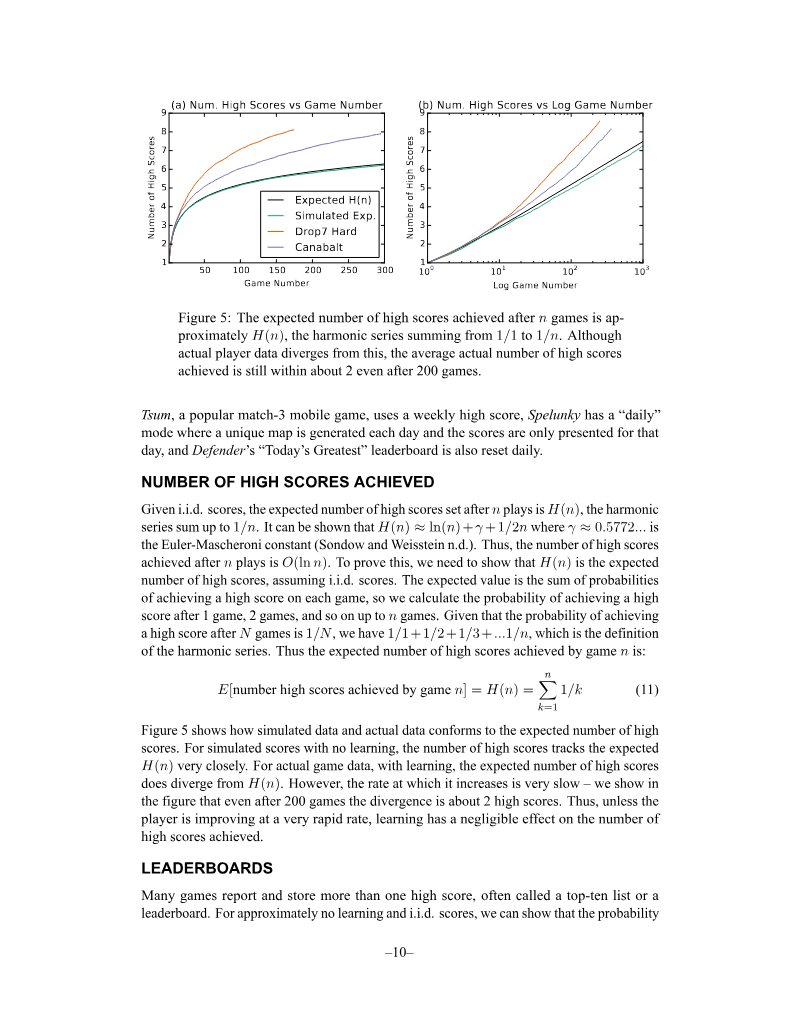
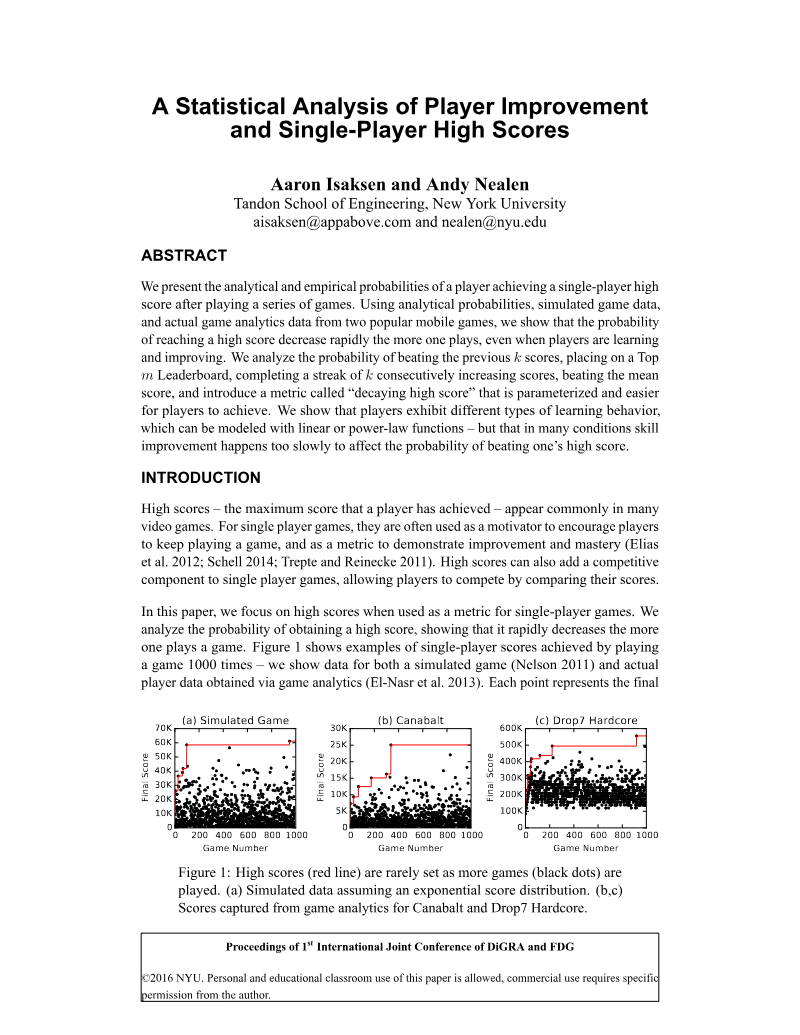
Player learning in single-player games creates a tension for high-score systems: even when players steadily improve, the probability of setting a new personal or all-time high drops rapidly as play continues.
- Improvement in player skill is often too slow to offset the declining odds of beating past scores, so high-score rewards become progressively harder to earn as play continues.
- Under an i.i.d. baseline with no learning, the chance of beating the previous score is 1/2 and the chance of a new all-time high on game n is 1/n, so expected high scores follow the harmonic series (approximately ln(n) plus the Euler-Mascheroni constant).
- Real data from Canabalt (roughly linear skill improvement) and Drop7 Hardcore (power-law learning curve) closely track these no-learning predictions, with fitted correction factors of only about 1.01 to 1.11 attributable to learning, whose influence diminishes as games accumulate.


Grouches, Extraverts, and Jellyfish: Assessment Validity and Game Mechanics in a Gamified Assessment
This study examines whether a personality inventory can be gamified without compromising its psychometric integrity.
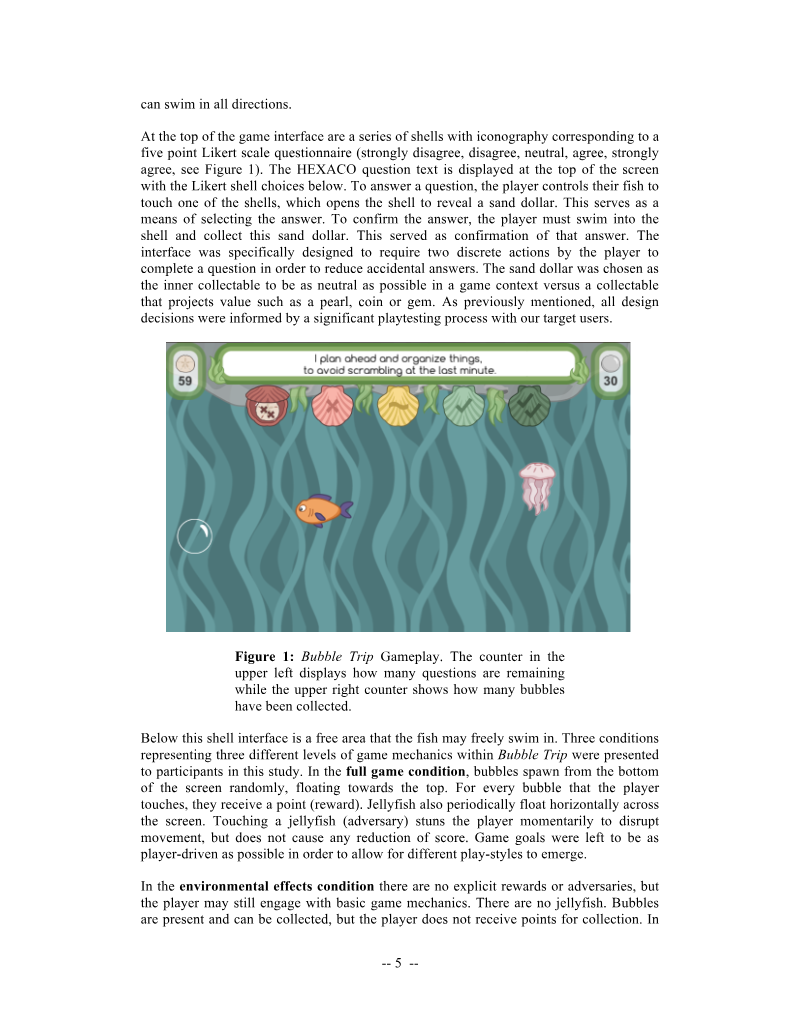
- Gamified administration of the 60-item HEXACO personality inventory produced personality scores and internal reliability (Cronbach's alphas) comparable to a traditional online survey, with no significant mean differences across conditions.
- Careless responding was low in both formats, with 17 respondents flagged in the game condition and 10 in the traditional survey.
- The full game condition, featuring enemies and point collection, significantly increased engagement: more bubbles collected, more changes to item responses, and an average play time of 5.5 minutes versus 4.9 to 5.1 minutes in the other conditions.


Three Shadowed Dimensions of Feminine Presence in Video Games
The paper "Three Shadowed Dimensions of Feminine Presence in Video Games" argues that scholarly and critical attention to women in games has concentrated narrowly on sexist portrayals and the action-heroine archetype, exemplified by Lara Croft, leaving other forms of feminine presence underexplored.
- The paper argues that scholarship on women in games has focused narrowly on sexist portrayals and the action-heroine archetype (exemplified by Lara Croft), leaving other forms of feminine presence underexplored.
- It proposes three neglected analytical axes: aging (including the 'Adventurous Alice' trope of child and older women characters), the contrast between protagonist-focused and world-focused perception, and feminine sociability.
- The sociability lens, adapted from the Bechdel-Wallace test, asks whether women interact meaningfully with one another rather than only in relation to men.
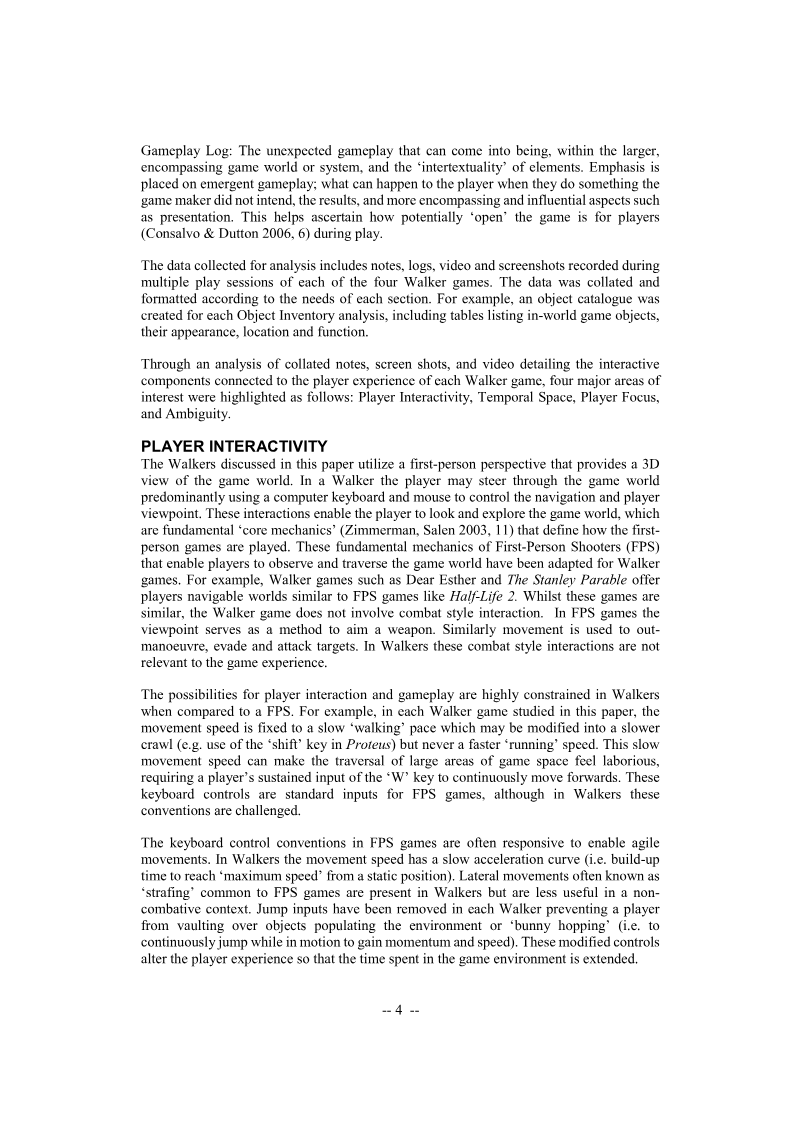

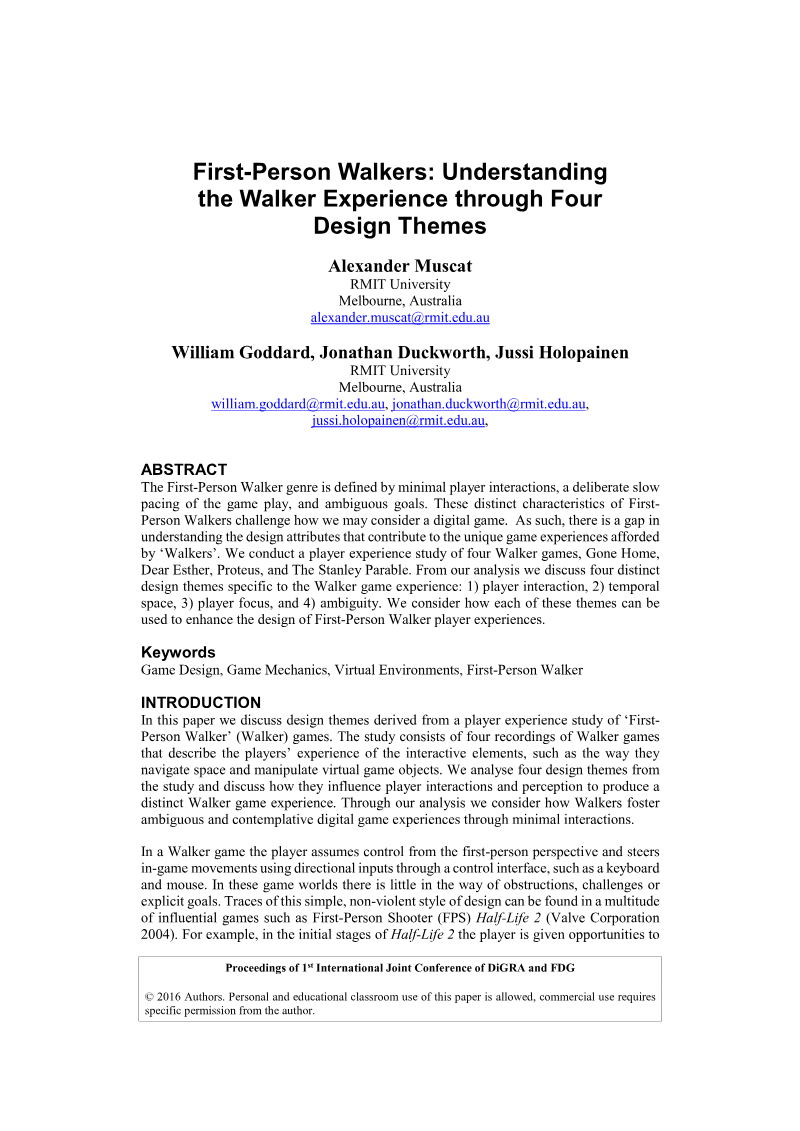
First-Person Walkers: Understanding the Walker Experience through Four Design Themes
First-Person Walker games, a genre exemplified by titles such as Dear Esther, Proteus, Gone Home, and The Stanley Parable, are defined by constrained interaction, deliberately slow movement, and ambiguous goals.
- The report defines First-Person Walker games (e.g., Dear Esther, Proteus, Gone Home, The Stanley Parable) by constrained interaction, deliberately slow movement, and ambiguous goals, distinguishing them from combat-oriented shooters like Half-Life 2.
- Its central finding is that limited controls, the absence of obstacles, and contextual "use" actions lengthen the time players spend in each environment and shift them from active challengers into attentive observers.
- The study identifies four design themes (player interactivity, temporal space, player focus, and ambiguity), derived from a qualitative method combining interaction mapping, interface study, object inventory, and gameplay logging across four representative games.