1 free read left. Create a free account for unlimited reading + AI research.
Create free accountWhitepaper DiGRA
1 free read left. Create a free account for unlimited reading + AI research.
Create free accountWhitepaperDiGRA
Distilling the key insights…
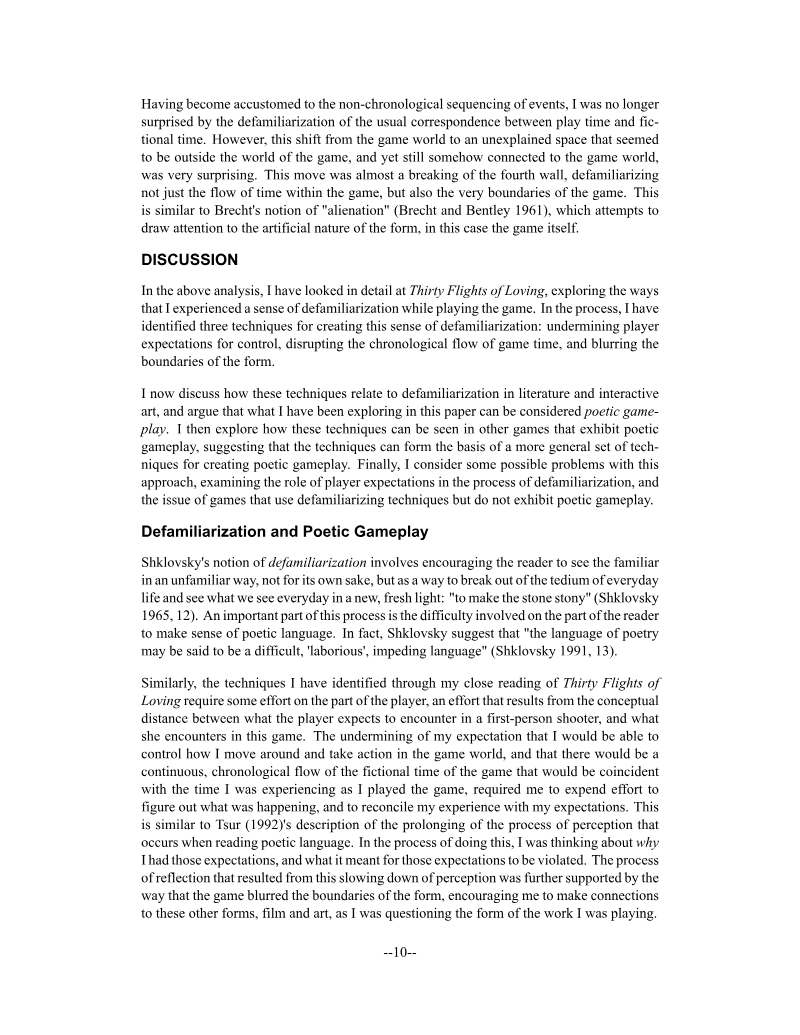
This study investigates whether the defamiliarizing techniques theorized by Mitchell and Ensslin actually produce poetic effects in players, rather than remaining a matter of theoretical argument or close reading. Drawing on defamiliarization and foregrounding theory from Shklovsky and Mukařovský, the authors examine how 21 participants, seven per game, responded to three self-described "poetic" games: The Graveyard, Thirty Flights of Loving, and The Stanley Parable. Using retrospective protocol analysis and semi-structured interviews, the work tests five defamiliarizing techniques against the lived experience of play, offering empirical evidence where prior scholarship had relied on theory and textual analysis alone.
The central finding is that defamiliarization does not reliably generate reflection. In The Graveyard and Thirty Flights of Loving, participants' contemplative engagement was frequently overshadowed by confusion over controls, objectives, and the basic question of what was happening. Unfamiliar mechanics such as slow walking or non-chronological jump cuts were read as meaningful by some participants and as distracting obstacles by others. The Stanley Parable, by contrast, let players reflect on its form and meaning, including its themes of limited agency and an unreliable narrator, while they continued to experience it as a functioning game with clear goals.
The authors conclude that the decisive factor is integration: difficulties must be meaningfully tied to a work's themes and free of extraneous obstacles that consume cognitive effort. Defamiliarization must also be calibrated, since too little disrupts nothing and too much, or disruption unrelated to meaning, obscures the intended poetic effect. The authors note that participant background, including weekly play hours and preferred genres, may also shape these responses, a question they leave for further study. The sample is small and limited to three titles, so the findings describe a set of exploratory cases rather than a general account of poetic games.
Each row is a game or company this document names, each column a document, oldest first. A mark means that document names it. Select a row to see those documents.



DiGRA · 2018

DiGRA · 2018



DiGRA · 2018



DiGRA · 2018

DiGRA · 2018

DiGRA · 2018



DiGRA · 2018



DiGRA · 2018



DiGRA · 2018



DiGRA · 2018

DiGRA · 2018



DiGRA · 2018
Game Developers Conference · 2019