1 free read left. Create a free account for unlimited reading + AI research.
Create free accountWhitepaper DiGRA
1 free read left. Create a free account for unlimited reading + AI research.
Create free accountWhitepaperDiGRA
Distilling the key insights…
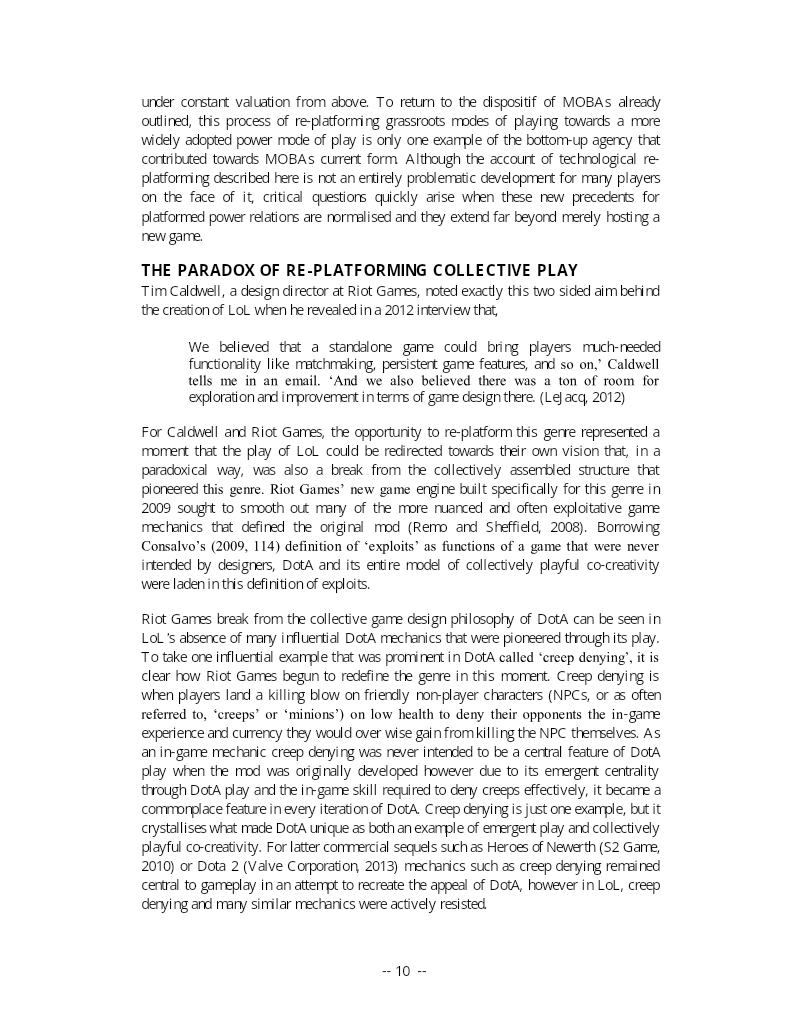
Donaldson's study examines how League of Legends players judge deviant in-game behaviour when community-established strategic norms, known as the "meta," collide with developer-written conduct rules. Its central argument is that Riot Games' vague and sometimes contradictory rules have left players without a shared understanding of what counts as reportable "greed play," and that enforcement based on these unclear standards shapes how the community comes to define legitimate play. The analysis draws on Kou and Nardi's (2014) work on rule ambiguity, positioning players as the ones who must interpret deviance for themselves.
The study's pivotal case is the 2016 to 2017 controversy surrounding the player AdellaideSkyhart, who used Singed in the Support role to roam and disrupt enemies. Threatened with a permanent ban in November 2016 and ultimately banned in 2017, the player became a focal point for a community divided between defending strategic innovation and prioritising a predictable, enjoyable match. A similar punitive case in February 2017 suggests the tension between developer rulings and player expectations remains unresolved.
The analysis also highlights structural factors that intensify this friction. The meta has persisted largely unchanged since launch, and Riot's 2016 role-based queue system reduced the pre-game position negotiation that once allowed teams to settle expectations before play began. Because the meta binds strangers into a cohesive team, a single player's deviation affects everyone, which makes the lack of clear developer standards especially consequential. The ranked queue's integration of metagame norms with position-based rules further complicates the picture.
The study's scope centres on the League of Legends player community and Riot Games' ranked enforcement during the late 2016 and early 2017 period. Its conclusions point to an unresolved gap between developer-written conduct rules and player-constructed norms, with implications for how competitive online games govern play through ambiguous, subjectively applied standards.
Each row is a game or company this document names, each column a document, oldest first. A mark means that document names it. Select a row to see those documents.
DiGRA · 2019
DiGRA · 2019
DiGRA · 2019
DiGRA · 2019
DiGRA · 2019
DiGRA · 2019
DiGRA · 2019
DiGRA · 2019
DiGRA · 2019
DiGRA · 2019
DiGRA · 2019
DiGRA · 2019
Game Developers Conference · 2017