
DiGRA
The Digital Games Research Association: the international association of academics and professionals who study digital games. Its Digital Library holds the proceedings of the DiGRA conferences since 2002.
Documents
"There Are No Women and They All Play Mercy": Understanding and Explaining (the Lack of) Women's Presence in Esports and Competitive Gaming
This Nordic DiGRA 2018 paper by Ruotsalainen and Friman investigates why women remain scarce in esports and competitive gaming, arguing that the explanation lies in cultural structures rather than any deficit in skill.
- The authors argue that women's scarcity in esports stems from cultural structures, namely toxic meritocracy and hegemonic geek masculinity, rather than any deficit in gaming skill, and that women's room for participation is extremely narrow in both extent and legitimate forms.
- In a questionnaire of 737 Finnish women gamers, 13.5 percent had considered competing, and the most common reasons for not doing so were disliking competitiveness, lacking interest in esports titles, and feeling insufficiently skilled, with gender-related concerns and community toxicity recurring as significant themes.
- Analysis of former Overwatch official forum discussions from 2016 to 2018 found that users largely attributed women's absence from the Overwatch League to cultural and environmental factors rather than biology, often citing research showing negligible gender differences in gaming skill.
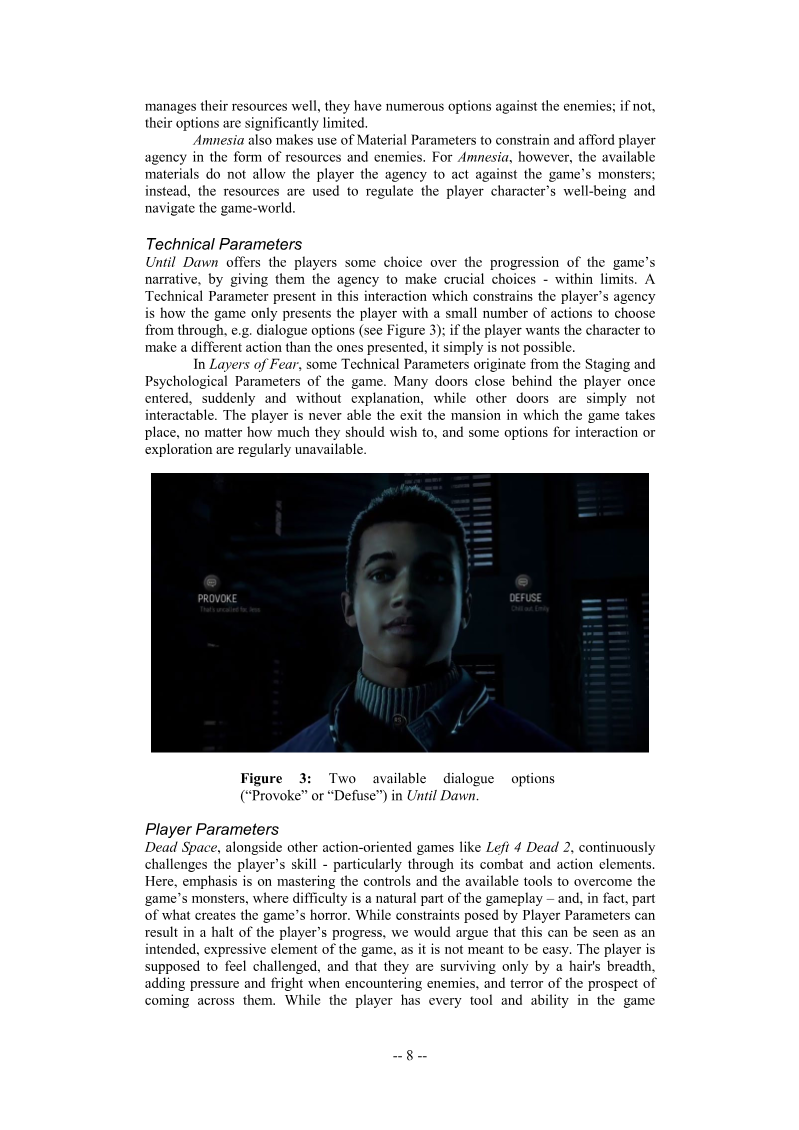
Paralysing Fear: Player Agency Parameters in Horror Games
"Paralysing Fear" examines how horror games manipulate player agency, arguing that the experience of fear in these games depends on carefully calibrated constraints and affordances rather than on content alone.
- Horror in games is produced less by content than by calibrated constraints and affordances that restrict or open up what the player can do, and the report proposes an Agency Parameter Model to analyse this.
- The model organises agency into three hierarchically arranged categories: Player Character Parameters (physical and psychological), System Parameters (technical and material), and Player Parameters, all encapsulated by Staging.
- The framework was built from hands-on play, fieldnotes, and recordings of six horror titles, including Amnesia: The Dark Descent, Dead Space, and Until Dawn, and is grounded in qualitative humanistic analysis.
Civic and Political Transgressions in Videogames: The Views and Experiences of the Players
This study examines how video game players perceive and experience civic and political transgression, arguing that games can serve as meaningful sites for civic learning when their ideological content is taken seriously.
- Players in ten participatory workshops (May–December 2017) with 73 members of the academic community in Porto, Portugal, analysed short, freely available games on social issues, and the transgressive framework emerged inductively from their accounts rather than being imposed in advance.
- Four forms of transgression were identified: the transgression of linear narratives (e.g., Unmanned), of ideologically neutral truth (e.g., Republia Times, To Build a Better Mousetrap), of the rhetoric of free choice and merit (e.g., Spent, Darfur is Dying, Ayiti), and of individualism and the myth of the "Other" (e.g., The Migrant Trail, Against All Odds, Quandary).
- Players recognised that structural conditions, rather than individual decisions alone, shape poverty and mobility, challenging meritocratic assumptions.
Games of Social Control: A Sociological Study of Addiction to Massively Multiplayer Online Role-Playing Games
This extended abstract, presented at DiGRA 2018, outlines a PhD project by Cindy Krassen and Stef Aupers at KU Leuven that challenges the dominant social-psychological explanations of game addiction.
- The project challenges dominant social-psychological explanations of game addiction, which attribute compulsive gaming to low self-esteem and weak social relations, by arguing that social networks within MMORPGs exert social pressure that leads players to neglect offline friends, family, school, and work.
- The authors frame the phenomenon through the sociological concept of social control, positing that shared in-game norms and obligations can restrict individual agency much as offline groups do.
- The abstract cites a reported 53 percent of frequent gamers playing multiplayer titles and states that MMORPG players average around 23 hours of play per week, with some sessions lasting ten hours or more.
The Significance of True Line of Sight in Warhammer 40,000
This extended abstract, presented at DiGRA 2018, examines "true line of sight" (TLOS) in Warhammer 40,000 as a lens for understanding miniatures, perception, bodies, and gameplay.
- True line of sight (TLOS) is a Warhammer 40,000 rule that determines which miniatures can see and attack one another, requiring players to trace a line from a model's head or weapon to a target's body.
- The paper argues that vision in wargaming is inherently tied to violence, since TLOS only has meaning within the shooting and damage resolution rules that follow it.
- Because the rule takes models and terrain positions at face value, a miniature's size, shape, and pose directly affect its vulnerability: a crouching figure is harder to shoot but less able to fire, while an exposed figure invites more fire, making modeling decisions strategically consequential.
Metagaming in Competitive Hearthstone: Heroes of Warcraft
This extended abstract, presented at DiGRA 2018, examines metagaming practices among competitive players of the digital collectible card game Hearthstone, focusing on live tournaments in the United Kingdom such as Insomnia Gaming Festival and local Manchester events.
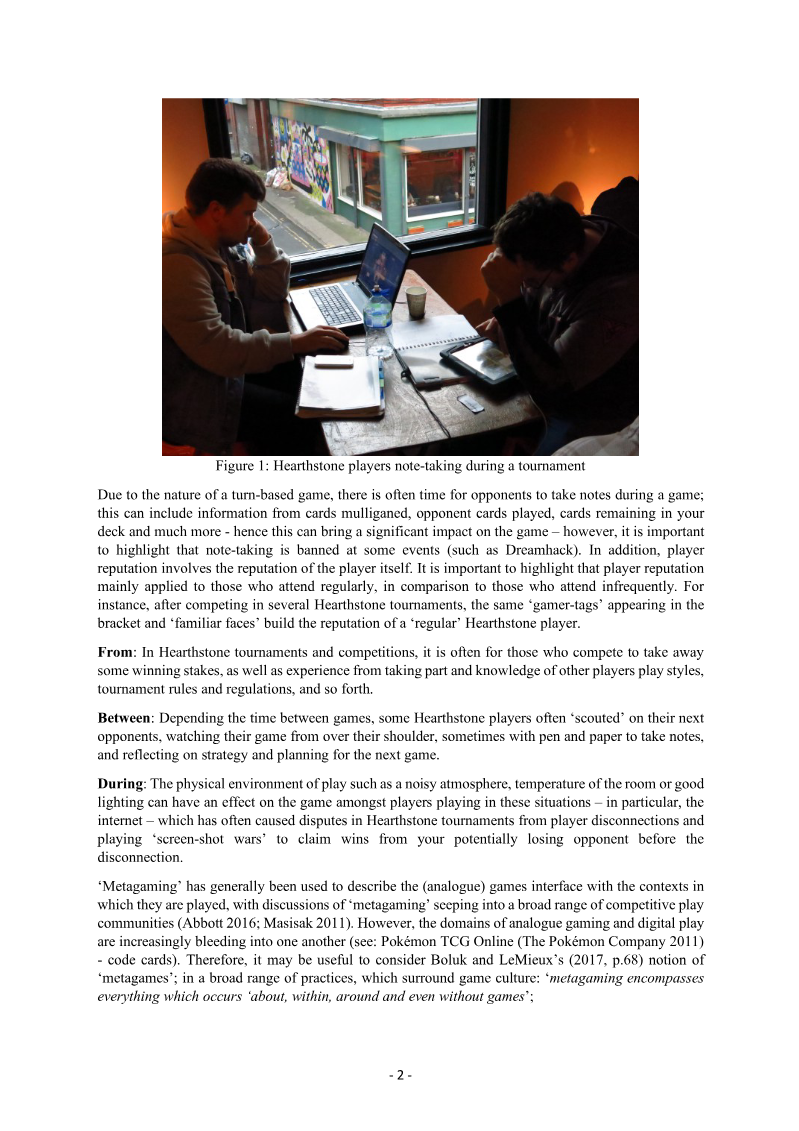
- Competitive Hearthstone players practise metagaming well beyond in-game play, including opponent analysis, note-taking during matches, scouting between games, and reputation-building among regular tournament competitors, adapting Garfield's (2000) Magic: The Gathering framework.
- Frequent patch-driven changes and inconsistent tournament rules create a dynamic environment in which players and communities negotiate norms and build identity, with some events banning note-taking altogether.
- The author adapts Boluk and LeMieux's (2017) fourfold typology of metagames (about, within, around and without games) to Hearthstone, with examples including World of Warcraft characters, loophole exploitation, player psychology, audience reactions, and external espionage and markets.
Imaginary Russia: The Orientalisation of USSR in Command & Conquer: Red Alert Series
This extended abstract, presented at DiGRA 2018 and authored by Szymon Piotr Kukulak of Jagiellonian University, argues that the Soviet Union as portrayed in the Command & Conquer: Red Alert series is constructed along the lines of Edward Said's concept of Orientalism rather than as a modern European superpower.
- Kukulak (Jagiellonian University, DiGRA 2018) argues that the Soviet Union in the Command & Conquer: Red Alert series is built on Edward Said's concept of Orientalism rather than depicted as a realistic modern European superpower.
- The author contends the franchise, especially from its second installment onward, shifted from a relatively realistic alternate-history Cold War toward a campier style that polarizes the factions, casting the Soviets as a malevolent 'Eastern' empire.
- Allied campaigns frame the player as defender against Soviet aggression, and Orthodox church domes on Soviet tank factories are cited as cultural markers that contradict real Communism.

The Sacred and the Mundane: Video Games in the Convenience Store
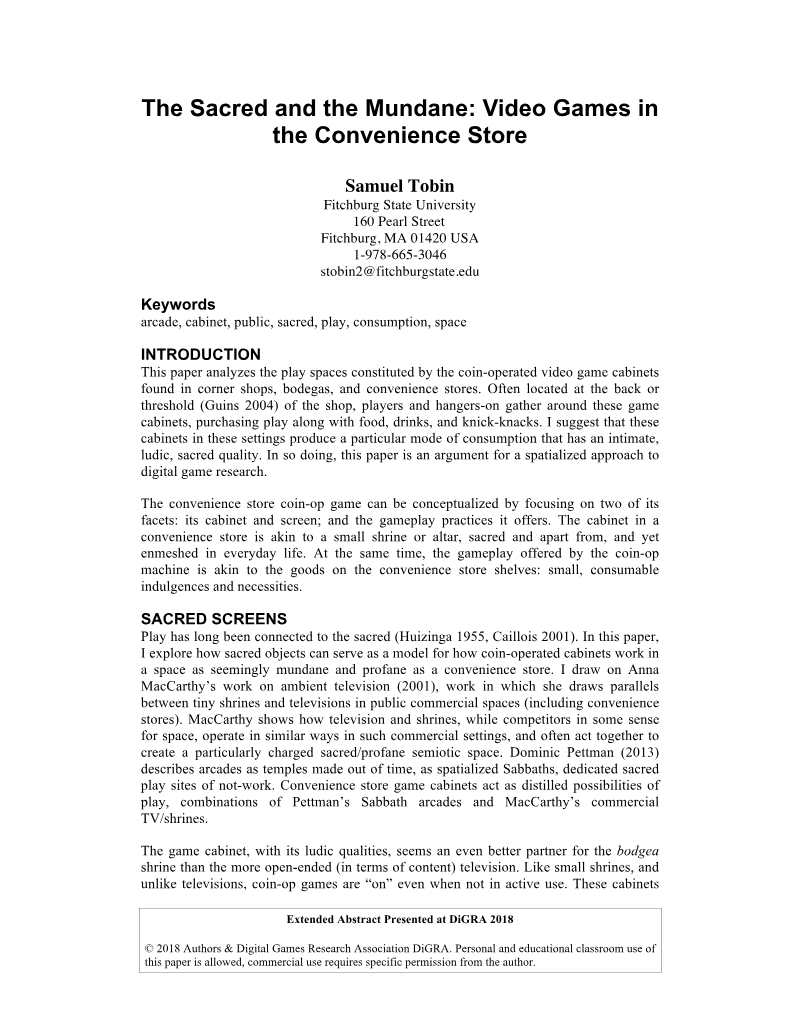
This extended abstract, presented at DiGRA 2018, argues for a spatialized approach to digital game research by examining coin-operated video game cabinets in corner shops, bodegas, and convenience stores.
- The paper is a conceptual and theoretical DiGRA 2018 extended abstract, not an empirical study: it presents no survey data, sample sizes, or quantitative findings.
- Its central thesis is that coin-operated video game cabinets in corner shops, bodegas, and convenience stores produce a distinctive mode of consumption with an intimate, ludic, and sacred quality, framed as a small shrine embedded in everyday commerce.
- The cabinet is positioned as tensioned between two roles: an object of consumption, like the snacks and necessities around it, and a site of potentially transformative play.
Characteristically Tensive: The Unreal in Poetic Gaming
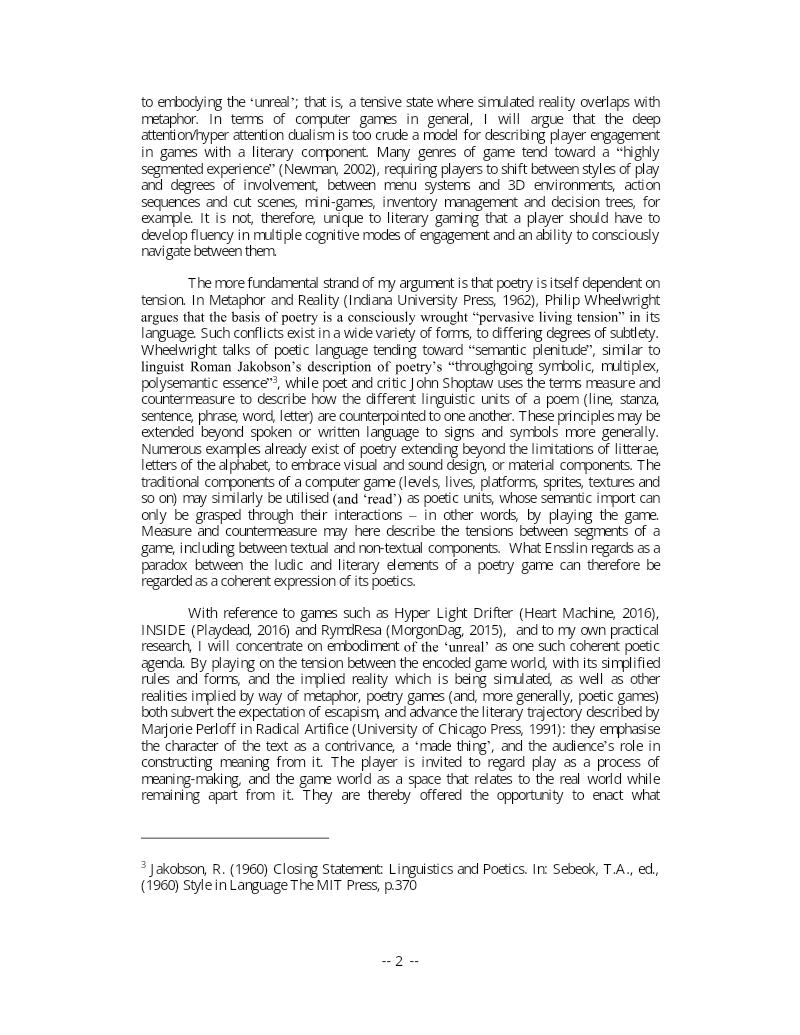
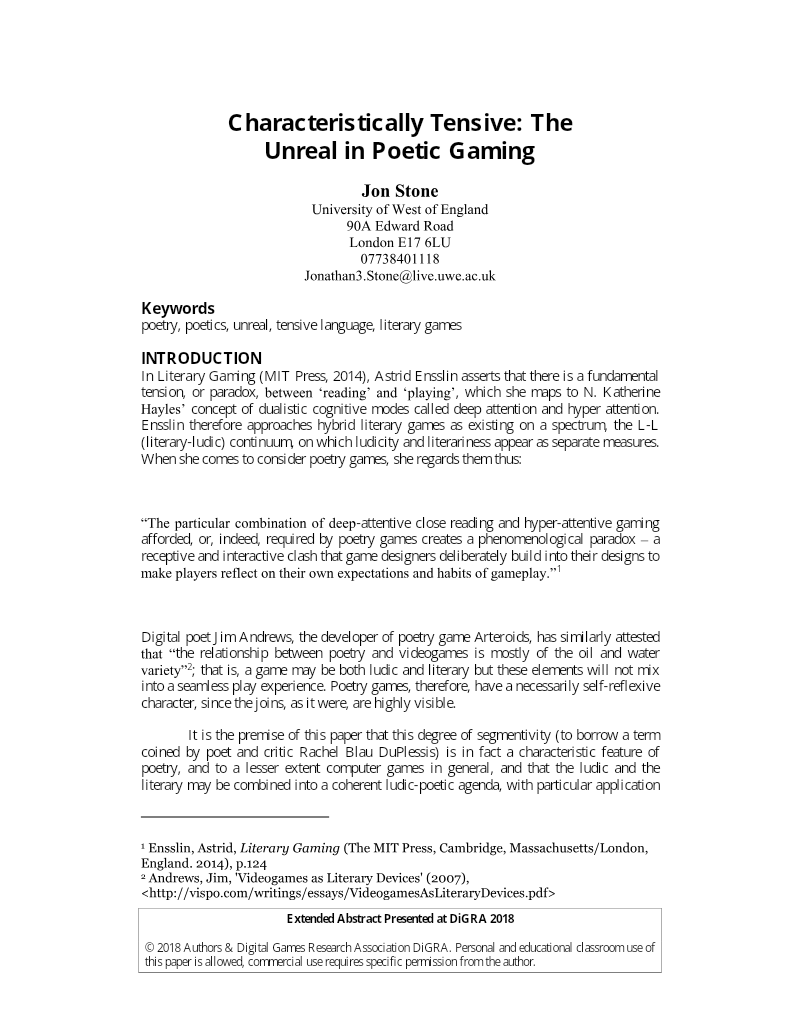
This paper argues that the tension between ludic and literary elements in poetry games is not a flaw to be resolved but a coherent expression of poetics, and that this tensive quality is characteristic of poetry itself.
- The paper argues that tension between ludic and literary elements in poetry games is not a flaw to be resolved but a coherent expression of poetics, and that this tensive quality is characteristic of poetry itself.
- It challenges Astrid Ensslin's model of poetry games as a paradox between deep and hyper attention, arguing the dualistic model is too crude because many game genres already require players to shift between menus, 3D environments, cut scenes, and decision trees.
- Drawing on Philip Wheelwright, Roman Jakobson, and John Shoptaw, the paper extends principles of poetic tension from written language to game components such as levels, sprites, and textures, which gain semantic meaning only through interaction.
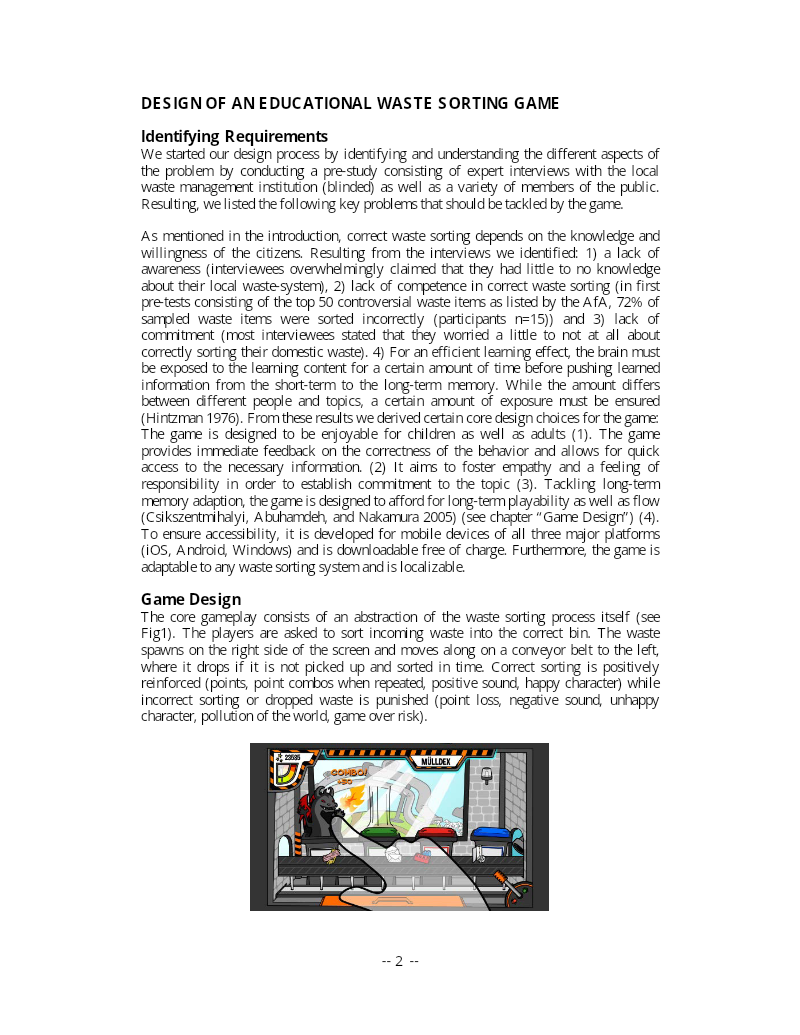
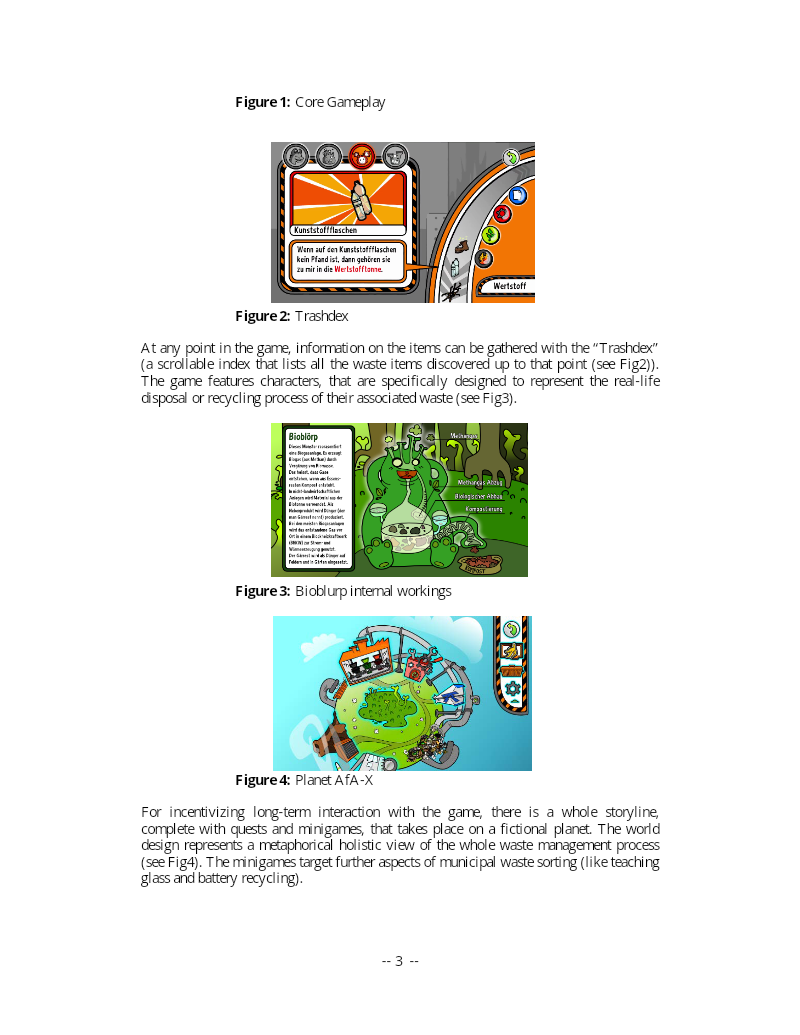
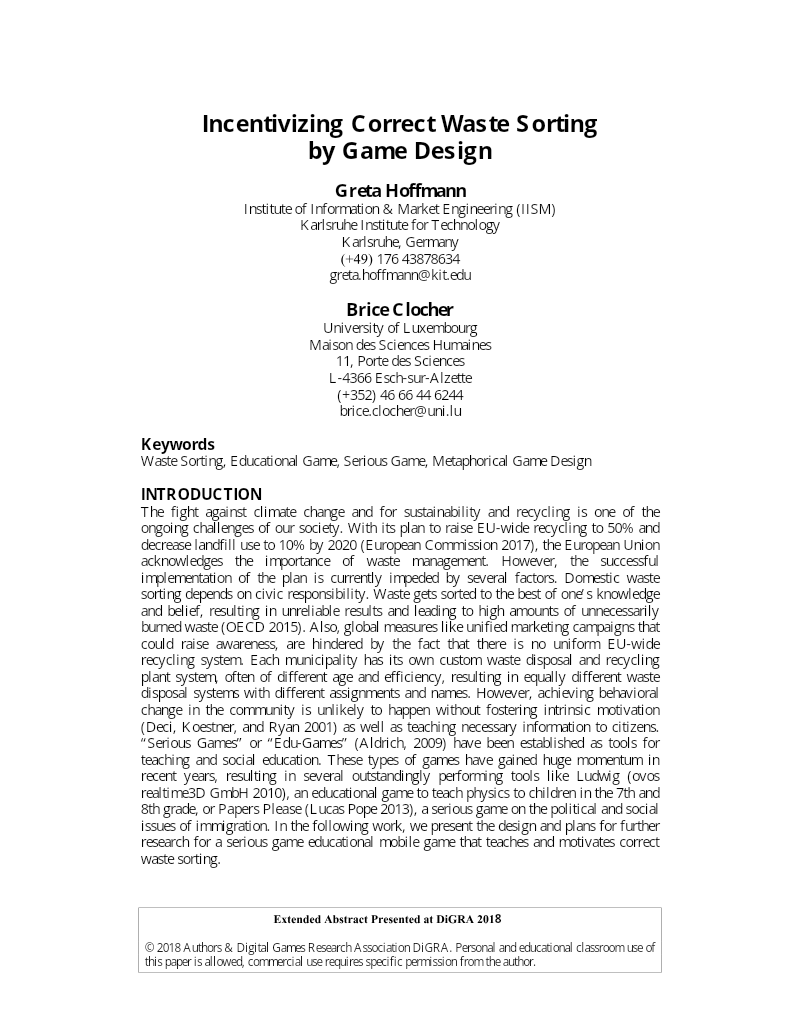
Incentivizing Correct Waste Sorting by Game Design
This extended abstract, presented at DiGRA 2018, describes the design and early evaluation of a free mobile serious game intended to teach and motivate correct household waste sorting.
- A pre-test found 72% of 50 controversial waste items were sorted incorrectly by 15 participants, and most interviewees reported little knowledge of their local sorting system or concern about sorting correctly.
- The authors frame citizen sorting errors as stemming from three gaps (low awareness, weak competence, and limited commitment), and argue game design can address all three.
- Because EU municipal waste systems differ, the authors propose a localizable app that adapts to any local sorting scheme as a substitute for the absence of a uniform EU-wide recycling system.
"We're Not Gonna Take It.": The Countercultural AAA Aesthetics of Wolfenstein: The New Colossus
Hans-Joachim Backe's analysis examines Wolfenstein II: The New Colossus (MachineGames, 2017) and argues that its apparent flaws are in fact deliberate components of a unified aesthetic.
- The paper argues that Wolfenstein II: The New Colossus (MachineGames, 2017) has apparent flaws that are deliberate parts of a unified aesthetic, and that critics and sympathetic reviewers missed the coherence between its narrative and ludic systems.
- The central thesis is that the game deploys Bakhtin's carnivalesque as a poetics of defamiliarization that stages the death and rebirth of first-person shooter conventions.
- The analysis reads the game's Nazi ideology as absurdist rather than endorsing, and interprets protagonist B.J. Blazkowicz's trajectory from an idealized Aryan body to a frail, grafted figure as an inversion of fascist notions of virility.
Games Biting Back: Anatomy and Ecofeminism
Alexander Duncan's paper examines the indie horror game ANATOMY by Kitty Horrorshow through an ecofeminist lens, arguing that the game deliberately challenges the traditional hierarchy that casts environments as passive containers of information and subordinates them to an active, male, European subject.
- Alexander Duncan's DiGRA 2018 extended abstract reads the indie horror game ANATOMY by Kitty Horrorshow through an ecofeminist lens, arguing it exposes rather than reinforces the hierarchy that casts environments as passive and subordinate to an active, male, European subject.
- Duncan builds on Henry Jenkins's concept of embedded narrative, arguing that its framing of game worlds as inert repositories waiting for the player still positions the environment as passive.
- The paper draws on Adorno and Horkheimer's critique of Enlightenment domination of nature and Val Plumwood's ecofeminist account of dichotomies linking passivity, nature, women, and colonized peoples.