1 free read left. Create a free account for unlimited reading + AI research.
Create free accountWhitepaper DiGRA
1 free read left. Create a free account for unlimited reading + AI research.
Create free accountWhitepaperDiGRA
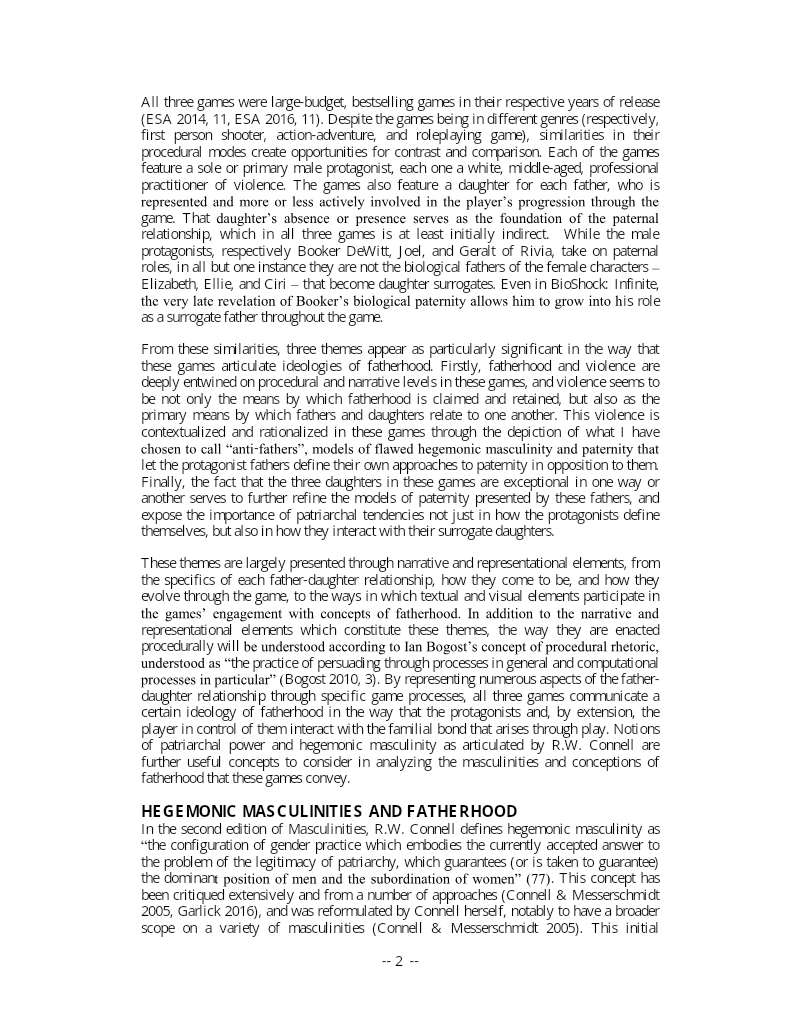
In all three games the protagonist becomes a surrogate father to a daughter who is not biologically his.
This paper examines fatherhood and masculinity across three acclaimed games, BioShock: Infinite, The Last of Us, and The Witcher 3: Wild Hunt, through close reading and attention to procedural rhetoric. Its central concern is how each game's narrative and mechanics reinforce, restore, or challenge patriarchal authority. In each case the protagonist is a middle-aged, white professional of violence who becomes a surrogate father to a daughter who is not biologically his, and violence functions as the primary means by which that paternal bond is claimed and sustained.
The analysis finds that violence is the framing device through which the games reconcile hegemonic masculinity with the breadwinner role. Each game also positions an "anti-father" (Comstock, David, and the Bloody Baron) defined by excessive, inward-directed violence and by community leadership, whose failures clarify what acceptable paternity looks like. The author concludes that the distance drawn between protagonist and anti-father, combined with the consecration of fatherhood through violence, tends to reinforce patriarchal models rather than invite critical reflection.
The three games diverge in meaningful ways. BioShock: Infinite shifts patriarchal authority from Comstock to Booker, while The Last of Us restores Joel's control through violence and deception at its ending. The Witcher 3 mounts the strongest challenge to hegemonic masculinity, most visibly through the botchling ritual that complicates the Bloody Baron's villainy and through Ciri's considerable independent agency, which produces a more equitable father-daughter dynamic. Elizabeth is largely utilitarian and subordinate, and Ellie occupies a middle position between these models.
The study's broader argument is that small differences in representation and procedure can produce markedly different outcomes regarding patriarchy. It concludes by calling for further critical analysis of how games engage with fatherhood and masculinity.
DiGRA · 2022
Game Developers Conference · 2020