
DiGRA
The Digital Games Research Association: the international association of academics and professionals who study digital games. Its Digital Library holds the proceedings of the DiGRA conferences since 2002.
Documents
Designing a Game to Model Consumer Misbehavior
The document proposes a novel application of game design theory to create a computer game specifically for modeling consumer misbehavior in marketing research.
- The paper proposes a graphical, single-player game as a controlled, ethical way to study consumer misbehavior, a largely emotion-driven phenomenon that is hard to examine through self-reports, direct observation, or role-play.
- The design relies on real-time constraints, a clear winning state, and deliberately withheld information or feedback to induce stress and frustration that may provoke misbehavior.
- Emotionally responsive, context-specific non-player character dialogue is intended to sustain realism, while strong immersion and player control are meant to keep participants engaged.
Peep-Boxes to Pixels: An Alternative History of Video Game Space
"Peep-Boxes to Pixels: An Alternative History of Video Game Space" posits that the evolution of video games is best understood through the concept of "space" rather than purely economic drivers.
- Philip Sharp argues that video game arcades arose from the convergence of leisure practices, technological innovation, and cultural identity rather than a single line of technical progress, with roots in nineteenth-century optical toys such as Dutch peep-boxes and Japanese magic lanterns, plus pinball and pachinko.
- Sharp contends Japan absorbed Western mechanical and optical devices and framed them as commercial leisure spaces, a pattern he sees continuing in modern arcades, while Japan's arcade and pachinko culture endured in contrast to the American shift toward home gaming and family entertainment centers.
- The report situates arcades within a recurring history of moral panic over amusement spaces, citing American pinball bans as an early stigma that anticipated later reactions to video game arcades.
Temporal Frames: A Unifying Framework for the Analysis of Game Temporality
This document proposes "temporal frames" as a formal analytical framework for understanding the multifaceted nature of time in games.
- Games rarely operate within a single temporal frame; the authors identify four recurring frames (real-world time, gameworld time, coordination time, and fictive time) that often coexist or succeed one another, and meaningful analysis depends on identifying each and how they interact.
- The paper critiques the familiar real-time versus turn-based binary as obscuring distinct temporal phenomena produced by frame interactions, and reconceives both as interactions between frames rather than fixed categories.
- Sequential and embedded arrangements of temporal frames generate temporal anomalies such as temporal bubbles, warping, and non-uniform temporality, illustrated with cases from Final Fantasy XII, Animal Crossing, Civilization, and Grand Theft Auto III.
The Lambent Reactive: Exploring the Audiovisual Kinesthetic Playform
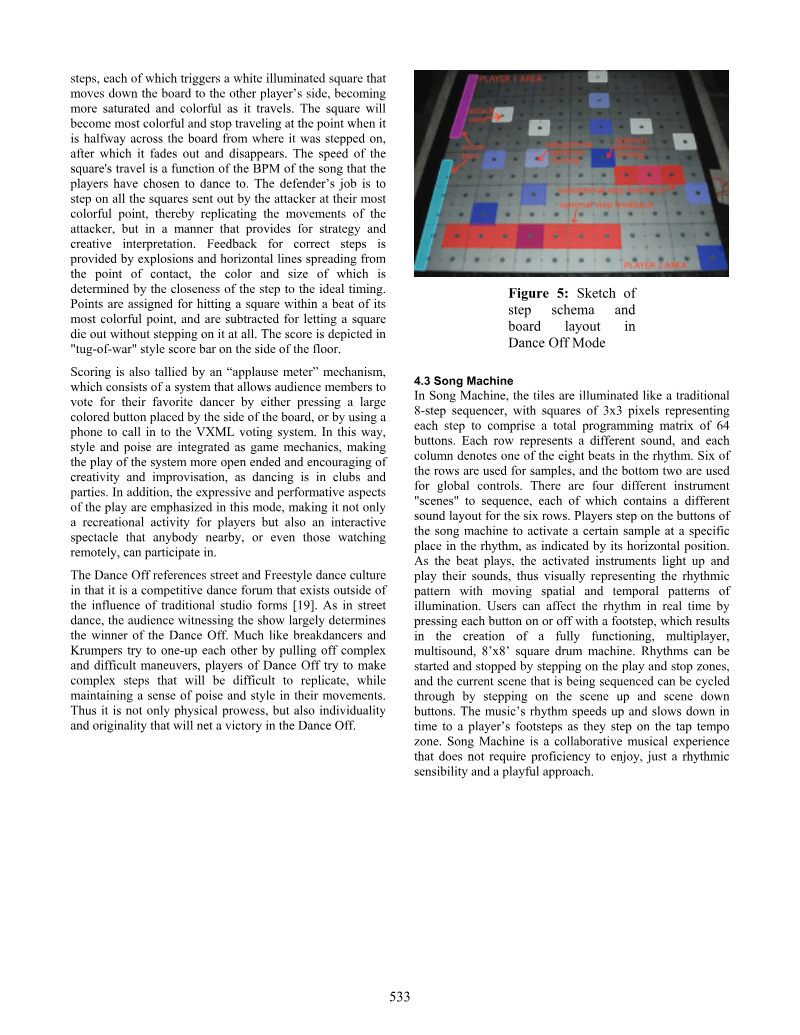
The Lambent Reactive project explores the design of multisensory immersive dance environments by integrating interactive audiovisual and kinesthetic elements.
- The central thesis is that fusing auditory, visual, and kinesthetic feedback in a single interactive space produces a more rewarding and flow-inducing play experience than any single modality alone.
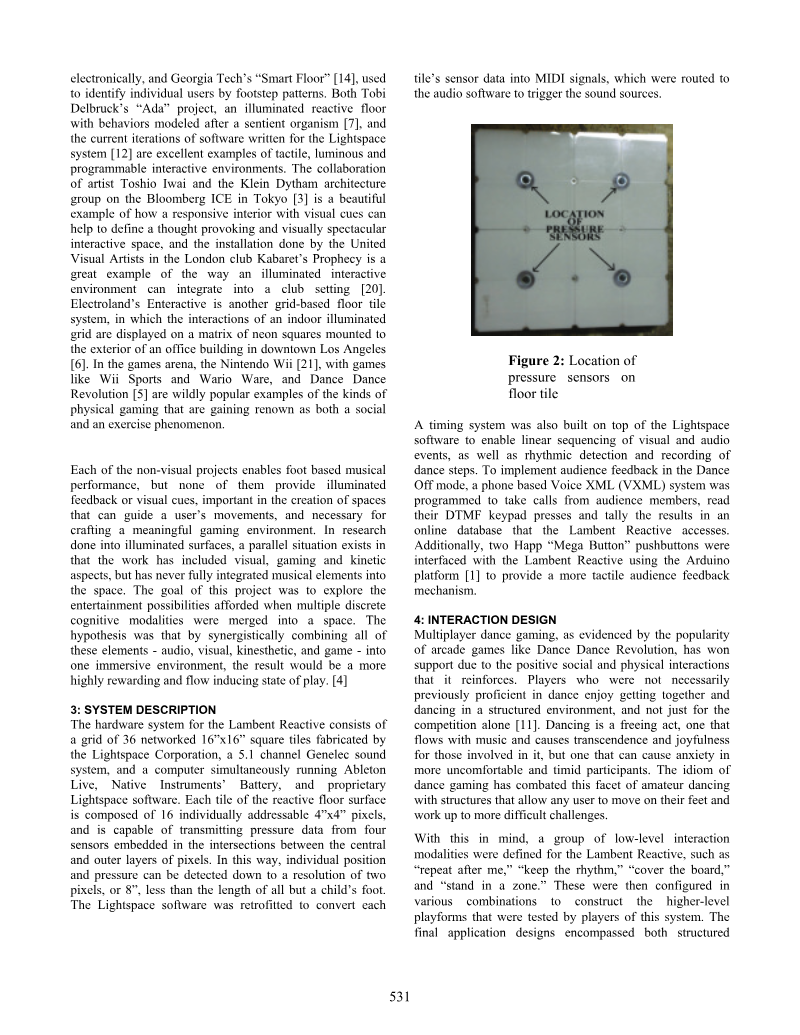
- The Lambent Reactive uses a 36-tile networked floor of pressure-sensitive, individually addressable light-emitting tiles, paired with a 5.1-channel speaker system and music software, with pressure detection down to roughly two pixels (8 inches).
- Pressure data is converted into MIDI signals to trigger sound, tying each footstep's location and force directly to musical output.
The Impact of Experience: The Influences of User and Online Review Ratings on the Performance of Video Games in the US Market
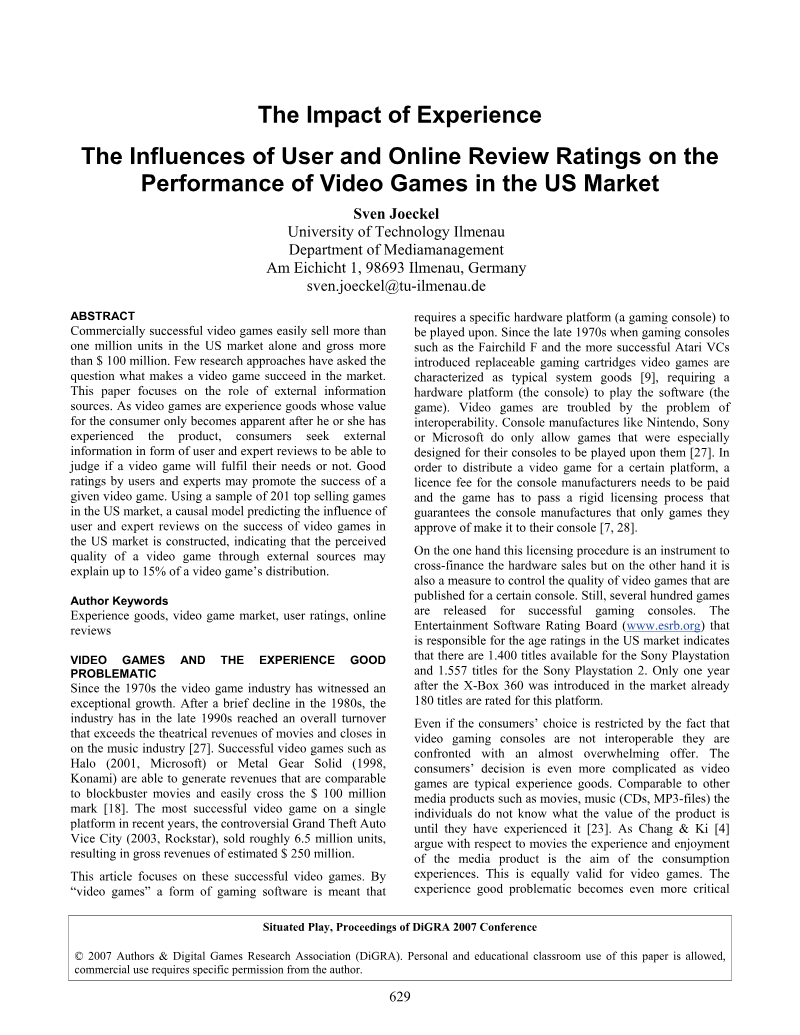
This analysis examines the influence of user and online review ratings on the economic performance of top-selling video games within the US market between 1995 and 2005.
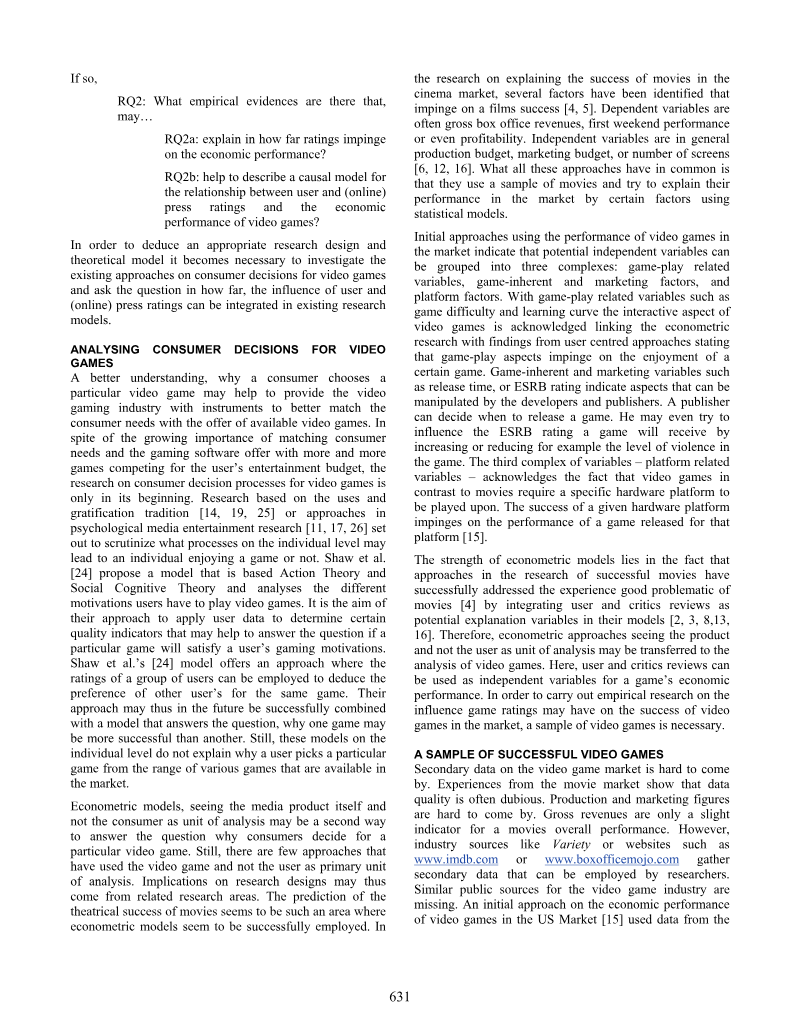
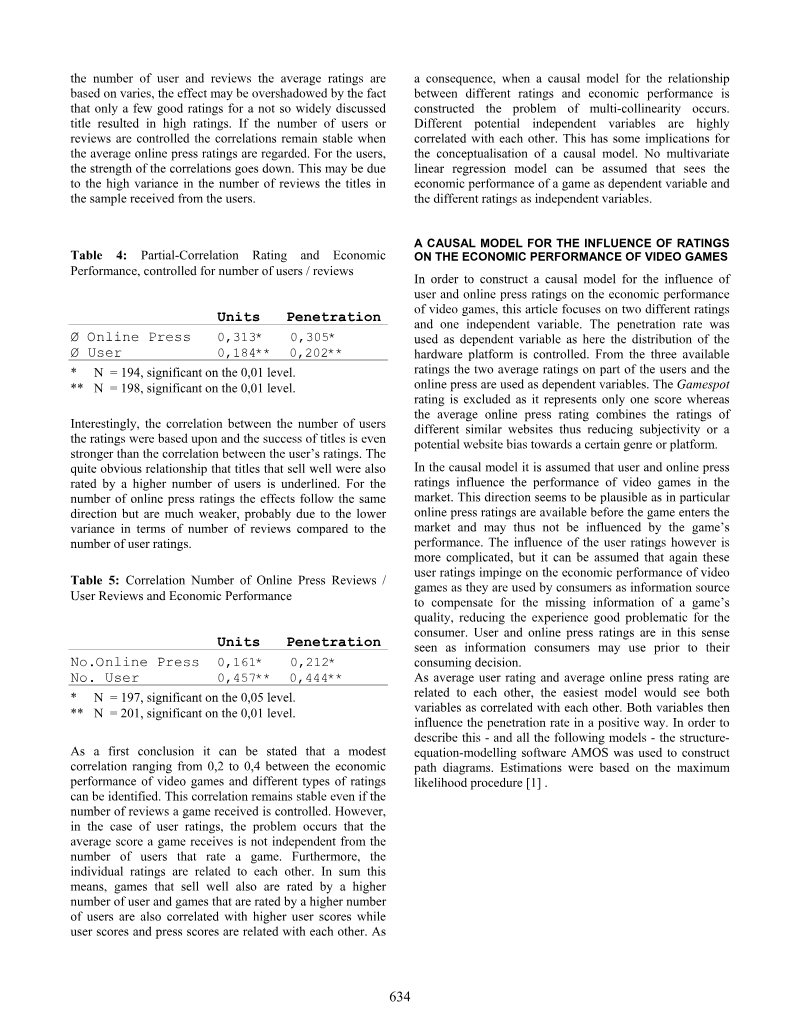
- Ratings show a moderate positive relationship with sales, with Pearson correlations of roughly 0.26 to 0.36, and user ratings and online press ratings are the strongest predictors.
- User and online press ratings both load onto a latent perceived-quality construct, which explains about 13 to 15 percent of the variance in penetration rate, with a standardized direct effect of 0.39.
- High ratings do not guarantee commercial success, as many critically acclaimed titles failed to reach one million units sold.
The Unbound Network of Product and Service Interaction of the MMOG Industry: With a Case Study of China
The MMOG industry is a rapidly expanding global sector, projected to reach $13 billion by 2011, with Asia (excluding Japan) dominating over half of the market.
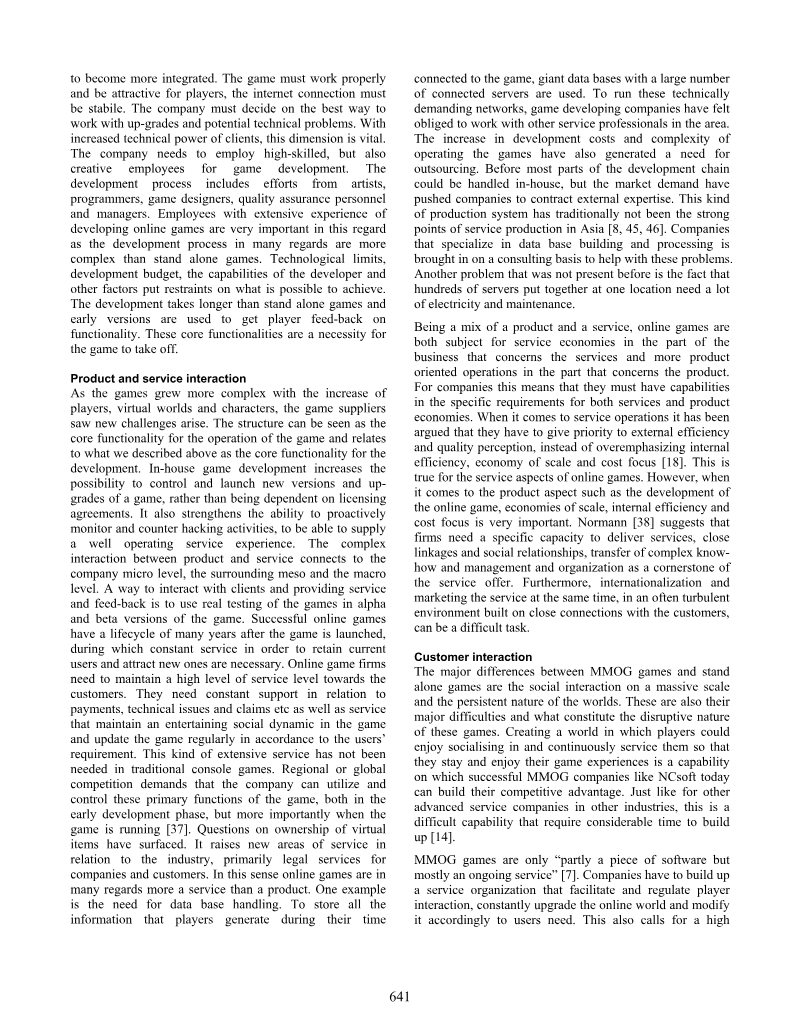
- The MMOG industry is best understood as an 'unbound network' of tightly interdependent relationships spanning technology infrastructure, outsourced development, and continuous customer service, so studying individual firms in isolation cannot fully explain competition.
- The Asian online game market was reportedly worth $3.4 billion in 2005 and projected to reach $13 billion by 2011, with Asia outside Japan accounting for more than half of the market.
- Chinese online game companies built their competitiveness on cost-efficient customer service, extensive distribution such as point-card sales through internet cafés, and early reliance on licensed foreign titles, financed largely through venture capital and stock market listings.

The Contextual Game Experience: On the Socio-Cultural Contexts for Meaning in Digital Play
This paper introduces a comprehensive contextual model for understanding game experiences, arguing that previous models, such as the SCI model of gameplay immersion, are insufficient to capture the full range of meaning in digital play.
- Frans Mäyrä argues that the SCI model of gameplay experience, which centers on immersion during active play, is insufficient for capturing the full range of how people encounter digital games.
- The proposed contextual game experience model draws on Richard Johnson's "Circuits of Culture" framework from cultural studies to situate play within layered social, cultural, and historical contexts.
- A game's significance, on this view, extends beyond its formal rules and core gameplay to include production conditions, social relations, personal histories, and wider societal values.
People, Places, and Play: A Research Framework for Digital Game Experience in a Socio-Spatial Context
This research framework, "People, Places, and Play," posits that digital game experience is profoundly shaped by socio-spatial contexts, challenging the notion of gaming as an inherently isolating activity.
- Gaming is argued to be inherently social, and existing models of game experience underweight the social processes that shape enjoyment, performance, and social contact.
- The framework draws on social psychology, including arousal-based and evaluation-apprehension mechanisms, to argue that the presence of others (co-playing, spectating, or the physical setting) meaningfully alters play rather than producing isolation.
- Four sociality characteristics are proposed as key dimensions for analysis: co-location, monitoring, communication, and relationship.
The Problem of Other Players: In-Game Cooperation as Collective Action
This paper examines the evolution of collaborative relationships in game design, proposing a typology of player interactions and arguing that certain game designs function as continuous experiments in collective action.
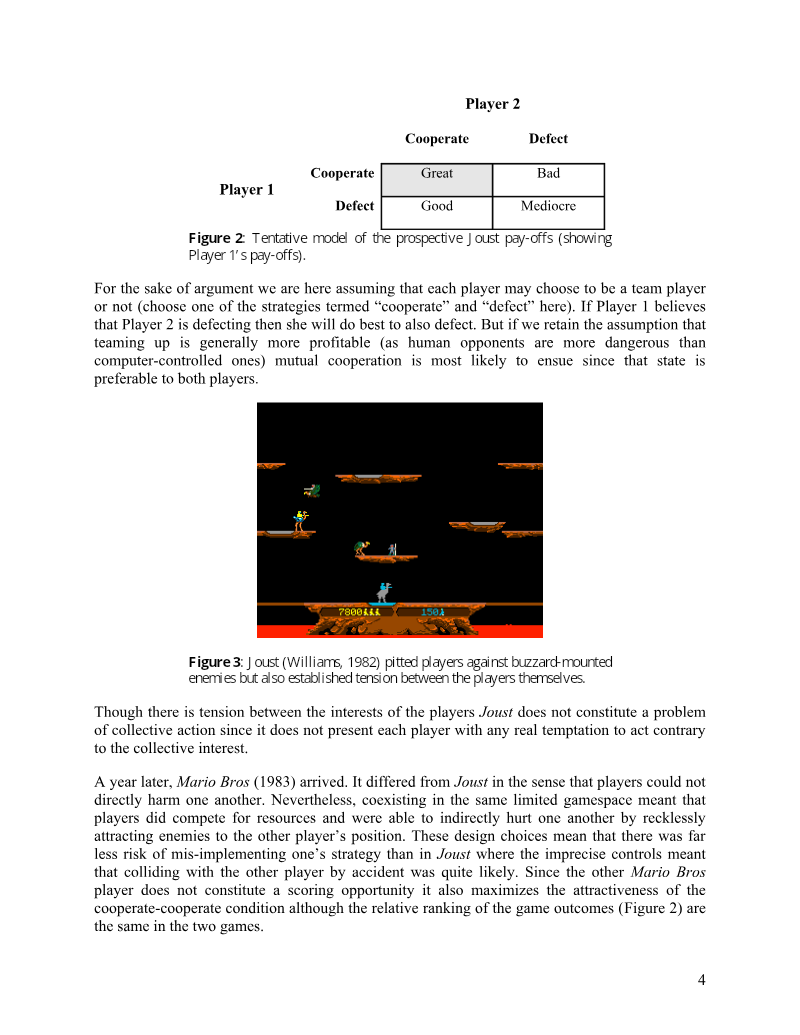
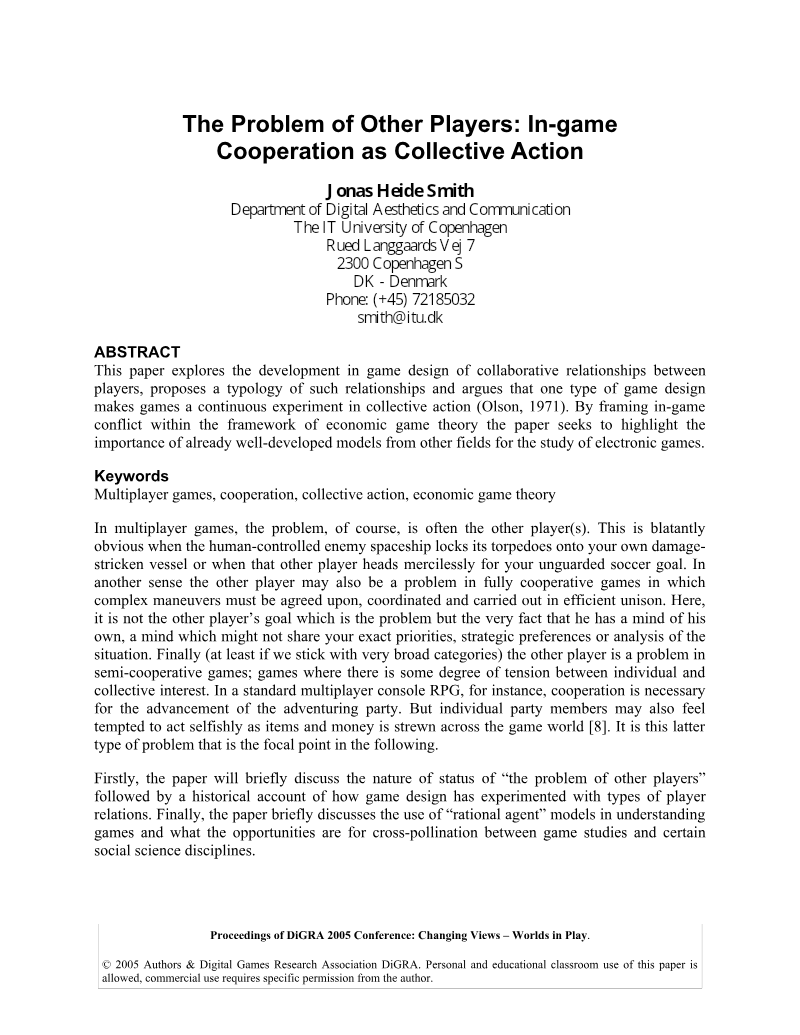
- The paper's central thesis is that the "problem of other players" in multiplayer games can be analyzed as a structure of collective action using economic game theory and the frameworks of Mancur Olson and Elinor Ostrom, rather than treated merely as an obstacle.
- It proposes a three-part typology of multiplayer games: cooperative games with exactly aligned interests, semi-cooperative games where collective and individual goals partly diverge, and zero-sum competitive games.
- Gauntlet is identified as a pivotal arcade design that introduced a genuine collective action problem, since shared progression depends on cooperation while individual resource collection tempts defection.

Opening the Production Pipeline: Unruly Creators
This paper examines the evolving relationship between game developers and fan content creators, focusing on the Australian developer Auran and its train simulation game, Trainz, from mid-2000 to 2004.
- The paper argues that fan creator labour in games cannot be dismissed as exploitation of unknowing fans, since participants are aware of the arrangement and engage as sophisticated practitioners, making entanglements between commercial and non-commercial activity unavoidable.
- Auran, an Australian PC developer, adopted third-party fan collaboration on Trainz (2000–2004) largely as a contingent response to weak sales and rising art production costs rather than as a deliberate long-term strategy.
- Auran integrated fan-made content into official releases, including Ultimate Trainz Collection (2002) and Trainz Railroad Simulator 2004, where 35 creators contributed content to the 2004 CD release, producing high-quality assets.

Game, Motivation, and Effective Learning: An Integrated Model for Educational Game Design
This document proposes an integrated model for designing educational games that effectively leverage motivation and learning.
- Educational games can produce intrinsically motivated learning through a chain of play leading to flow, flow increasing motivation, and motivation supporting learning, but this chain is not automatic.
- Players in a flow state rarely reflect on what they are learning, so the authors argue reflection must be embedded within gameplay so learning happens inside the immersive 'magic circle' rather than interrupting it.
- The framework integrates Keller's ARCS model (attention, relevance, confidence, satisfaction), Csikszentmihalyi's flow theory, Norman's seven requirements for effective learning environments, and Lepper and Malone's principles of challenge, curiosity, control, and fantasy.
The Nip and the Bite
Darshana Jayemanne argues that the cybernetic theory of play developed by Gregory Bateson and Anthony Wilden offers a productive framework for studying videogames as complex open systems in dynamic relation to players.
- Darshana Jayemanne applies non-mechanistic cybernetics (Gregory Bateson and Anthony Wilden) to videogames, treating them as complex open systems in dynamic relation with their players.
- Bateson's concept of the "nip" in animal play-fighting, a gesture resembling a bite that metacommunicates "this is play," serves as the paper's central analogy for how games signal their own fictional framing.
- Wilden's distinction between analogue and digital communication underpins the framework, with primary digitalisation (the nip) and secondary digitalisation (negation and the emergence of a subject) describing how meaning and selfhood arise.
Do you work at DiGRA? Get a free report of how these documents are read and cited here.