
DiGRA
The Digital Games Research Association: the international association of academics and professionals who study digital games. Its Digital Library holds the proceedings of the DiGRA conferences since 2002.
Documents
The Pleasure of the Playable Text: Towards an Aesthetic Theory of Computer Games
The document proposes an aesthetic theory of computer games, arguing that the prevailing focus on game poetics (form and structure) should be supplemented by an analysis of aesthetics, specifically how players engage with games and the pleasures derived from them.
- Georg Lauteren argues that the dominant poetics-based study of computer games should be supplemented by an aesthetic theory centred on pleasure: how players use games, what they enjoy, and what gratifications they experience.
- The paper frames computer games as "playable texts", combining their status as mediated sign systems that gain meaning through intertextual culture with their structure as rule-based, competitive activities in Johan Huizinga's sense.
- Lauteren proposes three analytical levels of pleasure: psychoanalytical, social, and physical, drawing on Laura Mulvey, John Fiske, and Roland Barthes.
Playing and Learning in Multi-User Virtual Environments
This study examines how 46 sixth-grade students in Los Angeles perceived two science-oriented multi-user virtual environments (MUVEs), River City and Whyville, after using both as part of a curriculum on communicable diseases spanning late 2003 and early 2004.
- River City, a closed 3D simulation of a nineteenth-century town, was rated far more educational for learning about disease (M=4.52) than Whyville, an open-access cartoonish community with over 800,000 registered users (M=2.96).
- Students preferred Whyville for communicating with real peers (M=4.44 versus 2.68 for River City's programmed residents), yet acknowledged that chatting with River City residents was more beneficial to their learning.
- Students felt a stronger sense of belonging in Whyville (M=4.05 versus 3.40), describing it as feeling like residents rather than guests, while River City offered a far more authentic sense of scientific inquiry (M=4.42 versus 2.47).
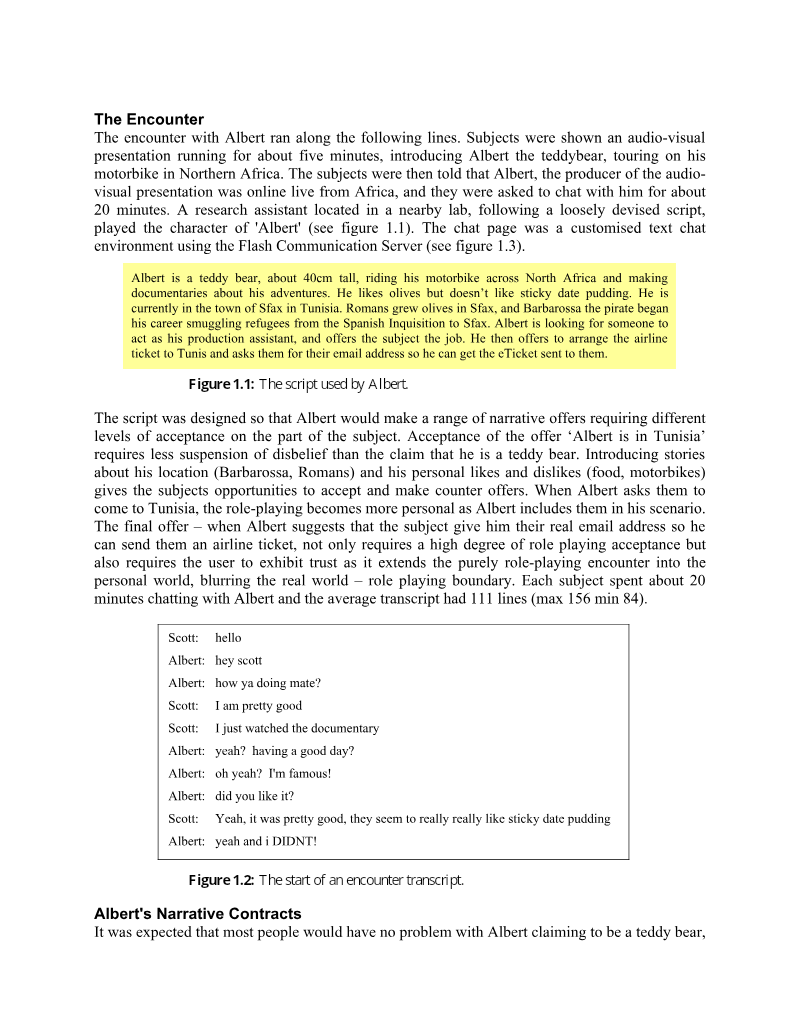
Albert Goes Narrative Contracting
This study investigates the relationship between narrative contracting behavior and player enjoyment and engagement in role-playing games, drawing parallels between improvisational theatre principles and online gaming interactions.
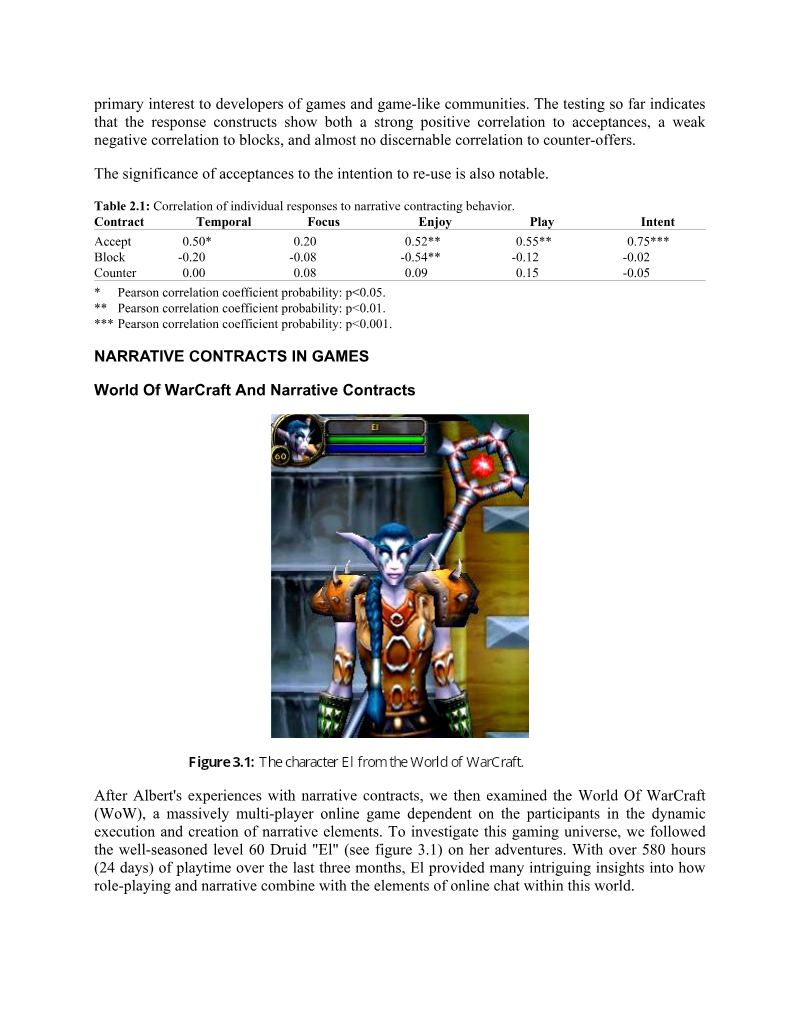
- Acceptance of a player's narrative offer shows the strongest association with enjoyment, playfulness, and intent to return, with the largest correlation to intent to revisit (r = 0.75, p<0.001).
- Blocks show only a weak negative correlation with enjoyment and little relationship to other fun measures, while counter-offers show almost no discernible correlation with any response.
- The authors frame conversational moves in role-playing as narrative offers that can be accepted, blocked, or countered, a concept borrowed from improvisational theatre.
The EverQuest Speech Community
The EverQuest Speech Community paper investigates the nature of linguistic interaction within the multiplayer online game EverQuest, aiming to define the characteristics of speech communities in such virtual environments.
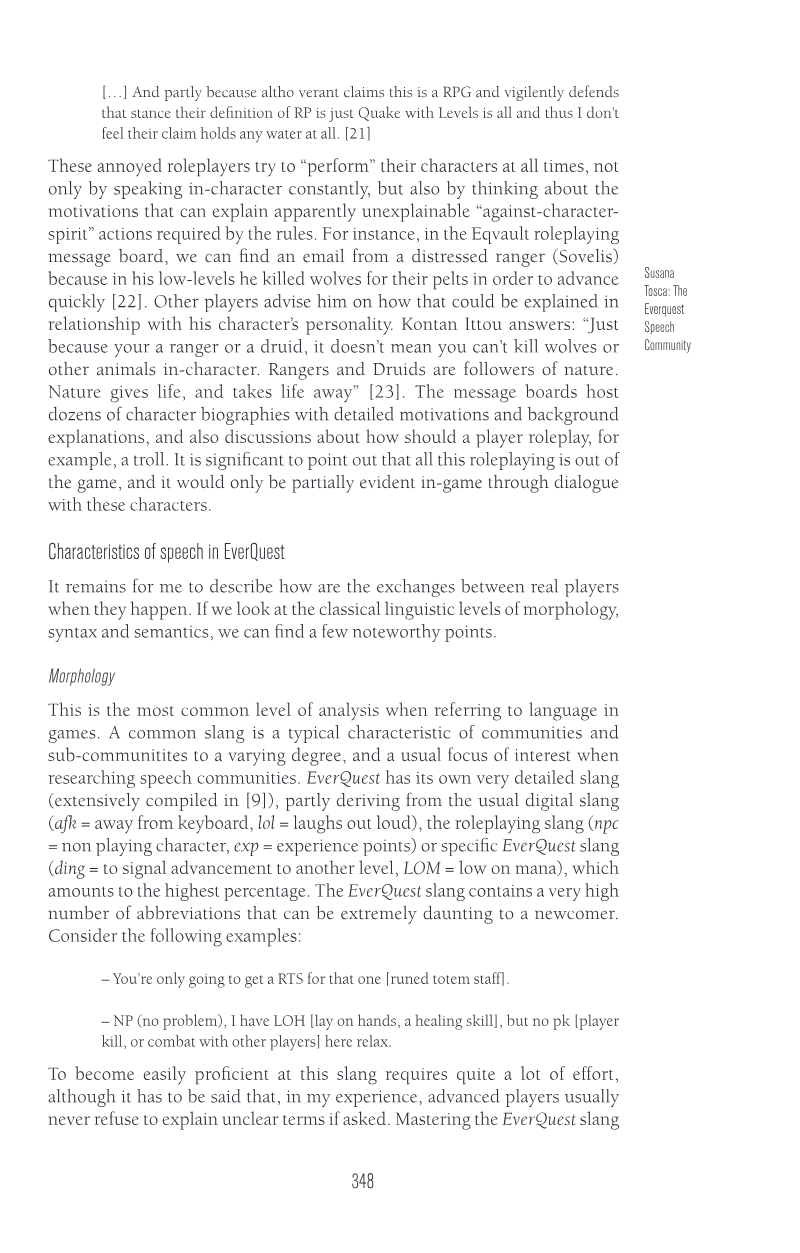
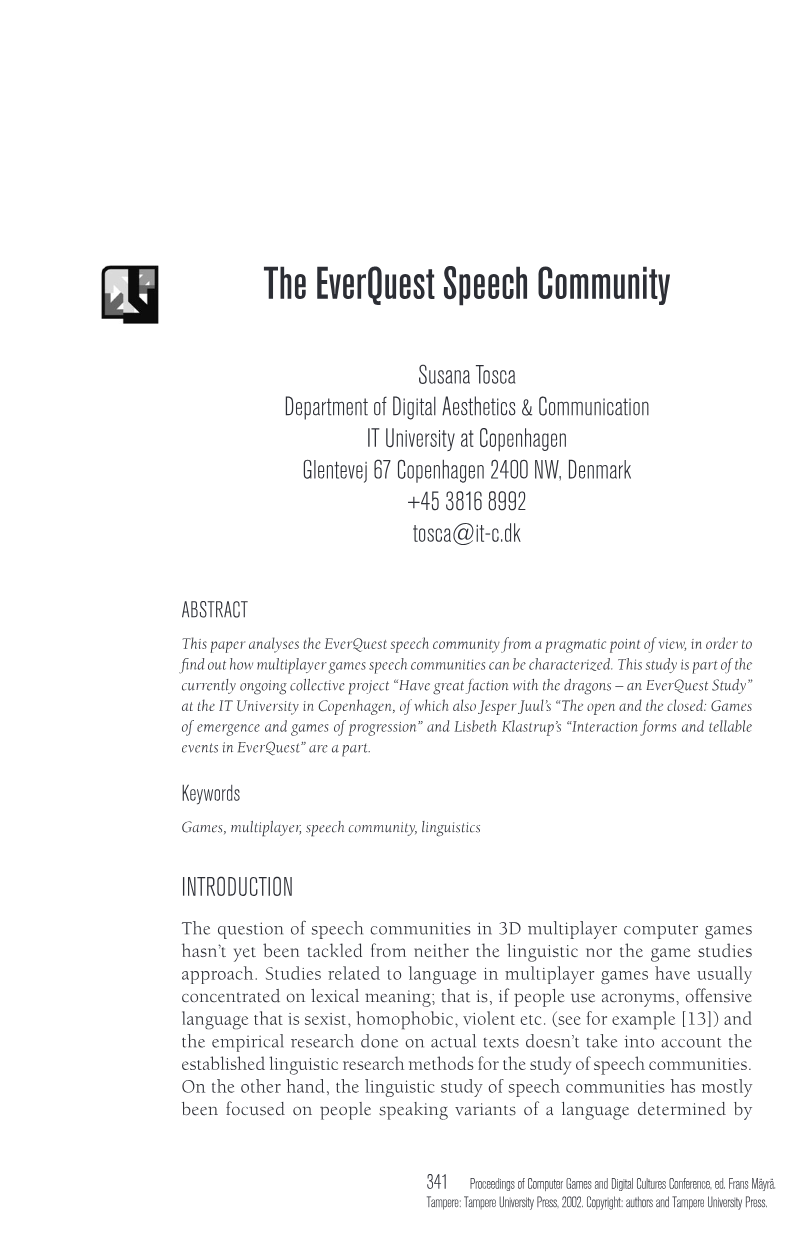
- Susana Tosca argues EverQuest's player base is a genuine speech community, applying Erickson's six criteria (membership, relationships, commitment, shared values, collective goods, duration) and Hymes's SPEAKING framework to text-based in-game interaction.
- The game studied had roughly 98,000 peak concurrent users and about 400,000 players, and was treated as a stable, context-bound community whose linguistic norms are shaped by its fictional gameworld.
- Field research found most players were "powerplayers" focused on character advancement rather than roleplay, so the performative speech the framework anticipated largely failed to materialize.
The Open and the Closed: Games of Emergence and Games of Progression
The document proposes a conceptual framework for analyzing computer game structures, differentiating between "emergence" and "progression" as fundamental design principles.
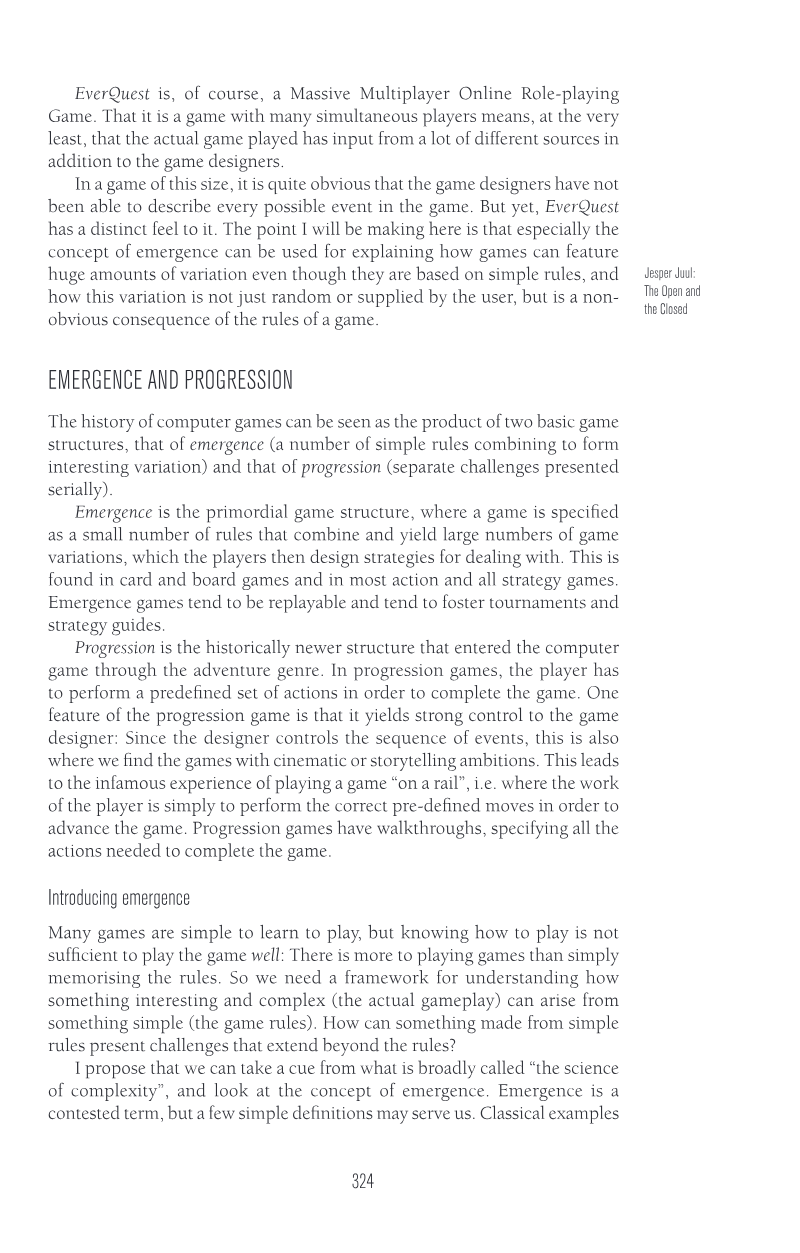
- Juul distinguishes two structures for presenting challenge: emergence, where a small set of simple rules combines to produce large variation, and progression, where challenges are introduced serially and their solutions are explicitly specified by the designer.
- Most computer games blend emergent and progression structures, and the variation found in complex games is a systematic, non-obvious consequence of their rules rather than mere randomness or player input.
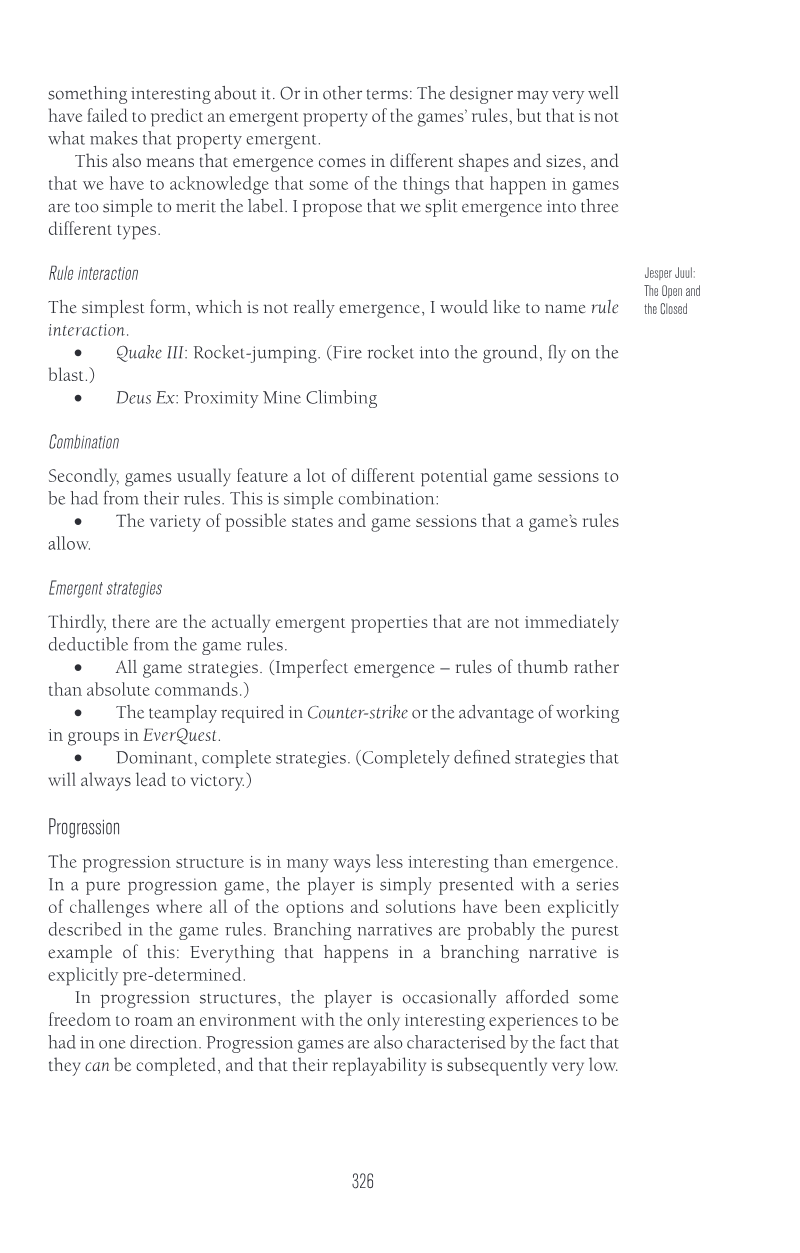
- Emergence is split into three types: rule interaction (e.g., rocket-jumping in Quake III, proximity mine climbing in Deus Ex), combination (the space of possible states a rule set permits), and emergent strategies (not immediately deducible from the rules, including rules of thumb and dominant strategies).
Interaction Forms, Agents and Tellable Events in EverQuest
This paper proposes a framework for analyzing interaction forms and agents in virtual worlds, specifically using EverQuest as a case study.
- The paper proposes an analytical framework for virtual worlds built on four basic agents (players; NPCs and informative objects; manipulable objects; world rules) and four basic interaction forms (navigation, manipulation, social interaction, information retrieval).
- The framework is presented as a work in progress: its in-depth empirical analysis of EverQuest (released 1999) is reserved for later publication.
- The author argues that existing definitions of interactivity are too vague to be analytically useful, and situates the framework within Jensen's three paradigms of interactivity and the ludology-narrative debate, claiming virtual worlds contain elements of all of them at once.
Representing Users in the Design of Digital Games
The document examines the strategies for representing users in digital game design, contrasting the traditional "supplier-driven" artistic approach with a "consumer-driven" model emphasizing user research.
- Digital game designers typically represent their users implicitly rather than through direct engagement, and this tacit approach, often shaped by designers' own tastes, can embed gender bias into game design.
- The study's Irish interviews covered digital game companies that were almost entirely male and targeted young men aged roughly 15 to 40, with industry factors such as risk-averse publishers, console manufacturers, and skilled-labour shortages shaping game types and design priorities.
- In the central case study of the fictional online multiplayer strategy game from games.inc, launched in Germany in December 2001 with about 1,000 subscribers, designers projected their own preferences as technologically literate male gamers aged 25 to 40 instead of conducting formal user research.
A Touch of Medieval: Narrative, Magic and Computer Technology in Massively Multiplayer Computer Role-Playing Games
The document, "A Touch of Medieval: Narrative, Magic and Computer Technology in Massively Multiplayer Computer Role-Playing Games," analyzes the complex interplay between advanced computer technology, medieval fantasy narratives, and emergent player communities within Massively Multiplayer Online Role-Playing Games (MMORPGs).
- By late 2001, Ultima Online had roughly 250,000 subscribers while EverQuest had between 400,000 and 700,000, signalling the large scale of the MMORPG phenomenon.
- Stern argues that dominant MMORPGs, controlled by a few large corporations, operate as indefinitely continuing services rather than finishable products, which defers narrative resolution indefinitely.
- Backstories and non-player characters are largely redundant to play: players tend to ignore backstories and treat NPCs mainly as dispensers of information, which Stern presents as evidence that conventional narrative approaches fail for software-narrative hybrids.
Killing Like a Girl: Gendered Gaming and Girl Gamers' Visibility
"Killing Like a Girl: Gendered Gaming and Girl Gamers' Visibility" examines the persistent invisibility of female gamers despite their significant historical and ongoing participation in the gaming landscape.
- Gaming is often framed as a male, violent, antisocial pastime, but Bryce and Rutter argue that female participation is substantial yet systematically overlooked in both academic and industry discourse.
- Survey data cited in the paper show 43 percent of US gamers were female (Interactive Digital Software Association), and European Leisure Software Publishers Association estimates valued the market at roughly £5.8 billion.
- The authors contend that text-based content analyses labelling games as stereotypically gendered overgeneralise from unrepresentative samples, neglect genre diversity and audience reception, and wrongly assume representation deterministically shapes consumption.
Do you work at DiGRA? Get a free report of how these documents are read and cited here.