
DiGRA
The Digital Games Research Association: the international association of academics and professionals who study digital games. Its Digital Library holds the proceedings of the DiGRA conferences since 2002.
Documents
The Spontaneous Playfulness of Creativity: Lessons from Interactive Theatre for Digital Games
This paper argues that integrating the theories and practices of improvisational and activist theatre can significantly enhance spontaneous, playful creativity in digital game design.
- The paper argues that improvisational and activist theatre methods can introduce spontaneous, playful creativity into digital game design, shifting developers away from a sole focus on technical topics like facial rendering and AI agents.
- It proposes adapting Uta Hagen's character analysis questions and Stanislavski-inspired "inside out" development to build digital characters from the inside rather than from surface traits.
- It applies Chris Crawford's arithmetic formulation of relationship motivation, along with Keith Johnstone's status-tower and "Lists" exercises, to construct relationship dynamics and generate first-instinct game ideas.
Digital Games for Education: When Meanings Play
"Digital Games for Education: When Meanings Play" explores the intricate relationship between game design and educational outcomes, using the development of "Contagion," a web-based game for 10-15 year olds on contagious diseases, as a case study.
- The authors argue that educational meaning is embedded in every element of a game's design, including character selection, art, narrative, programming, goals, and play itself, not just its subject matter.
- The project Contagion, built in Macromedia Flash for ages 10 to 15, covers four infectious diseases (SARS, West Nile Virus, Avian Flu, and AIDS) and was developed through design-based research at Simon Fraser University and York University.
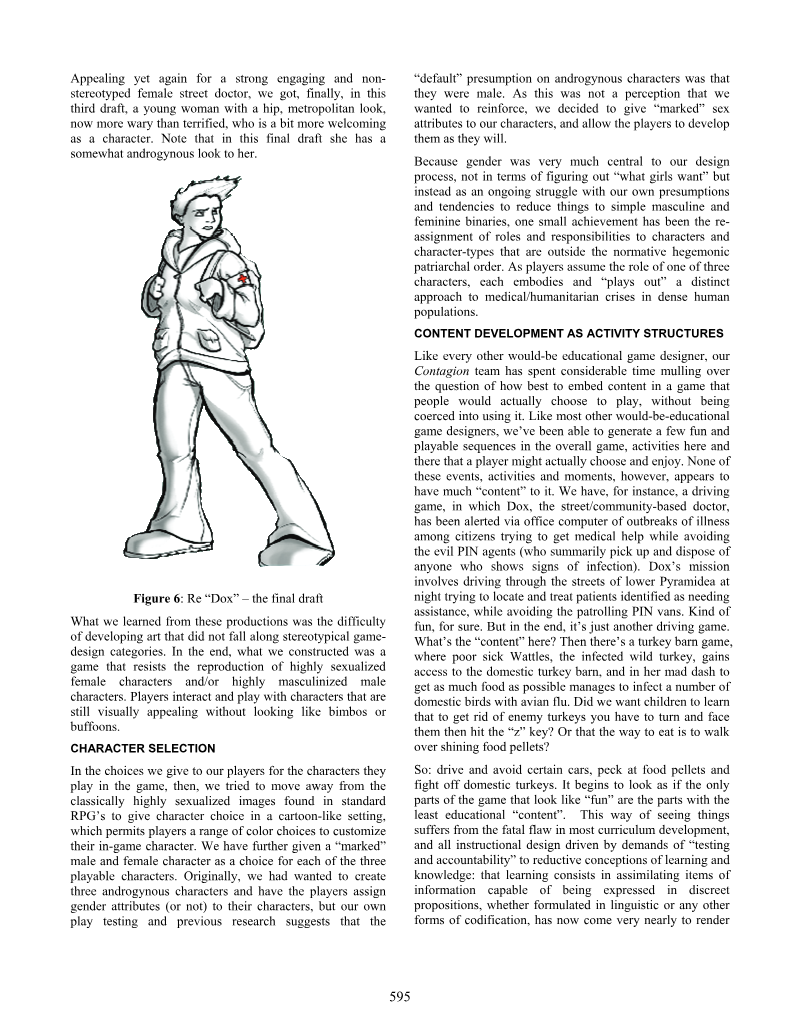
- The authors found that their initial character art and pronoun choices reproduced gender stereotypes, and they revised toward more ambiguous, "marked" characters.
Leaving a Never-Ending Game: Quitting MMORPGs and Online Gaming Addiction
Online game addiction has become a public concern in Taiwan, yet most research and media coverage treats addicted gamers as passive victims.
- Quitting a heavily played MMORPG is best understood as a gradual process over time rather than a single decision, and the factors that drew players into addiction often drive their eventual departure.
- The study's central hypothesis is that existing game-addiction research has focused on diagnostic criteria, personality traits, and structural game features while neglecting how attachment rises, changes, and declines over time.
- Addicted players showed self-awareness: they monitored their own behavior, felt guilt or social disapproval, and sought advice on forums, where suggestions ranged from pursuing other activities to deleting accounts.


Effect of Video Games on Children's Aggressive Behavior and Pro-social Behavior: A Panel Study with Elementary School Students
This panel study investigated the effects of video games on aggressive and pro-social behavior in elementary school students.
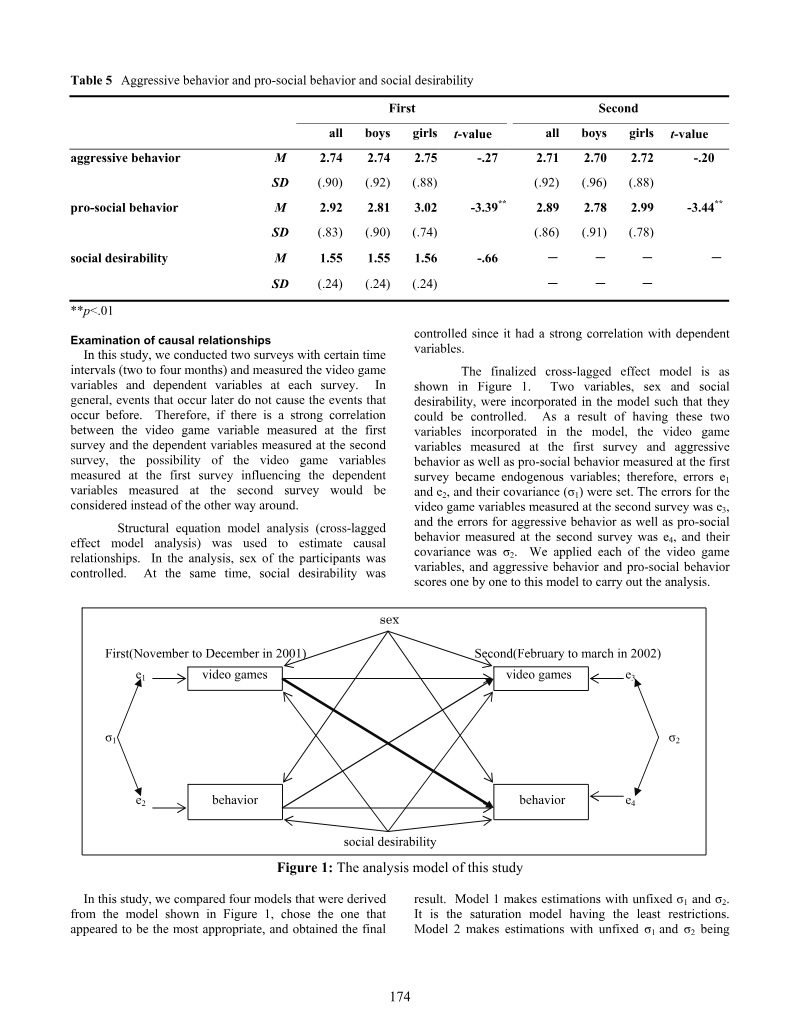
- A panel study of 780 Japanese fifth graders (384 boys, 396 girls), surveyed two to four months apart in late 2001 and early 2002, found no significant effect of video game use or violent content on aggressive behavior, departing from several earlier correlational findings.
- Violent game preference was negatively associated with pro-social behavior for all participants and for boys specifically, and greater weekday play predicted lower pro-social behavior among boys.
- Exposure to pro-social scenes was positively associated with pro-social behavior, while exposure to neither violent nor sexual scenes significantly predicted aggressive behavior.
Cash Trade Within the Magic Circle: Free-to-Play Game Challenges and Massively Multiplayer Online Game Player Responses
Cash trade in free-to-play massively multiplayer online games challenges Huizinga's "magic circle," the notion that play is set apart from real-world economic concerns.
- The study argues that cash trading of virtual items in free-to-play MMOGs shifts players from community members toward consumers, reshaping their norms of fairness, immersion, and self-image within the 'magic circle' of play.
- Focusing on Taiwanese players, who began migrating to free-to-play titles from 2004 onward, the authors estimate that about 20 percent reportedly bought virtual props with cash.
- The analysis codes 1,176 posts from Taiwanese forums such as Gamebase and Bahamut, where critics raise concerns about pay-to-win imbalances, a 'one game, two experiences' divide between paying and non-paying players, and declining community order.
Mobile Gaming with Children in Rural India: Contextual Factors in the Use of Game Design Patterns
This study examines the efficacy of established game design patterns in developing engaging mobile games for children in rural India, a population with limited exposure to technology and significant educational challenges, particularly in English as a Second Language.
- The study tested whether games built with design patterns would be more enjoyable for rural Indian children, and the hypothesis was not supported: pattern use alone did not predict enjoyment.
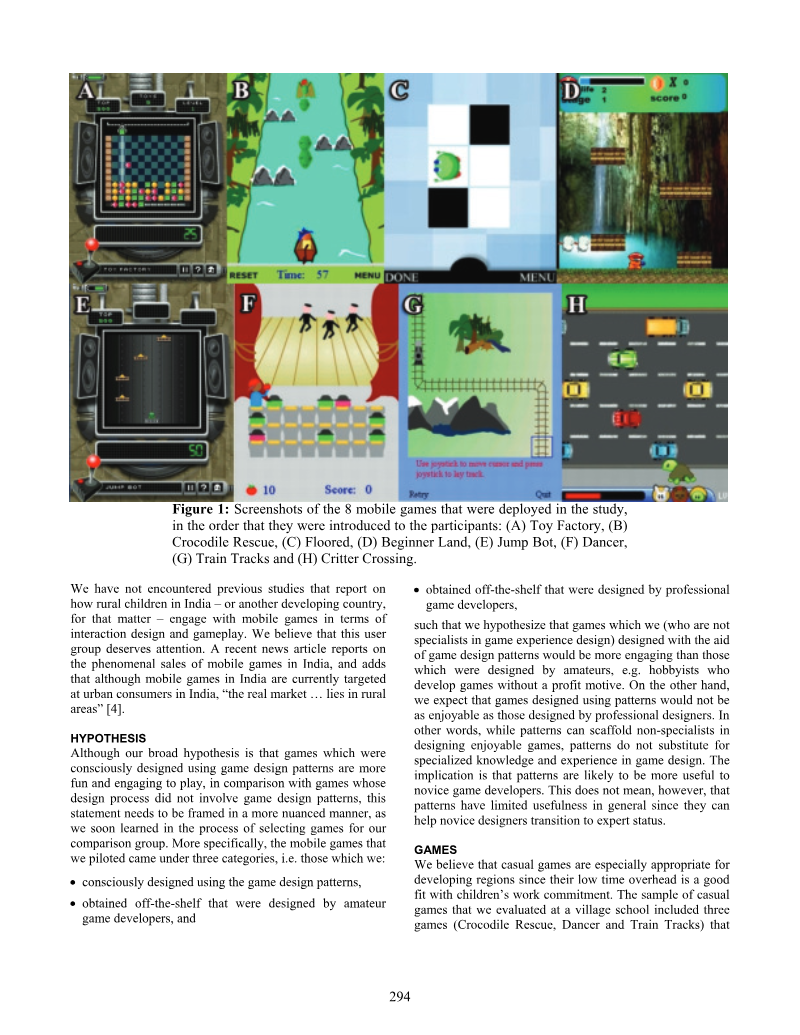
- In a 10-day field study with 24 first- and second-grade children at a rural Indian school, the top-rated games, Floored and Critter Crossing (both 4.5), and Jump Bot (4.1), were not built using patterns, while pattern-based games varied widely from Floored's top score to Crocodile Rescue's 3.4.
- Enjoyment was measured with adapted Fun Toolkit instruments, comparing three pattern-based games against five off-the-shelf titles made by amateur and professional developers.
Gender in Play: Mapping a Girls' Gaming Club
This document presents an ethnographic study exploring the micro-interactions of a girls' gaming club in an elementary school in Toronto, Canada, to understand how boys' privilege and girls' educational disadvantage in video games are maintained.
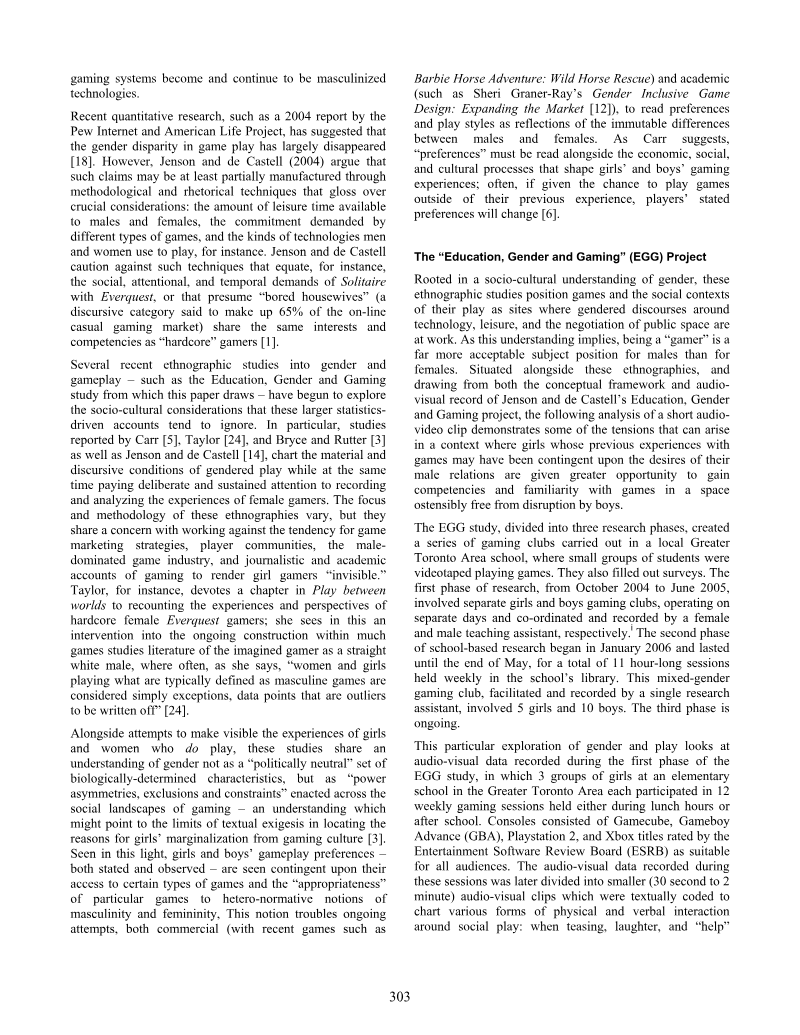
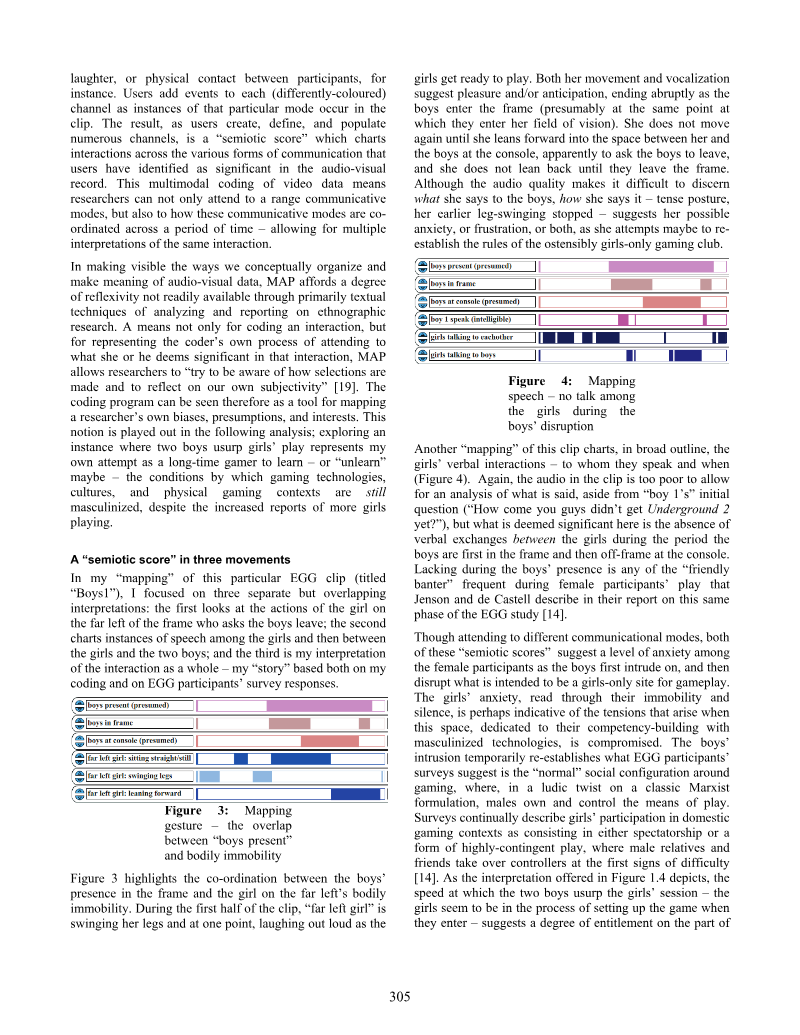
- The study's core finding is that girls' participation in gaming, even in girls-only spaces, is tenuous: in a 30-second clip from a Greater Toronto Area elementary school, two boys' interruption of a girls-only session prompted immobility and silence from the girls, while one girl's gesture effectively invited the boys back into control.
- The authors argue that conventional textual ethnography flattens the multimodal communication involved in such interactions, and they introduce the MAP (Multimodal Analysis Program) tool to chart gesture, posture, speech, and proximity as coordinated "semiotic scores."
- Survey data cited in the paper show female participants typically describe their gaming as spectatorship or play with male relatives, rather than as independent play.
From Gamers to Scholars: Challenges of Teaching Game Studies
Zagal and Bruckman's paper examines the pedagogical difficulties of teaching game studies at the university level, drawing on interviews with twelve instructors in the field.
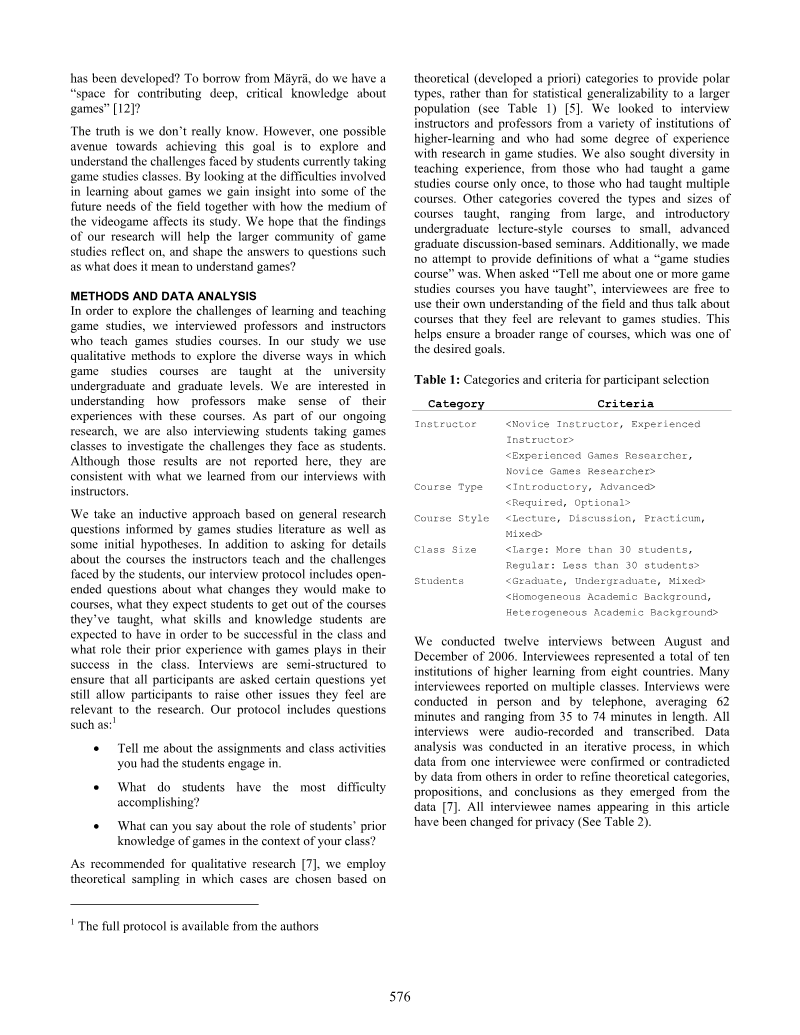
- Students' deep but narrow gaming backgrounds can boost motivation and supply rich analytical material, yet they often impede critical reasoning, as learners cling to genre-specific assumptions, dismiss older titles, and conflate skilled play with analytical insight.
- Instructors report that students resist perspectives that challenge their identity as "gamers," which makes it harder to foster the detached, critical stance that game studies requires.
- The field's relative youth, lack of an established canon, and practical access problems (platform obsolescence, time demands, uneven prior exposure) structurally compound the difficulty of teaching it.
Serious Games in Language Learning and Teaching: A Theoretical Perspective
The document, "Serious Games in Language Learning and Teaching: A Theoretical Perspective," conceptualizes the design of game-based language learning materials through an educational design theory framework.
- The paper is a theoretical, conceptual work (produced under the 'Serious Games on a Global Market' project, 2007–2010) that presents its claims as hypotheses rather than empirically established findings, reporting no quantitative data beyond one cited survey.
- Its core argument is that serious language-learning games can support meaningful communicative language use, drawing on educational design theory, project pedagogy, and social semiotics, and framing language teaching's shift from drill-based structural approaches through cognitive models toward socio-cognitive and communicative paradigms.
- The main empirical anchor is a 2002 SAFT survey of 9- to 16-year-olds, which found children learn about the Internet mainly from friends, then parents, their own experimentation, and teachers last, leading the authors to argue that games should build on children's informal competitive, interactive, and social play.

Play: A Procrustean Probe
"Play: A Procrustean Probe" explores the transformative impact of digital games on play and media consumption through the lens of McLuhan's tetrad.
- The report applies McLuhan's media tetrad as an exploratory lens rather than a rigorous scientific method, arguing that computerization transforms play in ways that challenge prevailing critiques of gaming.
- Against claims by Berger and Putnam that gaming is inherently isolating, the analysis argues that digital games deepen solo play through computational complexity while also enabling large-scale multiplayer interaction, as in MMORPGs.
- The author traces solitary play back through board games, pinball, and solo role-playing books, contending that isolation is a longstanding feature of play rather than a novel digital corruption.
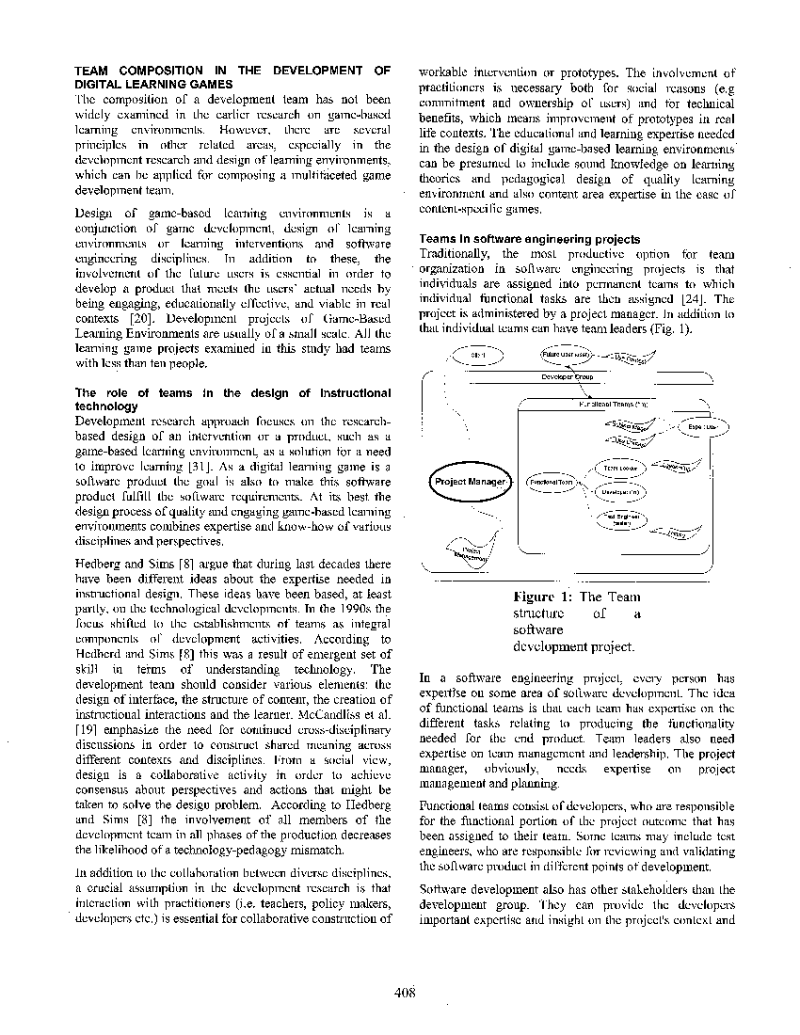
Team Structure in the Development of Game-Based Learning Environments
This study examines optimal team structures and collaborative practices for developing digital Game-Based Learning Environments (GBLEs), advocating for a multidisciplinary, user-driven approach.
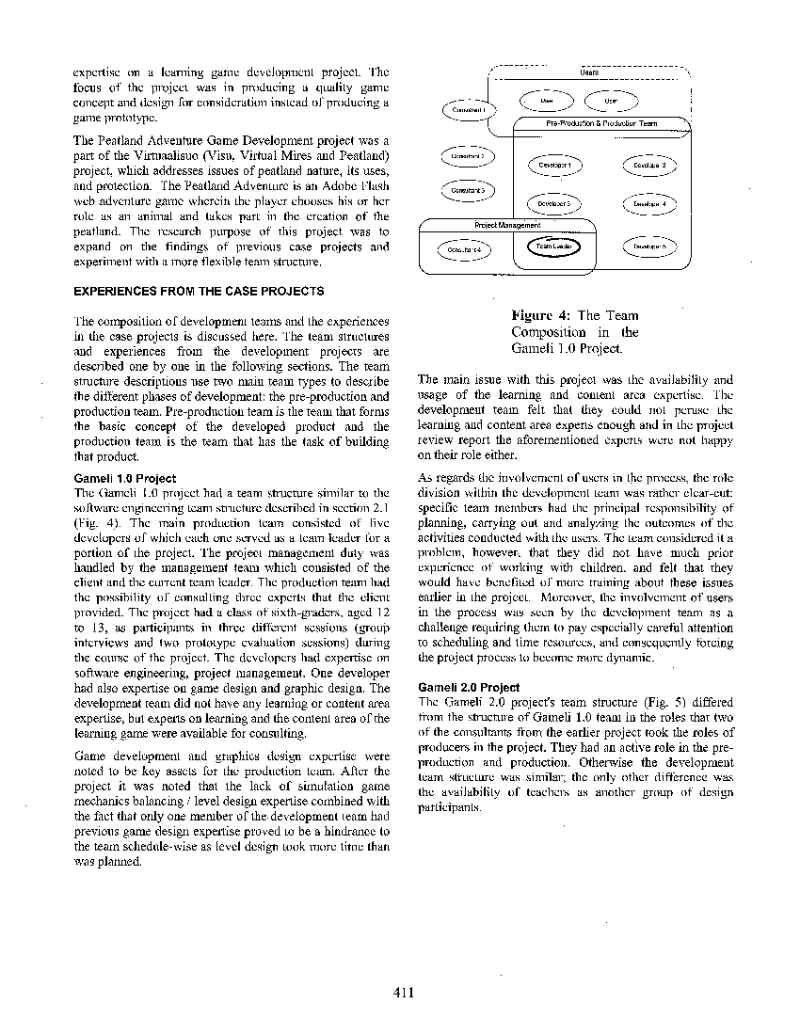
- Learning, content-area, and game-design expertise was frequently insufficient or underused across three case projects (Gameli 1.0, Gameli 2.0, and the Social Responsibility and Peatland Adventure projects), with learning and content experts often relegated to consultancy roles rather than responsible positions.
- The authors propose a general early-stage team structure comprising a management team, pre-production and production teams that include game design and software engineering expertise, and a design partner team representing end users.
- Pre-production is framed as the period for building shared understanding of project goals and common ground for implementing the final product, which underpins the argument for giving learning and content experts substantive roles from the outset.
Gameplay Design Patterns for Believable Non-Player Characters
The document explores gameplay design patterns aimed at enhancing the believability of Non-Player Characters (NPCs) within interactive game environments.
- Believable NPCs depend on players adopting an intentional stance toward them, which requires qualities such as self-awareness, self-impelled action, emotional expression, natural language use, and persistent traits.
- The authors argue that gameplay believability must stay consistent with narrative believability, and they propose new gameplay design patterns, in the format of Lankoski and Björk's existing collection of nearly 300 patterns, to fill the gaps they identify.
- A close case study of Claudette Perrick, a shopkeeper in The Elder Scrolls IV: Oblivion, shows partial believability: she displays initiative and goal-directed responses to theft and a basic sense of self, but fails to react to unwitnessed thefts, ignores physical disruptions, shows no lasting physical consequences, and cannot meaningfully alter her life trajectory.
Do you work at DiGRA? Get a free report of how these documents are read and cited here.