
DiGRA
The Digital Games Research Association: the international association of academics and professionals who study digital games. Its Digital Library holds the proceedings of the DiGRA conferences since 2002.
Documents

Framing the Gamer: A Study of Invented Marginality
This study examines how gamer identity was constructed in the Dutch- and Flemish-speaking games market during the 1990s, arguing that the figure of the male, white, heterosexual gamer was not merely reflected in advertising but actively formed through it.
- Advertising in the Dutch- and Flemish-speaking games market during the 1990s did not merely reflect the male, white, heterosexual gamer but actively constructed that identity, sorting people into 'gamers' and externalizing others.
- The study analyzes all advertisements (not just game ads) across the first five years (1993–1998) of Power Unlimited, a long-running Dutch game magazine, in a three-phase approach combining quantitative coding, qualitative readings, and comparison with a global corpus from the broader HACS project.
- Three patterns summarize the findings: advertising identified hegemony with a particular gamer figure, antagonized non-white figures as dangerous or immoral, and objectified non-male figures as helpless or subservient.
Male Gamers, Identity and Masculinity
This paper, presented at DiGRA 2020, offers preliminary results from a pre-study examining how young male gamers experience the ongoing schism in videogame culture between proponents of more inclusive, diversified games and those who view such changes as a threat to gaming as a traditional subculture.
- The paper is a preliminary pre-study presented at DiGRA 2020, built on focus groups with young male gamers in a single large Western European city rather than on quantitative or market data.
- Its central argument is that male gamers' sense of being the challenged core audience, set against 'masculinity in crisis' narratives, should be understood through processes of inclusion and exclusion shaping masculine identity rather than dismissed as simple hostility.
- The authors treat 'gamer' as a term of identity rather than a descriptive label, and highlight a paradox: gamer culture embraces self-described socially marginal 'underdogs' while strictly policing its boundaries.


ROOK: Urban Play and Data Visualization
Rook is a playful, non-screen data visualization device designed to disseminate air quality information in North Holland.
- Rook is a non-screen, playful data visualization device that displays hourly PM2.5 air quality readings from the Hollandse Luchten citizen sensor network in North Holland as colored mist lit by RGB light.
- The colors follow a green-yellow-red scale derived from EU directive 2008/50/EC, with occasionally menacing red tones intended to invite critical reflection on air quality.
- The authors argue that dashboards and numerical displays are hard for the public to interpret and tend to be experienced individually, whereas physicalized, ludic visualization in public space can foster collective experience and awareness.
Strategies of Anonymity in Game Workers Unite UK
Paolo Ruffino's paper examines Game Workers Unite UK (GWU UK), a labour union founded in January 2019 as the first national branch of the global Game Workers Unite group.
- Game Workers Unite UK, founded in January 2019, is the first national branch of the global Game Workers Unite group and is defined by its techniques for protecting member anonymity: members stay unnamed publicly and total membership figures are withheld to prevent delegitimization.
- Board members take on visible public roles to represent the union and negotiate with employers, and this exposure carries substantial personal risk, illustrated by the October 2019 dismissal of organizer Austin Kelmore from the independent studio ustwo.
- Ruffino frames the anonymity-based approach as both pragmatic and consistent with United Kingdom labour law, though it requires careful preparation.
EVE Online: The Worlds of Wealth and War
This paper examines the distribution of player-owned wealth in EVE Online, a science fiction massively multiplayer game with a player-driven economy, and asks whether veteran players hold a lasting first-mover advantage.
- Wealth in EVE Online is extremely concentrated, with a Gini coefficient of 0.97 across all players and 0.90 among activated players (20+ logged hours), and the top decile holds roughly 98% and 85% of wealth respectively, more concentrated than real-world economies.
- Accumulated playtime is the dominant driver of wealth: logon minutes correlate strongly with wealth (R² of 0.80 for all players and 0.69 for activated players), while account age has only a weak relationship (R² of 0.15 and 0.002).
- The author concludes that early entry confers no durable first-mover advantage, since account age barely predicts wealth once playtime is considered.
Uncovering Machine Vision in Videogames
This study maps how machine vision technologies, including night vision overlays, facial recognition, surveillance cameras, and drones, are represented within videogame virtual environments.
- The study analyzes a corpus of 47 videogame titles featuring at least one of sixteen machine vision technology types, including motion tracking, AR/VR, biometrics, body scanners, and emotion recognition.
- Videogames typically portray machine vision as an objective lens revealing unmediated truth, rarely prompting players to question its reliability.
- Machine vision is framed as a helpful tool when it serves the player, but the tone turns negative when characters become its object of surveillance.
Power Play: Regulatory Frameworks of Esports in Asia and Europe
This paper, presented at DiGRA 2020, examines how regulatory frameworks shape the development of esports across Europe and China, with particular attention to data protection and gambling.
- The paper argues that esports, a global industry driven by multinational companies, lacks any formal global governance beyond promotional bodies and game publishers, leaving cheating, match fixing, doping, and betting largely unresolved.
- The EU's GDPR, in force since 2018, conflicts with esports business practices such as licensing players' personal and biometric data to third parties, and produced fines exceeding €56 million across 91 companies in its first twelve months.
- China's 2019 draft cyber regulations largely mirror GDPR principles but adopt a more permissive consent model, requiring only implied consent for non-sensitive personal information.
Imaginary Platforms: The Neo Geo AES and the Object a of Videogame History
Benjamin Nicoll's paper examines the Neo Geo Advanced Entertainment System, a home console released by SNK in Japan in 1990 and marketed as a "home arcade" capable of reproducing arcade-quality play in the living room.
- The Neo Geo AES, released by SNK in Japan in 1990, was marketed as a "home arcade" that aimed to reproduce arcade-quality play in the living room.
- Benjamin Nicoll argues the arcade-home divide in videogame culture was discursive and psycho-social rather than purely technological.
- Magazine reception of the Neo Geo AES was largely critical despite early enthusiasm describing it as "the future" of videogames.
There's an App For That?: Are Mobile Music Games Serious Educational Tools
A study of 175 iOS music education apps, drawn from an initial pool of 313 candidates, asks whether these mobile serious games deliver the educational benefits commonly attributed to the serious games genre and whether they improve on traditional music teaching tools.
- The study examined 175 iOS music education apps, selected from an initial pool of 313 candidates, to assess whether mobile music games deliver the educational benefits associated with serious games.
- The authors conclude that these apps are useful as supplements to traditional music instruction but fall short as comprehensive educational tools, due to limits in depth, adaptivity, and coverage of broader musical knowledge.
- 132 of the 175 games reach only uni-structural learning outcomes, addressing a single relevant element of learning rather than integrating multiple ideas.
Esports Viewer Perspectives on Cheating in Competition
This study examines how esports viewers perceive different forms of cheating in competitive gaming, a topic that has received little scholarly attention despite the high financial and reputational stakes of professional play.
- The study analyzed 1,321 cleaned qualitative survey responses collected in May and June 2017 by the Esports Integrity Coalition, distributed via member organizations' mailing lists, social media, esports news outlets, and online forums.
- Viewers showed a low tolerance for "cheating to win" (gaining an advantage through hacks or doping), which the authors partly attribute to viewers' own experiences of cheating in ordinary online matches.
- Viewers were considerably more accommodating toward "cheating to lose" (deliberately throwing matches via match-fixing or bribery), especially when framed as a strategic choice or a response to career pressures.
Monetization and Gamification in Twitch Game Live Streaming
This paper examines how live streamers on Twitch.tv generate income, and how they increasingly draw on game-like interfaces, competitions, and concepts, a practice it terms gamification, to do so.
- Twitch's relative lack of explicit rules on streamer behaviour has fostered a wide range of monetization methods, and the platform and its streamers shape each other's conduct over time in an iterative, recursive relationship.
- The paper identifies seven core monetization methods: subscriptions, donations and "cheering," advertising, sponsorships, competitions and targets, unpredictable rewards drawing on gambling psychology, and monetary "channel games" that gamify the platform itself.
- Some streamers run games of chance of debatable legality, and how far Twitch will tolerate such practices remains unresolved.
DS-Hacker: Teaching Data Structures and Algorithms Through Analogical Representations in the Game Environment and Game Challenges
DS-Hacker is a serious game designed to teach college students the fundamentals of Binary Search Trees (BSTs), including their basic components, the BST ordering property, and core algorithms such as the get operation and in-order traversal.
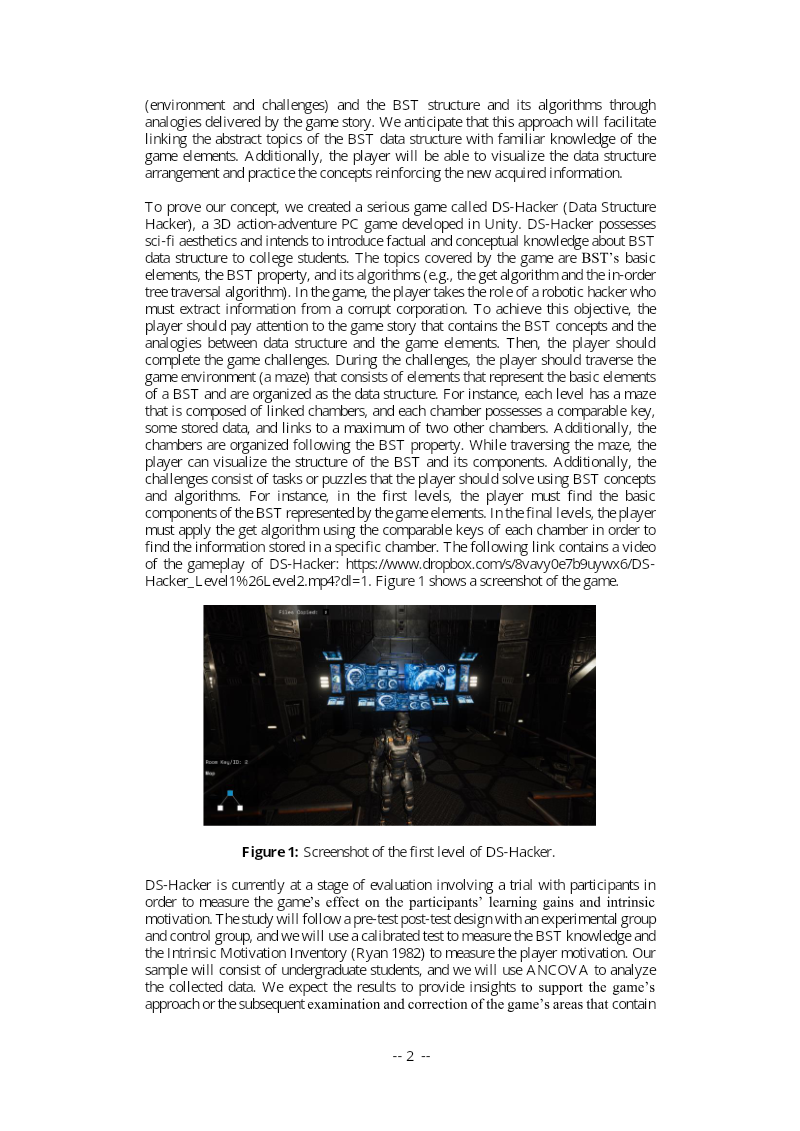
- DS-Hacker is a serious game that teaches college students Binary Search Trees by mapping the game environment onto a BST structure (chambers as nodes, keys and links as the BST property) and game challenges onto its algorithms such as get and in-order traversal.
- The game is grounded in meaningful learning and constructivist theory, which hold that abstract topics are learned better when connected to familiar knowledge, and it uses analogies delivered through its narrative to bridge game elements and data structure concepts.
- The game is a 3D action-adventure PC title built in Unity with a science-fiction aesthetic, in which a robotic hacker navigates linked chambers that each hold a comparable key, stored data, and up to two links to other chambers.