
DiGRA
The Digital Games Research Association: the international association of academics and professionals who study digital games. Its Digital Library holds the proceedings of the DiGRA conferences since 2002.
Documents
Computer Game Criticism: A Method for Computer Game Analysis
Lars Konzack's paper proposes a seven-layer method for analysing computer games, arguing that games must be examined on their own terms rather than by transferring frameworks from other disciplines, while still drawing on existing analytical traditions.
- Konzack proposes a seven-layer method for analysing computer games (hardware, program code, functionality, gameplay, meaning, referentiality, and socio-culture), arguing that all layers should be considered together so that technical, aesthetic, and socio-cultural perspectives are integrated.
- The method takes a bottom-up approach, beginning with a general description of the game that separates its virtual space from the surrounding playground to preserve a sense of the whole.
- The paper argues that games must be analysed on their own terms rather than by transferring frameworks from other disciplines, while still drawing on existing analytical traditions.
Gameplay Rhetoric: A Study of the Construction of Satirical and Associational Meaning in Short Computer Games for the WWW
This study examines how short web-based computer games construct rhetorical meaning that extends beyond their interactive mechanics, focusing on satire and allegory.
- The study argues that short web-based games communicate satirical and allegorical meaning through rhetorical devices rather than through story or simulation, so meaning persists even when gameplay is rudimentary.
- Satirical effect in these games is produced mainly by incongruity, pretense via parody and low burlesque, surprise, superiority, exaggeration, and violence, drawing on Feinberg's taxonomy of satirical technique.
- Allegorical meaning relies on conceptual mappings such as "life is a journey" and on metonymic relations, which the author's pilot game Vanitas Game uses to express mortality.
The Gameplay Gestalt, Narrative, and Interactive Storytelling
Craig Lindley's paper contends that gameplay in computer games is best understood as a "gameplay gestalt," a learned, repeatable pattern of perceptual, cognitive, and motor interaction, and that this repetitive structure undermines deep narrative immersion.
- Craig Lindley argues that gameplay in computer games is best understood as a "gameplay gestalt", a learned, repeatable pattern of perceptual, cognitive, and motor interaction, and that this repetitive structure undermines deep narrative immersion.
- In many action-oriented titles, the three-act story is delivered through non-interactive cut scenes while player interactivity is confined to low-level tasks with little bearing on the plot.
- Lindley proposes that gameplay gestalts be studied as measurable across perception, cognition, and motor demands, and notes that strategy games often compete with narrative for players' limited cognitive resources while offering thematically shallow experiences.
Whose Game Is This Anyway?: Negotiating Corporate Ownership in a Virtual World
T.L. Taylor's essay examines who legitimately holds a stake in massively multiplayer online games, using EverQuest as its central case and drawing on a two-year ethnographic study of that world.
- Taylor argues that corporate claims of ownership over MMOs like EverQuest are an incomplete account of authorship, because the identities, communities, and economic value of these virtual worlds are produced largely through players' collective labor.
- Sony's 2000 ban on selling accounts and items through eBay and Yahoo! was framed as intellectual property protection, but it also safeguarded subscription revenue and the integrity of the game's cooperative economies, illustrating how property rhetoric can serve commercial interests.
- Corporate owners assert control through end-user license agreements, account bans, and claims over fan fiction and derivative works, while users are poorly positioned to contest these claims in court.
The Pleasure of the Playable Text: Towards an Aesthetic Theory of Computer Games
Georg Lauteren's paper argues that the prevailing study of computer games, which focuses on their poetics or formal structure, should be supplemented by an aesthetic theory centered on pleasure, meaning how players use games, what they enjoy, and what kinds of gratification they experience.
- Georg Lauteren argues that the dominant poetics-based study of computer games should be supplemented by an aesthetic theory centred on pleasure: how players use games, what they enjoy, and what gratifications they experience.
- The paper frames computer games as "playable texts", combining their status as mediated sign systems that gain meaning through intertextual culture with their structure as rule-based, competitive activities in Johan Huizinga's sense.
- Lauteren proposes three analytical levels of pleasure: psychoanalytical, social, and physical, drawing on Laura Mulvey, John Fiske, and Roland Barthes.
Albert Goes Narrative Contracting
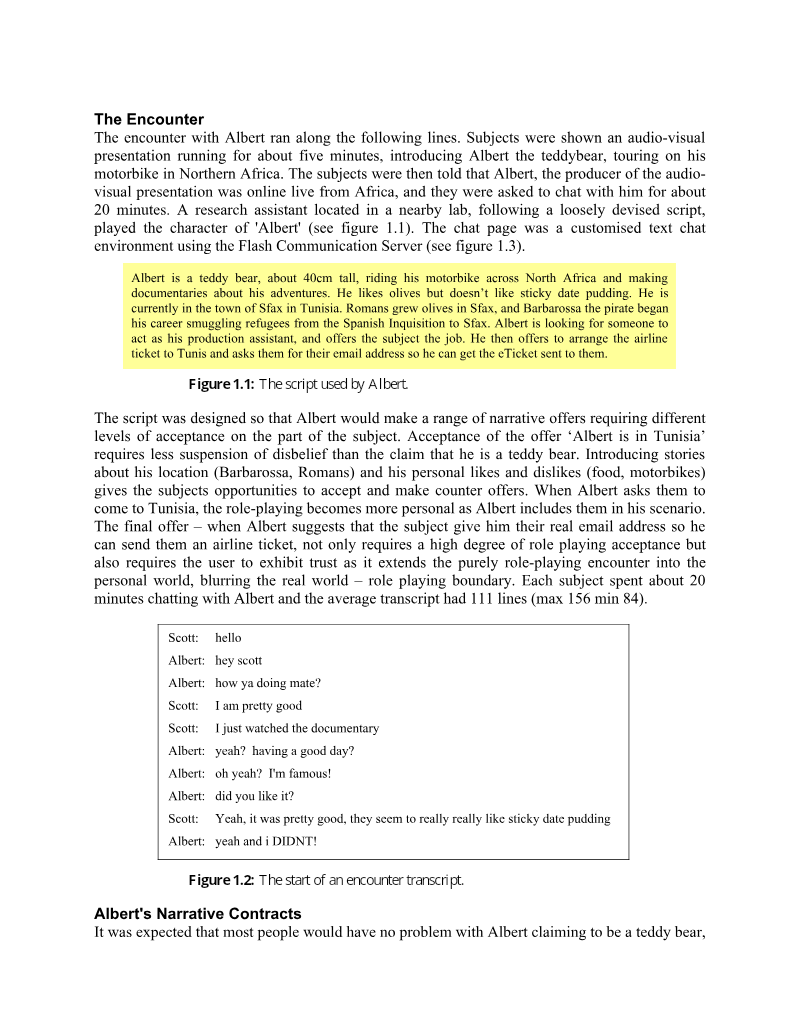
This paper, "Albert Goes Narrative Contracting," proposes a methodology for studying how participants in role-playing encounters negotiate shared fiction, framing each conversational move as a narrative offer that can be accepted, blocked, or met with a counter-offer, a concept drawn from improvisational theatre.
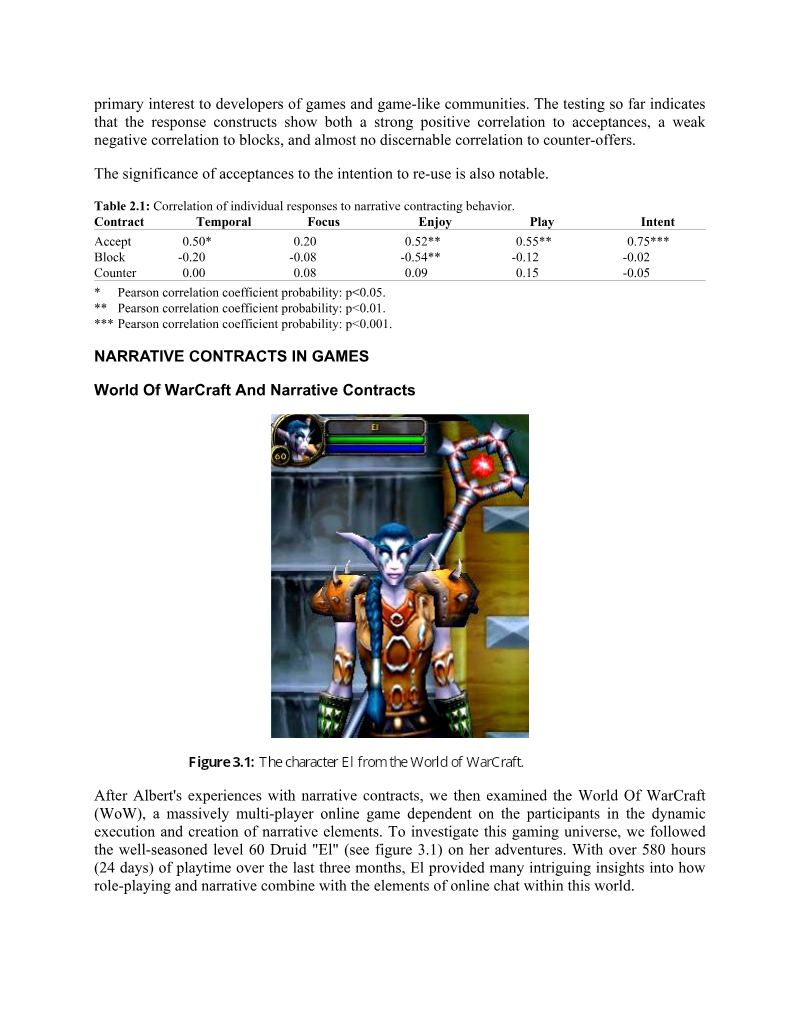
- Acceptance of a player's narrative offer shows the strongest association with enjoyment, playfulness, and intent to return, with the largest correlation to intent to revisit (r = 0.75, p<0.001).
- Blocks show only a weak negative correlation with enjoyment and little relationship to other fun measures, while counter-offers show almost no discernible correlation with any response.
- The authors frame conversational moves in role-playing as narrative offers that can be accepted, blocked, or countered, a concept borrowed from improvisational theatre.
The EverQuest Speech Community
Susana Tosca's study argues that the EverQuest player base constitutes a genuine speech community, despite earlier doubts about whether the concept of community can apply to online spaces.
- Susana Tosca argues EverQuest's player base is a genuine speech community, applying Erickson's six criteria (membership, relationships, commitment, shared values, collective goods, duration) and Hymes's SPEAKING framework to text-based in-game interaction.
- The game studied had roughly 98,000 peak concurrent users and about 400,000 players, and was treated as a stable, context-bound community whose linguistic norms are shaped by its fictional gameworld.
- Field research found most players were "powerplayers" focused on character advancement rather than roleplay, so the performative speech the framework anticipated largely failed to materialize.
The Open and the Closed: Games of Emergence and Games of Progression
Jesper Juul's paper proposes a conceptual framework for understanding computer game structure by distinguishing between two fundamental approaches to presenting challenge: emergence, in which a small set of simple rules combines to produce large variation, and progression, in which challenges are introduced serially and their…
- Juul distinguishes two structures for presenting challenge: emergence, where a small set of simple rules combines to produce large variation, and progression, where challenges are introduced serially and their solutions are explicitly specified by the designer.
- Most computer games blend emergent and progression structures, and the variation found in complex games is a systematic, non-obvious consequence of their rules rather than mere randomness or player input.
- Emergence is split into three types: rule interaction (e.g., rocket-jumping in Quake III, proximity mine climbing in Deus Ex), combination (the space of possible states a rule set permits), and emergent strategies (not immediately deducible from the rules, including rules of thumb and dominant strategies).
Interaction Forms, Agents and Tellable Events in EverQuest
This paper develops an analytical framework for studying interaction in virtual worlds, using the 1999 massively multiplayer online game EverQuest as its primary case.
- The paper proposes an analytical framework for virtual worlds built on four basic agents (players; NPCs and informative objects; manipulable objects; world rules) and four basic interaction forms (navigation, manipulation, social interaction, information retrieval).
- The framework is presented as a work in progress: its in-depth empirical analysis of EverQuest (released 1999) is reserved for later publication.
- The author argues that existing definitions of interactivity are too vague to be analytically useful, and situates the framework within Jensen's three paradigms of interactivity and the ludology-narrative debate, claiming virtual worlds contain elements of all of them at once.
Representing Users in the Design of Digital Games
Aphra Kerr's paper argues that digital game designers typically represent their users implicitly rather than through direct engagement, and that this tacit approach, often shaped by the designers' own tastes, can embed gender bias into game design.
- Digital game designers typically represent their users implicitly rather than through direct engagement, and this tacit approach, often shaped by designers' own tastes, can embed gender bias into game design.
- The study's Irish interviews covered digital game companies that were almost entirely male and targeted young men aged roughly 15 to 40, with industry factors such as risk-averse publishers, console manufacturers, and skilled-labour shortages shaping game types and design priorities.
- In the central case study of the fictional online multiplayer strategy game from games.inc, launched in Germany in December 2001 with about 1,000 subscribers, designers projected their own preferences as technologically literate male gamers aged 25 to 40 instead of conducting formal user research.
A Touch of Medieval: Narrative, Magic and Computer Technology in Massively Multiplayer Computer Role-Playing Games
Eddo Stern's essay argues that magic and technology, though often treated as opposites, share a long historical bond that shapes the narratives of massively multiplayer online role-playing games.
- By late 2001, Ultima Online had roughly 250,000 subscribers while EverQuest had between 400,000 and 700,000, signalling the large scale of the MMORPG phenomenon.
- Stern argues that dominant MMORPGs, controlled by a few large corporations, operate as indefinitely continuing services rather than finishable products, which defers narrative resolution indefinitely.
- Backstories and non-player characters are largely redundant to play: players tend to ignore backstories and treat NPCs mainly as dispensers of information, which Stern presents as evidence that conventional narrative approaches fail for software-narrative hybrids.
Killing Like a Girl: Gendered Gaming and Girl Gamers' Visibility
Bryce and Rutter's paper challenges the widespread framing of computer gaming as a male, violent, and antisocial pastime, arguing that female participation is substantial yet systematically overlooked in both academic and industry discourse.
- Gaming is often framed as a male, violent, antisocial pastime, but Bryce and Rutter argue that female participation is substantial yet systematically overlooked in both academic and industry discourse.
- Survey data cited in the paper show 43 percent of US gamers were female (Interactive Digital Software Association), and European Leisure Software Publishers Association estimates valued the market at roughly £5.8 billion.
- The authors contend that text-based content analyses labelling games as stereotypically gendered overgeneralise from unrepresentative samples, neglect genre diversity and audience reception, and wrongly assume representation deterministically shapes consumption.