1 free read left. Create a free account for unlimited reading + AI research.
Create free accountArticle DiGRA
1 free read left. Create a free account for unlimited reading + AI research.
Create free accountArticleDiGRA
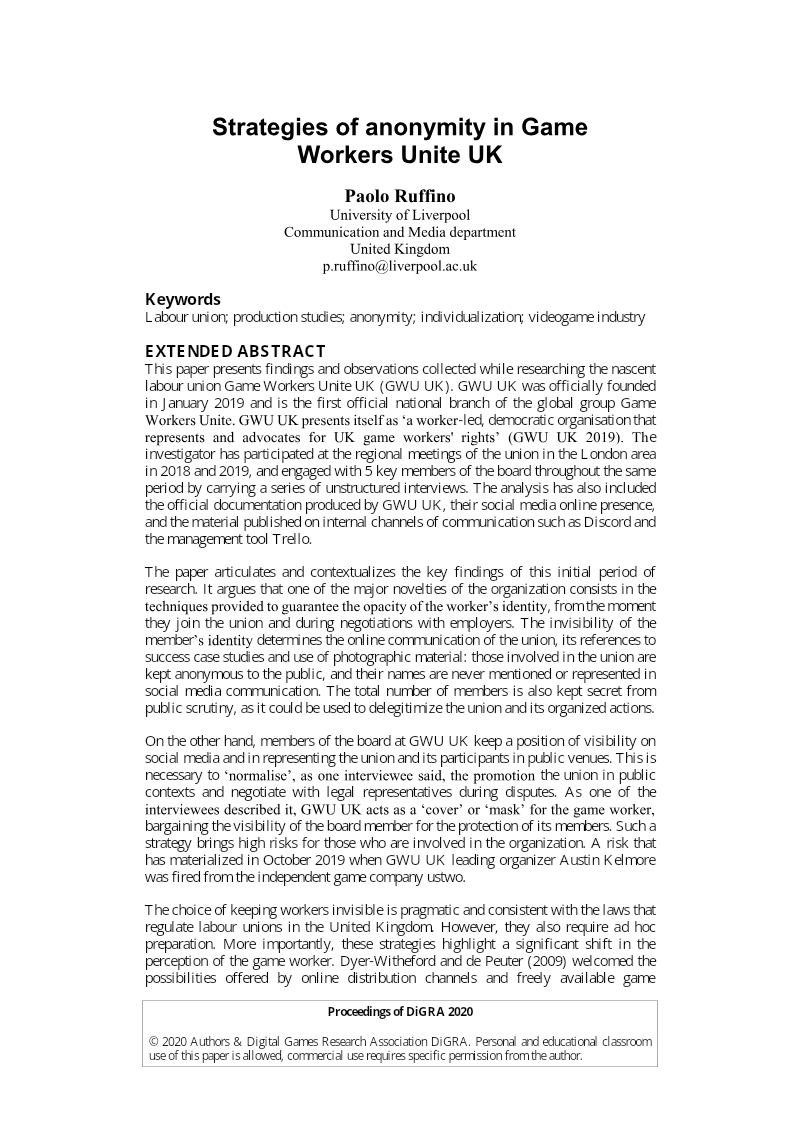
Game Workers Unite UK was founded in January 2019 as the first national branch of the global Game Workers Unite group.
Paolo Ruffino's paper examines Game Workers Unite UK (GWU UK), a labour union founded in January 2019 as the first national branch of the global Game Workers Unite group. Drawing on participation in regional meetings in London during 2018 and 2019, unstructured interviews with five board members, and analysis of official documents, social media, and internal channels such as Discord and Trello, the study argues that the union's defining innovation lies in its techniques for protecting member anonymity. Members remain unnamed in public communication, and total membership figures are withheld to prevent the union from being delegitimized, while board members take on visible public roles to represent the organization and negotiate with employers.
The paper contends that this strategy carries substantial personal risk, a danger illustrated in October 2019 when GWU UK organizer Austin Kelmore was dismissed from the independent studio ustwo. Ruffino frames the approach as both pragmatic and consistent with United Kingdom labour law, though it requires careful preparation. More broadly, he situates it against a shift in how game developers are expected to present themselves: in a self-funded, crowdfunded, and increasingly independent UK sector, creators are pressured to appear under their real names on platforms such as Kickstarter and Twitter, producing hyper-individualised labour conditions that weigh most heavily on marginalized groups.
Historical comparisons form part of the argument, including Electronic Arts' 1983 "We see farther" campaign, which publicized staff names and photographs, and the 2004 "EA Spouse" blog post, which denounced exploitative working conditions at the company. Ruffino reads GWU UK as re-establishing a degree of partial opacity in a context where user visibility is tightly bound to platform economics.
The paper concludes that GWU UK signals a meaningful change in how game workers understand their role, reflecting growing scepticism toward individualism as a precondition of creative expression. It contributes to wider debates on creative labour and offers novel models of collective organization in digital industries.
Each row is a game or company this document names, each column a document, oldest first. A mark means that document names it. Select a row to see those documents.

DiGRA · 2022

DiGRA · 2022



DiGRA · 2022



DiGRA · 2022

DiGRA · 2022

DiGRA · 2022



DiGRA · 2022

DiGRA · 2022

DiGRA · 2022



DiGRA · 2022



DiGRA · 2022

DiGRA · 2022
New Zealand Game Developers Association · 2026