User Acquisition reports and market data
Documents

Developing UA Skills Over a Career
User acquisition (UA) is evolving from a channel-specific discipline into a broader growth function that requires a blend of storytelling, product intimacy, and data-driven experimentation.
- UA is shifting from a channel-specific discipline to a holistic growth function that requires managing complex, multi-channel ecosystems rather than focusing on individual platforms.
- Successful growth marketing relies on four core pillars: omnichannel orientation, empathetic storytelling, deep product understanding, and data-centricity.
- Marketers must move beyond immediate ROAS metrics to prioritize long-term retention and account for the 'honeymoon phase' of user behavior.

The Future of UA | Surviving the Death of Performance Marketing
The landscape of user acquisition is undergoing a fundamental transformation as the industry pivots from manual, granular media buying toward automated, machine-learning-driven platforms.
- User acquisition is shifting from manual, granular media buying to automated, machine-learning-driven platforms, rendering traditional tactical campaign management obsolete.
- The deprecation of identifiers like IDFA and stricter privacy regulations have necessitated a move toward custom attribution and media mix modeling over traditional performance metrics.
- Marketing roles are evolving into a hybrid function requiring a synthesis of data science, brand strategy, and product development to navigate complex, automated data environments.


White Paper on Global Mobile Games
The white paper argues that mobile-game advertising has entered a new phase of intensity and sophistication, driven by rapid creative growth, the dominance of video formats, and evolving privacy regulations.
- Mobile advertising has shifted toward a video-first model, with video ads now accounting for over 85% of total spend and vertical formats outperforming horizontal ones with conversion rates near 0.15%.
- Privacy regulations have forced a move toward probabilistic attribution models like SKAN, shifting industry focus from granular user targeting to high-quality creative design.
- Ad creative volume surged 200% year-over-year in 2021, while CPMs increased by 34%, reflecting a period of intense market competition.


Mobile Game Video Ads Analysis: Optimal Video Lengths and End Cards
This analysis examines the relationship between video ad length, end card formats, and campaign performance across five major mobile gaming genres: Hyper-Casual, RPG, Strategy, Puzzle, and Social Casino.
- Optimal video ad length varies significantly by genre, ranging from 10 seconds for Social Casino to 46 seconds for RPGs.
- Hyper-Casual games achieve peak performance with 37-second ads paired with video end cards.
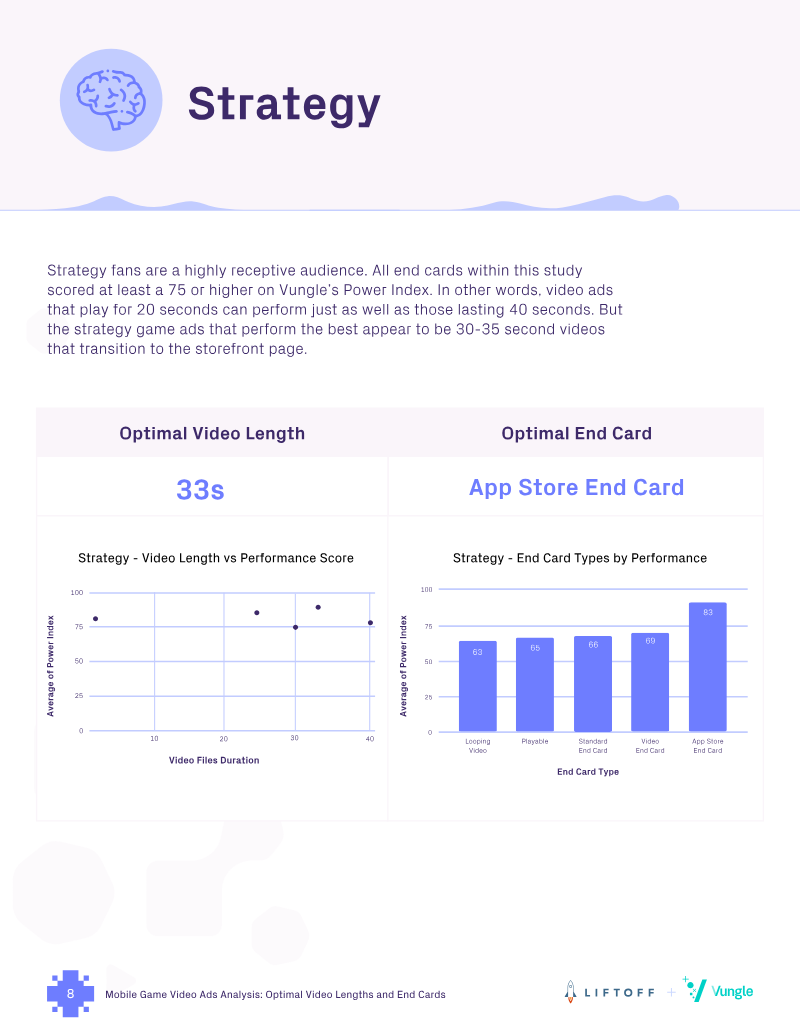
- Strategy games perform best with 33-second ads, while Puzzle games reach peak efficacy at 22 seconds; both benefit most from app store end cards.

Post-IDFA Mobile Game Advertising Costs: Casual vs Core
The analysis quantifies how Apple’s post-IDFA privacy updates have reshaped user-acquisition economics for mobile games, contrasting casual titles with core experiences.
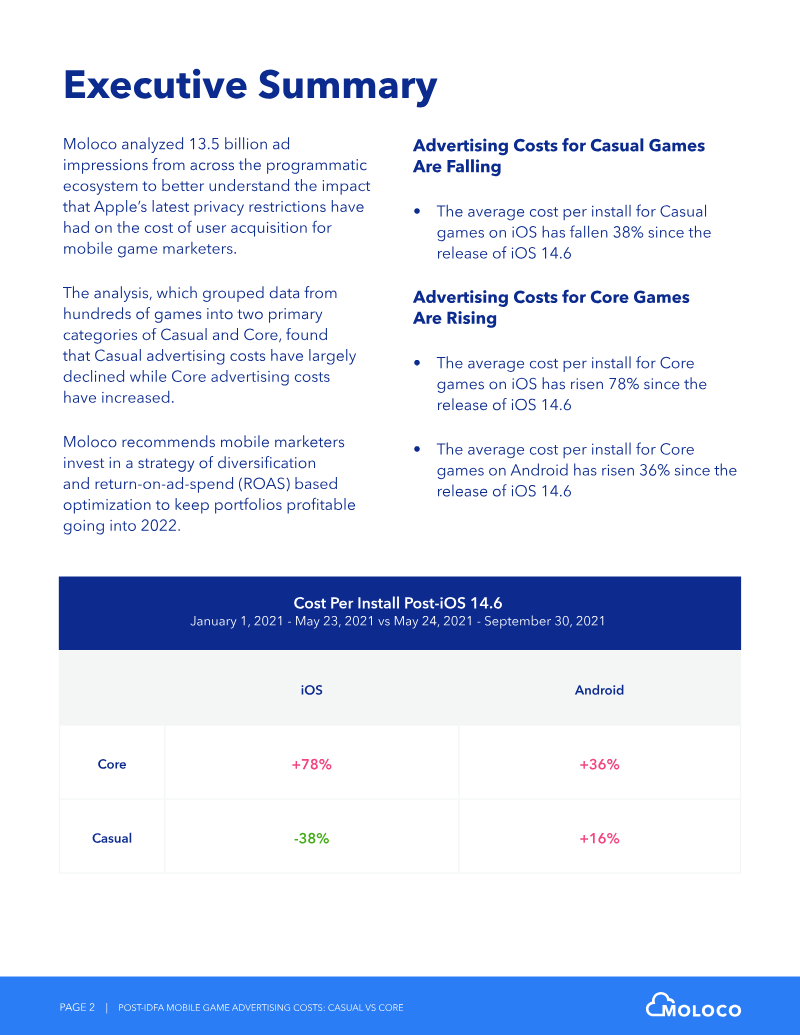
- Core games experienced a 78% surge in iOS CPI following the iOS 14.6 release, driven by intensified competition for a shrinking pool of high-value, trackable users.
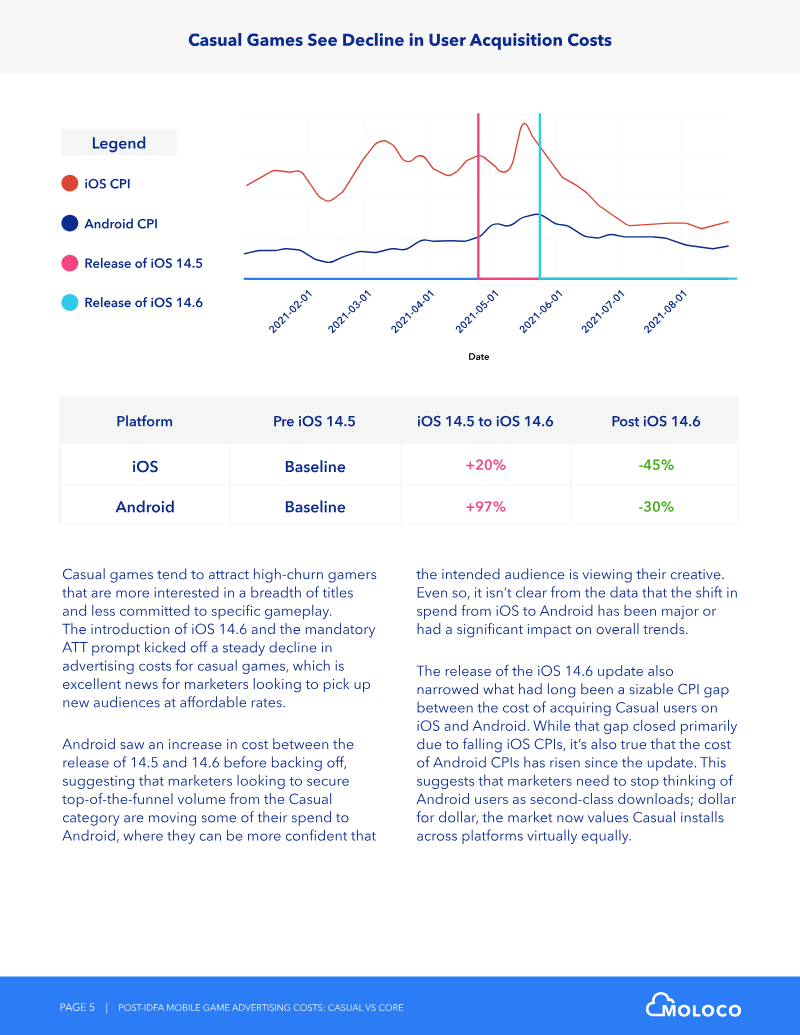
- Casual games saw a 38% decline in iOS CPI post-iOS 14.6, while Android CPI for the same segment rose by 16%.
- Android CPI for core games increased by 36% during the same period, reflecting broader market volatility across platforms.


Mobile Game Store Asset Optimization Trends 2021
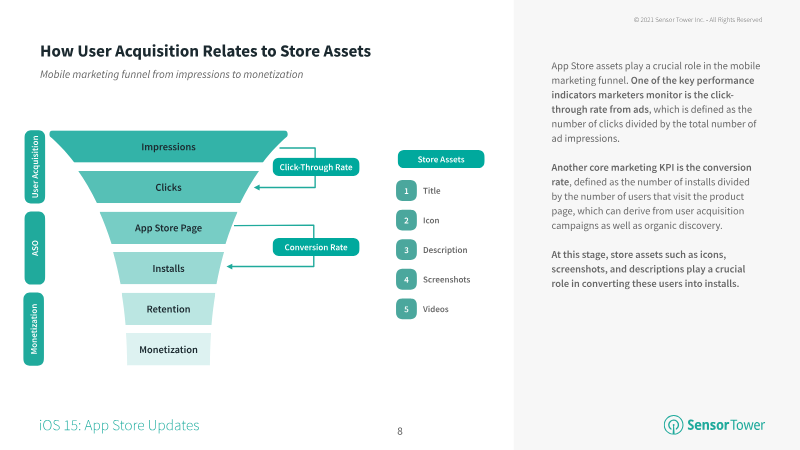
Strategic store asset optimization is a critical driver for increasing conversion rates and reducing user acquisition costs in the mobile gaming industry.
- The release of iOS 15 in late 2021 introduced native A/B testing for up to 90 days and the ability to create 35 unique Custom Product Pages, enabling highly targeted audience acquisition.
- Top-performing publishers are aligning App Store screenshots and icons with high-performing ad creatives—such as Playrix and Nexters' 'Pull the Pin' ads—to reduce user acquisition costs and minimize conversion friction.
- Successful mobile game publishers treat store assets as dynamic marketing tools rather than static elements, frequently updating them to reflect seasonal events, anniversaries, and live operations.


The African Mobile Apps Landscape (2021)
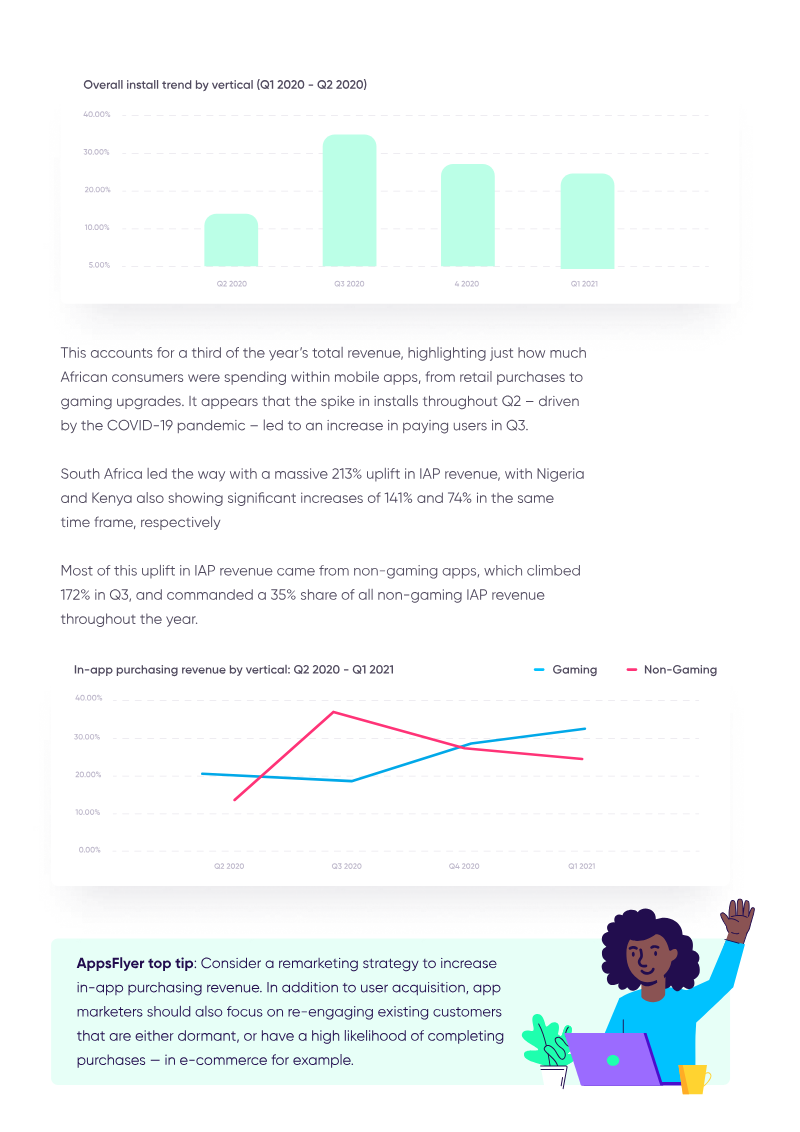
The African mobile app market experienced a period of rapid acceleration between Q1 2020 and Q1 2021, driven by a young, mobile-first population and the unique conditions of the COVID-19 pandemic.
- Between Q1 2020 and Q1 2021, mobile app installs across Nigeria, South Africa, and Kenya grew by 41%, with Nigeria leading the growth at 43%.
- The gaming sector saw a 50% jump in installs during Q2 2020, while in-app advertising revenue for gaming surged by 167% between Q2 2020 and Q1 2021.
- In-app purchasing revenue for gaming peaked in Q3 2020, contributing one-third of the total annual revenue.

Casual Gaming Apps Report: The State of Play in 2021
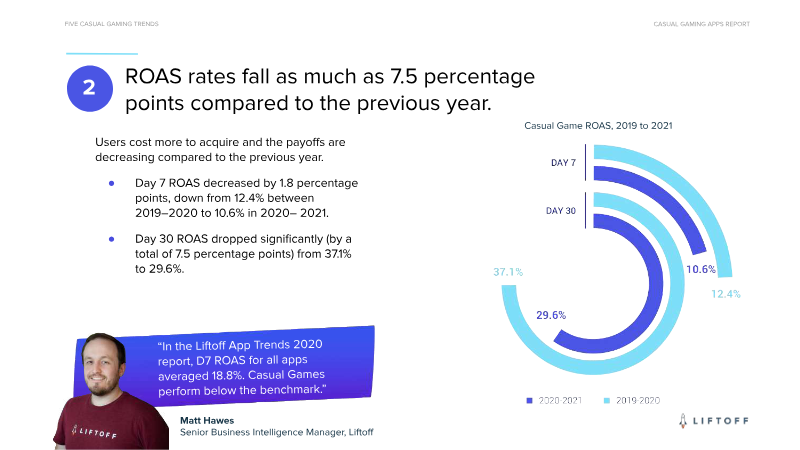
The casual gaming sector experienced significant growth and volatility between March 2020 and February 2021, driven largely by shifting consumer habits during the COVID-19 pandemic.
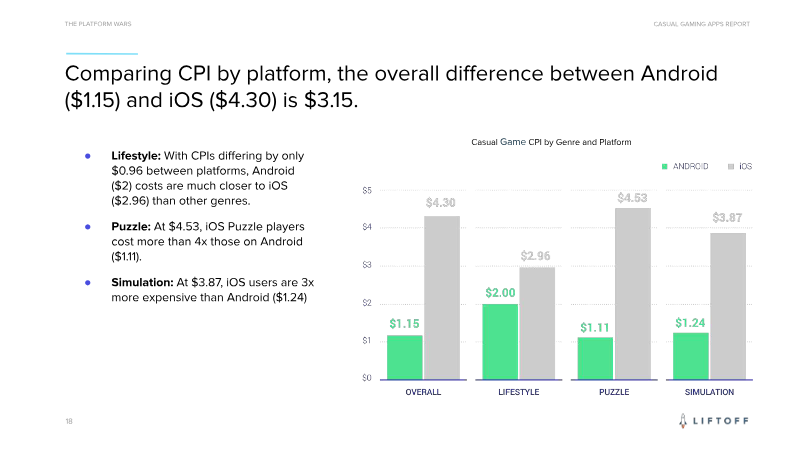
- Casual gaming user acquisition costs rose significantly between March 2020 and February 2021, with the average cost-per-install (CPI) increasing 45.2% year-over-year to $1.96.
- Return-on-ad-spend (ROAS) for casual games declined by 7.5 percentage points to 29.6% by Day 30, signaling a tightening market for profitability.
- Android CPIs surged 120% as marketers shifted strategies ahead of iOS privacy changes, though iOS remains more expensive with an average CPI of $4.30 compared to $1.15 on Android.

IDFA:How the Right Publisher can Help Choose Tools, Partners & Prepare Data to Avoid the Apocalypse.
The deprecation of the Identifier for Advertisers (IDFA) marks a fundamental shift in the mobile gaming industry, signaling the end of granular, machine-learning-driven user acquisition.
- The deprecation of IDFA has rendered traditional, granular machine-learning-driven user acquisition and legacy Mobile Measurement Partner (MMP) attribution models obsolete.
- Developers must transition to privacy-centric frameworks like Apple’s SKAdNetwork, which complicates the ability to distinguish between organic and acquired user segments.
- Internal data infrastructure is increasingly insufficient, necessitating a shift toward advanced lifetime value (LTV) prediction algorithms and diversified monetization suites.

Panel: How do we Prepare for the End of IDFA?
The deprecation of the Identifier for Advertisers (IDFA) represents a fundamental shift in the mobile gaming industry, necessitating a move away from granular, user-level tracking toward more sustainable, privacy-centric growth strategies.
- The deprecation of IDFA necessitates a shift from granular, user-level tracking to privacy-centric growth strategies like SKAdNetwork, incrementality testing, and media mix modeling.
- Performance-based advertising and retargeting are experiencing immediate volatility, resulting in initial declines in eCPM and overall ad revenue.
- Studios must transition toward predictive lifetime value modeling and cohort-based analysis to replace the lost efficacy of traditional user acquisition tactics.

Superstar Session: Do not Resuscitate - Why Publishing Managers are Life-guards, not Undertakers
Hyper-casual game publishing functions as a rigorous, data-centric enterprise where success is predicated on objective performance metrics rather than subjective creative intuition.
- Hyper-casual publishing prioritizes objective performance metrics over creative intuition to mitigate financial risk through early prototype testing and market analysis.
- The development lifecycle is highly compressed, typically moving from initial ideation to full market launch within a seven to twelve-week timeframe.
- Paid user acquisition is the primary engine for scaling, as organic growth is insufficient to maintain the performance benchmarks required for profitability.

Speed Panel: The Death of IDFA & Cookies - Your Monetisation is at Risk
The deprecation of IDFA and third-party cookies necessitates a fundamental shift in mobile gaming monetization, moving away from intrusive, data-heavy targeting toward privacy-compliant, authentic advertising models.
- The deprecation of IDFA and third-party cookies requires a shift from intrusive, data-heavy targeting toward privacy-compliant, game-centric advertising models.
- Intrinsic advertising, such as placing ads on in-game billboards, allows developers to monetize the entire player base rather than relying solely on a small cohort of spenders.
- Successful intrinsic advertising depends on contextual alignment, where ad content must resonate with the game's setting and audience to maintain brand value.