User Acquisition reports and market data
Documents

Game of Phones: Alex Merutka on the Battles Shaping Mobile Gaming’s Future
Mobile gaming currently functions as the primary laboratory for user acquisition and advertising technology, where the competitive landscape is defined by a relentless pursuit of marginal monetization gains.
- AppLovin has established a dominant market position by focusing on performance-based ad tech and monetization, creating a 'data moat' that makes it difficult for competitors like Unity to challenge them.
- Playable ads have become the industry standard for user acquisition because they allow users to qualify themselves through interaction, providing deeper behavioral data that compensates for the loss of precise targeting capabilities.
- The mobile gaming ad ecosystem is shifting toward dynamic, context-aware creative that adapts in real-time to variables like weather, time of day, and user environment to improve engagement.

TikTok and Shorts Are Insane for Indie Devs
The indie game development landscape is currently undergoing a shift where long-term, ambitious projects are finding significant commercial success through strategic short-form content marketing.
- Indie developers can effectively market games by posting one YouTube Short or TikTok per week, focusing on sharing small, interesting stories or unique bugs from their development process.
- Content platforms like YouTube and TikTok are not strictly momentum-based; high-quality, standalone videos can achieve viral success even on dormant channels without needing a large existing subscriber base.
- Social media content for games should prioritize authentic storytelling over traditional marketing, as this approach is less labor-intensive and avoids the perception of being 'slimy' to potential players.

Why most Soft Launches FAIL ❌ And how to avoid the trap by Matej Lancaric
Mobile game success relies on a disciplined, multi-stage soft launch process designed to validate retention curves and lifetime value models before committing to a global release.
- A soft launch should last 3–6 months to capture statistically significant retention curves (Day 30, 60, and 90) and evolving LTV/ROAS data, as one-month tests provide insufficient, partial insights.
- The framework follows a three-stage progression: Tech Testing (Philippines, Mexico, Brazil) to validate tracking and stability, Retention Validation (Poland, Netherlands) to hit KPI benchmarks, and Monetization Scaling (UK, Germany, Canada).
- Retention success is measured against industry benchmarks of 40% (Day 1), 20% (Day 7), and 10% (Day 30), though these vary significantly by genre, such as puzzle-survival games which may perform at 31% and 12% respectively.

🐳🔫 Inside Mech Assemble: AI Memes, Skibidi Toilets & $170K/Day
Mech Assemble: Zombie Swarm has established a significant foothold in the hyper-competitive shoot 'em up market by blending established mechanics from titles like Survivor.io and Bang Bang Survivor with high-quality 3D visuals and a unique mech customization system.
- Mech Assemble: Zombie Swarm generates between $70,000 and $170,000 in daily revenue by blending Survivor.io-style mechanics with 3D visuals and manual weapon customization.
- The game utilizes an aggressive monetization model driven primarily by whale-focused gacha systems and multiple battle passes, with ad revenue contributing only 13% to 15% of total earnings.
- User acquisition in the United States is highly expensive, with customer acquisition costs (CAC) exceeding $30 per user.

🚁 How War Drone 3D Hits $65K/day mainly with Organics, not UA. Warfare drone game from Miniclip!
War Drone 3D has emerged as a significant success within the mobile gaming market, scaling to approximately 500,000 daily active users and generating daily revenues reaching $65,000.
- War Drone 3D generates over $65,000 in daily revenue, driven primarily by heavy rewarded ad monetization and a gacha-based progression system.
- The game achieved peak scaling of over 300,000 installs per day in July 2024, maintaining a strong baseline of 150,000 daily downloads shortly thereafter.
- Over 50% of the game's total downloads are organic, fueled by an immersive 'news media' aesthetic that mimics realistic drone footage.

Casual Games Report H1 2025: Three Genres Generating 80% of Revenue
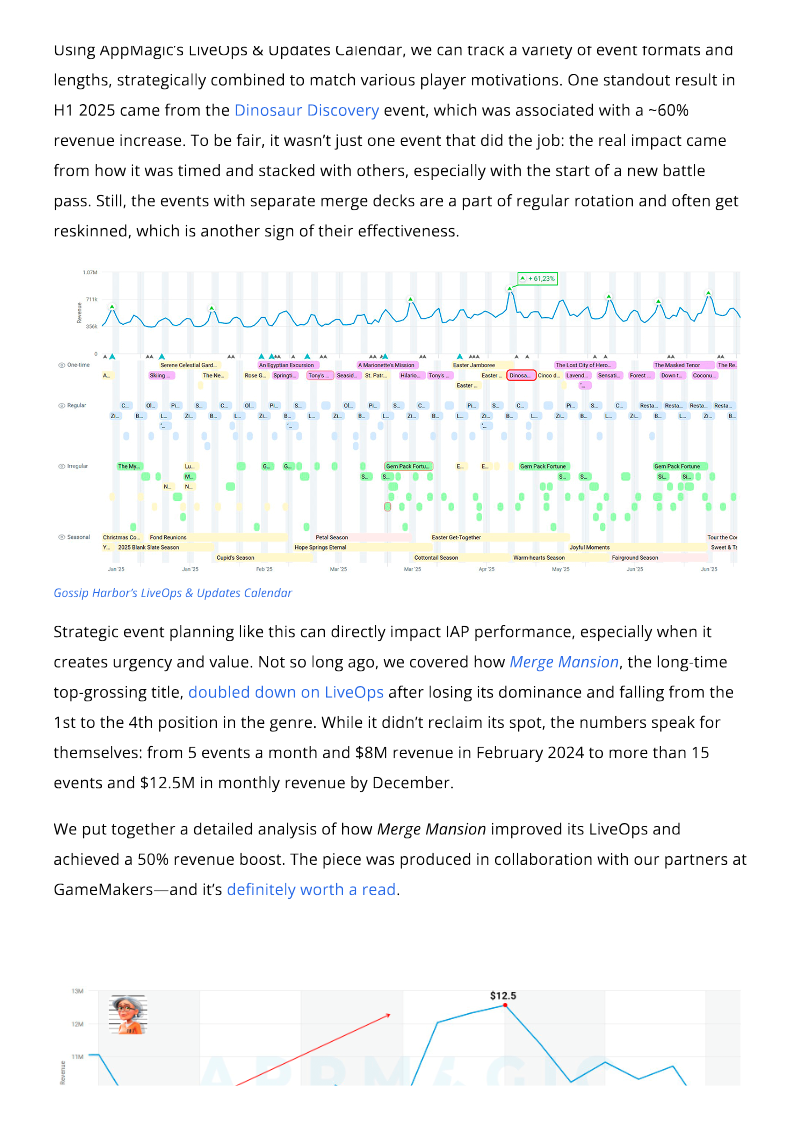
The casual games market generated $12 billion in net in-app purchase revenue during the first half of 2025, with 80% of this total concentrated within the Puzzle, Casino, and Simulation genres.
- The casual games market generated $12 billion in net in-app purchase revenue in H1 2025, with 80% of total earnings concentrated in the Puzzle, Casino, and Simulation genres.
- Puzzle games remain the primary growth engine with a 13% year-over-year revenue increase, driven largely by a 94% surge in the Merge-2 with Complex Meta subgenre.
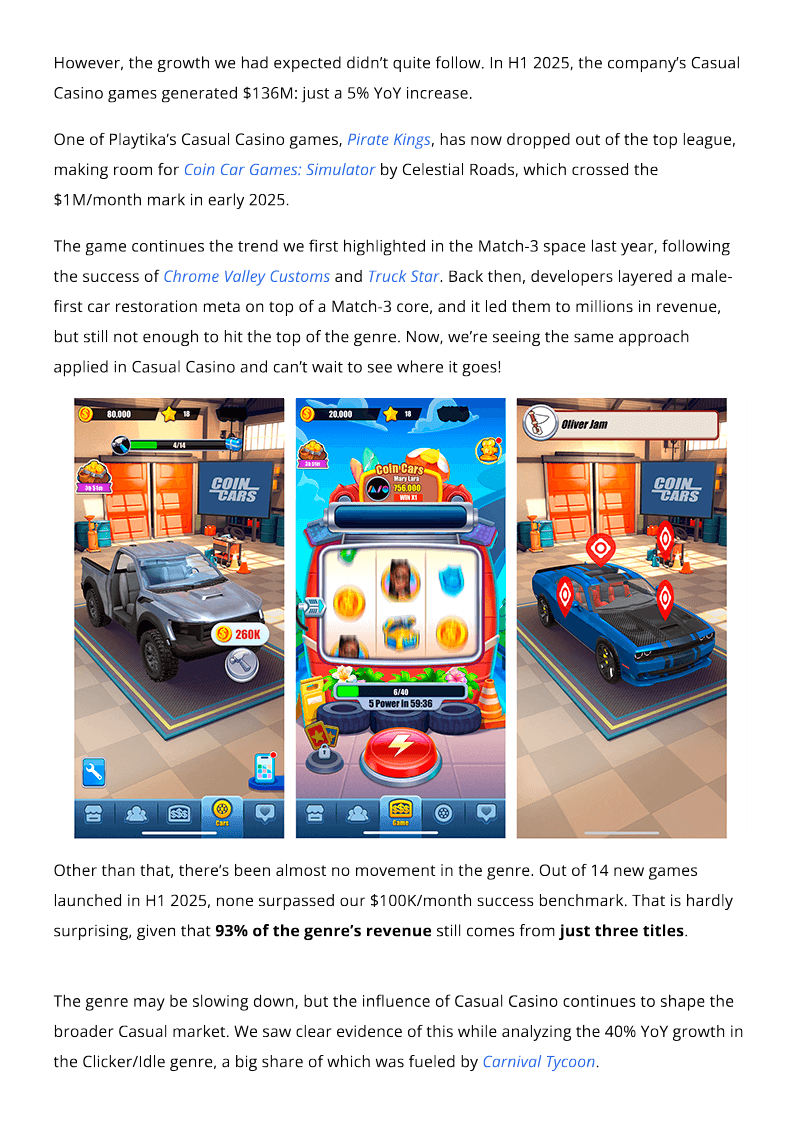
- The Casual Casino sector saw a 33% revenue contraction in H1 2025, primarily due to the scaling back of major titles like Monopoly GO!.

The Walled Garden Stack: Why no new Mediation platform has Survived Since 2017 by Felix Braberg
The mobile ad monetization landscape in 2025 is defined by a rigid, consolidated mediation market and a strategic shift among top publishers toward in-app purchase (IAP) revenue.
- The mobile mediation market is a closed ecosystem dominated by AppLovin MAX, Unity LevelPlay, and Google AdMob, with no successful new entrants since 2017 due to high barriers to accessing essential bidding demand.
- Top studios like Habby and Rollic are shifting toward IAP-first monetization, with ad revenue now accounting for as little as 11% to 20% of total earnings in recent titles.
- Effective cost-per-mille (eCPM) rates have declined by approximately 20% from pandemic-era peaks due to privacy-related targeting limitations, market corrections, and the transition to automated bidding.

Segmentation Is Over. Long Live Personalization!
Traditional manual segmentation has become an obsolete framework for modern game development, failing to address the complexities of global scale and evolving privacy regulations.
- Manual segmentation is being replaced by machine learning-driven personalization, which uses contextual multi-armed bandits to create thousands of unique, real-time player journeys.
- Automated personalization systems typically increase player lifetime value by 8% to 15%.
- These automated growth strategies are most effective for titles that have reached a threshold of 25,000 to 30,000 daily active users.
Tiles Survive Breakdown: FunPlus goes full Century Games
FunPlus has initiated a strategic pivot toward a proven, high-efficiency development model, moving away from experimental intellectual property in favor of the simplified, scalable frameworks popularized by Century Games.
- FunPlus's 'Tile Survive' is currently scaling at approximately $50,000 in daily revenue with roughly 60,000 daily downloads since its launch in March.
- The game utilizes a simplified version of the 'Dark War' 4X playbook, focusing on streamlined onboarding, events, and gacha mechanics rather than complex systems.
- Unlike its predecessors, 'Tile Survive' integrates scripted road-collection encounters directly into the core progression, effectively gating player advancement behind specific exploration levels.

What Makes a Winning Growth Marketing Team in Today?
Modern growth marketing organizations are undergoing a fundamental structural shift driven by the rise of automated machine learning platforms and the necessity of operating within an efficiency-focused economy.
- Creative output is now the primary lever for growth, requiring teams to build high-velocity machines that generate and test diverse concepts at scale.
- Growth marketing teams must shift their focus from manual campaign management and spreadsheet maintenance to creative pipeline management and cross-functional strategy.
- Organizations should eliminate redundant business intelligence and manual reporting roles, as these functions are now effectively handled by AI and automated software.

2 Hours of answering Steam Questions (Please don't watch this you have games to work on)
Achieving commercial success on Steam requires a strategic shift from passive development to active, data-driven market engagement.
- Steam's algorithm promotes games by testing them with small audiences; if early performance metrics are strong, the platform automatically expands the game's reach, but if initial engagement is low, the algorithm stops showing the game to new users.
- A Steam demo launch is a 'one-shot' opportunity to leverage the 'Trending Free' section and the single email blast allowed to all wishlisters, so developers must coordinate these efforts to maximize concurrent player counts.
- Developers should avoid live-streaming their own development process on platforms like YouTube or Twitch, as it distracts from core production and rarely yields meaningful marketing results compared to focused development time.

TWIG #342 Scopely Meltdown, Crazy Anime Story and One SHOCKING Game Recipe
The gaming industry is currently navigating a period of significant adjustment, characterized by stagnant growth, a contraction in venture capital, and the persistent challenges of mobile user acquisition following IDFA changes.
- Scopely faces significant portfolio risk, with Monopoly Go and Pokémon Go now accounting for over 90% of the company's total revenue as its legacy titles and recent acquisitions decline.
- Sony is leveraging strategic partnerships, such as its stake in Bandai Namco, to integrate major Japanese anime franchises into its ecosystem, though localizing these properties for Western mass-market audiences remains a significant challenge.
- The gaming industry is experiencing a period of stagnant growth and reduced venture capital, forcing companies to move beyond incremental testing toward methodologies that prioritize significant product variations to generate actionable data.